• Skip to main content
  • Skip to header right navigation
  • Skip to after header navigation
  • Skip to site footer
MyZA

MyZA

News, Directory, Events and Other Stuff

  • Social Media
  • Sport
  • World News
  • Home
  • Submit News
  • Directory
  • Events
  • Stratlec
  • TFSA
  • News
    • APO
    • Today’s Sport News
    • Todays Social Media and Tech Headlines
    • Today’s World News
    • Today’s SA Financial News
  • Contact
You are here: Home / Archives for health

health

18 December 2023

Young men urged to consider nursing as a career

Location: News

Young men urged to consider nursing as a career

KwaZulu-Natal Health MEC, Nomagugu Simelane, has urged young men to consider pursuing a career in the nursing profession. 

Simelane made the call during the graduation ceremony of 197 nurses, including 56 male nurses, from the KwaZulu-Natal College of Nursing.

“In our engagements with men during our community outreach programmes, such as Isibaya Samadoda and Ikhosomba Lamajita, we have established that some men are too ‘shy’ to speak openly to female health practitioners about certain ailments that they might have - especially those that may pertain to their sexual reproductive health - but also other diseases as well.

“As a result of this, men are simply dying from diseases that are otherwise preventable, treatable or manageable, purely because they do not come to our facilities. We are saying that the time has come for men to stop dying due to diseases such as prostate cancer, male breast cancer, HIV and AIDS, diabetes, hypertension and many others,” Simelane said.

The MEC said the department will continue to actively promote programmes that will ultimately make most its facilities “men-friendly.”

“When we delivered the Budget Speech for the 2023/24 financial year, one of the points that we re-iterated quite strongly was the elevation of Men’s Health in the province. This was actually the re-affirmation of a commitment that we made when we assumed office in 2019.

“We have made a commitment that every local municipality must have at least one facility – whether a CHC (community health centre) or a 24-hour clinic – that is dedicated to the health of men. These facilities will have a male nurse during the day, and after hours [because] we want to make it easy for men to visit healthcare facilities,” Simelane said.

The MEC also noted that the overall representation of men in the department currently stands at 12% across all nursing categories, and at 20% when it comes to nursing managers.

However, she said, when it comes to the student nurse cohort, men account for 42%, which is a “welcome improvement towards the goal that we are pursuing.”

“We also note with a great deal of encouragement that 56 men are graduating as male nurses today, which will add to the existing 4 088 cohort of male nurses. We encourage more men to consider pursuing a career in the nursing profession,” Simelane said.

The MEC also called on all nurses in KwaZulu-Natal not to neglect their own health, while caring for others.

“Finding the time to take care of our health is not a luxury, but an absolute necessity. It is not an option or an afterthought, but a fundamental priority. 

“We therefore encourage regular screening and preventive care among yourselves as well, because it can help detect potential health problems early, making them easier to manage or even prevent,” the MEC said.

Turning her attention to patient care, Simelane emphasised the need for nurses to advocate and care for patients. 

“Do not be that single bad element who gives everyone else a bad name. Do not let your actions tarnish the image of your facility, our department, the community that you come from, and the nursing profession at large.

“Always remember the commitments that you’ve made in the Nurses’ Pledge, and stick to them. Remember that you have the power to heal, to comfort, and to inspire,” Simelane said. – SAnews.gov.za
 

GabiK
Mon, 12/18/2023 - 14:37
116 views
Read moreYoung men urged to consider nursing as a career
18 December 2023

Health sets record straight on placement of medical interns, community service graduates 

Location: News

Health sets record straight on placement of medical interns, community service graduates 

The Department of Health says it has noted an inaccurate article, with a misleading headline, by News24 about the placement of medical interns and community service doctors. 

According to the article, National Treasury budget cuts could affect community service placements for nearly 200 health workers.

“Recent cuts to South Africa's provincial budgets are making less money available to pay for health science graduates, who need to do their community service. These positions are often crucial to the healthcare needs of poor and underserved communities,” the article read. 

The publication went further to say that nearly 200 graduates from the medicine, dental and rehabilitation therapy fields, who need to do community service before they can be fully-fledged doctors, had not been placed by 12 December. 

However, the department, working with provincial Departments of Health, said it has ensured that all health professionals that are essential to delivering health services are all allocated in positions as of 12 December 2023 for the 2024 intake. 

“The shortfalls in other areas of need, excluding medical interns and most categories of community service, are being addressed as a matter of urgency,” the department stressed. 

These, according to the department, include eight dentist posts, eight dietitian posts, 38 physiotherapist posts, and 118 environmental health practitioners. 

“The department would like to assure all unplaced graduates, who meet the minimum requirements, that all efforts are being made to have them allocated posts, and they will be kept abreast of the developments.” 

The department announced on 5 December that it had concluded the process of placing medical interns and community service applicants on the Internship and Community Service Programme (ICSP), due to commence next year.  

The department said all successful applicants have been notified accordingly. 

According to the department, it received 10 386 applications through an online application system, of which 10 228 were South African citizens, including permanent residents and 158 were foreign nationals. 

The department at the time said 9 395 applicants have since been placed, including medical doctors, nurses, pharmacists and other health professionals at health facilities throughout the country. – SAnews.gov.za
 

Gabisile
Mon, 12/18/2023 - 10:13

124 views
Read moreHealth sets record straight on placement of medical interns, community service graduates 
16 December 2023

Reconciliation is a commitment to creating a united society, says President

Location: News

Reconciliation is a commitment to creating a united society, says President

President Cyril Ramaphosa says reconciliation is a commitment to creating a society where everyone is valued, where diversity is celebrated and where the scars of the past are transformed into stepping stones towards a brighter and more compassionate future.

“As we mark Reconciliation Day, we are reminded of just how extraordinary our experience was,” President Ramaphosa said.

Speaking at the National Day of Reconciliation at the Thohoyandou Stadium in Limpopo on Saturday, President Ramaphosa said reconciliation is not an act of forgetting or ignoring the wounds of the past.

“Instead, it is a courageous and intentional effort to confront our history, to learn from it and to build bridges of understanding across the chasms of misunderstanding and mistrust,” the President said.

This year the Reconciliation Month is being commemorated under the theme: “Strengthening unity and social cohesion in a healing nation”.

President Ramaphosa said many believed it was not possible for the former oppressor and the oppressed to make peace and reconcile and they did so.

“Our national days, our flag, the national anthem and our national symbols stand as testament to a new, unique nation that emerged from a difficult and bitter past. These are no mere symbols or gestures. They serve as important reminders of what we have been able to build within a relatively short period of time.

“Our democracy will soon be 30 years old. Some of the world’s oldest democracies are still grappling with racial and ethnic tensions among their people,” the President said.

He said South Africa, despite its many challenges, has not slid into the morass of bigotry, racism and tribalism that is prevalent many other societies.

“This year we bore witness to the power of reconciliation when our national rugby team the Springboks won the Rugby World Cup in France.

“To have seen so many South Africans of all races and all ages rallying behind the team, showing their support so passionately and joining in the victory celebrations reminded us that, despite our many challenges, we are a united nation, proud of who we are and proud of how far we have come.

“The proud and resilient South African spirit has carried us through the many difficulties of the past and it will continue to do so well into the future.

“We came together and rallied behind the national effort to contain COVID-19. We all played our part to keep ourselves and others safe,” President Ramaphosa said.

South Africans must confront the uncomfortable truths, learn from them and work together to create a society where everyone can thrive, regardless of their background or identity.

“Inequality is the greatest challenge to meaningful and lasting reconciliation in our country. Central to the advancement of reconciliation must therefore be a concerted effort to end poverty and unemployment and meaningfully reduce inequality.

“We have undertaken a massive redistribution of resources towards mainly black South Africans through the provision of basic services, subsidised housing, improved education and health care, and social grants,” the President said.

The National Day of Reconciliation aims to promote national unity, social cohesion, constitutional democracy, human rights, and equality by highlighting and advancing the constitutional values and principles that bind together all South Africans.

The day also serves as a call to action to individuals to take responsibility to fight racism, discrimination, xenophobia and related intolerance.

In 2022, President Cyril Ramaphosa signed into law three pieces of legislation to strengthen the criminal justice system, promote accountability across the state and support survivors of various forms of abuse or infringements of rights. – SAnews.gov.za

Edwin
Sat, 12/16/2023 - 13:25

163 views
Read moreReconciliation is a commitment to creating a united society, says President
14 December 2023

President, Black Business Council discuss transformation of the economy

Location: News

President, Black Business Council discuss transformation of the economy

President Cyril Ramaphosa has held a meeting with the Black Business Council (BBC) to discuss challenges facing the economy and the transformation of the economy.

Also at the meeting were Minister of Agriculture, Land Reform and Rural Development Thoko Didiza; Trade, Industry and Competition Minister Ebrahim Patel; Minister of Employment and Labour Thulas Nxesi; Finance Minister Enoch Godongwana; Transport Minister Sindisiwe Chikunga and Minister in the Presidency for Electricity Kgosientsho Ramokgopa and Deputy Minister of Finance David Masondo.

Topics under discussion included issues hindering black business participation in contributing to development and economic growth, energy security, transport, agriculture, the capacity of the state, employment equity and transformation.

“Since the advent of democracy nearly 30 years ago, we have worked to advance the economic position of black and women South Africans. That is why we introduced broad-based black economic empowerment, affirmative action, preferential procurement and other transformation policies to address the imbalances created by years of apartheid rule.

“Our fiscal policies enabled a massive redistribution of resources towards mainly black South Africans through the provision of basic services, subsidised housing, improved education and health care, and social grants,” President Ramaphosa said.

BBC President Elias Monage said: “The BBC notes progress being made in processing the Public Procurement Bill. We view this bill as a very important instrument and the BBC is happy that the bill, in its current form, after many fights, contains the set-asides in the primary legislation”.

According to the Presidency, the meeting agreed to establish five focused work streams which will be coordinated from the Presidency with the first quarterly report back expected to take place in March 2024.

The work streams are:

  • Inclusive economic transformation
  • Funding of black small businesses
  • Energy (to be considered as part of NECOM work streams)
  • Transport and logistics (to be considered as part of NLCC work streams)
  • Capacity of the State

“President Ramaphosa reaffirmed the government’s commitment in addressing the energy crisis, logistics backlogs and crime and corruption by highlighting key interventions through the Energy Action Plan, National Logistics Crisis Committee and the recently adopted Freight Logistics Road map, and positive steps taken to appoint a new board of Transnet and the Eskom Group Chief Executive Officer,” the Presidency said. – SAnews.gov.za


NeoB
Thu, 12/14/2023 - 09:29

508 views
Read morePresident, Black Business Council discuss transformation of the economy
14 December 2023

Get rid of leaf blowers: they pollute and their purpose is dubious

Location: News

Many use two-stroke engines which are an environmental hazard

Read moreGet rid of leaf blowers: they pollute and their purpose is dubious
14 December 2023

The Essential Role of Food Product Manufacturers

Location: MyPR

Introduction The modern food industry hinges significantly on the contributions of food product manufacturers. These entities are pivotal in shaping our daily diets and culinary experiences, offering a wide array of consumables to cater to diverse tastes and needs.   The Range of Products These manufacturers pride themselves on a varied product portfolio, encompassing items …

Read moreThe Essential Role of Food Product Manufacturers
14 December 2023

Poverty and Progress: An Update on African Energy

Location: News
African Energy Chamber

By NJ Ayuk, Executive Chairman, African Energy Chamber (https://EnergyChamber.org).

In an era when such futuristic technologies as artificial intelligence, robotics, and quantum computing are here or on the horizon, almost half of sub-Saharan Africans — more than 600 million people — lack the electricity to heat, cool, or light their homes.

This energy poverty impedes nearly every aspect of life for this population, from conducting business and educating their children to deterring crime and providing healthcare.

Even in some well-electrified African nations such as Ghana, Gabon, and South Africa, the supply is inadequate and often unavailable.

As the African Energy Chamber (AEC) put it in our newly released The State of African Energy Outlook Report 2024, “Access to electricity in Africa is still a dream to millions of Africans.”

Our report gives compelling evidence to back this statement, providing statistics that show, among other things, that energy poverty is markedly deeper in sub-Saharan Africa (SSA) than in the rest of the continent.

Our report is sobering, but not without hope. It also provides a positive look toward the future, including energy developments likely to improve electrification rates in SSA and move its countries' citizens closer to the universal access they dream of. The key to delivering energy to more Africans will be using both renewables and fossil fuels.

The Statistics and What's Behind Them

Our report's numbers tell the story of just how much SSA, in particular, is still affected by energy poverty.

In contrast with most of the world, where electrification rates improved during the COVID-19 pandemic, SSA's worsened, as its percentage of the world's population lacking electricity grew from 71% in 2018 to 77% in 2020. Statistics compiled in 2020 showed sub-20% levels of electricity access in up to eight countries across the region.

While the education and business sectors suffer greatly from energy poverty, it is perhaps most acutely felt in the health sector, where medical equipment and procedures require electrical power.

Complicating the health impacts still further, households without electricity are often forced to use unhealthy fuels like wood, coal, or kerosene to cook and heat, producing indoor air pollution that leads to respiratory problems and other ailments.

In contrast to the 90%-plus electrification rate found in some North African countries, which is allowing them to decrease reliance on fossil fuels, electricity access in SSA is only about 55%, and a closer look at that number reveals it is driven by urban rates of close to 80%, while rural areas lag far behind with only about 33%, leaving two-thirds of residents in the dark.

In a nutshell, SSA has a lot of catching up to do to achieve the levels of access to electricity enjoyed by most of the world. Although the region has doubled the average rate of access since 2000, its current rate of just over half of the region's population is miniscule compared to the 90% global rate and the 80% North African rate.

As I said, even in SSA countries where electrification rates are quite high, such as Ghana, Gabon, and South Africa, load shedding presents a daily practical problem for people who must anticipate power outages. In South Africa, for instance, this type of staged rationing has been used every day this year by the power utility, Eskom.

Already in 2023, there has been more load-shedding in South Africa than in all of 2022, and outages are lasting longer — up to 12 hours daily — with a predictable disabling effect on economic development.

Meanwhile, the country's chasm between supply and demand only continues to expand.

Changes in Progress: South Africa as a Case in Point

The South African government is taking a proactive approach to the regulatory side of improving energy supply, shortening timelines for obtaining environmental authorizations and grid approvals.

It is also working to obtain and use USD98.7 billion in investment capital over the next five years for its Just Energy Transition Investment Plan (JETIP), a framework adopted in 2022 that outlines the country's strategic priorities for investment during climate transition.

A major thrust of JETIP is replacing the use of coal, which currently supplies over 80% of South Africa's power, with renewable energy, expected to grow from a current 11% of the power supply to 20% by the end of this decade and to over half of the supply by 2050.

Contributing to those numbers, Eskom-built renewables projects are slated to go live this year in Lethabo and Sere, and the utility will soon start building solar and battery storage facilities at Komati Lethabo and Majuba for a total of 2.8 gigawatts (GW) of new renewables capacity.

Of the total projected electricity capacity, solar, and wind are expected to drive almost 50% with fossil fuels adding up to a 10th of total projected capacity.

Implications for the Continent

These power-related statistics for South Africa—a country better positioned than many Sub-Saharan nations regarding electricity—show that the country, and therefore the continent, needs gas-to-power and battery storage along with wind and solar.

South Africa's numbers highlight a major point made in my recent book, “A Just Transition: Making Energy Poverty History with an Energy Mix,” — that, while the rest of the globe deals with the threat of devastating climate change, Africa must deal with two major challenges at once: the threat of climate change and debilitating energy poverty.  

Even as Africa works to support global efforts to prevent a climate crisis, we must embrace every solution available to us, including using our continent's vast natural gas reserves: totaling more than 800 trillion cubic feet. Not only is gas plentiful, but it's also the cleanest fossil fuel; producing it contributes to job creation and economic growth; and it can be monetized to help pay for energy infrastructure.

The “bottom line” is that Africa still needs to use its natural gas, and more of it, to deliver a much-needed increased supply of energy to its people.

Download The State of African Energy 2024 Outlook report: https://apo-opa.co/3QLEoHd

Distributed by APO Group on behalf of African Energy Chamber.

Media files
African Energy Chamber
Download logo
Read morePoverty and Progress: An Update on African Energy
13 December 2023

Empow-Her-Ing Excellence: FM Solutions Technical’s All-Women Team Revolutionises Facilities Management

Location: MyPR

In the world of Facilities Management (FM), where technical expertise and reliability are paramount, FM Solutions Technical is once again emerging as a trailblazing player, setting a new standard for diversity and competence in the industry. With an exciting new offering that boasts an all-women team in FM maintenance, FM Solutions is challenging stereotypes and …

Read moreEmpow-Her-Ing Excellence: FM Solutions Technical’s All-Women Team Revolutionises Facilities Management
13 December 2023

Breaking Barriers: Papillon Recovery Centre’s Holistic Mental Health Approach

Location: MyPR

Johannesburg, December, 13, 2023: Papillon Recovery Centre has been operating for over 12 years with a 70 percent success rate versus the national average of 12 percent success rate. We therefore remain the leaders in mental health rehabilitation. Papillon is SA’s only private step-down for mental health. We pride ourselves on being internationally accredited with …

Read moreBreaking Barriers: Papillon Recovery Centre’s Holistic Mental Health Approach
13 December 2023

SA, Zimbabwe gain a collective responsibility to prevent illegal activities at ports

Location: News

SA, Zimbabwe have a collective responsibility to prevent illegal activities at ports

Cooperation between South Africa and Zimbabwe in managing shared borders is critical for the protection of respective national interests.

“We have a collective responsibility to prevent illegal activities at our ports of entry and the border law enforcement areas such as illegal migration, any kind of smuggling, human trafficking, and all kinds of cross border crimes inclusive of the illegal movement of weapons, and or illicit goods between our countries,” Border Management Authority (BMA) Commissioner Michael Masiapato said.

He was speaking during a visit by the Zimbabwe Border Ports Authority in Pretoria on Wednesday.

The Commissioner said the South Africa/Zimbabwe border has long been a symbol of the intricate web of connections between the two countries.

“It is a border that does not just demarcate land but also represents a bridge of cultural, economic, and historical exchanges that we enjoyed over the years.”

He said besides geographic proximity, the two countries have a common and long history of regional affiliation as well as great aspirations for the development of the two nations.

“Therefore, it is in our interest to ensure effective border management which is crucial for ensuring the ultimate prosperity of both South Africa and Zimbabwe.

“Although cooperation on border management matters commonly embraces the aspects of enforcing territorial sovereignties, it also streamlines efforts for fostering economic growth and improvement in trade relations between nations.

“As the two jurisdictions within this sub-region, we have the responsibility to drive the objective of regional economic integration as articulated in the many resolutions of our leadership within the SADC [Southern African Development Community]  context,” Masiapato said. 

Border management is not just a matter of policy but a reflection of the shared commitment to regional stability and development of which border authority has to ensure the realisation of such an objective.

“As the Border Management Authority, South Africa, we are encouraged by the processes undertaken by the government of Zimbabwe in the development of the country’s Border Ports Authority Bill.

“This is critical towards the establishment of the Zimbabwean Border Ports Authority which carry similar resemblance our Border Management Authority,” the Commissioner said.

Masiapato is hosting his Zimbabwean counterpart for a bilateral visit in South Africa from 13 to 16 December 2023.

The visit aims to showcase South Africa’s model of administration and border management coordination.

The two countries are in a process of developing a Border Ports Authority Bill to establish the Zimbabwe Border Ports Authority and to provide for its functions.

In October this year President Cyril Ramaphosa presided over the launch of the BMA in Musina, Limpopo.

The launch of the BMA follows its formal establishment and assumption of its status as a schedule 3 (A) public entity on 1 April 2023.

The establishment of the BMA means that South Africa now has an integrated border management platform, with a single command and control with which to support the attainment of secure borders, safe travel and trade.

The BMA has, since its inception, recorded successes, among them intercepting stolen vehicles.

The authority is responsible for the execution of frontline border law enforcement functions related to, inter alia, port health, immigration control, access control, biosecurity, food safety and phyto-sanitary control, land border infrastructure development and maintenance, and border information and risk management. – SAnews.gov.za


Edwin
Wed, 12/13/2023 - 14:45

379 views
Read moreSA, Zimbabwe gain a collective responsibility to prevent illegal activities at ports
12 December 2023

Seeds for a better 2024 believe been sown – President Ramaphosa

Location: News

Seeds for a better 2024 have been sown – President Ramaphosa

Although South Africa continues to face challenges from various quarters, the ground work for a better 2024 has been laid.

This is according to President Cyril Ramaphosa who addressed the nation through his weekly newsletter.

The President acknowledged that 2023 has been a testing year for the country – with intense load shedding, Transnet’s challenges and a sluggish economy being just some of the worst challenges faced.

“Our economy has been weighed down by international events, including the ongoing Russia-Ukraine conflict and instability in the global economy. Like many across the world, South Africans have faced a substantial rise in the cost of our living. Our post-COVID recovery has been held back by continuing load shedding and inefficiency at our ports and railways.

“Yet, even in these circumstances, companies have continued to invest in our economy. At the fifth South Africa Investment Conference earlier this year, we surpassed our target for new investment commitments over five years. Our economy has grown, albeit too slowly and far below its potential. The number of people in employment has returned to pre-COVID levels, but jobs are still not being created fast enough to reduce levels of our unemployment,” he said.

President Ramaphosa conceded that the electricity crisis is “currently the main threat to our country’s progress”.

However, the work of the Energy Action Plan – launched in July 2022 – is beginning to show results, “giving us greater confidence that we will bring load shedding to an end”.

“While we experienced some of the worst load shedding ever in the first few months of the year, there has been a measurable and steady decline in the severity of load shedding over the last few months.

“Although electricity supply is still not stable, as we experienced in the last few weeks, the overall trend is towards less severe load shedding. Damaged units at the Kusile power station have been returned to service ahead of schedule and plant maintenance has received close attention.

“What gives us hope for even further improvements is the progress that has been made in bringing new electricity generation online. Regulatory reforms we have initiated have enabled a massive increase in private investment in electricity generation, with over 12 000 MW of confirmed projects in development. Following the introduction of tax incentives and financing mechanisms, the amount of installed rooftop solar has more than doubled to over 4 500 MW in the last year,” he said.

Tackling challenges

President Ramaphosa listed several interventions and measures that have been taken to address the country’s challenges including:

  • Government working closely with Transnet, industry and other social partners to relieve congestion at ports and increase the volumes of freight being carried on key rail corridors
  • Significant infrastructure projects in areas including social housing, road construction, rural bridges and dams which contribute to greater economic activity and provide much-needed infrastructure for economic growth and the needs of citizens
  • Undertaking reforms in other areas to improve the competitiveness of the economy in areas such as proceeding with the digital migration of broadcasting service to free up broadband spectrum and reduce the cost of data
  • The continuation of the special Social Relief of Distress grant introduced during COVID-19 which has kept millions of people out of poverty

On employment, President Ramaphosa said the Presidential Employment Stimulus has created work and livelihood opportunities for some 1.2 million people.

He added that breakthroughs have been made in combatting crime with governance improvements also recorded.

“The SAPS’ economic infrastructure task teams have made important breakthroughs and arrests for illegal mining, cash-in-transit hikes, cable theft, drug smuggling and similar crimes. We have recruited and trained thousands of new police personnel to further strengthen the fight against crime.

“We are implementing legislation to build a more professional, ethical and capable public service. There has been important progress in other areas, including towards the introduction of a National Health Insurance to ensure greater equity in the provision of health care,” he said.

The President said that while “times are still tough” much progress has been made but there is “still some way to go”.

“What is most important is that we have done much of the ground work needed to put our economy on a path of faster growth and job creation. By working together, by staying the course, we have used the last year to lay the basis for a better 2024.

“On Friday this week, we will mark a special public holiday to celebrate the historic victory of the Springboks in the Rugby World Cup. Their victory, alongside many other achievements by South Africans on the global stage, is a reminder of our country’s tremendous strengths and the promise that it holds.

“Let us come together on Friday to remind ourselves of everything that we love about South Africa. Let it be a day of hope, celebration and unity. I wish all South Africans a safe, peaceful and restful festive season as we all prepare for a successful new year,” President Ramaphosa concluded. – SAnews.gov.za

NeoB
Tue, 12/12/2023 - 11:14

373 views
Read moreSeeds for a better 2024 believe been sown – President Ramaphosa
12 December 2023

The Dynamic World of Dietary Supplements

Location: MyPR

In an era where health and fitness are paramount, dietary supplements have become integral to many individuals’ wellness regimes. Their diverse range caters to various health goals and lifestyles.   Protein Supplements Protein supplements, including whey, plant-based, and casein, are popular among fitness enthusiasts. They aid in muscle building, recovery, and provide a convenient source …

Read moreThe Dynamic World of Dietary Supplements
12 December 2023

President establishes Presidential PhD Initiative to boost innovation

Location: News

President establishes Presidential PhD Initiative to boost innovation

President Cyril Ramaphosa announced on Tuesday that government has established the Presidential PhD Initiative through an initial R1 billion investment from the National Skills Fund in efforts to boost science and technology.  

“The first phase aims to expose our country’s brightest young minds to cutting-edge thinking and research by negotiating opportunities at world-leading universities and research centres,” he explained.

President Ramaphosa announced the initiative during the inaugural Presidential Science, Technology and Innovation (STI) Plenary in Pretoria. 

The President told the attendees that the studies will be to large scale and established research programmes in public research facilities and industry.

The initiative will build critical skills in artificial intelligence research, advanced biotechnology, fuel cell development, battery storage, and next-generation mining. 

The country’s first citizen has since called to extend a call to the private sector and international partners to assist in growing the investment for the Presidential PhD Initiative fund to R5 billion by 2030. 

He said collaboration is needed to ensure synergy between programmes across the national innovation system. 

“We must harness education, science and innovation to protect our natural environment, drive inclusive economic growth and enrich all areas of human endeavour.” 

The country’s Commander-in-Chief described the first plenary as an important initiative that brings together government, academia, civil society and industry to collectively drive South Africa’s National System of Innovation (NSI). 

In November 2022, the Cabinet adopted the STI Decadal Plan to guide the first 10 years of implementing the 2019 White Paper on STI.

“Science, technology and innovation are essential for economies to thrive and for societies to prosper. 

“In the new world of work, in the era of the Fourth Industrial Revolution, science, technology and innovation determine which countries move forward and which are left behind. Our country has several strengths.”

Citing the 2022 Global Innovation Index published by the World Intellectual Property Organisation, he said South Africa ranked above the upper-middle-income group average in three areas. 

These include market sophistication, knowledge and technology outputs, and creative outputs.

According to the index, South Africa also improved the number of patents by origin, citable documents, intellectual property receipts, high-tech manufacturing and high-tech exports. 

“However, our performance is mixed for the factors that drive innovation, such as education expenditure, expenditure on research and development and access to information technology.”

The President also highlighted significant strides in higher education including the number of students graduating from public universities from about 60 000 in 1994 to around 230 000 by 2018. 

“The share of graduates in science, engineering and technology fields has been increasing compared to graduates in the humanities.”

He also acknowledged that the State needed to significantly increase investment in research and development. 

In 2021, gross expenditure on research and development (R&D) in South Africa was 0.6% of Gross Domestic Product (GDP), far below the targeted 1.5%.

“By comparison, in 2022, the United States spent 2.6% and South Korea spent 5% of their respective GDPs on research and development. 

“This is a situation that we are determined to turn around. Through greater cooperation between government and industry, we can reverse this trend.”

President Ramaphosa is of the view that the potential of science, technology and innovation to modernise and expand the productive sectors is vast. 

He cited the Mandela Mining Precinct and the South African Mining Extraction Research, Development and Innovation initiative, which are aimed at revitalising our mining industry. 

Shifting his focus on vaccines, he said Afrigen Biologics, a South African company part-owned by the Industrial Development Corporation, is working on a new tuberculosis vaccine using mRNA technology. 

Meanwhile, the Bill and Melinda Gates Foundation recently allocated US$5 million to Biovac to develop mRNA vaccines using a local platform. 

“This grant enables our researchers and scientists to strengthen the pharmaceutical research and vaccine production ecosystem so that we can address both current and future health challenges.” 

He said he views innovation as the driver of sustainable job creation and small business development and tackles the realities of climate change. 

“From these examples, it is clear that we are certainly progressing, but not at the pace we should be,” he admitted. 

“For science, technology and innovation to serve South Africa’s economy and society effectively, we need to aggressively and strategically invest in education and skills development because this is the lifeblood of a modern economy.

“We know that nations such as Japan, South Korea and Germany have science, technology and innovation in the service of their societies, with commendable results.”

However, Nzimande qualified that when they talk about STI, they refer to both the natural and social sciences and humanities. 

“For it is only possible to understand, let alone solve the major developmental and existential challenges of the 21st century through invoking the insights of trans-disciplinary knowledge.” – SAnews.gov.za


Gabisile
Tue, 12/12/2023 - 13:58

521 views
Read morePresident establishes Presidential PhD Initiative to boost innovation
12 December 2023

Health Ombud releases findings on Zenizole Vena case

Location: News

Health Ombud releases findings on Zenizole Vena case

The Health Ombud, Professor Taole Mokoena, on Tuesday released the findings of the investigation into the allegations of a patient denied provision of care at the Motherwell NU 11 Clinic in the Eastern Cape.

Mokoena said his office was requested by the Minister of Health, Joe Phaahla, to investigate potential negligence and suboptimal care at the clinic.   

The complaint alleged that the clinic denied provision of healthcare to Zenizole Vena, a 15-year-old, which resulted in her death.

Vena had gone to the clinic, accompanied by an elderly woman, seeking healthcare after being sexually assaulted.

The investigation established that Vena was turned away by healthcare workers at the clinic and that she later died at the Motherwell Police Station Community Service Centre (MPSCSC) where she had sought assistance.

The allegation that Vena was denied provision of care at Motherwell NU 11 Clinic was substantiated and confirmed based on the information gathered during the investigation, said Mokoena.

It was also established that two nurses did not arrange transport to take both the elderly escort and the victim to MPSCSC or call the police to come to Motherwell NU11 clinic to take over the case.

The investigation further revealed additional findings, such as the failure of the Motherwell Police Station Community Service Centre to assist Vena upon her arrival at the charge office.

At the station, she was told to wait and was attended to her after she waited for one hour and 30 minutes. During this time, she experienced seizures and was foaming at the mouth. She was later found dead on the floor in the charge office.

“The investigation was conducted through analysis and triangulation of information and documentary evidence received from Motherwell NU 11 Clinic, the Eastern Cape Provincial Department of Health (ECDoH), Nelson Mandela Bay District Health (NMBDH), onsite visits and interviews with relevant personnel,” Mokeona said.

Interviews were conducted with 13 witnesses between 28 February 2023 to 27 March 2023 by the investigation team from the Office of the Health Ombud.

“A further 10 interviews were conducted by the Ombud and the investigation team from 15 to 19 May 2023. This included eight witnesses, who were re-interviewed and they did not contradict themselves. Statements from three witnesses were also received from the Motherwell Police Station.

“It is important to mention that before the Office of the Health Ombud investigation, the Eastern Cape Provincial Department of Health had conducted an internal investigation in November 2022 and shared their report with the Office of the Health Ombud,” Mokoena said.

He said it was quite disturbing that a basic human instinct to assist a person in distress, particularly a child, does not seem to exist within the South African Police Service (SAPS) at Motherwell Police Station.

“The allegation that Motherwell NU 11 Clinic failed to refer Ms Z Vena to the next level of care was substantiated and confirmed.

“Based on the evidence obtained, it can be concluded that Ms Z Vena was not attended to in a manner that is consistent with the nature and severity of her health condition at Motherwell NU 11 Clinic,” Mokoena said.

The complaint was lodged by the Democratic Alliance’s Shadow Minister of Health, Michéle Clarke, in September 2022 against the Motherwell NU 11 Clinic.

In his remarks, Minister Phaahla said it is totally unacceptable for someone to be denied healthcare.

Recommendations include, among others, that the District Manager of the NMBDH should institute a disciplinary inquiry within one month against various personnel; the District Manager must, within two months, ensure that mentoring is provided to the healthcare workers to ensure that all the nurses are kept abreast of the new developments in the management of sexual assault cases; the District Manager of NMBDH and the Head of Department must, within six months, procure a service provider to install the Service/Notice Board at the Motherwell Clinic that indicates the health care services provided by the clinic and indication of working times at the clinic; the District Manager must within one month ensure the Standard Operating Procedure for the management of sexual assault cases is developed and in-service training is provided to the staff at Motherwell NU 11 Clinic.

The report with findings and recommendations was handed over to Health Minister for further analysis. It can be found on www.healthombud.org.za. – SAnews.gov.za

Edwin
Tue, 12/12/2023 - 14:40

131 views
Read moreHealth Ombud releases findings on Zenizole Vena case
12 December 2023

Navigating the Landscape of Property Development in South Africa

Location: MyPR

Introduction Property development in South Africa presents a dynamic and evolving landscape, rich with opportunities and challenges. This blog aims to delve into the various facets of this industry, offering a broad perspective on trends, challenges, and future prospects. Our focus will remain on the industry at large, steering clear of specific company mentions, to …

Read moreNavigating the Landscape of Property Development in South Africa
12 December 2023

President establishes Presidential PhD Initiative to boost innovative

Location: News

President establishes Presidential PhD Initiative to boost innovative

President Cyril Ramaphosa announced on Tuesday that government has established the Presidential PhD Initiative through an initial R1 billion investment from the National Skills Fund in efforts to boost science and technology.  

“The first phase aims to expose our country’s brightest young minds to cutting-edge thinking and research by negotiating opportunities at world-leading universities and research centres,” he explained.

President Ramaphosa announced the initiative during the inaugural Presidential Science, Technology and Innovation (STI) Plenary in Pretoria. 

The President told the attendees that the studies will be to large scale and established research programmes in public research facilities and industry.

The initiative will build critical skills in artificial intelligence research, advanced biotechnology, fuel cell development, battery storage, and next-generation mining. 

The country’s first citizen has since called to extend a call to the private sector and international partners to assist in growing the investment for the Presidential PhD Initiative fund to R5 billion by 2030. 

He said collaboration is needed to ensure synergy between programmes across the national innovation system. 

“We must harness education, science and innovation to protect our natural environment, drive inclusive economic growth and enrich all areas of human endeavour.” 

The country’s Commander-in-Chief described the first plenary as an important initiative that brings together government, academia, civil society and industry to collectively drive South Africa’s National System of Innovation (NSI). 

In November 2022, the Cabinet adopted the STI Decadal Plan to guide the first 10 years of implementing the 2019 White Paper on STI.

“Science, technology and innovation are essential for economies to thrive and for societies to prosper. 

“In the new world of work, in the era of the Fourth Industrial Revolution, science, technology and innovation determine which countries move forward and which are left behind. Our country has several strengths.”

Citing the 2022 Global Innovation Index published by the World Intellectual Property Organisation, he said South Africa ranked above the upper-middle-income group average in three areas. 

These include market sophistication, knowledge and technology outputs, and creative outputs.

According to the index, South Africa also improved the number of patents by origin, citable documents, intellectual property receipts, high-tech manufacturing and high-tech exports. 

“However, our performance is mixed for the factors that drive innovation, such as education expenditure, expenditure on research and development and access to information technology.”

The President also highlighted significant strides in higher education including the number of students graduating from public universities from about 60 000 in 1994 to around 230 000 by 2018. 

“The share of graduates in science, engineering and technology fields has been increasing compared to graduates in the humanities.”

He also acknowledged that the State needed to significantly increase investment in research and development. 

In 2021, gross expenditure on research and development (R&D) in South Africa was 0.6% of Gross Domestic Product (GDP), far below the targeted 1.5%.

“By comparison, in 2022, the United States spent 2.6% and South Korea spent 5% of their respective GDPs on research and development. 

“This is a situation that we are determined to turn around. Through greater cooperation between government and industry, we can reverse this trend.”

President Ramaphosa is of the view that the potential of science, technology and innovation to modernise and expand the productive sectors is vast. 

He cited the Mandela Mining Precinct and the South African Mining Extraction Research, Development and Innovation initiative, which are aimed at revitalising our mining industry. 

Shifting his focus on vaccines, he said Afrigen Biologics, a South African company part-owned by the Industrial Development Corporation, is working on a new tuberculosis vaccine using mRNA technology. 

Meanwhile, the Bill and Melinda Gates Foundation recently allocated US$5 million to Biovac to develop mRNA vaccines using a local platform. 

“This grant enables our researchers and scientists to strengthen the pharmaceutical research and vaccine production ecosystem so that we can address both current and future health challenges.” 

He said he views innovation as the driver of sustainable job creation and small business development and tackles the realities of climate change. 

“From these examples, it is clear that we are certainly progressing, but not at the pace we should be,” he admitted. 

“For science, technology and innovation to serve South Africa’s economy and society effectively, we need to aggressively and strategically invest in education and skills development because this is the lifeblood of a modern economy.

“We know that nations such as Japan, South Korea and Germany have science, technology and innovation in the service of their societies, with commendable results.”

However, Nzimande qualified that when they talk about STI, they refer to both the natural and social sciences and humanities. 

“For it is only possible to understand, let alone solve the major developmental and existential challenges of the 21st century through invoking the insights of trans-disciplinary knowledge.” – SAnews.gov.za


Gabisile
Tue, 12/12/2023 - 13:58

14 views
Read morePresident establishes Presidential PhD Initiative to boost innovative
12 December 2023

81-year-old Mthatha widow waiting two decades for her house

Location: News

Ndenzeni Njwenene first applied in 1999

Read more81-year-old Mthatha widow waiting two decades for her house
11 December 2023

“25 years of HIV Management Excellence: AfroCentric Group ‘s Aid for AIDS (AfA) leads the charge to dismantle stigma and rebrand HIV”

Location: MyPR

As we observed World AIDS Day, it was both a moment of reflection on progress and a call to action for a crucial issue that still persists to this day. In Southern Africa, where HIV is the most severe globally, the battle against the virus extends beyond medical challenges and stretches to societal barriers built …

Read more“25 years of HIV Management Excellence: AfroCentric Group ‘s Aid for AIDS (AfA) leads the charge to dismantle stigma and rebrand HIV”
11 December 2023

Health concerned about death rate among TB patients in SA

Location: News

Health concerned about death rate among TB patients in SA

Although South Africa’s Tuberculosis (TB) infection incidence is dropping, government is disturbed about the death rate among patients.

This is according to the Deputy Health Minister, Dr Sibongiseni Dhlomo, who was delivering a keynote address on the opening day of the BRICS TB Research Network Innovation Summit in Durban. 

“TB remains a pressing concern for South Africa, as it does for all BRICS countries and many nations,” he said on Monday. 

He told the summit attendees that about 300 000 people are estimated to get TB every year in South Africa.

“Last year alone, we managed to notify and put 224 000 people on a TB treatment regime. Although our infection incidence is declining, we are concerned about the unacceptable death rate among our TB patients.” 

According to Dhlomo, a major driver of TB infection is HIV – accounting for 48% of TB patients who are living with HIV in 2022. 

However, he said the country’s antiretroviral programme has led to a decrease in TB incidence. 

The BRICS nations – Brazil, Russia, India, China and South Africa - carry a disproportionate burden of drug-susceptible and drug-resistant TB infection and neglected diseases of the South. 

To address this public health threat, the BRICS TB Research Network was established in 2017 to bring together programme managers and scientists to exchange information and formulate redress strategies and solutions. 

“The ultimate goal of this endeavour was to establish collaborative research programmes aimed at developing new diagnostics, drugs, and vaccines for TB. 

“The TB control programmes from the various representative countries also undertook to learn from each other on key aspects of financing and strengthening the health systems in their respective nations.” 

Following the devastating impact of COVID-19 on public health programmes, South Africa developed a TB Recovery Plan to find missing people with TB linking them to care and creating a demand for testing. 

“TB prevention and improvement of data systems are also prioritised. Given our high HIV-TB comorbidity let me give our delegates some data on HIV in South Africa.”

He cited the sixth South African National HIV Prevalence, Incidence, and Behaviour among people aged 15 years and older living with HIV in South Africa in 2022. 

According to the data, 90% were aware of their status, 91% of those aware of their status were on antiretroviral treatment, and 94% of those on antiretroviral treatment were virally suppressed. 

“South Africa has made significant progress toward the UNAIDS 95-95-95 targets that by 2025, 95% of all people living with HIV to be aware of their HIV status, 95% of those aware of their status to be on antiretroviral treatment, and 95% of those on antiretroviral treatment who also know that that they are living with HIV to achieve viral load suppression.”

In addition, he stated that the country has been at the forefront of introducing and scaling up new tools for diagnosis and shorter treatment regimens for drug-resistant TB. 

“However, there is a need to do more to improve linkage to care and retention in care.”

He also believes that BRICS countries have made significant strides since the establishment of this network, with progress and some challenges. 

Dhlomo touched on the United Nations General Assembly High-Level Meeting on TB, in New York, in September this year. 

“We should, therefore, work very hard to ensure that we meet the targets we have set ourselves for this summit.”

The targets, he said, include the creation of innovations in therapeutics, diagnostics, and vaccines that the network can prioritise for collaboration, investment and development. 

“A world without TB is not just an aspiration but an attainable reality, and we should stand ready to play our part in making that vision a shared triumph. 

“I certainly believe that this network can make a significant contribution to this end. Let us recommit to the implementation of the Political Declaration on TB as we map out of future endeavour of ending TB in BRICS countries. 

“The goal to end TB is within our grasp. Our collective efforts must transcend borders, ideologies, and individual interests.” 

Dhlomo also took the time to congratulate Russia as it takes the baton of leadership of BRICS in 2024. – SAnews.gov.za


Gabisile
Mon, 12/11/2023 - 11:48

573 views
Read moreHealth concerned about death rate among TB patients in SA
11 December 2023

SA to celebrate Universal Health Coverage Day

Location: News

SA to celebrate Universal Health Coverage Day

South Africa will on Tuesday, 12 December, join the global community in celecrating the progress made towards health for all. 

According to the Department of Health, government will also observe the day by raising awareness of the necessity for resilient, equitable, and robust healthcare systems to achieve the Universal Health Coverage (UHC).

The Department of Health, in collaboration with the World Health Organisation (WHO) South Africa and other health sector stakeholders, will host a seminar to reinvigorate pledges to accelerate UHC efforts in South Africa.

The 2023 UHC Day theme is ‘Health for All: Time to Act’. 

“The theme emphasises the need for immediate and tangible steps to accelerate progress towards UHC, ahead of the United Nations Sustainable Development Goals 2030 deadline.”

The seminar will be attended by 300 delegates from different stakeholders in the health sector and the Health Minister, Dr Joe Phaahla, is expected to deliver a keynote address. 

The event comes after the National Council of Provinces (NCOP) adopted the National Health Insurance (NHI) Bill on 6 December 2023, a turning point for the country’s journey to achieve equal access to quality and affordable health care for all.

Phaahla will later in the day join the Health Ombud, Professor Taole Mokoena, during a media briefing to release findings of the investigation reports emanating from complaints lodged against the Eastern Cape Department of Health, Motherwell NU 11 Clinic. – SAnews.gov.za


Gabisile
Mon, 12/11/2023 - 13:30

179 views
Read moreSA to celebrate Universal Health Coverage Day
11 December 2023

Chikunga calls for heightened vigilance on the roads

Location: News

Chikunga calls for heightened vigilance on the roads

Transport Minister Sindisiwe Chikunga has reiterated her call to motorists and road users to exercise heightened vigilance on the roads as the festive season looms, with high traffic volumes expected to increase from Thursday.

Chikunga’s call comes after seven people lost their lives and over 50 sustained injuries during a major crash in Mpumalanga province.

According to reports, the incident occurred on Friday afternoon when a bus overturned on the R37 between Lydenburg and Sabie.

The reports indicated that the bus was ferrying passengers from Lydenburg to Sabie when the crash occurred. It is alleged that the bus had a tyre burst and the driver lost control and went through a barrier and down an embankment. The bus landed on its side approximately 30m from the road.

The Transport Department said crash reconstruction and investigation teams, together with law enforcement officers from the Road Traffic Management Corporation (RTMC) and the South African Police Service, will conduct investigations and submit an investigation report accordingly.

Chikunga has sent her condolences to the families, friends and loved ones of the deceased.  

“Our thoughts and our prayers are with all the families during this difficult time of sorrow.  Your pain is our pain and your loss is our loos.  

“We wish you all the strength as we come to terms with this tragic experience. We also wish a speedy return to good health to all the individuals who sustained injuries during the crash,” Chikunga said.

Chikunga has reiterated the clarion call for heightened caution and vigilance on the roads for motorists in particular and all other users.

“Road safety remains the responsibility of every individual. Let us heed the call and follow all the rules of the road without exception in order for us to save lives.  

“Roads are a public space that should be used and shared responsibly with due consideration for all the other users,” Chikunga said.

Road safety tips

With the festive season upon us, and traffic volumes are anticipated to increase as travellers make their journeys to and from various destinations.

The department reminded all road users of the following important road safety tips:

  • Do not drive under the influence of alcohol.
  •  Adhere to the speed limit.
  • Ensure that your vehicle is roadworthy.
  • Avoid using cell phones while driving.
  • Buckle up at all times
  • For long journeys, take regular breaks.
  • Pedestrians must cross streets at marked intersections.
  • Pedestrians must wear bright clothing when walking in dark areas.

On 26 November, Chikunga launched the 2023/24 Festive Season Road Safety Campaign at Tsakane Stadium in the East Rand.

The globe commemorates the World Day of Remembrance for Road Traffic Victims annually on the third Sunday of November to acknowledge sufferers of road traffic crashes and their families, as adopted by the United Nations General Assembly in 2005.

The focus of this year’s campaign is on the impact of alcohol on road user behavior and its contribution to the carnage. – SAnews.gov.za

GabiK
Sun, 12/10/2023 - 08:47

631 views
Read moreChikunga calls for heightened vigilance on the roads
11 December 2023

Amid rising corruption, most Africans say they risk retaliation if they speak up

Location: News
Afrobarometer

A majority of Africans say that corruption in their country is rising, that their government is failing in its efforts to fight it, and that ordinary citizens risk retaliation if they report corruption to the authorities, Afrobarometer's (www.Afrobarometer.org) latest Pan-Africa Profile (https://apo-opa.co/41k8N4i) reveals.

Download document (1): https://apo-opa.co/3NmOey6
Download document (2): https://apo-opa.co/3RDm193

Released ahead of International Anti-Corruption Day (9 December), the Afrobarometer report is based on nationally representative surveys in 39 African countries.

Findings show that among key public institutions, the police are most widely perceived as corrupt. In substantial numbers, citizens report having to pay bribes to obtain police assistance or avoid problems with the police, as well as to get government documents and services at health facilities and schools.

Citizens' assessments vary widely across countries, with Gabon, South Africa, Nigeria, Liberia, and Uganda among the worst-performing countries when it comes to perceived corruption in key public institutions, while Seychelles, Cabo Verde, Tanzania, and Mauritius turn in the best performances.

Key findings

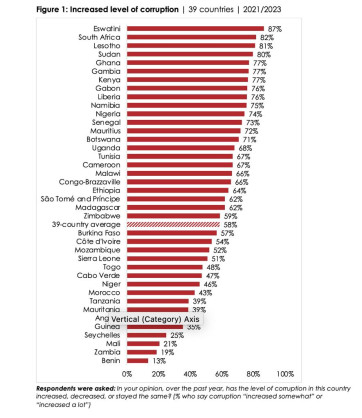
  • On average across 39 countries, a majority (58%) of Africans say corruption increased “somewhat” or “a lot” in their country during the preceding year (Figure 1).
    • Compared to 2014/2015, 12 countries recorded double-digit increases in perceptions of worsening corruption, including a surge of 39 percentage points in Senegal, while decreases reached a remarkable 61 points in Benin.
    • More than two-thirds (68%) of citizens say “some” or “a lot” of the resources intended to address the COVID-19 pandemic were lost to corruption.
  • Almost half (46%) of Africans say that “most” or “all” police officials are corrupt, the worst rating among 11 institutions and leaders the survey asked about. Tax officials, civil servants, and officials in the Presidency tie for second-worst, at 38% (Figure 2).
  • Among citizens who sought selected public services during the previous year, substantial proportions say they had to pay a bribe to obtain police assistance (36%), to avoid problems with the police (37%), to get a government document (31%), or to receive services at a public medical facility (20%) or a public school (19%) (Figure 3).
    • Self-reported bribe-paying varies widely across countries. For example, obtaining a government document required a bribe from 68% of applicants in Congo-Brazzaville, compared to 1% in Cabo Verde and Seychelles.
  • Two in three Africans (67%) say their government is doing a poor job of fighting corruption (Figure 4).
  • Only one in four Africans (26%) say people can report corruption to the authorities without fear of retaliation (Figure 5).

Distributed by APO Group on behalf of Afrobarometer.

For more information, please contact:
Daniel Iberi
Afrobarometer communications officer for East Africa
Email: diberi@afrobarometer.org
Telephone: +254725674457

Follow us on:
Twitter: https://apo-opa.info/3jYM2la
Facebook: https://apo-opa.info/3K0t6gq
YouTube: https://apo-opa.info/3Ysf4IU
Visit us online at www.Afrobarometer.org
Follow our releases on #VoicesAfrica.

Afrobarometer surveys:
Afrobarometer is a pan-African, non-partisan survey research network that provides reliable data on African experiences and evaluations of democracy, governance, and quality of life. Nine survey rounds in up to 42 countries have been completed since 1999. Round 9 surveys (2021/2023) cover 39 countries.

Afrobarometer's national partners conduct face-to-face interviews in the language of the respondent's choice with samples of 1,200-2,400 adults that yield country-level results with margins of error of +/-3 to +/-2 percentage points at a 95% confidence level.

Media files
Afrobarometer
Download logo
Read moreAmid rising corruption, most Africans say they risk retaliation if they speak up
10 December 2023

Ramokgopa urges public to engage with IRP 2023

Location: News

Ramokgopa urges public to engage with IRP 2023

Minister in the Presidency responsible for Electricity, Kgosientsho Ramokgopa, has urged the public to engage with the Integrated Resource Plan (IRP) 2023, which has been approved by Cabinet.

IRP 2023 is now set to be published by the Minister of Mineral Resources and Energy.

The Minister urged communities, stakeholders and interest groups to engage with the IRP 2023 and send their submissions, as part of determining the country’s “energy future”.

“This will underpin our responses in relation to how we are going to address the energy situation in the country.

“What is significant about this is that… the IRP 2023 computes two horizons [including up to 2030]. In the context of the energy crisis, the interventions [in this IRP] will help us in the short-term to ensure that we ameliorate the degree of the energy deficit that we are experiencing now.

“The IRP also computes horizon number two, which is from 2030 to 2050, and in the most bold fashion, it states what are these new sources of energy and essentially, it [deals with] our ability to be able to exploit our renewable energy endowment, and their linkages to the availability of transmission,” Ramokgopa said at the Energy Action Plan briefing on Sunday.

The Minister reiterated the commitment to resolve load shedding, and have a secure energy supply to protect the South African economy and ensure growth and development.

The IRP is a plan aimed at estimating South Africa's electricity demand. It takes into account how the demand for electricity will be met and the expense of such a demand. The plan refers to electricity generation and expansion programmes.

In formulating the National Development Plan, the Department of Energy gazetted the Integrated Resource Plan 2010-2030 (IRP 2010) in March 2011. This forecasted the energy demand for the 20-year period.

In October 2019, IRP 2019 was gazetted. This updates the energy forecast from 2019 to the year 2030.

The IRP is a “living document” that gets revised and updated.

Performance of power plants

The Minister announced that 980 megawatts (MW) at Koeberg Unit 2 will be taken out on Monday. Unit 1 one came back last month after significant delays. Koeberg is the only nuclear power station on the continent, with each of the two units producing 980 megawatts, according to the Minister. 

"It's very significant to the energy mix, and as part of our intention to extend its life by 20 years, we took out Unit 1 to comply with the requirements of the regulator (NERSA)... Now we are taking out Unit 2 for the same purpose," he said, noting that Unit 1 is almost at full load.

With regards to the performance of the grid over the past week, Ramokgopa said the unplanned capacity loss factor (UCLF) and partial load losses (the rate at which units are failing and not performing at optimal capacity) combined has been averaging just above 14 000MW.

“To put it into context, we have reached highs of 17 000MW of these losses. If we were to use May as our baseline, we were losing about 17 369MW. Essentially, we are better off by about 3 000MW, and that’s what we’ve been averaging.

“In fact, it looks even healthier if you were to take Saturday and today, where we’re at about 12 000MW. We have been able to introduce an improvement of about 5 000MW - 6 000MW… if you were to use the baseline of May,” the Minister said.

On why Stage 3 and 4 load shedding continues despite the improvement outlined by the Minister, he said the aim was to use the summer period to ramp up planned maintenance.

“We are averaging just close to 7 000MW. To put it into context, during the winter period, we were averaging about 2 500MW of planned maintenance. If you look at the period around May, it was 3 100MW. The team has taken out, of their own volition, an additional 3 000MW, compared to what was the situation in May.

“We reached a high of about 8 000MW on 8 December. That means there was an additional 4 000MW that has been taken out… It is important that we are able to do maintenance. The more you postpone maintenance, it will catch up with you and you will experience rapid failures of units.”

The Minister said the status quo shows the “true health” of the system, without “necessarily the assistance of the open cycle gas turbines”. While these are engaged at certain peaks, Ramokgopa said they are not being used at the rates at which they have previously been.

The Minister said all stakeholders are working hard to stabilise power supply, especially throughout the festive season.

New Eskom CEO

On the appointment of Dan Marokane as the new Eskom Group CEO, Ramokgopa said leadership stability is key to the resolution of the energy crisis that is confronting the country.

“We are looking forward to the contribution of Mr Marokane, together with the totality of the executive committee of Eskom… to give additional impetus to the work that we are doing,” Ramokgopa said, highlighting that there will now be “certainty in the apex office” of the power utility.

The Minister thanked the Interim Group CEO, Calib Cassim, for his contribution. – SAnews.gov.za

GabiK
Sun, 12/10/2023 - 12:47

130 views
Read moreRamokgopa urges public to engage with IRP 2023
8 December 2023

One child dead and several people injured in Bloemfontein storm

Location: News

Hundreds of people in Phase 6 location lost most of their belongings and now have to rebuild their homes

Read moreOne child dead and several people injured in Bloemfontein storm
  • Previous
  • Page 1
  • Interim pages omitted …
  • Page 78
  • Page 79
  • Page 80
  • Page 81
  • Page 82
  • Interim pages omitted …
  • Page 95
  • Next

Copyright © 2026 · MyZA · All Rights Reserved · Powered by Stratlec Online