• Skip to main content
  • Skip to header right navigation
  • Skip to after header navigation
  • Skip to site footer
MyZA

MyZA

News, Directory, Events and Other Stuff

  • Social Media
  • Sport
  • World News
  • Home
  • Submit News
  • Directory
  • Events
  • Stratlec
  • TFSA
  • News
    • APO
    • Today’s Sport News
    • Todays Social Media and Tech Headlines
    • Today’s World News
    • Today’s SA Financial News
  • Contact
You are here: Home / Archives for infrastructure

infrastructure

20 November 2023

Cabinet reiterates call for an terminate to Gaza conflict

Location: News

Cabinet reiterates call for an end to Gaza conflict

Cabinet has reiterated the call made by African leaders for an end to the conflict in Gaza, during the African-Saudi Summit in Riyadh hosted by Crown Prince Mohammed Bin Salman. 

The summit condemned the targeting of civilians, and the violations of international law by the Israeli government.

“The world cannot simply standby and watch. The global community needs to rise to stop this genocide now,” Minister in The Presidency, Khumbudzo Ntshavheni, said during a media briefing on the outcomes of the Cabinet meeting, on Monday.

Ntshavheni said Cabinet continues to be concerned by the atrocities of the Israeli government against the people of Palestine, including the deliberate attacks on the United Nations School in Gaza, and the massacre of hundreds of children who had sought refuge at the school. This is in addition to the continued attacks on hospital staff, patients and hospital infrastructure.  

Ntshavheni noted that it is because of these continued atrocities that are being committed with impunity by the Israeli government with the support and protection of powerful countries that on 17 November 2023, South Africa, together with the Comoros, Djibouti, Bolivia and Bangladesh, jointly referred the situation in Palestine and Israel to the International Criminal Court (ICC). 

While the Palestinian Authority did ask the ICC to investigate crimes under the court’s jurisdiction in 2018, the Minister said South Africa believes the current atrocities, particularly in Gaza needs renewed attention with the full backing of state parties. 

“Our ambassador in the Hague delivered the referral in person, which asked the ICC to investigate the commission of war crimes, crimes against humanity and genocide with a view to holding those most responsible accountable. Given that much of the global community are witnessing the commission of these crimes in real time, including statements of genocidal intent by many Israeli leaders, we expect that warrants of arrest for these leaders including Prime Minister Netanyahu will be issued shortly.  

“The ICC has been able to investigate the situation in Palestine since 2021 when the issue of territorial jurisdiction was settled, however, we have noted that the office of the prosecutor has continued to drag its feet despite the gravity of the situation. The current atrocities may not have occurred if these investigations took place as soon as the Palestinian Authorities first made its referral.”

Ntshavheni said South Africa now expects that other state parties also add their voices for an end to the impunity by Israel, and the significant levels of evidence available, that international warrants of arrest will be issued by the time the Conference of Parties meet in mid-December in New York.  

“Failure to do so will be indicative of a lack of will to act by the ICC and a strong signal to the total failure of the global system of good governance and the need to establish a new system.”

The Minister also noted that more children have been killed over the last month than those killed per annum in all conflicts combined for the last three years. This include more United Nations (UN) staff members who have been killed in Gaza since the founding of the United Nations. 

“The numbers of journalists killed have been staggering. These are all people killed by the actions of the Israeli government, not to defend itself, but evinced by the statements of its leaders to clear most of Gaza of Palestinians and to occupy it,” the Minister said. – SAnews.gov.za  


GabiK
Mon, 11/20/2023 - 13:16

503 views
Read moreCabinet reiterates call for an terminate to Gaza conflict
20 November 2023

Triumph over pit latrines near yet far

Location: News

Triumph over pit latrines near yet far

South Africa is poised to turn the corner in eradicating pit latrines in educational facilities before the UN-designated year of 2030, writes Minister of Basic Education Angie Motshekga.

On World Toilet Day, 19 November 2023, it is imperative to reflect on the critical role of sanitation in educational and social development to restore dignity while ensuring the safety of learners and educators.

The Sanitation Appropriate for Education (SAFE) initiative, spearheaded by the Department of Basic Education (DBE), represents a significant undertaking. It transcends the mere elimination of pit latrines, addressing broader issues at the core of adequate educational infrastructure and well-being.

This reflection comes when we’re emerging from the shadows of the COVID-19 pandemic, which significantly impacted all aspects of life, including the progress of essential sanitary projects in schools.

Sanitation, fundamentally linked to human dignity, is critical to global health and well-being. The World Health Organization (WHO) underscores that safe drinking water, sanitation, and hygiene (WASH) are not only essential for health but also contribute significantly to livelihoods, school attendance, and the dignity of individuals, fostering resilient communities in healthy environments​​. Human Rights Watch amplifies this, stating that the right to sanitation, a derivative of the right to an adequate standard of living, ensures everyone is entitled to sanitation services that provide privacy and uphold dignity​​.

The World Bank emphasises the necessity of investing in sanitation to prevent needless deaths, improve lives and livelihoods, and uphold human dignity. This is particularly poignant considering that around 4.2 billion people live without access to safely managed sanitation, with women and girls often bearing the brunt of this deprivation. The Hunger Project further highlights that a lack of access to sanitation is not only a health issue but also a matter of safety and human dignity. Sanitation is now a global priority, and efforts are being made to educate communities about its importance and to provide sustainable solutions like eco-toilets​​.

Additionally, improvements in sanitation, as part of the broader WASH framework, are fundamental to enhancing people’s living standards. These improvements yield numerous benefits, including better physical health, environmental protection, improved educational outcomes, time savings, and the assurance of a life of dignity, ensuring equal treatment for all genders.

The pandemic highlighted the importance of hygiene and sanitation, which the DBE had been addressing through its emergency water programme and the SAFE initiative. The latter, albeit delayed by the pandemic, has been a pivotal project to transform the sanitation facilities in South African ordinary public schools.

SAFE’s objective is not just a replacement of outdated pit latrines but a complete overhaul of the sanitation infrastructure in line with the Norms and Standards for school infrastructure. This overhaul is not merely about installing new toilet seats, which are determined by learner enrolment and include age-appropriate facilities for primary schools and those catering to the disabled. The scope of SAFE is extensive, encompassing the assessment of existing sanitation facilities, de-sludging and demolition of old pit toilets, construction of new, appropriate toilets, provision of rainwater harvesting systems, and the construction of accessible walkways.

This initiative, launched by President Cyril Ramaphosa in August 2018, underscores the power of collaboration for social change. It brought together an array of partners from both the public and private sectors, including Amalooloo, Assupol, AVBOB, Norcros, and international actors like the embassies of the Republic of Korea and the United States of America. This collective effort has resulted in the delivery of 126 projects out of a pledged 184. The diversity and innovation seen in these partnerships have been crucial in tailoring solutions to meet various needs, embodying the ‘stronger together’ ethos.

Alongside SAFE, the Accelerated Schools Infrastructure Delivery Initiative (ASIDI) targeted 1087 sanitation projects, all of which have been completed. This achievement signifies not just a quantitative success but a qualitative shift in the educational experience for millions of previously disadvantaged school children. The inclusion of children at the Grade R level in the education system underscored the need for age-appropriate sanitation facilities, a demand that SAFE has been addressing.

To date, 2978 out of 3898 SAFE projects have been completed since the program’s intensification in 2019. This progress is significant, considering the interruptions caused by the pandemic. More than just constructing facilities, SAFE emphasises the importance of hygiene education, ensuring that schools are equipped with better sanitation and the knowledge to maintain these standards.

The urgency of this mission aligns with the United Nations’ UN Water directive, which starkly reminds us that to meet the sanitation target of SDG 6 – safe toilets and water for all by 2030 – the world needs to accelerate its efforts. The DBE, with an expenditure of nearly R 3.7 billion, is confident in meeting these goals within the next two financial years, showcasing a commitment to transforming the landscape of school sanitation in South Africa.

In conclusion, the SAFE initiative is a testament to the power of collaborative effort in addressing critical social challenges. It goes beyond mere infrastructure development, encompassing a holistic approach that includes partnership, innovation, and education.

On this World Toilet Day, as we reflect on the strides made, we are reminded of the ongoing journey towards ensuring that every child has access to safe and dignified sanitation. This fundamental right underpins their health, educational success, and future prospects. It is about our people’s inherent right to dignity. We dare shall not fail.

*Angie Motshekga is the longest-serving Minister of Basic Education in South Africa, post 1994.


Matona
Mon, 11/20/2023 - 13:27

458 views
Read moreTriumph over pit latrines near yet far
20 November 2023

The Role of AWS Partners in South Africas Digital Landscape

Location: MyPR

Amazon Web Services (AWS), a global leader in cloud computing, has been pivotal in transforming how businesses operate worldwide. In South Africa, the adoption of AWS services is accelerating, marking a significant shift in the country’s digital infrastructure. This blog explores the integral role of AWS Partners in driving this transformation.   Understanding AWS Partnerships …

Read moreThe Role of AWS Partners in South Africas Digital Landscape
20 November 2023

SA Connect project forges ahead

Location: News

SA Connect project forges ahead

The government-driven SA Connect broadband connectivity project is going full steam ahead, with a report on Phase two of the project considered by Cabinet.

This is according to Minister in the Presidency Khumbudzo Ntshavheni who was addressing the media on the outcomes of the recently held Cabinet meeting.

“On progress with Phase 2 of the project, Cabinet was pleased that 1 000 households were connected with broadband and that 1 000 community Wi-Fi hotspots are planned to be installed by December 2023.

“In addition, the project has rolled out infrastructure for internet connectivity that allows households to access internet at cheaper rates. For R249 per month, a subscribing household has unlimited access to robust internet, with cheaper data costs as low as R5 for one gig per day,” she said.

Ntshavheni explained that the SA Connect project aims to “to bridge the digital divide by connecting households and government institutions and provide Wi-Fi access to communities across the country”.

“It is estimated that the project will also contribute to economic participation through provision of 4 505 semi-skilled and 169 skilled employment opportunities, and will support over 75 small to medium-sized companies.

“In addition, high demand spectrum will be provided to more than 18 000 schools, 943 libraries, 5 731 health facilities and 8 241 Tribal authorities over the next months through the social obligations to telecommunications companies.

“It is anticipated that the project will deliver connectivity to more than five million households and 32 000 community Wi-Fi hotspots across the country over the next 36 months,” Ntshavheni said.

On broadcasting digital migration, Ntshavheni said Cabinet noted the progress made in migrating from analogue to digital.

“As of 23 July 2023, all 123 analogue transmitters above 694 MHz were switched off in the remaining four provinces namely; the Eastern Cape, KwaZulu-Natal, the Western Cape and Gauteng. This will free up the spectrum needed for mobile broadband, and other information and communications technology related needs. 

“Cabinet was briefed that the Minister of Communications and Digital Technologies had determined December 2024 as the final date for switch off of all analogue broadcasting services, and that progress is on to meet the set target date,” Ntshavheni said. – SAnews.gov.za

NeoB
Mon, 11/20/2023 - 13:47

427 views
Read moreSA Connect project forges ahead
20 November 2023

Progress recorded at Dinokana water project in N West

Location: News

Progress recorded at Dinokana water project in N West

Water and Sanitation Minister Senzo Mchunu has committed to ensure that Operation Bulela Metsi meets its obligations to the people of Dinokana, North West, and ultimately the whole province.

The Minister said this during the sod-turning of the R106 million Dinokana Water Supply Intervention Project, implemented by Magalies Water, in Ramotshere Moiloa Local Municipality. 

The Dinokana project is one of the 27 water and sanitation projects under Operation Bulela Metsi that were unlocked and reprioritised after intergovernmental interventions led by Mchunu and the North West government earlier this year.

Mchunu conducted an oversight visit to the construction sites of the water project ahead of a meeting with the community of Dinokana. 

During the visit, the delegation was taken through the ‘sacred’ Dinokana eye, a natural spring where the water source and pump station is located. The delegation also conducted a walkabout at the site, where a 15-kilometre bulk pipeline is being laid.

Mchunu said through intergovernmental structures set up in the province and the constitutional mandate of each institution, the programme will ensure that every household has access to water through a standpipe, and that people need to be patient as the project is being implemented in phases. 

The project scope entails the refurbishment and upgrade of the Dinokana rural water supply infrastructure, which includes high lift pump refurbishment and upgrade from 2 Ml/day to 4 Ml/day; refurbishment of boreholes; upgrading of the spring water pump station and pipeline; refurbishment of the distribution system up to the bulk water reservoirs, and constructing an additional 2 Ml reservoir to provide additional gravity pressure.

Mchunu commended the progress made, saying that water will eventually reach everyone who needs to benefit from the project. 

“We are now here to point to the work that is currently being carried out. Refurbishing the pump station is critical so that all the pumps are working optimally in order to pump the required quantities, and be able to meet the demand of these communities in the four wards,” Mchunu said.

Over 1 000 metres of bulk pipeline has already been laid, including the commencement of work on the refurbishment and the bulk distribution network, which has also commenced.

Mchunu was accompanied by his deputy Judith Tshabalala, North West Premier Bushy Maape, Ngaka Modiri Molema District Municipality Mayor Khumalo Molefe, Ramotshere Moiloa Local Municipal Mayor Dinah Pitso, Magalies Water Board Chairperson, Dr Lydia Sebego, and local chiefs. 

Addressing Ramotshere Moiloa residents, Mchunu said 27 water and sanitation projects under Operation Bulela Metsi are currently underway throughout the North West province, and the Dinokana project is among them.
  
Dinokana Water Supply Intervention project is being implemented in four phases including: 
Phase 1 - Bulk pipeline distribution construction, including reservoir and refurbishment to existing transmission lines. 
Phase - 2 Refurbishment of boreholes and additional drilling and equipping of boreholes. 
Phase 3 - Reticulation and standpipe at 200m radial distance within village boundary. 
Phase 4 - Upgrading pump station and pumping line to allow both reservoirs to be fed by pump station. The objective is to provide an additional 35 000 residents with standpipes.

Mchunu said with the current 17 local people benefiting through the Dinokana water supply intervention project, five more job opportunities will in future be added to benefit 25 locals per ward. 

The Dinokana project, which commenced on 30 September 2023, is expected to be completed on 30 September 2024.

The Minister encouraged locals with illegal water connections to report to the local mayor to be legally connected for free, so that they won’t face the wrath of the law.

He further called on the community to safeguard the infrastructure, warning that connecting water illegally damages the pipes.

Operation Bulela Metsi is a water and sanitation intervention programme, which was introduced by Mchunu and the North West provincial government in July this year. 

The programme is a culmination of a series of intergovernmental engagements among the three spheres of government, including business, traditional leaders and community structures on the water and sanitation challenges faced by the province. – SAnews.gov.za
 

GabiK
Mon, 11/20/2023 - 14:43

318 views
Read moreProgress recorded at Dinokana water project in N West
20 November 2023

Revolutionising Payment Acceptance with Mobile SoftPOS Technology

Location: MyPR

The world of financial transactions is evolving rapidly, and one of the most significant advancements in recent years is the emergence of mobile SoftPOS (Software-based Point of Sale) technology. This innovative approach is transforming how businesses of all sizes accept payments, making the process more accessible, efficient, and cost-effective.   What is Mobile SoftPOS? Mobile …

Read moreRevolutionising Payment Acceptance with Mobile SoftPOS Technology
20 November 2023

Zikalala to host Property Sector Conference

Location: News

Zikalala to host Property Sector Conference

Public Works and Infrastructure (DPWI) Minister, Sihle Zikalala, is expected to address property sector participants in a conference to be held in Cape Town, Western Cape.

The Property Sector Conference will be held on Thursday.

As part of the Minister’s strategic engagement, he will start by visiting some of the hijacked buildings in Cape Town before outlining various strategies currently being developed by the DPWI to optimise the utilisation of state-owned buildings, curb illegal occupation and hijacking of buildings, improving energy efficiency and the discontinuing of total reliance on private leases. 

Zikalala will also articulate the department’s plans regarding the ballooning government lease portfolio and how to further maximise revenue generation for the department.

Some of the key focus areas the Minister will address include the transformation of the property sector, ensuring that DPWI’s partnership with the private sector in delivering quality accommodation, is within budget and at a reasonable time.

The conference is aimed at engaging stakeholders on various challenges facing the department on delivering on its legislative mandate to be the real estate agent of South Africa and, therefore, address property industry players on the key role they ought to play in collaboration with the department. – SAnews.gov.za


Edwin
Mon, 11/20/2023 - 15:23

119 views
Read moreZikalala to host Property Sector Conference
19 November 2023

S&P keeps SA credit ratings unchanged

Location: News

S&P keeps SA credit ratings unchanged

Government says it has noted Standard and Poor (S&P) Global Ratings’ decision to affirm South Africa’s long-term foreign and local currency debt ratings at ‘BB-’ and ‘BB’, respectively, and maintain the stable outlook.

According to S&P, the stable outlook balances South Africa's credit strengths - particularly a credible central bank, a flexible exchange rate, an actively traded currency, and deep capital markets - against infrastructure-related pressures on growth and downside risks to the fiscal and debt position.

“The agency also acknowledges that private-sector investment in power generation and renewables is picking up and will support the strengthening of real Gross Domestic Product (GDP) growth over the medium term.

“Over the next three years, government will focus on raising GDP growth by improving the provision of electricity and logistics, enhancing the delivery of infrastructure and restructuring the state to be efficient and fit-for-purpose,” said National Treasury in a statement.

The department said fiscal policy continues to support this approach by stabilising debt and debt-service costs.

Additionally, fiscal consolidation will be implemented through spending reductions, efficiency measures across government and moderate tax revenue measures. – SAnews.gov.za

Janine
Sun, 11/19/2023 - 11:08

428 views
Read moreS&P keeps SA credit ratings unchanged
19 November 2023

Learning from Israel’s past Gaza Strip invasions

Location: News

“A political resolution that addresses the roots of the conflict is the only way to defend Israel’s borders and citizens” writes a former Israeli soldier

Read moreLearning from Israel’s past Gaza Strip invasions
17 November 2023

Stakeholders say transformative industrialisation is critical for Africa’s sustainable development

Location: News

United Nations Economic Commission for Africa (ECA)
Download logo

Some stakeholders have reiterated the need for transformative industrialisation, saying it is critical for sustainable development on the continent.

They have been speaking at a special event, "Leveraging on strategic foresight for an agile, robust, and forward-looking sustainable industrial development in Africa", on Thursday at the African Economic Conference (AEC) in Addis-Ababa, Ethiopia.

Fiona Tregenna a Professor at the University of Johannesburg, and Chair of the Industrial Development National Research Foundation (NRF) of South Africa, delivered a paper on Transformative Industrialisation for Africa (TIFA) and links with strategic foresight. She highlighted some of the challenges that have hindered industrialisation on the continent.

According to Tregenna, achieving the Africa we want is not business as usual, otherwise we will not get the transformative change to give us the Africa we want.

She added: "A strategic and systemic approach is critical for a sustainable Africa. We are not looking at interventions that will yield today, but long-term investments."

Mr Ibrahima Sall, former Minister of Planning in Senegal, said engagement with various relevant stakeholders was required for sustainable industrial development in Africa.

"We need a flexible, agile, high-impact industrialisation that is robust. Even in the professor's introduction, it is clear that there are some industrial processes, and we need to keep the strength going. We know how to implement industrial policies, no policy cannot be selective. Otherwise, we will be sprinkling without impacting or wasting capital. So, there must be a selective national champion. How do we build with major stakeholders? What matters most is to look at selectivity and information and inform the states to understand that policies are not made on the ground. The engagement of states is key, and they must pay attention to the industrial sector," Sall said.

He added that selective criteria are critical. The vertical policy of African nations entails focusing on processing raw materials. And we have horizontal and selective, which involve all actions: sustainability, infrastructure, human capital, and technology. With this, states do not need to be flexible but focus on sustainability.

Speaking on Malawi's strategy, Thomas Munthali, Director General at the country's National Planning Commission, said that knowing that the effects of climate change were gradually destroying the country, it embarked on climate-resilient infrastructure and appreciated the future of industrialisation.

Munthali urged countries on the continent to venture more into digitisation, engage the private sector to catalyse investments, experiment, and learn from successful nations. He said, "We should be learning from nations. We should try and fail, but never fail to try."

For her part, Hauwa Ibrahim of the Nasarawa State University in Nigeria, said Africa stood at the crossroads of opportunities and challenges.

Ibrahim added that, "While we know there are no perfect policies, those with rooted outcomes stand the test of time. There is a need for research and development on the continent to ensure a sustainable Africa. The demographic population is vital and should be considered because we have many young people and what they are learning now should matter to us. We need to recognise the role of technology and ensure it is applied at all levels. We cannot take out the role of education in defining technology because we do not want to industrialise and have to invest elsewhere, away from the continent, in certain labour forces. Therefore, while we invest in technology, we must also invest in the education of young people."

Earlier, Karima Ben Soltane, the Director of the United Nations African Institute for Economic Development and Planning (IDEP), ECA, while moderating the session, said the theme was focused on what African countries needed to enact their policies, implement the SDGs, and make strategic investments, among others.

"What are the key drivers of change in the workforce landscape? We are cognizant that tomorrow's jobs do not exist today. And we need to ensure ways of bringing up initiatives and effectively preparing governments, individuals, institutions, and industries for these changes,” Ben Soltane added.

Distributed by APO Group on behalf of United Nations Economic Commission for Africa (ECA).

Read moreStakeholders say transformative industrialisation is critical for Africa’s sustainable development
17 November 2023

Public works slammed for mismanagement of prime Cape Town property

Location: News

A two-hectare property and heritage buildings have been left to ruin

Read morePublic works slammed for mismanagement of prime Cape Town property
17 November 2023

The Case for an Industrial Revolution in Africa: Can South Africa’s Re-industrialisation be the spark?

Location: MyPR

Paul Terna Gbahabo is a research consultant and a PhD graduate in Development Finance at Stellenbosch Business School. Africa, a continent of immense potential, stands at a critical juncture. The call for an industrial revolution is not merely a suggestion but an economic imperative. Africa desperately needs an industrial revolution. Though daunting, it is not …

Read moreThe Case for an Industrial Revolution in Africa: Can South Africa’s Re-industrialisation be the spark?
16 November 2023

PRASA initiative offers commuters fare discounts

Location: News

PRASA initiative offers commuters fare discounts

The Passenger Rail Agency of South Africa (PRASA) has introduced the #TravelOffPeak campaign, an initiative aimed at promoting travel during off-peak by providing attractive fare discounts to commuters.

“Recognising the importance of promoting reliable transit not only during the weekday rush hours but off-peak too, PRASA is pleased to offer various off-peak discounts across all its operational routes starting from 13 November 2023.”

PRASA GCEO Hishaam Emeran explained that the initiative is part of the organisation’s commitment to encourage the public to use Metrorail services not only during peak hours but also during off-peak periods.

"This is a significant step towards enhancing the commuter experience and saving commuters money by paying lower fares. By choosing to travel during off-peak, commuters will not only enjoy a quieter and relaxed journey but contribute to a more evenly distributed and efficient use of our transportation infrastructure," Emeran said.

Fares are discounted as follows:

  • Pensioners: 50% discount during off-peak.
  • General public/commuters: 40% discount during off-peak.
  • Scholars in uniform: 50% anytime of the day.
  • Bulk purchase: 10% discount on bulk buying.
  • Events or promotions (schools or groups): 50% discount for groups travelling together.

These off-peak discounts are applicable between 09h30 and 14h30 weekdays, and during weekends and public holidays.

“PRASA wishes to remind commuters to check their eligibility for discounted fares ahead of their journey. All tickets will be valid on the day of purchase and at off-peak hours.

“It is crucial to note that these tickets should not be used during peak hours, except for scholars in school uniforms, whose tickets remain valid for the entire day.

“PRASA invites commuters to #TravelOffPeak and save while enjoying a more comfortable and cost-effective travel experience to their various destinations,” the agency said. – SAnews.gov.za


nosihle
Thu, 11/16/2023 - 10:24

383 views
Read morePRASA initiative offers commuters fare discounts
16 November 2023

22 Gauteng schools built with asbestos still haven’t been replaced

Location: News

Historic Kliptown Primary School is one of them

Read more22 Gauteng schools built with asbestos still haven’t been replaced
16 November 2023

SAWS warns of severe thunderstorms

Location: News

SAWS warns of severe thunderstorms

The South African Weather Service (SAWS) has issued a warning for severe thunderstorms resulting in strong, damaging winds and possible large amounts of small hail.

This is expected to cause damage to infrastructure, flooding, damaging winds over the North West, Gauteng, north eastern parts of the Northern Cape, Free State and south western KwaZulu-Natal.

“This warning remains valid until 11pm tonight. In addition, a Yellow Level 1 warning for severe thunderstorms was issued with damaging winds and hail expected over the northern and eastern parts of the Eastern Cape.

“On Friday and Saturday, we expect showers and thundershowers over the central interior extending to the east,” SAWS Senior Manager: Disaster Risk Management, Tshepho Ngobeni.

He was addressing a media briefing in Pretoria on Thursday.

“South Africa, like many other countries across the globe, is prone to hazardous weather events. These include heavy rainfall, severe thunderstorms, droughts, floods, storms and wildfires. Consequently, the need for the people of South Africa to be WeatherSMART cannot be stressed enough.”

He said a WeatherSMART person is safe, more informed, alert, resilient, and has timely access to relevant information and services where matters of weather and climate are concerned. – SAnews.gov.za


nosihle
Thu, 11/16/2023 - 14:40

628 views
Read moreSAWS warns of severe thunderstorms
16 November 2023

Cybercriminal for hire

Location: News
KnowBe4

Ransomware attacks are a global concern, with a shocking 40% increase in both frequency and severity over the last year. “South Africans are at significant risk due to the increasing use of Ransomware-as-a-Service (RaaS),” warns Anna Collard, SVP Content Strategy & Evangelist at KnowBe4 AFRICA (www.KnowBe4.com). Using RaaS also increased by 40% (https://apo-opa.co/49Bynp3) over the last year. Threat actors now sell their sophisticated ransomware solutions and services, keeping up to 80% of the profits.

Ransomware attacks are rapidly posing a greater threat due to the availability of RaaS solutions on the dark web. These solutions can be purchased at varying prices, ranging from less than $100 to thousands of dollars. The ease of access to these kits, coupled with the fact that they often come with customer support, allows attackers to quickly set up and execute multiple ransomware attacks with little to no technical skill.

This accessibility to RaaS solutions has led to the evolution of ransomware, with cybercriminals focusing on enhancing its sophistication and capabilities. The aim is to create a product that is highly effective and profitable, catering to the demands of potential buyers in the cybercriminal market. They readily select their ransomware from a shopping list, pay the creators, and go. This represents the epitome of commodity attacks — a matter of utmost concern, especially for South Africa.

“One of the key factors contributing to South Africa's vulnerability to these types of attacks is the widespread use of English,” explains Collard. “Attackers often need to negotiate with their victims, which means they need to speak a common language. It is difficult to negotiate with someone whose culture and language you do not understand. As a result, Western countries are more frequently targeted because of a higher percentage of threat actors originating from Europe. South Africa, with its strong English speaking business culture, advanced digital infrastructure, and thriving financial services ecosystem, is consequently at risk of being targeted by these attacks.”

In South Africa, both the private and public sectors rely significantly on digital infrastructure for their critical operations. Companies are prioritising digitalisation efforts to maintain their competitiveness in the local and global markets. This strategic investment in digital technologies has proven invaluable, enabling companies to navigate through the challenges posed by the pandemic and fostering remarkable innovation. In fact, South Africa was recognised as the most innovative country in Africa in 2022 (https://apo-opa.co/3SJXgJ8). However, this increased reliance on digital platforms has also exposed the country and its companies to vulnerabilities and risks.

“North America was the primary ransomware target for a long time but there has been a downward trend because the government has come down hard on these criminal organisations,” says Collard. “They have the resources, law enforcement, and probably the budgets to clamp down on cybercrime syndicates that South Africa does not. In short, countries like the United States have become more responsive to threats and so the bad actors are turning to countries that do not have these resources or systems in place.”

When we combine this significant change in targeting, as highlighted in the recent Cy-Xplorer 2023 report by Orange Cyberdefense (https://apo-opa.co/3R2aboD), with the swiftly evolving RaaS market, it is obvious why South African organisations need to stop and pay attention to the rising ransomware threat. It has been commoditised and simplified, turned into a solution as easy to use and implement as an app for a smartphone. Plug, play, steal.

“RaaS presents a very real and constantly evolving challenge to cybersecurity specialists and organisations,” concludes Collard. “The methods of attack, the approaches, the level of sophistication—it is very easy for anyone to be caught out. End users must remain vigilant to ensure that they do not become the reason a company falls victim to ransomware, and companies must continually train and remind employees of the risks to prevent complacency.”

User awareness is critical. If people can recognise threats, they will not click on links or make mistakes. If people are aware of how easy it is to be fooled by fake emails and sites, they will be cautious with their passwords and their information. If companies constantly reinforce these messages, they are protecting their data, their people and their systems from an onslaught of RaaS threats that are only set to get even better and more prevalent in the future.

Distributed by APO Group on behalf of KnowBe4.

Media files
KnowBe4
Download logo
Read moreCybercriminal for hire
16 November 2023

Mchunu affirms traditional leadership role in Mzimvubu Water Project

Location: News

Mchunu affirms traditional leadership role in Mzimvubu Water Project

Water and Sanitation Minister Senzo Mchunu has assured the traditional leadership in the Joe Gqabi, OR Tambo and Alfred Nzo District Municipalities that they will be fully involved in the implementation of the multibillion Mzimvubu Water Project.

Following years of delay due to a deadlock about funding, the project has since been reconfigured to make it more affordable, with the cost been reduced from R18 billion to R8 billion. 

During a recent meeting with district municipalities’ mayors and traditional leaders, Mchunu reported that the Ntabelanga Dam project, which is one of the Mzimvubu Water Project components, has since commenced its implementation in the Ntabelanga mountains, along the Tsitsa River, Tsolo, in the cross boundary of Elundini and Mhlontlo Local Municipalities in the Joe Gqabi District. 

Stage one of the dam component, which includes the construction of access roads to the dam wall site, is currently sitting at over 90%, while pegging of the dam wall site, identification and pegging of land and households that will be affected by the dam impoundment, is underway. 

“Other components of the Ntabelanga project include construction of a water treatment plant, primary and secondary reservoirs, and bulk pipelines for treatment, transfer and storage of potable water to enable the water services authorities to reticulate to communities earmarked to benefit from the project.

“Meanwhile, the overall Mzimvubu water project will look at the existing water supply schemes within the Mzimvubu Catchment Area, in order to optimise and harness them to benefit the communities in the three districts,” Mchunu said.

The Minister said the resuscitation of the multibillion Mzimvubu project confirms that people in rural areas also have constitutional human rights, which include the right to have access to clean, potable water for their basic needs, like the rest of the citizens who reside in urban areas.

“Through this project, we as the national, together with the provincial government and the responsible districts as water services authorities as well as relevant municipalities, should make sure that there are no more hindrances to the progress of this project to its completion. Like many other projects that have been unlocked, what is happening on this site is a beginning of a new era and makes us happy,” Mchunu said. 

To ensure transparency and prevent unnecessary disruptions and delays to the project implementation, Mchunu said all relevant stakeholder representatives are going to form part of the Political Steering Committee.

The Minister and Eastern Cape Premier, Oscar Mabuyane, will establish and co-chair the committee. The members of the steering committee will include both Water and Sanitation Deputy Ministers, David Mahlobo and Judith Tshabalala, two representatives from the provincial executive cabinet, three mayors of the affected districts and two local municipalities, representatives from the Kingdom, and affected traditional councils.

The Minister said the Technical Task Team, led by the department’s Acting Deputy Director-General of Infrastructure Management, Leonardo Manus, will be formed and include the Public Liaison Committee (PLC) members and community representatives. 

“The task team will deal with the technical implementation of the project including issues of relocation and compensation of households that will be affected by the dam impoundment. The task team will be expected to provide an update on the progress of the project and will report to the Steering Committee on regular basis,” the Minister explained.

Mchunu noted that with the structures setting up, the department is going to correct all the errors made previously, and will ensure that all the issues raised in the meeting receive necessary audience to ensure the continuation of the project implementation without unnecessary disruptions.

“Ultimately, the communities in the districts will receive the much needed clean, drinking water through proper infrastructure,” the Minister said. – SAnews.gov.za

GabiK
Thu, 11/16/2023 - 10:52

109 views
Read moreMchunu affirms traditional leadership role in Mzimvubu Water Project
16 November 2023

South Africa and UAE are Sustainability Leaders

Location: News
Agility

South Africa, the United Arab Emirates, Egypt and Saudi Arabia are doing the most to combat climate change in the Middle East and Africa, according to a new report that compares government and business sustainability policies, investment and actions.

Download document: (https://apo-opa.co/49FTzKm)

The Middle East and Africa Environmental Sustainability Scorecard (https://apo-opa.co/49Bcfeq), released Thursday, is ta detailed examination  of country performance in environmental sustainability outcomes, government policies, and corporate practices in the two regions.

The report concludes that the 17 countries covered “are relative ‘late comers' to global sustainable development but at the same time represent regions that are rapidly stepping-up their sustainability strategies, programs and investments.”

The report was commissioned by Agility (www.Agility.com), a global supply chain services company based in Kuwait. It was compiled by Horizon Group (www.Horizon-Group.ch), a Geneva-based firm that specializes in research and analysis for governments, international organizations, and leading businesses worldwide.

South Africa is among the leaders in four of six pillar categories. It is 2nd in Sustainable Energy & Transport; 5th in Energy Transition; 2nd in Environmental Ecosystems; and 2nd in Circularity. Among African countries, South Africa is 3rd in Green Investment & Technology behind Morocco and Egypt.

Among the factors driving South Africa's performance: a national Biofuel Industrial Strategy; formal code of corporate governance; ESG reporting requirements and transparency and accountability standards for companies listed on the Johannesburg Stock Exchange; a World Bank energy transition partnership to decommission a coal-fired power plant and replace the power supply with renewable energy and batteries; and steps to protect habitat and cut pollution.  

Egypt ranks 3rd overall in the scorecard. It is 5th in Green Investment & Technology; 7th in Sustainable Infrastructure & Transport; 5th in Governance & Reporting; 3rd in Environmental Ecosystems; and 1st in Circularity, which measures resource use and waste management.

A food security and African displacement launched by Egypt contributed to its ranking, along with its participation in a Qatar-led carbon credit program.

Other top performers in Africa: Morocco is 3rd in Green Investment & Technology and 3rd in Governance & Reporting; Rwanda and Kenya are 5th and 6th in Sustainable Infrastructure & Transport.

African countries dominate the energy transition, mainly on the strength of their green transport and energy conservation efforts. Uganda, Nigeria, Rwanda, Kenya, South Africa, Ghana, Tanzania, Mozambique, Cote d'Ivoire, Egypt and Morocco are Nos. 1 through 11 in Energy Transition.The scorecard uses 48 performance and progress indicators to compare countries. The indicators include data, regulatory frameworks, policy assessments, incentives and corporate practices across six pillar areas: green investment and technology; sustainable infrastructure and transport; governance and reporting; energy transition; environmental ecosystems; and circularity. To capture corporate practices and progress, Horizon surveyed 647 business executives in the 17 countries.

Overall, 1 through 17, here's how the countries rank: South Africa, UAE, Egypt, Saudi Arabia, Rwanda, Kenya, Uganda, Ghana, Morocco, Qatar, Tanzania, Nigeria, Bahrain, Kuwait, Cote d'Ivoire, Oman, Mozambique.

Key Findings

• Business isn't paying attention to COP. Eighty-two percent of African businesses and 49% of Middle East businesses are not aware of the UN-led COP process that nations are using to push and measure efforts to tackle climate change. Few companies use COP to set their sustainability targets.

• Climate change is hurting businesses. Ninety-seven percent of companies say their business has been affected by climate change, and 49% say climate change has caused “severe damage” or has a “significant and growing” impact on them.

• Governments are leading as businesses play catch up. When it comes to climate action, governments are outpacing the private sector in both the Middle East and Africa. 

• No one size fits all. Different countries have different sustainability priorities based on income, economic strengths, energy dependency, and other factors. High-income, energy-producing Gulf countries generally invest more in sustainable infrastructure and ecosystems. African economies perform best in energy conservation and consumption.

• Green investment is expensive. High- and middle-income countries are investing the most: Qatar, UAE, Morocco and Saudi Arabia. 

• Africa is focused on green transport. African countries topped the scorecard in the move to non-fossil fuels for transport. Hydrocarbon producing Gulf countries are focused more on green buildings. For Gulf countries, the transition to cleaner energy is complicated by energy-intensive national priorities: the desire to boost manufacturing and the need for desalinated water.

• Waste management, consumption are tied to wealth. High-income countries are doing more to manage waste sustainably. Poorer ones do more to constrain consumption. Overall Egypt, South Africa, Bahrain and UAE perform best in “circularity” – cutting waste, encouraging recycling and sustainable production, and lowering consumption.

Agility was recently named the No. 3 Middle East “Sustainability Leader” for Transport & Logistics by Forbes Middle East. Vice Chairman Tarek Sultan said the company's strategy and investment decisions are increasingly shaped by the urgency of the climate fight.

“As a supply chain operator and investor in the Middle East and Africa, we want to know what governments and businesses are prioritizing, and where they're putting resources in the climate change battle,” Sultan said. “We want to know who we can partner with in green infrastructure and transport, alternative fuels, and supply chain services that reduce environmental impact without sacrificing performance.”

Horizon, which compiled the scorecard report for Agility, said its intent was to look “beyond the selective characteristics of the Middle East being fossil fuel-dependent with high greenhouse gas emissions per capita, and African countries being low emitters of greenhouse gases but taking relatively little action on the environment.”

The scorecard report comes on the eve of COP28, the UN-led global climate change conference convening from Nov. 30 to Dec. 12 in Dubai. Its findings amplify those in a World Economic Forum (WEF) report (https://apo-opa.co/3MKvh8d), issued in October, on decarbonization and energy transition in the Middle East and North Africa.

The WEF report concluded that “MENA countries trail behind comparable regions in terms of their sustainability progress. While local governments have pledged in the past 24 months to bring 60% of MENA's emissions under the net zero ambition, businesses overall have yet to follow suit and bridge the gap with comparable global markets –12% have set up a net zero target and 6% have established a roadmap to reach net zero.”

Distributed by APO Group on behalf of Agility.

Media contact:
Sabrina Mundy
Man Bites Dog
teamagility@manbitesdog.com
+44 1273 716 820

For more information about Agility, visit:
Website: www.Agility.com
Twitter: https://apo-opa.co/40Ki6Kj  
LinkedIn: https://apo-opa.co/49GTqqq
YouTube: https://apo-opa.co/3MNqYJr

About Agility:
Agility (www.Agility.com) is a global leader in supply chain services, infrastructure, and innovation with 45,000+ employees across six continents. A multi-business operator and investor, Agility specializes in growing and scaling operating businesses. Agility's companies include the world's largest aviation services company (Menzies Aviation); a global fuel logistics business (Tristar); a leading logistics parks developer and operator across the Middle East, South Asia, and Africa (Agility Logistics Parks); and a commercial real-estate company developing a mega-mall in the UAE (UPAC). Other Agility companies offer customs digitization services, remote-site infrastructure services, defense and government services, and ecommerce-enablement and digital logistics. Agility invests in supply chain innovation, sustainability, and resilience, and has minority holdings in a growing portfolio of listed and non-listed companies. 

Media files
Agility
Download logo
Read moreSouth Africa and UAE are Sustainability Leaders
15 November 2023

62 small-scale fishing co-operatives obtain fishing rights in W Cape

Location: News

62 small-scale fishing co-operatives get fishing rights in W Cape

Government has allocated 15-year fishing rights to 62 small-scale fishing cooperatives, with a total membership of 3 850 declared fishers, in the Western Cape.

This marks the final province where these rights have been granted for the first time in South Africa's history.

“This achievement signifies the end of the interim relief era and the formal inclusion of Western Cape fishing communities, whose livelihoods have been intertwined with fishing for centuries. Historically, these communities faced systematic exclusion due to past injustices, hindering their participation in fishing operations.

“From today, the fishing cooperatives will promote employment and economic development in fishing communities, as well as support food security, and decriminalise traditional fishing.

"The department is [aware] that much more needs to be done to support the sector's growth and development, and we are very committed to this process,” Minister of Forestry, Fisheries and the Environment, Barbara Creecy, said on Wednesday.

She made these remarks during a virtual media briefing on the finalisation of the appeals on the verification of small-scale process and the allocation of small-scale fishing rights in the Western Cape.

In the lead-up to fishing rights allocation, the Department of Forestry, Fisheries and the Environment (DFFE) worked with community-based organisations and fishing communities to register cooperatives and  identify suitable species and fishing areas to be used by the cooperatives.

The department has also commenced with providing two-day training workshops aimed at registering cooperatives as community-based legal entities earmarked for the allocation of small-scale fishing rights.

The Minister said the department is still in the process of developing a sustainable and financially viable basket of species for the small-scale sector.

Some of the species that have been granted to date include commercial traditional line-fish species, West Coast Rock Lobster, Seaweed, bait species, abalone aquaculture ranching sites, net-fish species, white mussels, oysters and hake handline.

A few years ago, the DFFE conducted a survey to understand the challenges facing small-scale fishers in the Western Cape. This survey revealed a lack of access to markets, suitable infrastructure, and access to the broader fishing value chains.

“Consequently, the department developed a support strategy, which includes formalised agreements with the Department of Small Business Development and with one of the maritime academies.  

"Many other partners, such as the National Development Agency, the Department of Public Works and Infrastructure, Small Enterprise Development Agency (SEDA) and South African International Maritime Institute (SAIMI) have committed their support to the small-scale fishing co-operatives of the Western Cape,” the Minister said.

The DFFE will appoint 62 mentors so each cooperative will have dedicated direct support for the next three years.

Before 2014, the fishing rights framework only acknowledged access rights in the recreational, commercial and subsistence sectors, thus marginalising many local fishing communities.

During this time, small-scale fishers were often deemed illegal fishers, as they were not authorised to participate in regulated fishing sectors.   

In 2019, the Marine Living Resources Act was amended to include small-scale fishers and to recognise an individual as a small-scale fisher if that person is “a member of a small-scale fishing community engaged in fishing to meet food and basic livelihood needs, or directly involved in processing or marketing of fish”.

During the period between 2016 to 2019, the DFFE initiated a process to allocate of small-scale fishing rights, nationwide.  Rights were finalised in the Northern Cape in 2018, and in KwaZulu-Natal and the Eastern Cape in 2019 and 2020, respectively.

In 2019, the department received a total of 8 646 applications from individual applicants seeking to be recognised as small-scale fishers in the Western Cape alone.

Only 29% of the applicants were allocated rights.

In 2020, as a result of several fishing communities submitting complaints against the verification process and its outcomes in the Western Cape, the Minister called for an audit inquiry into the findings of the verification process.

Based on audit findings, the Minister sought an order from the Western Cape High Court to review and set aside the verification process for the Western Cape and to remit the verification process to the department for reconsideration.

Working collaboratively with community-based organisations, the department redesigned a fair process on the verification of small-scale fishers, resulting in over 5 000 applications from 109 fishing communities in the Western Cape.

The Delegated Authority’s final list declared over 84% of applicants successful, a significant improvement from the 2019 process success rate of 29%.

Aggrieved applicants were again entitled to lodge an appeal against the decision taken by the Delegated Authority to refuse their application. The department worked closely with the communities to provide the necessary information, support and guidance to enable appellants to lodge their appeals in an administratively and legally sound manner.

“The department received a total of 461 appeals and I considered each of these appeals on its own merits. In my consideration of these appeals, I followed the principle that all applicants are successful unless they were unable to provide proof that they met all the required criteria as set out in the Small-Scale Regulations.

“I was also mindful of the unique circumstances of fishing communities and that the completion of application forms may have been a challenge for certain individuals. I am satisfied that the process was inclusive, addressed various historical imbalances, and therefore the outcome is fair and correct.

"Four hundred and thirty-one of these appeals were upheld and this translates into a success rate of 93%,” Creecy said.

The launch of the small-scale fisheries sector in the Western Cape coincides with the commencement of the West Coast Rock Lobster fishing season.

For the full “General Published Reasons for Decisions on for the Verification of Small-Scale Fishers in the Western Cape Province” click on this link. https://www.dffe.gov.za/sites/default/files/legislations/appeals/13nov23gpr_smallscalefisheries_reallocation.pdf. - SAnews.gov.za

nosihle
Wed, 11/15/2023 - 10:54

1213 views
Read more62 small-scale fishing co-operatives obtain fishing rights in W Cape
15 November 2023

Eskom lays out on transmission expansion

Location: News

Eskom lays out on transmission expansion

Eskom Managing Director of Transmission, Segomoco Scheppers, says the power utility is working hard to expand transmission lines and unlock future generation capacity for the power grid “as fast as possible”.

He was addressing the Transmission Development Plan (TDP) Implementation Forum held at the Eskom Academy of Learning on Wednesday.

Previously, the power utility said it needed to augment the transmission network by approximately 14 200km by 2032 to ensure energy security in the country.

“[There] are currently 46 expansion projects in execution, of which 26 will deliver 1 632km of transmission lines, 11 290MVA and enable over 15 000MW of generation capacity. Of these 26 projects, 50% will deliver 890km of transmission lines, 3 290MVA of transformer capacity and enable the safe and reliable operation of over 10 000MW of new generation.

“This includes specifically Medupi and Kusile [power stations] as well as the Garob 267MW project connecting at Kronos substation in the Northern Cape. The other 50%... are in different phases of procurement and will deliver 435km and 8 000MVA, enabling 4 975MW of new generation capacity, mainly in the Northern and Western Cape,” he said.

Scheppers assured the forum that Eskom is “very focused on ensuring that we expand the grid as fast as possible, while safely managing the power system”.

Into the future

Looking into the future of Eskom transmission, Scheppers said Eskom has approved “the execution of R26 billion in capital investment” for transmission, with two priority programmes already in the pipeline to “accelerate the delivery of the transmission infrastructure”.

“These programmes entail, firstly, the development of 25 projects in existing substations… which will unlock 13 000MW of new generation in the next five years; secondly, 22 expedited transmission projects that will unlock 24 000MW of grid connection capacity by 2033.

“We are developing these 47 projects, which have the potential to unlock 37 000MW of grid connection capacity between 2025 and 2033. These projects are at different stages of implementation in terms of design, procurement and construction,” he said.

Scheppers called on all stakeholders to support the power utility in its plans.

“I cannot overemphasise the fact that the successful roll out of our plans will require continued support from all key stakeholders, including relevant authorities unlocking bottlenecks, as well as the market in terms of construction, contractors, suppliers and consultants.

“We are very grateful for the various NECOM [National Energy Crisis Committee] initiatives, which are proving very effective in addressing some of our historical challenges,” he said.

National Transmission Company SA

Scheppers gave the forum an update on the legal separation of Eskom into the Generation, Distribution and Transmission entities.

According to Scheppers, the separation of transmission entity – dubbed the National Transmission Company South Africa SOC Ltd (NTCSA) – is fully underway.

“We are in the process of getting final approval from the Minister of Public Enterprises for the independent board of directors for this new company. A binding merger agreement has already been signed with suspensive conditions to be fulfilled… in order to transfer the current transmission business into the new subsidiary.

“Following the fulfilment of the suspensive conditions, NTCSA will then be operationalised and employees transferred to the new company on the same conditions of service and without disrupting their years of service. We are busy with the lender engagements that are required for us to obtain consent, and these are already at an advanced stage,” he said.

The National Energy Regulator of South Africa (NERSA) has already approved licences for operating the transmission system, trading in electricity, and for import and export.

“The final licences and associated conditions are being finalised and in fact, we expect that we’ll be in possession of these licences before the end of this month,” he said. – SAnews.gov.za

NeoB
Wed, 11/15/2023 - 11:41

535 views
Read moreEskom lays out on transmission expansion
15 November 2023

SA, Qatar bolster relations

Location: News

SA, Qatar bolster relations

President Cyril Ramaphosa has deemed his visit to Qatar as significant, saying it serves as an opportunity to discuss and share views on the recent international developments. 

“This visit is very significant, not only as an opportunity to strengthen bilateral relations between our two countries, but also to share views on recent international developments. 

“The events in Palestine, and the growing deaths of civilians, particularly children, grieves us all. South Africa supports all efforts to secure an immediate and full ceasefire, with talks on a political solution to address the legitimate aspirations of the Palestinian people for statehood,” President Ramaphosa said. 

The President was delivering remarks at the Qatar - South Africa Business Roundtable in Doha, Qatar, on Wednesday. 

President Ramaphosa is currently on a two-day State Visit in Qatar at the invitation of His Highness Sheikh Tamim bin Hamad Al Thani, Amir of the State of Qatar.

The visit occurs in the context of three decades of diplomatic relations. The two countries will celebrate the 30th anniversary of establishing diplomatic relations on 11 May 2024. This is President Ramaphosa's first visit to the State of Qatar as Head of State.

President Ramaphosa told the roundtable that while the political relationship between the two countries is strong, much more can be done with each other in areas of trade, investment and economic development. 

“For this reason, I am particularly pleased that I have had an opportunity to engage with both the Qatari Business Association and the Qatar Chamber of Commerce earlier. I want to point to five features of the South African economy that offer us the opportunity to build and expand our economic relationship,” he said. 

Firstly, the President highlighted that South Africa is Africa’s most industrialised economy with well-established companies.

He told the roundtable that many of these companies are active in the Middle East and Qatar. The President mentioned companies like Sasol in the petro-chemical sector with its advanced technologies and iconic consumer brands such as Nandos and Ocean Basket. 

“South African has well developed manufacturing and services sectors. South African agriculture and agro-processing companies are world class, and we can support the Food Security Program of the State of Qatar. 

“Beyond these, South Africa is developing its expertise in areas such as pharmaceuticals, the space industry and advanced manufacturing,” he said. 

Secondly, the President said South Africa is developing greater market access across the world. 

He mentioned that the country has free trade agreements in place with the European Union and the United Kingdom and is about to implement the African Continental Free Trade Area, uniting 54 economies into a large tariff-free market intended to cover 1.3 billion consumers. 

In addition, South Africa currently has access to the US market on preferential terms through the African Growth and Opportunities Act (AGOA) and preferential access to certain Latin American markets. 

Thirdly, President Ramaphosa emphasised that the African continent has vast resources of critical minerals that will be used as the world embraces cleaner, greener growth. 

With Qatar’s experience, technology and capital in the petrochemicals, natural gas and energy infrastructure, President Ramaphosa said government is looking to companies from Qatar partnering with South Africa as it implement its just energy transition.

Fourthly, the President highlighted that the country is embarking on far-ranging economic reforms that provide opportunities for partnerships between foreign investors and domestic firms in South Africa. 

He said the energy market is being restructured. The public electricity utility, Eskom, which faced severe challenges, has improved maintenance of its generation fleet and has received debt relief from the State to strengthen its financial position. 

“Private energy generation, specifically in renewables, constitutes a growing share of total energy generated. Since the implementation of regulatory changes, the pipeline of private sector generation projects has increased to over 100 projects representing more than 10,000 MW of potential new capacity,” he said. 

Fifthly, the President told the business roundtable that the country has a stable legal system, strong protections of property rights, a deep capital market with Africa’s largest stock exchange, and a growing pool of skilled employees. 

“South Africa is ready to build partnerships for faster, sustainable and inclusive growth. South Africa is keen to deepen our bilateral relationship with Qatar. We look forward to partnering in sectors such as agro-processing, automotive, aquaculture, manufacturing, hydrocarbons, infrastructure, hospitality and tourism, to mention a few.

“I invite Qatar to join us in developing a portfolio of South African investments that your sovereign wealth fund and your private sector can participate in,” the President said. 

President Ramaphosa commended the business delegations from South Africa and Qatar for their engagement, adding that he look forward to successful outcomes. – SAnews.gov.za 

DikelediM
Wed, 11/15/2023 - 15:20

464 views
Read moreSA, Qatar bolster relations
15 November 2023

MultiChoice Group: Resilient Operational Performance and Significant Progress

Location: Business
MultiChoice Group

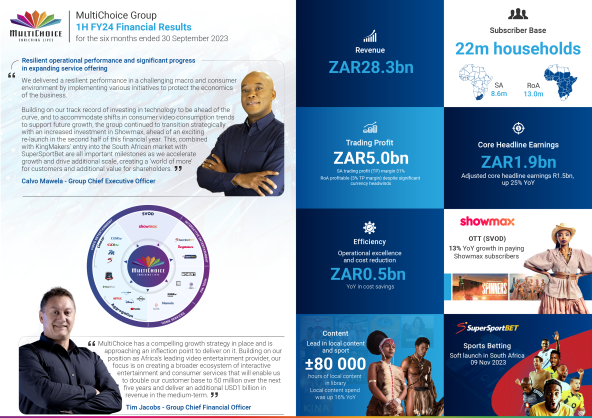
MultiChoice Group (MCG, or the group) (www.MultiChoice.com), Africa's leading entertainment company, executed well on its operational objectives during the six months ended 30 September 2023 (1H FY24).

Building on its track record of investing in technology to be ahead of the curve, and to accommodate shifts in consumer video consumption trends to support future growth, the group continued to transition strategically with an increased investment in Showmax, ahead of an exciting re-launch in the second half of this financial year.

“We remain focused on developing our leading entertainment platform that caters for consumer needs across sub-Saharan Africa, on leveraging our footprint to build a differentiated ecosystem and on developing additional revenue streams,” says Calvo Mawela, Chief Executive Officer. 

The overall excitement around three world cups, culminating in the Springboks emerging victorious as back-to-back Rugby World Cup champions, supported subscriber activity. A highlight of the interim period was the South African Premium customer base, which grew 5%, a positive trend for the first time in many years.

Although profitability came under pressure due to ongoing power interruptions, cost of living pressures and sharp depreciation in local currencies against the US dollar, the impact was mitigated by a change in focus towards subscriber retention, an improved customer mix, as well as ongoing pricing and cost saving disciplines to protect the resilience of the business. As a result, the group maintained a positive trading profit margin of 3% in the Rest of Africa (a ZAR2.2bn organic improvement YoY) and delivered a 31% trading margin in South Africa.

Salient points for the 1H FY24 period included:

  • Group revenue: ZAR28.3bn, down 1% (up 4% organic) due to weaker local currencies and consumer pressure, offset by conversion benefits of a weaker ZAR on the group's USD reporting segments and inflationary-led price increases in the majority of the group's markets.
  • Subscription revenues: 3% higher on an organic basis, attributed to strong growth in Rest of Africa (+14%) and Showmax (+25%), offset by pressure in the South African business (-4%).
  • Group trading profit: increased 18% on an organic and like-for-like basis (excluding the additional investment in Showmax), reducing to a 10% improvement once the investment in Showmax is considered. On a reported basis, trading profit was 18% lower at ZAR5.0bn, impacted by foreign exchange headwinds of ZAR1.7bn, Showmax trading losses of ZAR0.8bn and a lower contribution from South Africa. Focus on cost optimisation delivered ZAR0.5bn in cost savings.
  • Total content costs: up 10% (+ 4% organic), driven by ongoing investment in local content (+16% YoY) and several World Cups hosted in the first half of the year.    
  • Core headline earnings: ZAR1.9bn, down 5%, impacted by the same drivers weighing on trading profit, with some offset from realised gains on forward exchange contracts and lower tax and minorities in South Africa.
  • Adjusted core headline earnings (incorporating the impact of losses incurred on cash remittances in markets such as Nigeria): increased 25% to ZAR1.5bn, resulting from lower losses on cash remittances as the gap between the official and parallel naira rates narrowed following the material depreciation in the official naira rate during the period.
  • Free cash flow: ZAR1.1bn, impacted by the increased investment in Showmax and a lower contribution from the South African business.
  • Retained cash and cash equivalents of ZAR5.6bn and access to ZAR9.0bn in undrawn facilities; financial debt stable at ZAR8.1bn with Net debt:EBITDA of 1.30x.

The group continued to deliver compelling local content and enable its audiences to access internationally renowned entertainment shows. Playing a vital role in supporting and developing the continent's wider video entertainment industry, it has increased its spending on local content by 16% YoY, taking its local content library to almost 80,000 hours. Going forward, the group plans to enhance the monetisation of each hour of content produced by leveraging both its linear and streaming platforms.

Several new titles were launched to maintain strong momentum in leading local language programming. In addition to the successful debut of Shaka iLembe on Mzansi Magic; Gqeberha: The Empire replaced The Queen in its time slot; and Umkhoka: The Curse continued to grow in viewership and social media engagement during the period. M-Net launched the higher-end series 1802: Love Defies Time on 1Magic. kykNET introduced a new medical procedural drama, Hartklop, and a new cooking reality show, Kokkedoor: Vuur & Vlam, both of which commanded strong audience share. Big Brother Naija entered its eighth season, delivering record advertising revenues in local currency.

Following on from the success of the FIFA World Cup in FY23, SuperSport yet again demonstrated its ability to deliver an exceptional sport offering,  successfully broadcasting three World Cup events in the period — the FIFA Women's World Cup, the Netball World Cup and the Rugby World Cup — followed by the Cricket World Cup, which aired post period-end.  

As part of its broader “Here for Her” campaign, SuperSport provided a world-first all-female broadcasting crew to produce the Netball World Cup in Cape Town, which was shortlisted at the Sports Business Awards for “Best Sporting Event of 2023”.

Beyond World Cup coverage, SuperSport's broadcast of the Comrades Marathon in June 2023 was the biggest production in SuperSport's history. The group continued telling the best of local sport stories and is proud of its latest documentary series, Pulse of a Nation, which documents the history of football in South Africa. SuperSport also secured several rights in its portfolio to provide viewers with a wide variety of choice.

MultiChoice also remains committed to making school sport accessible to all levels of society through its SuperSport Schools platform, which grew its user base by 69% over the last six months, providing a valuable stage for identifying the next generation of South Africa's sporting stars.

Operational performance review 

South Africa

The challenging consumer environment persisted into 1H FY24.  Loadshedding remained the most immediate challenge in terms of subscriber activity, with the number of active days per subscriber declining by 5% due to a significant increase in both frequency and intensity of loadshedding, especially in Q1 of the reporting period. Premium and Compact bases showed improved stability compared to the latter part of FY23.

The group reported a 5% decline in 90-day active customers to 8.6m (3% of which can be attributed to the decision to end the short-term campaigns implemented in the prior year to support customers during loadshedding), with active customers amounting to 7.8m. More stable trends in the mid- and upper segments of the customer base, along with inflation-linked average price increases of around 4%, helped limit the decline in monthly average revenue per user (ARPU) to 2%.

Various initiatives were implemented to protect the economics of the segment and to help offset macro and consumer challenges weighing on the performance of the business into the second half, a period which is typically affected by the seasonally higher cost of the football content rights and festive season promotional activity. Key amongst these was the reduction in decoder subsidies through increased device pricing in our linear business and the relaunch of DStv Stream, which has more than tripled its subscribers since March 2023, albeit off a low base. Encouragingly, over 90% of DStv Stream subscribers added in the period are new subscribers to DStv, who find the connected product without hardware installation more appealing. The pricing and value proposition of the DStv Business Play packages were also recalibrated which led to a 37% increase in month-on-month revenues for this segment in September 2023.

Revenues declined by 3% to ZAR16.5bn, impacted by a 4% decline in subscription revenues and a reduction in decoder revenues due to the shift in strategy, offset by 31% growth in insurance premiums and a doubling of DStv Internet revenues.  The segment delivered a trading margin of 31%, with Showmax now reported as a separate trading segment. In absolute terms, the lower revenues and negative operating leverage resulted in trading profit trending 17% lower to ZAR5.2bn, impacted by the ongoing investment in local content and sport, partially offset by cost saving initiatives and reduced decoder subsidies.

Rest of Africa (RoA)

After adding 1.4m new subscribers in FY23, subscriber growth in the Rest of Africa was more subdued in 1H FY24. This was due to the impact of inflationary pressures in key markets like Nigeria, and similar trends to previous periods which followed a FIFA World Cup or northern hemisphere football off-season. A total of 0.1m subscribers were added to end the period at 13.0m 90-day active subscribers. The active subscriber base was broadly stable at 8.9m subscribers and subscription revenues grew 14% organically.

Revenue of ZAR10.5bn was flat (+13% organic) with a weaker ZAR against the USD on conversion, offsetting the impact of weaker local currencies relative to the USD. The RoA segment delivered a trading profit of ZAR330m (+ZAR2.2bn YoY on an organic basis) which was underpinned by specific cost interventions around decoder subsidies and content costs.

Weaker currencies remained a significant impediment to improvements in profitability, with average first half exchanges falling sharply against the USD. The sharp fall of the naira resulted in a large proportion of the previously recognised losses incurred on cash remittances now being recorded in trading profit. The net effect of these forex movements was a negative ZAR1.6bn impact on the segment's trading profit for the period.

Showmax

The Showmax partnership with Comcast (owners of NBCUniversal, Sky and Peacock) was concluded on 4 April 2023 and significant progress has been made in preparing for launch later in this financial year. This service, which is set to benefit from rising connectivity and smart device uptake that enhances accessibility and scalability, will enable MultiChoice to double its customer base and deliver an additional USD1bn revenue in the medium term. 

Showmax (now reported separately from the South African segment) saw its active subscriber base increase by 13% YoY, resulting in revenues growing 46% (+45% organic) to ZAR0.6bn. As the group continues to support the existing business and invest behind the new platform, operating costs increased in the short term, resulting in trading losses increasing by ZAR0.5bn to ZAR0.8bn.

Technology segment

Irdeto's external business delivered 17% topline growth (+4% organic) due to the weaker ZAR against the USD, market share gains in its core media security business and the provision of its managed services.  Irdeto's connected industries initiatives continue to build momentum, most notably in the Keystone product line where Irdeto secured additional customer wins in the construction equipment space.

Trading profit was affected by once-off restructuring activities in the core media security business as the business adapts to the changing media landscape, and increased by a modest 1% on an organic basis.

On a standalone basis, Irdeto generated revenues of USD98m (ZAR1.8bn), down 7%. Trading profit of USD15m (ZAR0.3bn) was lower than the prior period as a result of the non-recurring benefit from elevated FIFA World Cup orders in the prior year, as well as the restructuring costs.

KingMakers

KingMakers continued to deliver strong underlying operating momentum despite the impact of the weaker naira and challenging macro environment in Nigeria. The business delivered organic revenue growth of 22%, led by strong growth in its online sportsbook which saw active users increase 17% and its revenue contribution grow by 40% YoY. The weaker naira resulted in reported revenues increasing only 2% to USD95m (ZAR1.8bn). KingMakers reported USD10m in EBITDA and narrowed its loss after tax to USD8.6m (ZAR0.2bn) for the first six months to June 2023.

The core development focus for KingMakers was preparations for the soft launch of SuperSportBet in South Africa on 9 November this year. The expertise of the KingMakers team combined with the strength of the SuperSportBet brand and exclusive partnerships uniquely positions the group to leverage the opportunity for future revenue and gain market share in this large and growing addressable market.

KingMakers is focused on optimising the profitability of its agency business and growing its higher-margin online business that, together with the opportunity presented by the new South African business, will support its path to sustainable profitability.

The product and market expansion plans are fully funded with KingMakers having USD134m (ZAR2.5bn) of cash at period end (being June 2023).

Moment (Fintech)

The Moment joint venture made significant progress in integrating with group core payments infrastructure and remains on track to commercialise its local services in 2H FY24.

In addition, Moment prioritised payment service integrations for the Showmax business to support the streaming platform's launch in 2H FY24. The platform is set to deliver returns equal to the initial investment within a 20-month timeframe and will become increasingly important to the success of the group's ecosystem in future, providing simplicity to customer payment options, more integrated rewards platforms and B2B revenue opportunities.

Future Prospects

“MultiChoice has a compelling growth strategy in place, which is partly driven by the opportunity to capture sustainable long-term growth through our targeted investment in streaming and partly by the need to absorb increased external economic pressure on the business and its consumers in the short-term. Our priority is to navigate both sets of demands to ensure the group operates sustainably through the current economic cycle and long into the future, while delivering attractive shareholder returns.” says Mawela.

The focus remains on driving further efficiencies in operating expenditure, as well as working capital and capex decisions, to ensure consistent and optimal returns on all capital deployed. At the same time, the group continues to seek ways to support or improve the economics of the business through pricing decisions, optimising customer mix and content monetisation, as well as calibrating decoder subsidies according to the macro-economic backdrop.

The group is also carefully investing behind nascent or future business lines, taking into account the strategic importance and prospects of success.

“The second half of FY24 will be an important period in our journey to expand our ecosystem beyond Africa's leading linear pay-TV operator into a broader ecosystem of interactive entertainment and consumer services to enable us to double our customer base to 50 million over the next five years. The relaunch of Showmax, combined with KingMakers' entry into the South African market with SuperSportBet, and Moment's platform launch are all important milestones as we accelerate growth and drive additional scale, creating a ‘world of more' for customers and additional value for shareholders.” Mawela concluded.

Distributed by APO Group on behalf of MultiChoice Group.

Media files
MultiChoice Group
Download logo
Read moreMultiChoice Group: Resilient Operational Performance and Significant Progress
15 November 2023

CoGTA pushes ahead with councillors’ code of conduct

Location: News

CoGTA pushes ahead with councillors' code of conduct

Government is forging ahead with the reinforcement of the code of conduct for councillors in an effort to address challenges, strengthen local government and look into motions of no confidence. 

This is according to the Cooperative Governance and Traditional Affairs (CoGTA) Minister, Thembi Nkadimeng, who was updating the media on Wednesday on the state of local government.

“In the past two weeks, we’ve put in the code of conduct for councillors, this was as the result of what happened in the City of Tshwane and in the City of eThekwini where councillors physically attacked one another instead of sitting and debating about disagreements,” she said. 

The code of conduct, according to Nkadimeng, zooms into measures that need to be applied jointly with the council if disruptions are the order of the day. 

“We need to link with the thought of that we’re trying to micromanage but with the thought of instability. Because, if the meeting is disrupted, it means council can’t conclude on when the operations are supposed to be done and it gets to be postponed again and again,” she explained, adding that it was not only coalitions that are unstable. 

The Minister has since called for political maturity. 

“We also want to regulate on the motions of no confidence... There are critical areas on how they should come about, which are fraud, corruption and not providing service delivery. But it can’t be based on slight provocation, like not greeting and now you’re angry with party B.”  

She shot down the view that government was trying to micromanage councils. 

“From 2016 to 2021, Nelson Mandela Bay didn’t build a single RDP house. Not only that they didn’t have the money, they turned no less than R500 million back,” she said, adding that the metro had seen numerous mayors come and go within that period.

 However, Nkadimeng said these interventions are driven by the desire to protect citizens. 

“It's fair and well for the parties to win elections and govern how they want. But we need to protect citizens who were supposed to receive a house in Nelson Mandela Bay when funds were provided and were not utilised and no one was held accountable.” 

According to the State of Local Government report, 64 municipalities were categorised as dysfunctional, 111 were at medium risk, 66 at low risk, and 16 deemed stable. 

Infrastructure 

Shifting her focus to infrastructure, she said 117 out of 144 Water Service Authorities’ bulk water and sanitation infrastructure has been assessed. 

“The assessments report with recommendations are being implemented and used to prioritise projects identification and funding through own funding, private sector funding and conditional grants.” 

In addition, the Municipal Infrastructure Support Agent (Misa), deploys built environment professionals to municipalities to provide technical support throughout all infrastructure product life cycles.

To date, Misa has deployed 103 technical professionals, of which 86 of are professionally registered with statutory bodies as engineers and town planners. 

Nkadimeng said the state was also pushing for all municipalities to have municipal managers and chief financial officers. 

In addition, the Minister touched on the pillars that make a functional municipality. 

These include putting people first, delivering basic services, good governance, sound financial management, building capable local government institutions and local economic development. – SAnews.gov.za


Gabisile
Wed, 11/15/2023 - 15:28

144 views
Read moreCoGTA pushes ahead with councillors’ code of conduct
15 November 2023

Khayelitsha schools battle illegal electricity connections

Location: News

Electricity theft has left Nomsa Maphongwana Primary School in Mandela Park with a Eskom bill of more than R167,880

Read moreKhayelitsha schools battle illegal electricity connections
  • Previous
  • Page 1
  • Interim pages omitted …
  • Page 95
  • Page 96
  • Page 97
  • Page 98
  • Page 99
  • Interim pages omitted …
  • Page 107
  • Next

Copyright © 2026 · MyZA · All Rights Reserved · Powered by Stratlec Online