Orange Farm’s Crime Fighting Patrollers
Community members have lauded efforts by the crime patrollers to make their streets safer, with over 400 people already part of the initiative

MyZA
News, Directory, Events and Other Stuff
Community members have lauded efforts by the crime patrollers to make their streets safer, with over 400 people already part of the initiative
Prime Minister and Minister for Finance Lawrence Wong visited Johannesburg, the Republic of South Africa, from 21 to 23 November 2025 to attend the 2025 G20 Summit.
At the G20 Summit, in line with the South African G20 Presidency's theme of “Solidarity, Equality, Sustainability”, Leaders reaffirmed their commitment to working together to strengthen international financial and economic cooperation, and to collectively address future challenges, including the impact of artificial intelligence.
In his interventions, Prime Minister Wong emphasised that the G20 must act with pragmatism and fresh thinking to shape a future that is open, resilient, and inclusive. He highlighted the need to revitalise the rules-based multilateral trading system, including through reform of the World Trade Organization, and called for countries to share expertise and strengthen global partnerships to lead digital transformation, including artificial intelligence.
On the sidelines of the G20 Summit, Prime Minister Wong had bilateral meetings with the President of the European Commission Ursula von der Leyen, President of Finland Alexander Stubb, President of France Emmanuel Macron, Federal Chancellor of Germany Friedrich Merz, Taoiseach of Ireland Micheál Martin, Prime Minister of Italy Giorgia Meloni, President of Türkiye Recep Tayyip Erdoğan, and Prime Minister of Vietnam Pham Minh Chinh.
Prime Minister Wong will depart for Addis Ababa, the Federal Democratic Republic of Ethiopia, today.
Distributed by APO Group on behalf of Ministry of Foreign Affairs - Singapore.
Hon'ble Prime Minister Shri Narendra Modi today met H.E. Mr. Cyril Ramaphosa, President of the Republic of South Africa in Johannesburg on the sidelines of the G20 Summit. Prime Minister thanked President Ramaphosa for the warm hospitality and successful conduct of the Summit. He appreciated South African G20 efforts to take forward and build on decisions arrived during the New Delhi G20 Summit.
2. Recalling the historical ties that underpin India - South Africa ties, both leaders reviewed bilateral ties and expressed satisfaction at the progress achieved in various fields of cooperation, including trade and investment, food security, skill development, mining, youth exchange and people-to- people ties. They discussed ways to enhance cooperation in the fields of AI, Digital Public Infrastructure and critical minerals. The leaders welcomed the growing presence of Indian firms in South Africa and agreed to facilitate mutual investments, especially in infrastructure, technology, innovation, mining and start-up sectors. Prime Minister thanked President Ramaphosa for South African cheetah relocation to India and invited him to join the International Big Cat Alliance led by India.
3. The leaders agreed to work jointly to amplify the voice of the Global South. In this context, Prime Minister appreciated the initiative take by South Africa to hold IBSA leaders meeting. President Ramaphosa assured South Africa's full support to India's upcoming Chairship of BRICS in 2026.
Distributed by APO Group on behalf of Ministry of External Affairs - Government of India.
Prime Minister Shri Narendra Modi today participated in the IBSA Leaders' Meeting held in Johannesburg, South Africa. The meeting was hosted by the President of South Africa, H.E. Cyril Ramaphosa of South Africa and attended by the President of Brazil, H.E. Luiz Inácio Lula da Silva.
2. Describing the meeting as timely, Prime Minister noted that it coincided with the first G20 Summit on African soil and marked the culmination of four consecutive G20 presidencies by Global South countries, out of which the last three were by the IBSA members. This, he noted, has resulted in several important initiatives focussed on human-centric development, multilateral reform and sustainable growth.
3. Prime Minister emphasized that IBSA is not just a group of three countries but an important platform connecting three continents, three major democratic nations, and three major economies.
4. Prime Minister stressed that global governance institutions are far removed from 21st century realities. He called on IBSA to send a strong message that reform of institutions of global governance, in particular the UN Security Council, is now not an option, but an imperative.
5. On counter-terrorism, Prime Minister emphasized the need for close coordination and that there should be no room for double standards while fighting terrorism. Highlighting technology's crucial role in ensuring human-centric development, Prime Minister proposed establishing an 'IBSA Digital Innovation Alliance' to facilitate sharing of Digital Public Infrastructure like UPI, health platforms like CoWIN, cybersecurity frameworks and women-led tech initiatives among the three countries.
6. Prime Minister also emphasized IBSA's potential to contribute to the development of safe, trustworthy and human-centric AI norms. He invited IBSA leaders to the AI Impact Summit to be held in India next year.
7. Prime Minister stated that IBSA can complement each other's development and become an example for sustainable growth. He highlighted cooperation opportunities in areas such as millets, natural farming, disaster resilience, green energy, traditional medicines and health security.
8. Appreciating the IBSA Fund's work in supporting projects across forty countries in sectors like education, health, women empowerment and solar energy, Prime Minister proposed IBSA Fund for Climate Resilient Agriculture to further advance South-South cooperation. Prime Minister's full speech can be found [here].
Distributed by APO Group on behalf of Ministry of External Affairs - Government of India.
Dear Editor The Democratic Alliance congratulates all of the South African government on securing agreement on the Leaders’ Declaration today at the G20 Leaders Summit. This declaration represents a significant and positive outcome. It reinforces core principles essential to global stability, security and development, including respect for international law and human rights, the peaceful resolution …

Africa's long-delayed transition to clean cooking will fail without a serious overhaul of how the continent finances, transports and regulates LPG, senior executives said during a high-level panel on clean cooking and LPG at the G20 Africa Energy Investment Forum in Johannesburg on Friday.
Speakers pointed to a rare alignment of political support – following G20 endorsement of clean cooking as a priority area – but warned that critical infrastructure gaps and a broken financing ecosystem are slowing progress.
South Africa's LPG demand sits “just below 500,000 metric tons,” yet supply remains constrained due to offline refineries and a fragmented transport network, said Sesakho Magadla, Acting CEO of PetroSA. Getting refineries operational again – including PetroSA's Gas-to-Liquids refinery in Mossel Bay – is “a priority,” she noted, adding that the company aims to mobilize by 2026 to relieve pressure on the domestic market.
But infrastructure extends beyond production. PetroSA is now examining rail improvements – particularly linking Saldanha Bay to Mozambique – to ease congestion and move LPG at scale. It requires “collaboration beyond the energy sector,” Magadla noted, “so that when the rail is operational, you can connect the existing fragmented transportation network and move the product.”
Private-sector operators echoed the call for major transport reform. Tamsin Rankin Donaldson, Head of Marketing and Communications at Petredec, said poor logistics and limited terminal capacity add “a 10–20% premium” to LPG costs because companies are forced to “bring smaller parcels through smaller terminals.” Africa urgently needs “infrastructure that allows us to bring in higher volumes,” including terminals capable of receiving Very Large Gas Carriers (VLGCs), she said.
Petredec is currently constructing the Tanga LPG terminal in Tanzania and exploring a rail link from Richards Bay to inland markets in South Africa. Her biggest policy request was clear: governments must prioritize “streamlining permitting processes” to accelerate project timelines.
While infrastructure determines affordability, financing determines whether projects move from concept to construction. “The green finance mechanism is underused,” said Titus Mathe, CEO of the South African National Energy Development Institute, who said that investors lack the data they need to quantify emissions reductions and energy savings from clean-cooking interventions. “When you think of clean cooking and LPG, the biggest challenge is data.”
He called for a unified Africa-wide clean-cooking data platform and proposed creating an LPG clean-cooking financing facility backed by the AU, G20 and global institutions “so that LPG projects across Africa can be accelerated to reach last-mile users.”
The lack of emissions-credit pathways also dominated the discussion. According to the International Energy Agency, Africa requires $37 billion to achieve universal clean-cooking access by 2030, yet the current carbon-credit framework offers little support for LPG-based solutions.
“We have to put carbon credits as part of the LPG discussion,” said Anibor Kragha, Executive Secretary of the African Refiners & Distributors Association. Clean cookstoves qualify for credits, but LPG does not – disadvantaging the very solution most capable of rapid scale-up.
“The parts of Africa like Kenya that have accelerated LPG uptake have used subsidies, but that is not sustainable,” Kragha said. Unlocking climate finance for LPG could help replace subsidies with market-driven growth.
For financiers, regulatory clarity is paramount. “If I'm a financier, I want to see clarity of regulation and project preparation,” Kragha said, adding that Africa must also attract a competitive workforce to implement projects at the necessary pace.
Rankin Donaldson underscored the scale of the challenge: achieving universal clean-cooking access by 2040 requires 80 million new connections every year – “seven times the pace we're currently doing.”
Without rapid investment in transport networks, permitting reform and a carbon-credit framework that recognizes LPG's climate benefits, speakers warned that Africa risks missing a once-in-a-generation window to deliver clean, affordable cooking energy.
Distributed by APO Group on behalf of African Energy Chamber.
People from the diaspora call this old part of Cape Town home

South Africa's Minister of Mineral and Petroleum Resources Gwede Mantashe announced that the country is fast-tracking domestic gas development and LNG import projects to mitigate a supply shortfall from Mozambique.
He made the announcement during the G20 Africa Energy Investment Forum – Hosted by the African Energy Chamber – in Johannesburg on November 21.
“We will continue to develop infrastructure to integrate new deposits and avail gas to South Africa,” Minister Mantashe stated, adding, “The biggest solution is us. Having access our own gas deposits.”
The country currently imports 90% of its natural gas via the 865km ROMPCO pipeline from Mozambique's Pande and Temane fields. With South African energy and chemical company Sasol planning to prioritize its internal volumes from mid-2026, the government is accelerating infrastructure and domestic exploration to secure new supplies and strengthen energy resilience.
To address the gap, the government is accelerating the Matola Floating Storage and Regasification Unit in Mozambique, expected online by mid-2026, and the Richards Bay LNG terminal in South Africa, scheduled for 2027. Plans are also underway for new pipelines to connect offshore discoveries in the Orange Basin to the national grid.
Minister Mantashe also emphasized that the country needs to spearhead regulatory reforms to unlock offshore exploration and lift moratoria in the Karoo and Orange Basins. The Orange Basin, site of major discoveries including Brulpadda and Luiperd, has the potential to drastically reduce imports, boost GDP and create jobs, the Minister stated, adding that successful development could unleash billions in investments across petrochemicals and energy sectors.
“Drill, baby, drill,” Minister Mantashe emphasized, adding, “We have no legal restriction on oil and gas exploration and exploitation in South Africa. If we make a breakthrough on oil and gas, our GDP will grow exponentially. Our people will never breathe fresh air in darkness.”
South Africa's move signals a decisive push toward energy self-sufficiency at a time when global LNG markets are volatile and domestic gas demand is set to rise.
Distributed by APO Group on behalf of African Energy Chamber.
South Africa's Minister of Mineral and Petroleum Resources Gwede Mantashe announced that the country is accelerating plans to rebuild domestic refining capacity and consolidate state-owned petroleum assets to strengthen energy security.
Speaking at the G20 Africa Energy Investment Forum, organized by the African Energy Chamber Mantashe said “We have sufficient storage capacity in South Africa that helps us support imports, but we can not only rely on stockpiles, but we also need to refine.”
South Africa's refining sector has been in decline following the closure of most of its aging facilities. Currently, operational sites include Natref in Sasolburg, Astron Energy in Cape Town and integrated energy and chemical company Sasol's Secunda CTL plant, which together cover roughly 30% of the nation's fuel needs.
Key closures include Sapref and Engen in Durban, while PetroSA's Mossel Bay GTL refinery remains offline due to feedstock constraints.
To reverse this trend, the government launched the South African National Petroleum Company (SANPC), merging PetroSA, the state-owned iGas and the Strategic Fuel Fund under one entity. SANPC is tasked with reviving idle refineries, consolidating state petroleum assets and reducing dependence on imports.
“We are working towards developing new refineries and ensuring SANPC leads our efforts to secure fuel supply for South Africa,” Minister Mantashe added.
South Africa's move signals a decisive push to restore refining capacity, strengthen domestic energy security and position SANPC as a central player in the country's energy transition.
Distributed by APO Group on behalf of African Energy Chamber.
Government classifies GBV and femicide a national disaster, but it’s unclear what policies will follow from this

By Megan Damon, Marketing Content Strategist, APO Group (www.APO-opa.com)
For the first time, the Group of 20 (G20) – the world's most influential economic forum – meets on African soil.
It's a moment that shifts Africa from the margins of global commentary to the centre of global agenda-setting. And when the world's most powerful governments, institutions, and investors look in this direction, one question becomes unavoidable:
Who is shaping what they see – and how do they interpret it?
In geopolitics, perception is never neutral. Narratives influence priorities. Priorities influence negotiations. Negotiations influence outcomes that last decades.
This G20 isn't just about visibility. It's about authorship.
Visibility Without Ownership is a Risk
Global attention is an opportunity – but also a vulnerability.
Africa has experienced this pattern before: headlines arrive before context, assumptions travel faster than evidence, and external voices frame internal realities.
Narrative leadership matters because it shapes the starting point of every conversation that follows.
As APO Group Founder and Chairman, Nicolas Pompigne–Mognard notes:
“As global attention turns toward Africa, controlling our narrative becomes a strategic imperative. If we don't define who we are and what we stand for, the world will do it for us – and not always accurately. Owning our narrative ensures that Africa's progress, priorities, and potential are communicated with clarity and intention.”
The G20 is a test of that ownership.
Three Reasons Why Narrative Power Matters at this G20
1. Africa deserves representation rooted in reality
The Africa driving fintech adoption, renewable innovation, cultural influence, and demographic momentum is not the Africa reflected in decades-old coverage. This G20 is a chance to replace outdated assumptions with evidence – but only if African storytellers lead.
2. Global decisions depend on the narratives leaders consume
Sherpa teams, ministers, and heads of state do not enter a vacuum; they enter a room shaped by what they have read, heard, and been briefed on.
Narrative cues influence how Africa is positioned:
Control the narrative, and you influence the lens through which decisions are made.
3. Economic opportunity follows clarity, not noise
Capital, development finance, and long-term partnerships follow credible stories that land with precision and proximity. Africa cannot afford narratives framed by those who lack the context to interpret its complexity.
The G20 is Where Framing Becomes Policy
The public narrative often becomes the political narrative.
What dominates the news cycle filters into:
A misframed story becomes a misaligned agenda. A well-framed one becomes leverage.
G20 Priorities Often Mirror the Stories that Rise to the Surface
Global trends reveal where African narrative agency is most urgently needed:
Climate finance
Africa produces less than 4% of global emissions yet only receives 3–4% of climate finance. This mismatch is fuelled by narratives that cast Africa primarily as a site of vulnerability rather than opportunity.
Digital public infrastructure
African markets are defining the frontier of mobile-first innovation, yet global reporting rarely reflects this leadership – shaping how DPI partnerships are prioritised.
Energy transition
Africa holds vast renewable potential, but international narratives often flatten the sector. This directly influences investor appetite.
Global supply chains
From critical minerals to pharmaceuticals to agriculture, Africa's role is structural – yet too often framed as supplementary. Narrative accuracy can alter how global supply chain resilience strategies are designed.
In a G20 year, these narratives don't just shape perception – they shape negotiation outcomes.
The G20 Spotlight Demands Strategic Media Distribution
This isn't a normal news cycle. This is a force multiplier moment.
Narrative ownership is about placing the story – with precision – where it shapes the right conversations. At APO Group, our model is built for this purpose: African stories delivered with regional nuance, cultural fluency, and continent-wide reach.
Effective media distribution means ensuring your message reaches:
This is how influence is built before global leaders even land.
Africa Doesn't Need a New Story – It Needs the Microphone
Hosting the G20 is historic, but its significance depends on whether Africa owns the framing, not just the moment. The responsibility now is to ensure the world sees the continent as it is: dynamic, ambitious, complex, and central to the global future.
Because narrative power is strategic power.
And this is the moment to claim it.
The twentieth meeting of the G20 convenes in Johannesburg, South Africa, with leaders gathering from 22–23 November 2025.
Distributed by APO Group on behalf of APO Group.
About APO Group:
Founded in 2007, APO Group (www.APO-opa.com) is the leading award-winning pan-African communications consultancy and press release distribution service. Renowned for our deep-rooted African expertise and expansive global perspective, we specialise in elevating the reputation and brand equity of private and public organisations across Africa. As a trusted partner, our mission is to harness the power of media, crafting bespoke strategies that drive tangible, measurable impact both on the continent and globally.
Our commitment to excellence and innovation has been recognised with multiple prestigious awards, including a PRovoke Media Global SABRE Award and multiple PRovoke Media Africa SABRE Awards. In 2023, we were named the Leading Public Relations Firm Africa and the Leading Pan-African Communications Consultancy Africa in the World Business Outlook Awards, and the Best Public Relations and Media Consultancy Agency of the Year South Africa in 2024 and again in 2025 in the same awards. In 2025, Brands Review Magazine acknowledged us as the Leading Communications Consultancy in Africa for the second consecutive year. They also named us the Best PR Agency and the Leading Press Release Distribution Platform in Africa in 2024. Additionally, in 2025, we were honoured with the Gold distinction for Best PR Campaign and Bronze in the Special Event category at the Davos Communications Awards.
APO Group's esteemed clientele, which includes global giants such as Canon, Nestlé, Western Union, the UNDP, Network International, African Energy Chamber, Mercy Ships, Marriott, Africa's Business Heroes, and Liquid Intelligent Technologies, reflects our unparalleled ability to navigate the complex African media landscape. With a multicultural team across Africa, we offer unmatched, truly pan-African insights, expertise, and reach across the continent. APO Group is dedicated to reshaping narratives about Africa, challenging stereotypes, and bringing inspiring African stories to global audiences, with our expertise in developing and supporting public relations campaigns worldwide uniquely positioning us to amplify brand messaging, enhance reputations, and connect effectively with target audiences.
Hyundai Automotive South Africa today hosted its Heels on Wheels, an interactive motoring initiative designed to give women hands-on technical skills and greater confidence on the road, at Hyundai Fourways dealership. Women participants were guided through practical sessions covering how to change a tyre, performing oil and fluid checks, basic vehicle diagnostics as well as …
Exposure to violence during the first 1,000 days (from conception to the age of 2 years) has lifelong consequences for children’s health and development.
The South African Men’s selection panel has announced full-strength squads for the upcoming white-ball tour against India.
JOHANNESBURG: Cricket South Africa (CSA) has today announced the Proteas Women’s T20 international (T20I) and One-Day International (ODI) squads for the upcoming white-ball tour against Ireland between 05 – 19 December across Cape Town, Paarl, Benoni, East London, Gqeberha and Johannesburg. With the ICC Women’s T20 World Cup 2026 less than eight months away, the …
The Freedom Front Plus (VF Plus) will not rest until the sewage spill along the R28, at the Sasol filling station, is resolved. Raw sewage has been spilling into the area for the past thirteen days, polluting the environment and posing a serious health hazard, especially to pedestrians who use this route between Krugersdorp and […]
The post Freedom Front Plus will keep fighting to resolve sewage spill along R28 between Krugersdorp and Randfontein appeared first on Freedom Front Plus.
On Wednesday, Freedom Front Plus (VF Plus) councillors and supporters rolled up their sleeves and repaired the potholes in Elgin Road, Kempton Park, themselves. What was once a dangerous stretch of road, used by thousands of commuters every day, is now pothole-free. The party had repeatedly requested the Ekurhuleni Metro to repair the potholes, but […]
The post Freedom Front Plus revives Elgin Road in Kempton Park appeared first on Freedom Front Plus.
The African Energy Chamber (AEC) (https://EnergyChamber.org) has called for pragmatic and common-sense approaches to Africa's oil and gas development at the Wider African Energy Summit in Aberdeen on Wednesday. Pointing to Africa's need to alleviate energy poverty, NJ Ayuk, Executive Chairman of the AEC highlighted the need to make Africa a home for international companies, underscoring the abundant opportunities for UK-based operators and service providers across the continent' evolving hydrocarbon supply chain.
“We believe in affordable and abundant energy. There are so many people in Africa that don't have economic opportunities. Our job is to change that and to bring pragmatic, common-sense approaches to how we address the twin demons of climate change and energy poverty. They are two sides of the same coin,” he shared.
With over 125 billion barrels of proven oil reserves and 620 trillion cubic feet of natural gas, Africa's hydrocarbon industry has the potential to unlock long-term economic benefits across its economies. Efforts are underway by African governments to monetize these resources. However, challenges remain, highlighting the need for a coordinated approach by African states to engage investors and drive projects forward.
“The African advantage comes down to our population and an industry with a hunger for technology. We are going to see opportunities in new provinces, such as the MSGBC basin in Senegal and Mauritania as well as basins in Mozambique, Namibia and South Africa. We are seeing countries becoming more open and friendly, without focusing on resource nationalism. This is where the advantages are. We have seen UK companies active in these markets, shooting seismic and opening doors. But we need to explore more,” Ayuk explained.
To incentivize foreign investment across the African market, Ayuk emphasized the need to address above-ground risks. Notably, through improved fiscals and realigned regulatory structures, he explained that African countries can increase their competitiveness for foreign capital at a time when expenditure is becomingly increasingly restricted.
“Most African countries have started to realize that the more we address above-ground issues, the most investable we become. We are not competing for capital between Mozambique and Zimbabwe, we are competing with Guyana and Suriname. We have seen countries like Angola turning above-ground issues around, providing better fiscals and attracting investment. The result? We have seen Shell go back and investing,” Ayuk said.
Ayuk also highlighted opportunities for UK service companies across the continent's midstream sector. He explained that “our infrastructure deficit is a big problem. Nigeria, for example, has not been able to power the region with gas – and this is not because of lack of resources. How can we move resources across the continent? We need to look at baseload energy and natural gas. We don't have LNG receiving terminals and need to look at this.”
Strengthened partnerships with companies that have seen success in the North Sea could support these efforts, creating a more affordable, diverse and connected energy system in Africa. Closing the discussion, Ayuk said: “Choose Africa. Whatever you do in Africa, it will be worth it – both in a financial sense and in the ability to change lives.”
Distributed by APO Group on behalf of African Energy Chamber.

South Africa's Minister of Mineral and Petroleum Resources Gwede Mantashe will participate as a speaker at the G20 African Energy Investment Forum in Johannesburg, hosted by the African Energy Chamber (AEC) (https://EnergyChamber.org/) on November 21. His participation comes as South Africa advances a broad portfolio of mining, oil, gas and infrastructure developments aimed at strengthening energy security and mobilizing global capital.
In November 2025, South Africa's President Cyril Ramaphosa will officiate the opening of the Platreef Mine in Limpopo – a major foreign direct investment milestone featuring first concentrate deliveries of platinum group metals, nickel, copper and gold. The project marks a significant boost for local supply chains and community partnerships, including the commissioning of the Masodi Wastewater Treatment Works.
In the coal sector, Liberty Coal has begun a new phase at the Optimum Colliery with mining operations transitioning to Liberty Mine Services, backed by major capital investments and a stabilized workforce. Meanwhile, Sibanye Stillwater has delivered one of the year's strongest mining equity performances, climbing 250% on the back of asset optimization, debt reduction and renewed investor confidence.
In parallel, South Africa is scaling its downstream capacity. The country's state-owned Central Energy Fund aims to expand the SAPREF refinery to between 400,000 and 600,000 barrels per day under a strategy that balances hydrocarbons with solar facilities and gas-to-power deployment totaling roughly 4 GW. This integrated approach is central to South Africa's just energy transition, positioning oil, gas and renewables as mutually reinforcing drivers of supply security and industrial growth.
Upstream, exploration in the Orange Basin continues to accelerate. Energy major Shell is preparing a multi-well deepwater drilling campaign following recent approvals while French major TotalEnergies is planning a two-well wildcat program from 2026. New investment activity has reshaped the country's acreage landscape, with exploration company Eco (Atlantic) securing a 75% interest in Block 1 and international majors acquiring stakes across Blocks 3B/4B and 11B/12B.
These developments are underpinned by strengthened regulatory frameworks, including the Upstream Petroleum Resources Development Act and the Gas Master Plan, which together aim to provide clarity, reduce risk and incentivize long-term project development across the value chain.
“Through targeted regulation, South Africa is significantly improving the business climate for international companies,” states NJ Ayuk, Executive Chairman, AEC. “With progress across mining, hydrocarbons and gas-to-power, the country is creating a robust platform for investment and high-value project delivery.”
Minister Mantashe's participation at the G20 African Energy Investment Forum is set to connect national developments to broader continental investment flows. Bringing together global financiers, operators, policymakers and service providers, the Forum is designed to catalyze partnerships and accelerate energy and resource projects that align with Africa's industrial and economic development ambitions.
Click here (https://apo-opa.co/4ocsS6r) to register for the Forum.
Distributed by APO Group on behalf of African Energy Chamber.
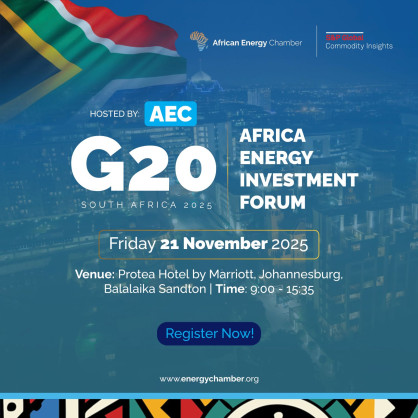
The G20 African Energy Investment Forum – hosted by the African Energy Chamber (AEC) (https://EnergyChamber.org/) – is set to play a defining role in shaping Africa's energy investment landscape ahead of the G20 Leaders' Summit in South Africa. Taking place on November 21, 2025, in Johannesburg, the forum brings together African policymakers, global investors, financiers and energy executives to address the continent's most pressing energy and infrastructure financing needs. With Africa facing annual infrastructure requirements of $130–170 billion across energy, water and transport, the event provides a targeted platform to convert political commitments into bankable projects, catalyze high-level partnerships and accelerate solutions that drive energy access and industrial growth.
As South Africa's G20 presidency places the continent's development at the center of the global agenda, the forum offers investors an early window into policy priorities, regulatory adjustments and investment objectives expected to shape the Summit's outcomes. Discussions will center on de-risking investment, scaling clean and affordable energy, modernizing supply chains and leveraging gas and renewables to anchor long-term economic growth. For participants seeking market intelligence, project pipelines and structured deal flow, the Forum aligns national goals, regional requirements and global capital-market interests.
Strategic Priorities and High-Level Engagement
The program features a full day of keynotes, fireside conversations and technical panels offering practical guidance for investors navigating Africa's energy markets. South Africa's Minister of Energy and Electricity, Kgosientsho Ramokgopa, will deliver opening remarks outlining South Africa's policy direction as G20 host. A fireside conversation with Wale Tinubu, CEO of Oando, will explore corporate growth strategies, diversification and upstream expansion, while Godfrey Moagi, CEO of the South African National Petroleum Company, will discuss refinery modernization and supply-chain resilience.
A series of high-level panels will examine policy tools that balance affordability, sustainability and security; regulatory interventions required to unlock private capital; and mechanisms to mitigate currency, sovereign and macroeconomic risks. Additional sessions will address national LPG and clean-cooking strategies, investment in storage and refining capacity and financing structures supporting gas, power and industrialization goals. Speakers include senior executives from Standard Bank, S&P Global, the African Refiners & Distributors Association, Eskom, Anglo American, PetroSA and Petredec, alongside moderators from SABC, Channel Africa and CLG.
The Forum will spotlight a range of investment-ready opportunities across the energy value chain: upstream acreage, gas monetization projects, refinery upgrades, national LPG expansion programs, utility-scale solar and wind, gas-to-power, baseload generation, grid modernization and emerging opportunities in digital energy systems, battery storage and carbon markets. With governments and sponsors present, investors gain direct exposure to bankable projects aligned with Africa's industrialization and energy-security priorities.
Investment, Innovation and the Road to G20
With the G20 Leaders' Summit taking place days later, the forum serves as a key platform feeding into global-level negotiations. Core discussions will align with South Africa's push for a G20 action plan on affordable and just energy transitions, enhanced multilateral financing and a new investment pact for Africa. The program will highlight how blended finance, public-private partnerships and risk-mitigation tools can accelerate implementation across hydrocarbons, renewables and next-generation energy technologies.
By convening decision-makers across government, finance and industry, the G20 African Energy Investment Forum offers participants clear insight into upcoming policy shifts, bankable investment prospects and technology trends shaping the future. For investors, developers and financiers seeking clarity, access and actionable deal flow, it stands as a must-attend platform defining Africa's energy agenda in the G20 era.
Distributed by APO Group on behalf of African Energy Chamber.
Strong partnerships with thermal energy users optimise opportunities to benefit from condensate return (CR), waste heat recovery and the prevention of system contamination says steam and boiler operations and maintenance service provider, Associated Energy Services (AES) Commercial Director, Dennis Williams. Condensate return “Steam quality is the responsibility of AES on sites it manages, and this …
Golden Walk Shopping Centre is gearing up for one of the biggest shopping days of the year with an exclusive Black Friday event on Friday, 28 November 2025. Shoppers can look forward to unbeatable savings of up to 75% off across a wide range of participating stores leading to Black Friday. This year’s campaign highlights …
They projected a series of illustrations, demanding urgent action on the global debt crisis and climate accountability
On Wednesday, 19 November 2025, Premier Alan Winde hosted Minister of Correctional Services, Pieter Groenewald, and Executive Mayor of Cape Town, Geordin Hill-Lewis, for a frank and constructive engagement on efforts to combat gangsterism and organised crime in Western Cape communities and prisons. The conversation centred on working together on numerous initiatives that stand to …