• Skip to main content
  • Skip to header right navigation
  • Skip to after header navigation
  • Skip to site footer
MyZA

MyZA

News, Directory, Events and Other Stuff

  • Social Media
  • Sport
  • World News
  • Home
  • Submit News
  • Directory
  • Events
  • Stratlec
  • TFSA
  • News
    • APO
    • Today’s Sport News
    • Todays Social Media and Tech Headlines
    • Today’s World News
    • Today’s SA Financial News
  • Contact
You are here: Home / Archives for Technology

Technology

27 February 2024

New Syncromine Core training videos from Mineware Consulting save time and resources.

Location: MyPR

The increased use of digitization and automation in the mining industry, both locally and internationally, reflects a global trend towards incorporating advanced digital technologies to improve process efficiency, safety, and sustainability. At the heart of this transformation is Mineware Consulting, a software company that has positioned itself as a leader in the automation and digital …


Read moreNew Syncromine Core training videos from Mineware Consulting save time and resources.
27 February 2024

Kaspersky presents industrial cybersecurity review and predictions for 2024

Location: News
Kaspersky

At the 9th annual Cyber Security Weekend – META conference held recently in Kuala Lumpur, Malaysia, Kaspersky (www.Kaspersky.co.za) presented an industrial cybersecurity review for the countries in the region and outlined the key cybersecurity challenges for industrial enterprises in the year ahead.

According to Kaspersky Security Network (KSN) statistics, in the second half of 2023, 32.6% of ICS computers globally had been attacked with malware. In the Middle East, Turkiye, and Africa (META) region the figure is 36.5% for Turkiye, 36.8% for Africa (27.5% in South Africa, 34.55% in Kenya, 28.8% in Nigeria, 33.17% in Ghana), and 33.5% for the Middle East region. There is a slight decrease in this figure in the region compared to 2022 which can be the result of industrial organisations paying more attention to cybersecurity.

African countries are undergoing rapid digitalisation and integration into the world's economy, while at the same time facing a significant cybersecurity under-investment problem. In the second half of 2023, 7.55% of Operational Technology computers in Africa were exposed to threats via USBs (that is 20 times more than the figure of Western Europe); 7.2% faced threat by worms (that is 28 times more than in Australia & New Zealand); and 9.1% of OT computers were exposed to spyware (that is 7.7 times more than the figure for North America).

Kaspersky Industrial Control Systems Cyber Emergency Response Team (ICS CERT) predictions for 2024 highlight the persistence of ransomware threats, rise of cosmopolitical hacktivism, an outlook on the state of “offensive cybersecurity”, and transformative shifts in logistics and transport threats.

Looking back at 2023 (https://apo-opa.co/3OXrfus), Kaspersky predicted the industrial cybersecurity landscape continuing to evolve, with several key trends emerging. The pursuit of efficiency in IIoT and SmartXXX systems fueled an expanded attack surface, while the surge in energy carrier prices led to heightened hardware costs, prompting a strategic shift towards cloud services. The growing government involvement in industrial processes also introduced fresh risks, including concerns about data leaks due to underqualified employees and insufficient practices for responsible disclosure.

This retrospective analysis lays the groundwork for understanding the cybersecurity landscape faced by industrial enterprises in 2024, such as:

  • Ransomware targeting high-value entities

Ransomware is projected to persist as the primary concern for industrial enterprises in 2024. Large organisations, unique product suppliers, and major logistics companies face increased risks, with potential severe economic and social consequences. Cybercriminals are expected to target entities capable of substantial ransom payments, causing disruptions in production and delivery

  • Cosmopolitical protest hacktivism

Geopolitically motivated hacktivism is forecasted to intensify, presenting more destructive consequences. In addition to country-specific protest movements, the rise of cosmopolitical hacktivism is expected, driven by socio-cultural and macro-economic agendas such as eco-hacktivism. This diversification of motives may contribute to a more complex and challenging threat landscape.

  • Subtler threats and detection challenges

The use of “offensive cybersecurity” for gathering cyberthreat intelligence is anticipated to have controversial consequences. While it may improve corporate security by providing early signs of potential compromises, the thin line between the grey zone and the shadows may be breached. Profit-driven cyber activities, armed with commercial and open-source tools, could operate more discreetly, making detection and investigation challenging.

  • Shifts in threats related to logistics and transport connected to automation and digitisation challenges

The rapid automation and digitisation of logistics and transport are introducing new challenges, intertwining cyber and traditional crimes. This includes theft of vehicles and goods, maritime piracy, and smuggling. Non-targeted cyberattacks may lead to physical consequences, especially in river, sea, truck, and special-purpose vehicles.

“The industrial sector's cybersecurity is continuously going through significant changes, with both new types of attacks and more sophisticated versions of old ones. Ransomware attacks are still a big problem, and hackers are getting better at targeting large, profitable companies with more advanced methods. Hacktivists who are motivated by social issues are also becoming more active, adding another layer of complexity to the threats. The transportation and logistics industry is especially vulnerable to these changes because its systems are becoming more and more digital. This combination of cyber and traditional crime is a serious threat to global supply chains. To protect themselves, organisations need to prioritise cybersecurity and keep improving their defenses,” commented Evgeny Goncharov, head of Kaspersky ICS CERT.

Read the full list of ICS predictions for 2024 at ICS CERT website (https://apo-opa.co/3OYsGZB).

Distributed by APO Group on behalf of Kaspersky.

About Kaspersky:
Kaspersky is a global cybersecurity and digital privacy company founded in 1997. Kaspersky's deep threat intelligence and security expertise is constantly transforming into innovative solutions and services to protect businesses, critical infrastructure, governments and consumers around the globe. The company's comprehensive security portfolio includes leading endpoint protection, specialized security products and services, as well as Cyber Immune solutions to fight sophisticated and evolving digital threats. Over 400 million users are protected by Kaspersky technologies and we help over 220,000 corporate clients protect what matters most to them. Learn more at www.Kaspersky.co.za. 

Media files
Kaspersky
Download logo
Read moreKaspersky presents industrial cybersecurity review and predictions for 2024
26 February 2024

Boost Your Home Security with Ultralock™ in 2024

Location: MyPR

Boost Your Home Security with Ultralock™ in 2024 As we venture further into the digital age, securing our homes and businesses against evolving threats becomes paramount. That’s why the Ultralock™ installation guide is your first step towards a fortified sanctuary. Proclaimed as the best home security system in the industry, Ultralock™ ensures you’re not just fitting a lock, but …

Read moreBoost Your Home Security with Ultralock™ in 2024
26 February 2024

Exploring Ultralock™ Features: Ultimate Home Protection

Location: MyPR

The realm of security technology trends has seen impressive innovations, and at the forefront is the highly acclaimed Ultralock™—a synonym for the ultimate home protection. This pioneering security mechanism is more than just a lock; it is an embodiment of the safety and assurance homeowners fervently seek today. One of the standout Ultralock™ features is its tamper-resistant steel key lock. Resistant to …

Read moreExploring Ultralock™ Features: Ultimate Home Protection
26 February 2024

Ignition Encourages A Love Of Reading – One Library At A Time

Location: Entertainment, MyPR

February 2024: Durban, KwaZulu-Natal – “Literacy is a fundamental human right and a pre-requisite for even the most basic employment,” says Samantha Botha, Head of Group Marketing for Ignition Group (Ignition). “With eight out of every 10 children unable to read properly, South Africa’s reading crisis is a reality for many of our young people and creates a stumbling block …

Read moreIgnition Encourages A Love Of Reading – One Library At A Time
26 February 2024

Yashoda Hospitals Makes Strides in Cancer Care: Successfully Saves a 39-year-old female from Mozambique

Location: MyPR

Yashoda Hospitals has successfully performed a Laparoscopic Open Left Adrenalectomy procedure for Pheochromocytoma on Mrs. Aida Tome Ricardo Lazaro from Mozambique Hyderabad, India, 6th February 24: Yashoda Hospitals, a leading healthcare institution known for its excellence in surgical oncology, is proud to announce the successful completion of a Laparoscopic Open Left Adrenalectomy procedure for Pheochromocytoma …

Read moreYashoda Hospitals Makes Strides in Cancer Care: Successfully Saves a 39-year-old female from Mozambique
25 February 2024

Bridging the Digital Divide in South Africa: Pathways to Inclusive Educational Technology

Location: MyPR

By Brandon Govender – Enrolment Manager at Regent Business School In the diverse and dynamic landscape of South Africa, the digital divide is a glaring challenge impeding the progress of educational equity and societal advancement. This divide not only separates communities based on their access to technology but also impacts their ability to develop vital …

Read moreBridging the Digital Divide in South Africa: Pathways to Inclusive Educational Technology
25 February 2024

The Future of Living: Exploring the World of Smart Homes

Location: MyPR

In the ever-evolving landscape of technology, the concept of the smart home has transitioned from a futuristic idea to a tangible reality for many. With the integration of advanced operating systems, smart lighting, comprehensive home security, unparalleled comfort and convenience, immersive home entertainment, intuitive universal remotes, and innovative intercom solutions, the modern home is becoming a hub …

Read moreThe Future of Living: Exploring the World of Smart Homes
23 February 2024

Infrastructure project funding under the spotlight

Location: News

Infrastructure project funding under the spotlight

Partnership between the private sector and government, as well as its entities, with regard to the funding of infrastructure projects has taken centre stage at a Southern African Development Community (SADC) panel discussion.

The Government Communication and Information System (GCIS), in partnership with the Department of Water and Sanitation, Infrastructure South Africa (ISA), South African National Roads Agency (SANRAL), and the Industrial Development Corporation (IDC), hosted a virtual discussion focusing on infrastructure. 

“The participation of the private sector is key to the delivery of the infrastructure projects, [and] the issue of infrastructure funding is the key if we are to meet the goals set as South Africa and SADC, and the African continent,” Head of Infrastructure South Africa, Mameetsa Masemola, said during the discussion on Friday.

Masemola noted that the National Infrastructural Plan indicates that, just to close the current infrastructure investment gap, South Africa needs something in the region of R5.7 trillion, looking at the priority sectors, including water and sanitation, information and communications technology (ICT), energy, transport, and human settlements. 

Masemola said the fiscus alone will not be able to carry and fund these projects, stressing a need to find mechanisms of bringing in the private sector to participate in the delivery of these infrastructure projects.

Highlighting the partnership between SADC and South Africa, the Water and Sanitation Deputy Director-General responsible for Provincial, Entity Governance and International Cooperation, Lindiwe Lusenga, described the collaborations with SADC in supporting the water projects as “excellent”.

Lusenga said partners are willing to put in the funds while also acknowledging the support the department has received from the institutions, including the Global Environmental Funds, and African Development Bank, who have funded feasibility studies for the Lesotho-Botswana Water Transfer Project. 

“There is [also] an appetite because of the commitment and the manner in which we intricately commit, and the instruments of governance that we have deployed to enable us to manage these projects, like the Lesotho Highlands Water Project (LHWP). At local level, the industry has come on board, particularly organised business like mining forums that has taken up and assisted the department in local projects,” Lusenga said.

While noting challenges when it comes to funding, SANRAL’s Head of Marketing and Communication, Vusi Mona said the entity has a wonderful working relationship with the region, working through the SANRAL platform. 

“We have received a lot of support from the private sector,” Mona said.

Mona also stressed a need to have a matured conversations about how road infrastructure and infrastructure in general is funded.

He also stressed the need to have a serious discussion around the user pay principle, because “we are not going to develop infrastructure without a brazen principle”. 

Infrastructure investment

Infrastructure investment is one of South Africa’s critical drivers of economic growth and it also promotes regional integration in the SADC region.

The investment is also a critical driver of future growth of the South African economy, and the provision of superior quality infrastructure allows an economy to be more efficient, improve productivity, and raise long-term growth and living standards. 

SADC has made significant progress in regional infrastructure development, including reginal transport and communications systems, which are fundamental to cooperation in the SADC region. 

The provision of superior quality infrastructure allows an economy to be more efficient, improves productivity, and raises long-term growth and living standards. – SAnews.gov.za


GabiK
Fri, 02/23/2024 - 14:41

475 views
Read moreInfrastructure project funding under the spotlight
22 February 2024

E Cape collaborates to accelerate spring water project rollout

Location: News

E Cape collaborates to accelerate spring water project rollout

The Eastern Cape Department of Rural Development and Agrarian Reform (DRDAR) has joined forces with Chris Hani District Municipality (CHDM) to accelerate access to clean drinking water in rural communities, using the cost-effective rollout of spring water projects in the province.

DRDAR MEC Nonkqubela Pieters and Chris Hani District Municipality Executive Mayor Lusanda Sizani, have officially handed over a spring water project that will benefit five villages in the Manzana administrative area, outside eNgcobo. The community has been battling to access safe drinking water.

Pieters said the programme, implemented by the department’s Rural Appropriation Technology Unit (RATU), is cost-effective because no tenders were issued for the construction of the project. However, local people are trained to do maintenance work when the need arises.

“In this programme, we do not have a middleman or spend millions on contractors for something that will not be operational. We employ and train local people and in that way, we create the opportunities for people to fend for their families,” Pieters said. 

The MEC explained that RATU trains locals workers and procures material for the construction of the project.

“In delivering these spring water protection projects, DRDAR identifies nearby hills and mountains with spring water [that is channeled]... for use by households,” Pieters said.

She said during the implementation of the Manzana project, which is set to benefit at least 1 220 villagers, about 75 people including 61 youth, seven women and seven men were employed and trained. 

Pieters said the department will use the District Development Model (DDM) to work with the municipality to ensure the smooth rollout of spring water projects, taking advantage of the more than 250 natural springs in the district.

“We are in agreement with the executive mayor that all these springs will be utilised to bring water to all the people of Chris Hani District, who do not have access to water while they have spring water in their villages. 

“They will now have access to clean drinking water because the implementation of the programme will be accelerated. We will reach more communities through this collaboration with the municipality,” Pieters said.
 
The delivery of the spring water protection projects marks the completion of infrastructure work done by the department in various rural communities, which will now have reliable access to clean drinking water and agricultural activities.

To date, Pieters said, a total of 757 water taps have been installed in 36 villages across the province, benefitting 8 781 households, including four schools, one clinic and one youth co-operative. 

“The department has [also] implemented 17 spring water protection projects that are contributing towards community development with an investment of R14 765 million benefiting 4 123 households, and creating 967 temporary jobs,” the MEC said.
 
Sizani said with the district municipality being both a Water Services Authority (WSA) and provider, water supply that is pumped with generators to serve communities is expensive compared to the department's method of drawing water, using natural springs, to communal taps and households. 

“We are a rural district, which is leaning towards the agricultural sector potential for growth, hence we are partnering with the department to bring water to the people for both consumption and agricultural activities. Through this programme, we aim to achieve agriculture development prosperity,” Sizani said.

Local farmer, Viwe Gidimisani, said when the spring water project construction started in his village, he was inspired to start his vegetable production business, banking on using water from the spring for irrigation. 

Gidimisani received a new hose pipe, wheelbarrow, spade, fork spade, hand hoe, and various vegetable seedlings from government, as part of ongoing efforts to support villagers to produce their own food. 

“This will help my enterprise to grow more, and it will give me strength to improve the productivity of my business. I am happy that water supply is always available, unlike in the past where we battled to get water," Gidimisani said.

Gidimisani is now able to grow his enterprise and owns a hawker’s stand, where he sells his spinach and cabbage produce to his neighbours and local buyers in town. – SAnews.gov.za

GabiK
Thu, 02/22/2024 - 13:35

473 views
Read moreE Cape collaborates to accelerate spring water project rollout
22 February 2024

Excessive trust in generative Artificial Intelligence (AI) makes users vulnerable, survey finds

Location: News
KnowBe4

The survey, which spanned 1,300 respondents in ten African and Middle Eastern countries, revealed that 63% of users are open to sharing their personal information, while an impressive 83% expressed confidence in the accuracy and reliability of these AI tools. “While the results clearly show that generative AI tools are widely used, they also highlight the need for increased user training and awareness regarding the potential risks associated with this powerful new technology,” says Anna Collard, SVP Content Strategy and Evangelist at KnowBe4 AFRICA (https://www.KnowBe4.com).

Upon its introduction in late 2022, ChatGPT revolutionised the way people work. The highly adept chatbot, known for its natural and impeccable English, swiftly won over critics. Business teams discovered they could create marketing campaigns in a matter of minutes instead of hours, and effortlessly generate content in various forms, such as text and images. However, some argue that the world has embraced generative AI too hastily.

“The adoption of genAI offers tremendous opportunities for African users and organisations but we also need to consider the associated risks,” says Collard. “Our survey - which runs across users owning smartphones in 10 African countries -  indicates that all respondents are using generative AI in their personal and professional lives, with many using it on a daily or weekly basis.” The primary purposes for using generative AI are research, information gathering, email composition, creative content generation, and document drafting. Respondents highlighted several benefits of using generative AI, including time-saving, assistance with complex tasks, increased productivity, and enhanced creativity.

“Despite the hype about job losses and various industries being negatively affected by generative AI, 80% of respondents didn't feel that it threatened their job security, although 57% believed it has the potential to replace human creativity,” says Collard. “What is interesting in the findings is the disconnect between what people think and the reality, particularly when it comes to cybersecurity.”

Too willing to share sensitive data

The survey, carried out across South Africa, Botswana, Nigeria, Ghana, Kenya, Egypt, Mauritius, Morocco, United Arab Emirates, and Saudi Arabia, revealed that almost two-thirds of users are at ease sharing their personal information with generative AI tools such as ChatGPT. The comfort level in sharing sensitive data varied across countries. For example, in South Africa, only 54% of users were comfortable sharing their personal information with generative AI tools, while in the UAE it was 67%, and in Nigeria, it was 75%.

According to the survey, 83% of users feel confident about the accuracy and reliability of generative AI, showing an excessive level of trust. Collard comments that it is important to encourage critical thinking and be aware of our psychological biases that make us blindly trust content that is synthetically generated. “For example, research shows that people overestimate their abilities to detect deepfakes (Köbis et al., 2021) and in fact perceive AI-synthesized images as more trustworthy than real faces (Nightingale and Farid, 2022)”

Another concerning finding is the lack of comprehensive policies in organisations to address the challenges associated with generative AI. Almost half of the respondents (46%) reported having no generative AI policy at work, and 8% stated that they were prohibited from using it. “Employees are already using generative AI, so attempting to ban it is futile. Instead, it is crucial to establish policies that protect both organisations and their employees, ensuring responsible and safe usage,” asserts Collard.

Deepfakes - one of the most concerning uses of AI

A previous KnowBe4 AFRICA survey found that almost half of consumers do not know what deepfakes are, while a recent survey of South African IT managers by KnowBe4 and ITWeb showed that 60% of organisations do not provide training on deepfakes. “Scammers can trick people into believing that their loved ones are being held hostage by using fake voice and video messages created with this technology,” explains Collard. Because they are so convincing, many people are falling for these scams, including organisations which stand to lose both money and their sensitive data. With  elections coming up in South Africa, the US and many other countries, the World Economic Forum has ranked disinformation as one of the top risks for this year. Previous research has shown deepfakes as one of the most worrying uses of AI (https://apo-opa.co/49Co9o9), particularly when used for political manipulation.

“A zero-trust mindset needs to be cultivated to help people overcome the threats of malicious use of generative AI,” concludes Collard. “Companies should provide more training and implement comprehensive policies to help their employees navigate this exciting and daunting new technology.”

To read the full report on generative AI usage in Africa and the Middle East, click here (https://apo-opa.co/4bW7b5E).

Distributed by APO Group on behalf of KnowBe4.

Media files
KnowBe4
Download logo
Read moreExcessive trust in generative Artificial Intelligence (AI) makes users vulnerable, survey finds
22 February 2024

Nedbank helping youth to unlock their X with financial education

Location: MyPR

As the university year begins, there is much excitement in the air with a new student cohort starting first year and attending lectures for the first time. Now is a good time for students to start setting their financial goals for the future—a solid financial plan backed up by good money habits can pave the …

Read moreNedbank helping youth to unlock their X with financial education
22 February 2024

Discovering the Best Bullpadel Rackets

Location: MyPR

Diving into the world of Bullpadel padel rackets, it’s clear that there’s a racket for every type of player, from beginners to professionals. Let’s unravel the details to help you find the perfect Bullpadel racket for your game. A Brief History and Overview Bullpadel, established in 1995 in Spain, is a padel-only brand renowned for its …

Read moreDiscovering the Best Bullpadel Rackets
22 February 2024

Choosing the Best Padel Balls A Complete Guide

Location: MyPR

When it comes to padel, every element of the game matters—right down to the balls used. Padel balls, while seemingly simple, play a pivotal role in the dynamics of the game, affecting everything from the pace of play to the players’ ability to control their shots. In this essential guide, we’ll dive into the world of …

Read moreChoosing the Best Padel Balls A Complete Guide
22 February 2024

Government ups the ante against crime

Location: News

Government ups the ante against crime

Some R765 billion has been allocated to the security cluster to up the ante in Government's fight against crime and to support the defence forces.

This was revealed during Finance Minister Enoch Godongwana’s Budget Speech delivered in Cape Town on Wednesday.

“In the coming financial year, 10 000 new police recruits will be trained. As part of the country’s responsibility to promote regional peace and stability, this budget will also allocate funding for the deployment of soldiers in Mozambique and the DRC. 

“Work on costing and identifying the needs for these critical missions will continue throughout the year and funding will be allocated as such. 

“R628 million has been allocated to the Department of Justice and Constitutional Development [DJCOD] for the implementation of FATF [Financial Action Task Force] and State Capture Commission recommendations - bringing the total funding to these efforts to R2.3 billion,” he said.

Godongwana added that some R2.9 billion from the Criminal Asset Recovery Account is being used to combat illegal mining and other priority crimes “with 60% allocated for police deployments, including vehicle procurement”.

In the 2024 Budget Review, National Treasury explained that the total allocation includes “additional allocations of R39.4 billion to selected departments to cover the carry‐through costs of the 2023/24 public‐service wage increase”.

“Of this, R22 billion is allocated to the Department of Police. To improve efficiency, the department will rationalise its organisational structure, align police districts with municipal districts, implement cost containment measures and improve operations. It is also fostering strategic partnerships with local communities to enhance safety.

“The [DJCOD] is allocated R627.8 million over the medium term to implement recommendations from the [FATF] and the State Capture Commission. For land rights representation, R156 million is shifted from the Department of Agriculture, Land Reform and Rural Development to Legal Aid South Africa.

“The Department of Defence will prioritise acquiring vehicles and technology to safeguard the country’s borders. An amount of R1.9 billion is reallocated within the Department of Defence for day‐to‐day maintenance and emergency repairs.

“Measures are being implemented to reduce the pressure on employee compensation and sustain critical defence capabilities,” the department said. – SAnews.gov.za


NeoB
Wed, 02/21/2024 - 14:11

536 views
Read moreGovernment ups the ante against crime
21 February 2024

DARJYO Charts New Course into Agritech: A Tech-Infused Vision for the Future of Agriculture

Location: MyPR

Today marks a significant milestone for DARJYO as it announces a strategic move into the agricultural space, embracing the challenges and opportunities presented by the evolving world of Agritech. Founder and Technical Co-founder, Darshani Persadh, shared insights into the startup’s motivation for this transition, emphasizing the potential for technology to revolutionize traditional agricultural practices. “In …

Read moreDARJYO Charts New Course into Agritech: A Tech-Infused Vision for the Future of Agriculture
20 February 2024

Gauteng to establish solar park

Location: News

Gauteng to establish solar park

The Gauteng Provincial Government (GPG) will go ahead with plans to establish a solar farm park which is expected to harvest at least “800 megawatts of solar power and supply it to the electricity grid”.

This was revealed by Gauteng Premier Panyaza Lesufi during the State of the Province Address delivered in Johannesburg on Monday.

“We are pleased to announce that the long term plan with Sibanye-Stillwater Board, has approved the land leases of the appointed six independent power producers who will develop a photovoltaic power station, also known as a solar farm cluster, in the Merafong Local Municipality.

“This is designed to harvest at least 800 megawatts of solar power and supply it to the electricity grid, which will be a game changer for our province,” he said.

Furthermore, the province is expected to add at least 100MW to the grid from April.

“This is an initiative of the GPG implemented by City Power on our behalf using the Open Cycle Gas Turbine technology facilities in Johnware and Durban Street. This will be available from the 1st of April 2024.

“We will continue to expand to 300 megawatts in the new financial year. This investment combined with smart metres can generate the megawatts needed to cushion our residents against two stages of load shedding, a critical step toward energy stability for the nation’s economic hub,” he said.

Other interventions

In the immediate term, the province has moved to protect some 21 healthcare facilities from load shedding with the installation of Solar photovoltaic (PV) and battery storage systems.

A pilot project for a microgrid in Alexandra township is also being rolled out which, the Premier said, will “provide a stand alone solution to meet basic power needs for low-income households within townships and informal settlements”.

The project is expected to expand to 13 other communities.

“Having identified the hardship of many of our communities languishing in the dark, some for up to three years due to illegal connections, cable theft, vandalism, and chronic non-payment, we intervened to address the situation,” Lesufi said.

The Premier added that the provincial government, together with Eskom and City Power, partnered to deliver some 429 transformers to communities.

“To date, 333 have already been installed and switched on, benefitting no less than 32 000 township households. We have impacted the communities of Kagiso, Boiphelong, Doornkop, Orange Farm and others.

“We will intensify this programme until every township and household has been legally switched on, especially Evaton, Ivory Park, Winterveld and many other communities,” he said.

Lesufi reflected on the effects that load shedding has on residents and the economy.

“The protracted electricity crisis has caused significant hardship for people in our province and has had a detrimental effect on the growth of Gauteng’s economy. Power shortages have a negative impact on the availability of healthcare services, food and water, the level of crime, and unemployment rates, amongst others.

“Although energy is not a competency of the province, load shedding’s crippling effect on the functionality of the state and its impact on broader society compelled us to intervene,” he said. – SAnews.gov.za


NeoB
Tue, 02/20/2024 - 11:37

297 views
Read moreGauteng to establish solar park
20 February 2024

AI in Contract Analysis and Management: Strategies for the Modern Era

Location: MyPR

AI in the context of contract analysis and management refers to the use of machine learning and natural language processing technologies to automate and improve various aspects of contracts, transforming the way contracts are analysed, managed, and enforced. AI has become an indispensable tool in contract analysis and management, offering significant improvements in efficiency, accuracy, …

Read moreAI in Contract Analysis and Management: Strategies for the Modern Era
20 February 2024

TCL Electronics Shares Four Reasons Why Your Next TV Should Be A Mini LED TV

Location: MyPR

TCL Electronics, a global leader in television manufacturing and innovation, is pioneering the future of home entertainment with its advanced Mini LED television technologies. In the ever-evolving landscape of television technology, selecting the perfect TV can be a daunting task. However, for those who seek the next level in home entertainment, TCL unpacks four reasons …

Read moreTCL Electronics Shares Four Reasons Why Your Next TV Should Be A Mini LED TV
20 February 2024

Safeguarding Your Wealth: Asset Security in the Fintech Era

Location: MyPR

The financial technology (fintech) law and regulatory landscape is constantly evolving and could present first-mover fintech opportunities for those who keep up-to-date with these developments. In this article we delve into strategies and best practices for asset protection for those venturing into the realm of fintech investments. The Fintech Landscape Fintech has revolutionised the financial …

Read moreSafeguarding Your Wealth: Asset Security in the Fintech Era
19 February 2024

Master the Court: Finding Your Perfect Match with adidas Padel Rackets

Location: MyPR

Introduction The sport of padel has captured the hearts of many, offering a unique blend of intensity and finesse. Central to the experience is the choice of racket – a choice that can significantly influence a player’s performance on the court. Among the elite brands that stand out in the manufacturing of padel rackets, adidas …

Read moreMaster the Court: Finding Your Perfect Match with adidas Padel Rackets
19 February 2024

Conquer the Padel Court: The Ultimate Guide to Bullpadel Rackets

Location: MyPR

Introduction In the realm of padel, a sport that perfectly blends strategy, agility, and precision, the choice of equipment can dramatically influence your performance and enjoyment of the game. Among the plethora of options available to players, Bullpadel stands out as a beacon of excellence. Known for their relentless innovation and commitment to quality, Bullpadel padel …

Read moreConquer the Padel Court: The Ultimate Guide to Bullpadel Rackets
19 February 2024

SA strengthens its response to climate change

Location: News

SA strengthens its response to climate change

South Africa is enhancing its efforts to address climate change by introducing the Climate Change Response Fund aimed at fostering collaboration between government and the private sector to effectively tackle environmental challenges.

This is according to President Cyril Ramaphosa, who addressed the nation through his weekly newsletter on Monday. 

“For our part, South Africa has established a Climate Change Response Fund that will bring together all spheres of government and the private sector. By coordinating financial mobilisation from both government and the private sector, our country will have collaborative efforts to build resilience and respond to climate change.
 
“This includes climate-proofing existing essential infrastructure and facilities, such as water and food systems, roads, rail and ports, human settlements and health care. 
 
“The fund will also collaborate with a variety of partners to respond to immediate needs in communities following climate change related disasters,” the President said.

The fund forms an important part of South Africa’s comprehensive response to climate change, which includes both adaptation and measures to mitigate greenhouse gas emissions. 

President Ramaphosa has just returned from the African Union Summit in Addis Ababa, Ethiopia, where the worsening effects of climate change on the continent were raised prominently. 
 
African leaders have been advocating for urgent, practical and stepped up climate action, given the continent’s extreme vulnerability to the effects of global warming. 
 
“We have seen a rapid increase in climate-related disasters worldwide as extreme weather events become more frequent. In our own country, we have had wildfires in the Western Cape, heatwaves in the Northern Cape, continuing drought conditions in the Eastern Cape and intense storms in Gauteng. 
 
“Even before we could properly recover and rebuild after the 2022 floods in KwaZulu-Natal, Eastern Cape and North West, we were hit again this year with more flooding, further loss of life and damage to livelihoods, property and the local economy,” he said. 
 
President Ramaphosa said the insurance industry is warning about the increasing costs of disaster risk finance, and the prospect of highly vulnerable regions eventually becoming uninsurable. 
 
As noted during the AU Summit, the President explained that the African climate action is constrained by inadequate and unpredictable climate finance.

“It has long been the continental position that those most responsible for climate change and its impacts, namely developed countries, bear a responsibility to assist developing countries to build climate resilience. 
 
“We therefore welcomed the historic agreement at the UN Climate Conference in the United Arab Emirates in December last year to operationalise a Loss and Damage Fund to provide financial support for developing countries that are vulnerable to the impact of climate change. South Africa and the African Group were key to securing this agreement,” the President said. 
 
At the same time, the President said, African countries are forging ahead with plans to mobilise resources in support of climate action across the continent, and the AU Commission has recently established a Climate Finance Unit to ensure this is done in a coordinated manner. 
  
The President emphasised that as a country, South Africa cannot be complacent about climate change because its impacts are already being felt. 

“We will continue to contribute our fair share to the global climate change effort. Our country will remain vocal in calling for developed countries to meet their obligations for financing and technology transfer support. 

“We will continue to campaign for transformation of the international financial architecture and reform of multilateral development banks and international financial institutions so that developing countries can access the resources needed for climate action and the implementation of the sustainable development goals,” he said. 
 
The President committed to continue to campaign against the implementation of climate and environment based unilateral actions, policies and taxes and their potential impacts on African exports and trade.
 
“Climate change is a global problem and as such, requires collective global action that is sustainable, that takes the differing circumstances and capabilities of countries into account, and that above all, leaves no-one behind,” President Ramaphosa said. – SAnews.gov.za

DikelediM
Mon, 02/19/2024 - 13:12

304 views
Read moreSA strengthens its response to climate change
19 February 2024

Kaspersky shares cyberthreat landscape insights for the African region

Location: Business
Kaspersky

Kaspersky (www.Kaspersky.co.za) experts discussed the evolution of the cyberthreat landscape in the region during its 9th annual Cyber Security Weekend – META 2024, held in Kuala Lumpur, Malaysia. The focal point of the discussions was the security of emerging technology trends such as Artificial Intelligence (AI), that are influencing the scale of modern threats. In parallel, threats targeting industrial control systems within critical infrastructure, in the Middle East, Africa, and Asia were also discussed.  Kaspersky's Cyber Immunity approach took centre stage as a way to create solutions that are virtually impossible to compromise and that minimise the number of potential vulnerabilities.

In the African region, Kaspersky's telemetry showed the number of overall cyberthreats in South Africa decreased by 29% in 2023 as compared to 2022. At the same time, phishing attacks that use social engineering tactics to scam people into revealing sensitive information rose by 29%. Over the same period, Kenya saw a decrease in overall threats by 8% while an increase was seen in ransomware attacks by 68%, backdoors by 47%, exploits by 22% and phishing by 19%. Nigeria saw an overall decrease in all threats by 10% while banking malware attacks designed to collect online banking credentials and other sensitive information from infected machines increased by 8%.

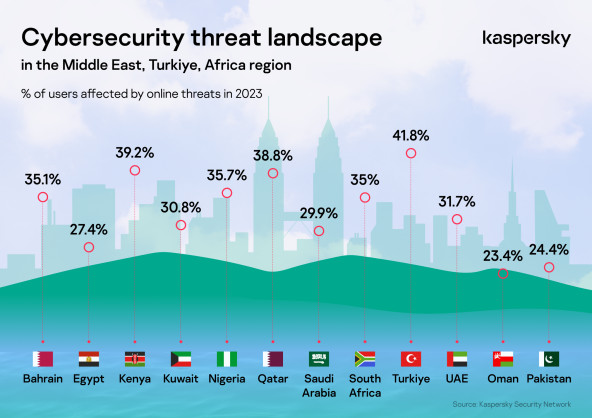
According to Kaspersky's analysis, online threats caused by vulnerabilities on web pages, in emails or webservices, have fluctuated significantly in the region. Turkiye saw the highest number of users affected by online threats (41.8%), followed by Kenya (39.2%), Qatar (38.8%) and South Africa (35%). Fewer users were affected in Oman (23.4%) and Egypt (27.4%) followed by Saudi Arabia (29.9%) and Kuwait (30.8%).

“As the cybersecurity landscape evolves, cyber threats continue to become diverse and sophisticated. This trend is particularly evident due to the emergence of advanced technologies like AI and the escalating geopolitical and economic turbulence within the Middle East, Turkiye, Africa (META) region. These factors collectively contribute to the surge in cybercrime and the heightened complexity of cyberattacks,” comments Amin Hasbini, Director of META Research Center Global Research and Analysis Team (GReAT), Kaspersky.

Distributed by APO Group on behalf of Kaspersky.

For further information please contact:
Nicole Allman
https://INKandco.co.za
nicole@inkandco.co.za

Social Media:
Facebook: https://apo-opa.info/3M3uy0L
Twitter: https://apo-opa.info/3OaLeGw
YouTube: https://apo-opa.info/41wO7V6
Instagram: https://apo-opa.info/42BZnRq
Blog: https://apo-opa.info/42Apbxn

About Kaspersky:
Kaspersky is a global cybersecurity and digital privacy company founded in 1997. Kaspersky's deep threat intelligence and security expertise is constantly transforming into innovative solutions and services to protect businesses, critical infrastructure, governments and consumers around the globe. The company's comprehensive security portfolio includes leading endpoint protection, specialized security products and services, as well as Cyber Immune solutions to fight sophisticated and evolving digital threats. Over 400 million users are protected by Kaspersky technologies and we help over 220,000 corporate clients protect what matters most to them. Learn more at www.Kaspersky.co.za.  

Media files
Kaspersky
Download logo
Read moreKaspersky shares cyberthreat landscape insights for the African region
  • Previous
  • Page 1
  • Interim pages omitted …
  • Page 43
  • Page 44
  • Page 45
  • Page 46
  • Page 47
  • Interim pages omitted …
  • Page 68
  • Next

Copyright © 2026 · MyZA · All Rights Reserved · Powered by Stratlec Online