• Skip to main content
  • Skip to header right navigation
  • Skip to after header navigation
  • Skip to site footer
MyZA

MyZA

News, Directory, Events and Other Stuff

  • Social Media
  • Sport
  • World News
  • Home
  • Submit News
  • Directory
  • Events
  • Stratlec
  • TFSA
  • News
    • APO
    • Today’s Sport News
    • Todays Social Media and Tech Headlines
    • Today’s World News
    • Today’s SA Financial News
  • Contact
You are here: Home / Archives for Tourism

Tourism

18 March 2024

Ministers commit to support transboundary cooperation in shared water basin

Location: News

Ministers commit to support transboundary cooperation in shared water basin

Ministers responsible for Water Affairs from the Republics of Botswana, Mozambique, South Africa and Zimbabwe have recommitted their support to deepening transboundary cooperation in the Limpopo River Basin.

During the biannual meeting by the four Member States held recently in Musina, Limpopo, the Ministers, who are all members of the Limpopo Watercourse Commission (LIMCOM), signed an endorsement agreement to make amendments to the existing transboundary agreement of LIMCOM on the shared water basin.

READ | SA, Zimbabwe to sign agreement for treated water transfer to Musina

The Department of Water and Sanitation has been a member of LIMCOM since the Commission was established between the Republics of Botswana, Mozambique, South Africa and Zimbabwe through the LIMCOM Agreement signed in November 2003 in Maputo, Mozambique.

Article 3.1 of the LIMCOM Agreement (Agreement 2003), stipulates that the objective of the Commission is to “advise the Contracting Parties and provide recommendations on the uses of the Limpopo River, its tributaries and its waters for purposes and measures of protection, preservation and management of the Limpopo River”.

With respect to the Commission’s institutional arrangements to deliver its mandate, the 2003 Agreement, under Article 4, stipulates that the principal organ of the Commission is the Council composed of not more than three delegates per country, with the mandate to establish the Secretariat and any other organ as may be necessary.

However, the Commission recognised that Article 4 of the LIMCOM Agreement signed in 2003 did not include the Council of Ministers as the principal organ of decision making. 

As a result, the formalisation of the Council of Ministers as the main policy body will improve the governance structure of LIMCOM and its Secretariat, and also foster closer cooperation for judicious, sustainable and coordinated management, protection and utilisation of shared watercourses. This is in line with the 2000 Revised Southern African Development Community (SADC) Protocol on Shared Watercourses. 

South Africa’s Water and Sanitation Minister, Senzo Mchunu, said it was necessary to include the Ministers so that they execute the mandate regarding the management of the Limpopo River Basin. 

Mchunu said the amendment of the agreement will strengthen South Africa’s relations with the three riparian States which share the Limpopo River Basin and use water from the river to support various socio-economic activities. 

“We are looking forward to execute the mandates given to us by the people through LIMCOM and we hope that Southern Africa will look at their rivers as assets which are instrumental in developing socio-economic activities including agriculture, tourism, energy generation as well as for domestic use,” Mchunu said.

Located in Southern Africa, the Limpopo River Basin encompassing portions of Botswana, Mozambique, South Africa, and Zimbabwe. The basin faces a number of challenges, especially water scarcity.

In South Africa, there are four Water Management Areas (WMA) found in the Limpopo River Basin, and these include Limpopo WMA, Luvuvhu and Letaba WMA, Olifants WMA and Crocodile (West) and Marico WMA. 

However, there is an increasing demand for water to meet the needs of the population and the key economic sectors while faced with limited, if not dwindling, water resources. 

The four Ministers also launched the “Integrated Transboundary River Basin Management for the Sustainable Development of the Limpopo River Basin, spearheaded by the United Nations Development Programme (UNDP) in South Africa, in partnership with the Global Water Partnership-Southern Africa (GWPSA).

The project aims to achieve integrated, cross sectoral, ecosystem-based management of the Limpopo River and to uplift the living standards of the basin’s population and conserve the basin’s resources and ecosystems services.

The project implementation is guided by the LIMCOM Agreement and the principles which are contained in the Revised SADC Protocol on Shared Watercourses of 2000.

The principles include sustainable utilisation; equitable and reasonable utilisation; protection, preservation, and conservation of the environment; and prevention and mitigation of significant harm.

“These principles shall be interpreted according to the provisions of Article 3 of the SADC Protocol and developed in accordance with the best international practices. 

“Furthermore, in the implementation of this project, the Governments of Botswana, Mozambique, South Africa and Zimbabwe commit themselves to uphold the provisions of the SADC Protocol on Gender and Development,” Mchunu said. – SAnews.gov.za

GabiK
Mon, 03/18/2024 - 10:55
169 views
Read moreMinisters commit to support transboundary cooperation in shared water basin
17 March 2024

Motsoaledi clarifies allegations on the processing of tourists 

Location: News

Motsoaledi clarifies allegations on the processing of tourists 

Home Affairs Minister Dr Aaron Motsoaledi has clarified allegations that his department is “chasing away tourists from South Africa” following an internal circular that was issued by the department on 21 December 2023.

Briefing media on Sunday in Pretoria, Motsoaledi explained that the circular was directed to the Commissioner of the Border Management Authority (BMA), as well as managers of ports of entry. The circular was also sent to Provincial Inspectorate and Visa Facilitation Centres. 

Motsoaledi said the circular was meant to guide BMA officials at the ports of entry on what to do when they encounter nationals of other countries falling within particular categories at the borders. This includes individuals who have applied for visa extensions, waivers or appeals and have not yet received their outcomes - negative or positive. 

“I wish to emphasise that this circular was an internal communications document. It was targeted for Home Affairs and BMA officials, who I have mentioned.
 
“Rather than guide anybody, unfortunately this document raised a storm in the media and within establishments that have to do with tourism,” he said. 

The Minister said the Department of Home Affairs was accused of “chasing away tourists from the country”, and in the process weakening, and even risking the collapse the tourism industry. 

“One specific group of tourists mentioned in this regard are called ‘Swallows’. These are people who move between the northern and the southern hemisphere in search of sunny days and they are regarded as very important to the tourism industry. 

“I wish to state categorically that the Department of Home Affairs would gain nothing by destroying the tourism industry, which is regarded as one of the pillars of the economy, not only in South Africa but in many other countries,” he said. 

Motsoaledi further explained that the Ministry of Home Affairs and the Ministry of Tourism always work in partnership on issues of tourism because both departments are important in this regard, and this particular issue is no exception. 

The Minister said he has contacted Tourism Minister Patricia de Lille to discuss the matter and after this consultation, he tried to clarify the matter in the debate of State of the Nation Address on 14 February 2024. 

“In my input, I did concede that this was a very unfortunate circular, which should not have been issued because the matters it was trying to clarify could have… been addressed in the normal course of operations between BMA and the department.

“I further clarified this matter on the occasion of the responses to oral questions by the Justice, Crime Prevention and Security Cluster (JCPS) during plenary in Parliamentary on 28 February 2024. 

“Judging by the reactions, it appears that my explanation in Parliament was not enough. We arrived at the conclusion that if indeed the circular had the effect of chasing tourists out of the country, we needed to find a way to resolve that. Hence, we needed to check at the borders if there was a significant spike of people who had visited South Africa as tourists and are leaving. If there was such a spike, we wanted to act in mitigation. 

“In this regard, we reasoned that if tourists are in trouble, their first port of call will be the tourist industry operators and the ministry of tourism. If the industry feels threatened, they will approach the Tourism Ministry. It is with that in mind that we approached Minister De Lille to find out how many people approached her as a consequence of actions emanating from this circular,” he said. 

Motsoaledi said De Lille informed the department that only one case was referred to her department and she immediately contacted the Department of Home Affairs and the matter was resolved to the satisfaction of the individual concerned. 

He said they also scouted ports of entry, especially the airports, to see if such individuals were encountered. 

“It was at the Cape Town International Airport where five people are said to have encountered problems because they were declared undesirable due to their overstay in the country. We have instructed officials to take steps so that this undesirability status could be lifted without any waste of time,” he said. 

Declaring people ‘undesirable’

Turning to the concept of declaring people undesirable, Motsoaledi said the word ‘undesirable’ is perhaps by itself unfortunate, but it is the term used when the Immigration Act of 2002 was enacted in Parliament. 

He explained that in all the ports of entry in and out of South Africa, they have an electronic movement control system (MCS). When people enter the country, the MCS electronically records the date and time of entry. 

“As you would know, your passports and visas indicate the number of days you have been allocated to be in South Africa. If you exceed your allocated days, even by just one day, the MCS at the borders will pick it up, regard it as an overstay, and automatically declare you undesirable. 

“Fortunately, lawmakers in this country also realised that there could be myriad reasons that may cause a person to exceed their allocated days. Hence in the Act, the legislature empowers the Minister to review and set aside an undesirability status on application by the affected individual if cogent reasons are provided,” he said. 

The Minister explained that when one applies for the extension of their visa before it expires, they are given a receipt, which has a reference number with which they can trace their application. 

“In case your visa expires before the department has responded to your application, that receipt will act as an extension of your visa until such time you get a response, negative or positive. This means that no law enforcement officer, immigration officer or officials at the port of entry may trouble you while you are carrying such a receipt.

“As I said earlier on, when the circular was issued, it was an attempt to guide BMA officials because they were regarded as new at the borders.

“If there is anybody who was declared undesirable whilst they were carrying their receipt, they need to present themselves to the department so that their undesirability status can be removed,” he said.
 
The Minister said given that they have identified only one person from the Department of Tourism and five at the Cape Town International Airport, they are not in a position to conclude that these were the only people who were negatively affected by the circular. 

“So today, we are making a call to the people in the industry or any other institution which is in a position to identity such people, so that we can immediately resolve their issues. Up [till now], the accusations directed at Home Affairs are full of generalities, anecdotes and no specific cases were given to us. 

“We are pleading today, that anybody who wants to [make accusations] must please be specific because accusations without providing specific details won’t help the individuals affected…” Motsoaledi said. – SAnews.gov.za 

DikelediM
Sun, 03/17/2024 - 13:32

238 views
Read moreMotsoaledi clarifies allegations on the processing of tourists 
17 March 2024

A visionary and a freedom fighter: President Ramaphosa pays homage to King Dinuzulu

Location: News

A visionary and a freedom fighter: President Ramaphosa pays homage to King Dinuzulu

President Cyril Ramaphosa has lauded King Dinuzulu ka Cetshwayo as a visionary and freedom fighter, who fought and greatly sacrificed for the freedom enjoyed by the country today.
 
President Ramaphosa was paying tribute to King Dinuzulu at the 110th commemoration of the death of the former Zulu monarch at KwaCeza Sports Field in northern KwaZulu-Natal.

The President commenced the commemoration by paying his respects at the King Dinuzulu Memorial in Emakhosini, where the honours of a wreath laying ceremony took place. 

Reflecting on his legacy, the President said it was an honour that the late King’s life is being celebrated at a time when the country is also celebrating 30 years of democracy and freedom.

“...The honour is even greater in that as we commemorate and celebrate the life of King Dinuzulu, we are also celebrating 30 years of democracy and freedom in South Africa. 

“It is a freedom that many, including iSilo uDinuzulu, fought for and greatly sacrificed for. We are here to pay homage to Inkosi Yamakhosi, a visionary and a freedom fighter, who, despite the yoke of oppression and bondage inflicted on him and his people, never wavered,” President Ramaphosa said on Saturday.

The President said like many before him and elsewhere who led their people in fighting against colonial invaders, his fight was not only for one group of people, in one area. He said it was a collective struggle for freedom for all the oppressed people of South Africa, even though his battle theatre was in KwaZulu.

“Since the colonisers first arrived on our soil, our forebearers, the Khoi, the San, the amaXhosa, the amaZulu, AbeSotho, Batswana, BaVenda, BaShangane, ba Dzonga, BaPedi, the Xhu and the Khwe, Ama Swati all took up arms in defence of our sovereignty, in defence of the land, and in defence of our people.

“Long before the founding of the African National Congress in 1912, it was traditional and indigenous leaders at the forefront of the resistance against colonialism,” the President said. 

The President further elaborated on King Dinuzulu’s love for education and music, which went on to have a big impact on the Zulu Royal Household. 

He said that he embraced education and his children, including Princess Magogo and her brother King Solomon, were all sent to school. 

“He became deeply involved in the arts. Earlier in his life, he had been a prolific composer of Amahubo esiZulu. On St Helena [where he was exiled], he played the piano and the organ, and developed a love for church hymns that he sang in isiZulu and English. 

“This love for music led to the spread of choral music and other transitional styles like isicathamiya, maskandi and others, which are unique to the Zulu Kingdom,” he said. 

President Ramaphosa described King Dinuzulu as one of the country’s greatest forebears. 

“On this 110th anniversary commemoration of one of our greatest forebears, we must ensure that the story of this son of the African soil is not lost in the annals of history, but that it continues to be told by generations to come. 

“As government departments, provinces and municipalities, we continue to embrace our cultural heritage and liberation history,” he said. 

The President told the gathering that liberation tourism has a key role to play in developing the economy of the province and the country as a whole. He called on the private sector to be part of this endeavour aimed at preserving the story of South Africa's liberation.
 
“It is important that these events and activities be translated into sustainable socio-economic endeavours aimed at job creation in the related sectors.

“It will also be important that our academics and intellectuals are engaged in the documentation of our history. For us to know where we are going, we have to know where we come from as a people,” he said.
 
President Ramaphosa emphasised that with the foundation laid by forebears such as King Dinuzulu, the country shall overcome poverty, inequality, unemployment and underdevelopment. 

“We are mindful that the struggle for liberation was waged by those who were robbed of enjoying their own youth, as was the case with Inkosi uDinuzulu. 

“We shall not fail to make them proud. We shall ensure that their struggle and sacrifice was not in vain. We shall ensure that we leave no-one behind,” he said. - SAnews.gov.za

DikelediM
Sun, 03/17/2024 - 09:58

85 views
Read moreA visionary and a freedom fighter: President Ramaphosa pays homage to King Dinuzulu
16 March 2024

South African President to Open Sustainable Infrastructure Development Symposium of South Africa (SIDSSA) 2024, Featuring Strong Slate of Ministers

Location: News

Energy Capital & Power
Download logo

South Africa's President Cyril Ramaphosa will deliver a keynote and open the Sustainable Infrastructure Development Symposium of South Africa (SIDSSA) 2024, taking place on March 17-19 at the Century City Conference Center in Cape Town. Poised to showcase updates and announcements on new international partnerships and joint ventures in South Africa, SIDSSA 2024 is set to gazette opportunities for investing in infrastructure for stakeholders in the region.

The symposium will feature the participation of South Africa's Deputy President Paul Mashatile, who is expected to showcase the country's long-term plan for driving public and private sector-led infrastructure development while reaffirming the President's stated goal of reaching 5.5% year-on-year economic growth. The Deputy President will deliver a keynote during the SIDSSA 2024 stakeholder dinner.

Taking place on March 17-19 at the Century City Conference Center in Cape Town, the SIDSSA will bring together key stakeholders in South Africa and across the continent with the aim of driving infrastructure development. SIDSSA 2024 serves as a crucial platform for discussions and partnerships in the infrastructure investment landscape, with a focus on accelerating economic recovery through strategic infrastructure plans. For more information, visit https://SIDSSA.org.za/.

This year, the symposium will be held under the leadership of South Africa's Minister of Public Works and Infrastructure Sihle Zikalala, who is expected to address regulatory and policy reforms, explore innovative funding models, showcase the strength of the emerging 2024/2025 pipeline and highlight opportunities for investing in infrastructure in the country. Minister Zikalala will be accompanied by the department's Deputy Minister Bernice Swartz.

Supporting some of South Africa's largest infrastructure projects, including the $34 million Musina Ring Road project and the transformation of the N3 highway into a Smart Freight Corridor, the symposium will feature the participation of the country's Minister of Transport Sindisiwe Chikunga and the department's Deputy Minister Lisa Mangcu. Set to facilitate greater economic activity between South Africa and neighboring countries and positioning the country as a freight and logistics hub for Africa, respectively, the Musina Ring Road and N3 highway projects are poised to drive connectivity and cultivate collaboration throughout the region.

Meanwhile, the participation of South Africa's Minister of Cooperative Governance and Traditional Affairs Thembi Nkadimeng promises to showcase and gazette investment opportunities in the country's infrastructure projects for the benefit of all stakeholders. Further bolstering confidence in South Africa's ability to fuel investment in its key sectors, the country's Minister of Tourism Patricia de Lille and Deputy Minister of Communication and Digital Technologies add to the symposium's impressive roster of speakers from the South African Cabinet while facilitating synergy between the objectives of the country's Sustainable Development Plan.

In addition to members from South Africa's Cabinet, SIDSSA 2024 will also feature a strong line-up of international ministers, including Namibia's Minister of Works and Transport John Mutorwa, who is expected to showcase investment opportunities in the country's sustainable mobility systems. Meanwhile, with second phase of the Lesotho Highlands Water project currently underway, the participation of Lesotho's Minister of Home Affairs Lebone Lephema adds to the symposium's theme of inclusive growth in the southern African region.

In alignment with the event's promise to contribute to the accelerated delivery of infrastructure throughout Africa, key infrastructure initiatives in some of Africa's most promising investment destinations will be showcased by Senegal's Minister of Infrastructure, Land Transport and Opening-Up Amadou Mansour Faye and Algeria's Minister of Public Works and Basic Infrastructure Lakhdar Rakhroukh. Additionally, Swaziland's Minister of Work and Transport Chief Ndlaluhlaza Ndwandwe rounds off the southern African region's esteemed host of ministerial delegates.

Serving as the launchpad for major energy project's in South Africa's 2024/2025 pipeline, SIDSSA 2024 will also feature the attendance of South Africa's Deputy Minister in the Presidency Kenny Morolong. The Deputy Minister's participation works in alignment with the event's promise to showcase South Africa's pipeline of 12 infrastructure projects due to start development in 2024/2025.

Distributed by APO Group on behalf of Energy Capital & Power.

About SIDSSA 2024:
SIDSSA 2024 is organized by the Investment and Infrastructure Office under the Presidency, in collaboration with the Association of African Exhibition Organizers and Energy Capital & Power. The National African Federation for the Building Industry joins as an association partner, while the Development Bank of Southern Africa is the official sponsor of the event.

Read moreSouth African President to Open Sustainable Infrastructure Development Symposium of South Africa (SIDSSA) 2024, Featuring Strong Slate of Ministers
15 March 2024

3 Reasons Why the KZN South Coast is the Destination for Renewable Energy Investment

Location: MyPR

“By harnessing the potential of renewable energy, Africa’s young, dynamically growing economies can ensure energy supply is generated in line with international climate goals.” – The Renewable Energy Transition in Africa The climate crisis and increasing demand for energy across the continent are supporting the shift towards renewable energy production. Solar power generation, in particular, …

Read more3 Reasons Why the KZN South Coast is the Destination for Renewable Energy Investment
13 March 2024

Port Alfred Easter Festival presented by Port Alfred Tourism – Two Weeks To Go!

Location: Entertainment, MyPR

Port Alfred – With only two weeks to go before the PORT ALFRED EASTER FESTIVALkicks off, there is much excitement in the air. The entries are open for the Rip Curl GromSearch and the Rip Curl Cup, the Bands At The Beach Music Fest is good to go, and the Good Time Fair On The …

Read morePort Alfred Easter Festival presented by Port Alfred Tourism – Two Weeks To Go!
12 March 2024

SA, Ghana explore ways to expand trade and investment

Location: News

SA, Ghana explore ways to expand trade and investment

President Cyril Ramaphosa has emphasised the significance of expanding trade and investment between South Africa and Ghana, highlighting the need to explore avenues for enhancing cooperation beyond the existing areas covered by the Bi-National Commission (BNC).

He was delivering opening remarks at the second session of the South Africa-Ghana BNC held at the Department of International Relations and Cooperation's OR Tambo Building in Pretoria on Tuesday. 

“In addition to the many areas of cooperation that the BNC covers, it is important that we explore how best both countries can increase trade and investment among ourselves.
 
“The purpose of the Business Forum that will take place on the margins of this BNC is to expand trade and investment between our two countries. 

“Ghana is host to several South African companies. Our companies are keen to expand their investments in Ghana and look to us to work together to improve the business environment. We invite investors from Ghana to look at opportunities in our country,” the President said.

The President further emphasised that collaboration between the two countries' private sectors and State-owned entities is particularly important.

He told his Ghanaian counterpart, President Nana Addo Dankwa Akufo-Addo, that bidding for procurement contracts in each other’s countries, instead of sourcing from outside the continent, would be desirable and commercially viable.

The President highlighted that South African companies, including several in the banking sector, have expressed interest in exploring opportunities in line with Ghana’s investment plans. 

“There is also scope for collaboration in infrastructure between our two economies, particularly in the building of dry ports, railway networks, airports and hospital facilities. There are also opportunities to be explored in the pre-chemicals sector.

“As we are both coastal countries, maritime shipping and the related economy holds potential for us and opportunities should be explored further in this regard. We need to work together to reverse the decline in trade between our countries over the past four years,” he said. 

President Ramaphosa highlighted that the introduction of preferential trading within the African Continental Free Trade Area (AfCFTA) is a significant development, poised to substantially reshape trade dynamics across the continent. 

“On the 31st of January 2024, South Africa sent its first shipment to Ghana and other countries under the AfCFTA Agreement. This is an important first step.
 
“For many African countries, the start of preferential trade will create great opportunities for growth and development,” he said.

Agreements between SA and Ghana

The BNC between South Africa and Ghana was inaugurated when President Nana Akufo-Addo hosted President Ramaphosa in Accra in 2020.

There are 24 agreements and memoranda of understanding between South Africa and Ghana covering various areas of economic, technical, scientific, social and cultural cooperation.

President Ramaphosa emphasised that they must accelerate the implementation of these agreements and finalise discussions on additional agreements. 

He pointed out that one of the recent highlights in bilateral relations was the signing of the reciprocal visa exemption for ordinary passport holders for a period of 90 days per annum, which entered into force on the 1st of November 2023. 

“This has resulted in a considerable increase of travellers between our two countries, contributing not only to tourism but towards enhancing business-to-business links, educational and scientific exchanges, and people-to-people ties,” he said. 

Peace and security

As the two Heads of State meet at a time when the state of peace and security is fragile across the globe, President Ramaphosa emphasised that they redouble their efforts to 'Silence the Guns in Africa'. 

He said they need to capacitate the African Union and the Regional Economic Communities to do more in pursuit of peace and stability. 

“Internal strife, conflicts and wars, compounded by terrorism and violent extremism, are a major obstacle to peace, security and stability. They threaten to constrain our developmental efforts and our recovery from the COVID-19 pandemic. 

“The situations in Sudan, Somalia, Libya and the Sahel, among others, are of grave concern, as are the armed hostilities in the eastern Democratic Republic of the Congo and the extremist insurrection in northern Mozambique,” he said. 

Elections in Africa

President Ramaphosa further highlighted that this will be an important year for democracy in Africa, with 19 African countries – including South Africa and Ghana – holding presidential or national elections in 2024.
 
He emphasised that these elections are important for the quality of governance and the strength of democracy on the continent.
 
“We must, however, be concerned that in several parts of the continent, unconstitutional changes of government, particularly through military coups, are on the rise.

“Global developments, such as the ongoing war between Russia and Ukraine, continue to threaten food and energy security in Africa,” he said.

The President said African nations, with their own bitter experiences of colonial occupation, are extremely concerned by the terrible events in Palestine and the suffering unleashed on the people of Gaza. 

“On our own continent, the matter of Western Sahara remains unresolved. As we pursue our own developmental goals, we stand in solidarity with all who continue to suffer the effects of occupation and dispossession,” he said. – SAnews.gov.za 

DikelediM
Tue, 03/12/2024 - 13:42

981 views
Read moreSA, Ghana explore ways to expand trade and investment
11 March 2024

SA, Zimbabwe to sign agreement for treated water transfer to Musina

Location: News

SA, Zimbabwe to sign agreement for treated water transfer to Musina

Water and Sanitation Minister, Senzo Mchunu, and his Zimbabwean counterpart, Lands, Agriculture, Fisheries and Rural Development Minister, Dr Anxious Jongwe Masuka, will on Thursday sign a Memorandum of Understanding (MOU) for the transfer of treated water to Musina.

The bilateral agreement between the two countries will allow for supply of about 15 million cubic metres per annum (m3/a) which is equal to 41 Ml/d of treated water from Beitbridge Water Treatment Works in the Republic of Zimbabwe to Musina in South Africa. 

The Musina Local Municipality has a total population of 132 009 people residing in 192 villages and one town, which is Musina. The area is dry with limited sources of water and largely relies on groundwater for supply.

“South Africa and Zimbabwe signed a bilateral agreement on Co-operation on Water Resources Management and the Establishment and Functioning of the Joint Water Commission (JWC) in 2015,” the department said in a statement.

Limpopo Watercourse Commission agreement amendment

On the day of the signing of the agreement, Mchunu with his counterparts from Zimbabwe, Botswana, and Mozambique - who are all members of the Limpopo Watercourse Commission (LIMCOM) - will also sign the amended LIMCOM Agreement in the transboundary agreement.

LIMCOM is a transboundary organisation established by four member countries to use management of the shared water resources in an equitable manner.

The department said the agreement will enable the Ministers to adopt policies, decisions and provide guidance on the promotion and coordination of the management, development, and equitable utilisation of the shared water resources. 

“During the Commission Sitting, the four countries will sign a commitment to implement the Integrated Transboundary River Basin Management for the Sustainable Development of the Limpopo River Basin.

“The agreement will strengthen South Africa’s relations with the three riparian states which share the basin and use water from the river to support various socio-economic activities, including agriculture, tourism, energy generation, as well as for domestic use,” the department said.

National Water Month

Meanwhile, Mchunu and his Deputies, David Mahlobo and Judith Tshabalala, together with Vhembe District Municipality Mayor, Freda Nkondo, will on Friday engage with the community of Musina at Musina Showgrounds, to provide feedback and progress made to address water supply challenges in the area. 

The two-day activities form part of the annual National Water Month host by the Department of Water and Sanitation in March.

The National Water Month is South Africa's expansion of World Water Day, which is observed on 22 March and focuses attention on the importance of freshwater and advocating for the sustainable management of freshwater resources.

This year’s World Water Day will be observed under the theme ‘Water for Peace’, which focuses on the critical role water plays in the stability and prosperity of the world. – SAnews.gov.za


GabiK
Mon, 03/11/2024 - 12:47

961 views
Read moreSA, Zimbabwe to sign agreement for treated water transfer to Musina
11 March 2024

20 Outdoor adventures to try this Easter on the KZN South Coast!

Location: MyPR

The subtropical climate and breathtaking scenery make the KZN South Coast a must-visit destination this Easter. From the Blue Flag beaches to the lush hinterland, this action-packed destination is an outdoor adventurer’s dream! “There is a growing trend of travel-based experiences that can either be relaxing or adrenaline-inducing – but all fun!” says Deborah Ludick, …

Read more20 Outdoor adventures to try this Easter on the KZN South Coast!
11 March 2024

Book into the Sapphire Coast for the Galleria Mall Challenge now!

Location: MyPR

Runners and walkers will get another chance to enjoy the stunning Sapphire Coast with the first-ever Galleria Mall Challenge – organised by Amanzimtoti Athletics Club and supported by Sapphire Coast Tourism – taking place in Amanzimtoti on Sunday, 7 April. This is a great opportunity to spend a weekend enjoying the beautiful beaches and tourist …

Read moreBook into the Sapphire Coast for the Galleria Mall Challenge now!
8 March 2024

Commemorating Zulu stalwarts at Ntelezi Msani Heritage Centre this March

Location: Entertainment, MyPR

The Bhambatha Rebellion tells the story of the 1906 Zulu uprising against the cruel colonial poll tax which resulted in the imprisonment and death of thousands of Zulu warriors. This pivotal moment in history will be commemorated at KwaZulu-Natal South Coast’s Ntelezi Msani Heritage Centre – supported by South Coast Tourism & Investment Enterprise (SCTIE) …

Read moreCommemorating Zulu stalwarts at Ntelezi Msani Heritage Centre this March
6 March 2024

KZN South Coast extends its rural tourism with launch of the KwaNdwalane Adventure Experience

Location: MyPR

While the Paradise of the Zulu Kingdom is renowned for its Blue Flag beaches and world-class dive sites, the enchanting hinterland is home to incredible natural beauty and adventure. South Coast Tourism & Investment Enterprise (SCTIE) continues to extend these rural tourism offerings with the launch of the KwaNdwalane Adventure Experience on 1 March 2024. …

Read moreKZN South Coast extends its rural tourism with launch of the KwaNdwalane Adventure Experience
6 March 2024

SCTIE continues to grow tourism investment potential on KZN South Coast

Location: MyPR

Boasting the highest number of Blue Flag beaches in the province, as well as two world-class dive sites, adventure and extreme tourism offerings, Ugu District remains a top tourism destination. South Coast Tourism & Investment Enterprise (SCTIE) continues to develop these tourism products, expanding the tourism economy which brings with it significant investment opportunities. “Our …

Read moreSCTIE continues to grow tourism investment potential on KZN South Coast
5 March 2024

High festive tourism numbers on KZN South Coast are a good sign for Easter

Location: MyPR

In the past few years, Ugu District has attracted a significant number of tourists during the festive season – and according to local establishments, the 2023 figures indicate a similar pattern. This bodes well for the KZN South Coast with the Easter holidays around the corner! “The occupancy rates are a very positive indicator of …

Read moreHigh festive tourism numbers on KZN South Coast are a good sign for Easter
1 March 2024

DWS kick-starts National Water Month  

Location: News

DWS kick-starts National Water Month  

The Department of Water and Sanitation (DWS) will be embarking on advocacy programmes as part of National Water Month.

Today, the department kick-starts National Water Month, which is conceptualised along the annual commemoration of World Water Day.

World Water Day is spearheaded by the United Nations (UN) and is observed on 22 March.

The UN uses World Water Day to focus attention on the global water crisis and raise awareness of the 2.2 billion people living without access to safe water, with the aim of aspiring nations to commit to long-term action.

This is to ensure that everyone in the world has access to safe water by 2030, while not impacting the environment. 

World Water Day also brings attention to the importance of freshwater and advocating for the sustainable management of freshwater resources. 

This year’s Water Day will be observed under the theme, 'Leveraging Water for Peace', which encourages communities and countries to use water as a tool for peace, when cooperating over this precious shared resource.

The theme also highlights that water can spark and intensify conflict when access is denied and usage unfairly shared. 

The department said National Water Month will be used to reflect and deliver the department’s mandate in response to these challenges, with the strategies to avoid the projected deficit.

Water and Sanitation Services Policy on privately-owned land

The ministerial launch of the Water and Sanitation Services Policy on privately owned land, scheduled to take place in KwaZulu-Natal, will be the highlight of this year’s National Water Month. 

“The Minister of Water and Sanitation, Senzo Mchunu, will launch this holistic policy with the intention of unifying and simplifying the provision and regulation of sustainable and equitable water services to residents living on privately-owned land,” the department said. 

The month-long activities will also see Mchunu visiting Limpopo to assess progress on the Giyani Bulk Water Supply Scheme, which will benefit 24 villages.

This follows his commitment to accelerate the project through, among others, optimisation of the Giyani water treatment works to its original capacity and increase the project scope to ensure 55 villages benefit from the scheme. This is through funds allocated for reticulation and expanding access to yard connections. 

To this end, the department said 24 villages are in various stages of construction and some of the villages will soon be receiving water in their taps. 

“Minister Mchunu will also meet with his four counterparts from Botswana, Mozambique and Zimbabwe to sign the amendment of the Limpopo Watercourse Commission (LIMCOM) by the four riparian States which share the Limpopo River Basin and use water from the river to support various socio-economic activities, including agriculture, tourism, energy generation, as well as for domestic use.

“The agreement signed in 2003, will be amended to formalise the establishment of the LIMCOM Council of Ministers to be the main policy and decision-making body on transboundary, water resource management issues in the Limpopo River Basin,” the department said. 

The department has reiterated its call to all South Africans to make a difference by changing the way they use, drink and manage water in their respective lives. 

“South Africa is a dry and water-scarce country with an average annual rainfall of 470mm compared to the global annual average of 814mm. Thus, it has limited water availability, which is diminishing compared to other countries,” the department said. – SAnews.gov.za

GabiK
Fri, 03/01/2024 - 10:58

756 views
Read moreDWS kick-starts National Water Month  
1 March 2024

128 Mpumalanga schools introduce coding, robotics  

Location: News

128 Mpumalanga schools introduce coding, robotics  

The Mpumalanga provincial government has introduced coding and robotics in 128 schools, as part of its pilot programme.

“That pilot is progressing well and 128 schools, from Grade R to 3 and Grade 7, are currently doing coding and robotics,” Mpumalanga Premier Refilwe Mtshweni-Tsipane said on Friday when delivering the State of the Province Address (SOPA).

Since 2022, in its quest to improve learner performance, the provincial government is providing all Grade 12 learners and teachers in Quantile 1 to 3 schools with tablets and laptops respectively.

These devices, the Premier said, are loaded with e-content and will be provided this year with an offline application to enable access to learning even outside the four walls of the classroom without data or connectivity.

“This government continues to strengthen e-learning in our schools. This year, the province will introduce the smart schools concept in eight schools where both teachers and learners will utilise technological devices and thus making the schools paperless," Mtshweni-Tsipane said.

She said the land for the construction of the proposed School for the Deaf and Blind has been secured at Emalahleni Municipality.

“Once the school is completed, the 250 deaf learners currently studying at Bukhosibetfu Full Service School and the 200 in other special schools will be relocated to the new school."

Job creation

By the end of January 2024, a total of 63 478 jobs were created through the 21 identified programmes, including the Siyatentela Road Maintenance Programme, Government Nutrition Programme, School Handymen and Tourism Safety Monitors, to name a few.

“Since 2021 and through the Presidential Employment Stimulus, we have trained and created a total of 65 296 job opportunities for unemployed youth in different schools.

“Since its inception in 2019, the Premier’s Youth Development Fund has disbursed R258 million to fund 182 youth-owned enterprises. The funded beneficiaries have created more than 630 jobs in agriculture, mining, manufacturing as well as film and production,” Mtshweni-Tsipane said.

Growing tourism

As part of ongoing efforts to attract tourism to Mpumalanga, the provincial government has upgraded tourism facilities in four nature reserves with accommodation facilities.

These include Songimvelo-Kromdraai Camp, Andover, SS Skhosana and Manyeleti.

“Phase 2 of fence installations is in progress in order to minimise human wildlife conflict in Songimvelo, Mthethomusha and Mdala reserves. It’s important for us to implement these projects efficiently, economically and effectively in order to increase the number visitors to our province.

"We are pleased with the intention to support the provincial efforts in this regard, expressed from the National Department of Agriculture, Land Reform and Rural Development,” the Premier said.

As of 1 April 2024, FlySaFair introduced new routes between Kruger Mpumalanga International Airport and Cape Town

“This adds further impetus to the gains we made when Eurowings, a German airline, chose Mpumalanga as its destination of choice more than a year ago. This is further supported by the Stats SA Tourism and migration report released in January 2024, which placed Mpumalanga at the second spot in international tourist arrivals.

“As early as February 2024, we entered into a strategic partnership with Aspinall Foundation to elevate the Loskop Dam Nature Reserve to a Big Five Game Reserve. We have also concluded a collaboration with Greater Kruger Environmental Protection Foundation to fight poaching in Manyeleti. This collaboration includes establishing new pickets, maintenance of fence and the training of field rangers,” the Premier said.

Transport

The provincial government plans to build a state-of-the-art interchange along the railway line from the city centre leading to Pine Ridge, Klarinet, Siyanqoba and Verena.

“This interchange will improve safety and ease traffic flow in that area. The planning and design process has been completed. The construction of the interchange will commence in the 2024/25 financial,” the Premier said.

During the current administration, government will complete projects including the rehabilitation of sections P8/1 (R36) between Mashishing and Bambi Phase 3; D2950 Mananga to River Crossing; Coal Haul P36/1 Delmas to N12 and the upgrading of D481 Mooiplaas and Ekulindeni; D4407 Hluvukani – Orpen Road near Welverdied.

Caring for the vulnerable

Since the beginning of the sixth administration, government has placed 542 children in foster care.

The Premier also touched on social ills.

"Substance abuse has become endemic, negatively impacting on the lives of the substance abusers and their close families. We opened our doors and our hearts to more than 1 942 substance abusers who needed our help. 

“We have completed the construction of the Swartfontein and the Nkangala treatment centres. In the days ahead, we will officially handover the Nkangala treatment centre.

“In the current administration, 7 409 Non-Profit Organisations (NPOs) have been supported to implement programmes that are impact driven and aid our efforts to create a Mpumalanga anchored on morals and social cohesion,” the Premier said. – SAnews.gov.za

nosihle
Fri, 03/01/2024 - 12:54

47 views
Read more128 Mpumalanga schools introduce coding, robotics  
1 March 2024

DWS kickstarts National Water Month  

Location: News

DWS kickstarts National Water Month  

The Department of Water and Sanitation (DWS) will be embarking on advocacy programmes as part of National Water Month.

Today, the department kick-starts National Water Month, which is conceptualised along the annual commemoration of World Water Day.

World Water Day is spearheaded by the United Nations (UN) and is observed on 22 March.

The UN uses World Water Day to focus attention on the global water crisis and raise awareness of the 2.2 billion people living without access to safe water, with the aim of aspiring nations to commit to long-term action.

This is to ensure that everyone in the world has access to safe water by 2030, while not impacting the environment. 

World Water Day also brings attention to the importance of freshwater and advocating for the sustainable management of freshwater resources. 

This year’s Water Day will be observed under the theme, 'Leveraging Water for Peace', which encourages communities and countries to use water as a tool for peace, when cooperating over this precious shared resource.

The theme also highlights that water can spark and intensify conflict when access is denied and usage unfairly shared. 

The department said National Water Month will be used to reflect and deliver the department’s mandate in response to these challenges, with the strategies to avoid the projected deficit.

Water and Sanitation Services Policy on privately-owned land

The ministerial launch of the Water and Sanitation Services Policy on privately owned land, scheduled to take place in KwaZulu-Natal, will be the highlight of this year’s National Water Month. 

“The Minister of Water and Sanitation, Senzo Mchunu, will launch this holistic policy with the intention of unifying and simplifying the provision and regulation of sustainable and equitable water services to residents living on privately-owned land,” the department said. 

The month-long activities will also see Mchunu visiting Limpopo to assess progress on the Giyani Bulk Water Supply Scheme, which will benefit 24 villages.

This follows his commitment to accelerate the project through, among others, optimisation of the Giyani water treatment works to its original capacity and increase the project scope to ensure 55 villages benefit from the scheme. This is through funds allocated for reticulation and expanding access to yard connections. 

To this end, the department said 24 villages are in various stages of construction and some of the villages will soon be receiving water in their taps. 

“Minister Mchunu will also meet with his four counterparts from Botswana, Mozambique and Zimbabwe to sign the amendment of the Limpopo Watercourse Commission (LIMCOM) by the four riparian States which share the Limpopo River Basin and use water from the river to support various socio-economic activities, including agriculture, tourism, energy generation, as well as for domestic use.

“The agreement signed in 2003, will be amended to formalise the establishment of the LIMCOM Council of Ministers to be the main policy and decision-making body on transboundary, water resource management issues in the Limpopo River Basin,” the department said. 

The department has reiterated its call to all South Africans to make a difference by changing the way they use, drink and manage water in their respective lives. 

“South Africa is a dry and water-scarce country with an average annual rainfall of 470mm compared to the global annual average of 814mm. Thus, it has limited water availability, which is diminishing compared to other countries,” the department said. – SAnews.gov.za

GabiK
Fri, 03/01/2024 - 10:58

124 views
Read moreDWS kickstarts National Water Month  
29 February 2024

Dube-Ncube commends setting up of victim-friendly rooms at police stations

Location: News

Dube-Ncube commends setting up of victim-friendly rooms at police stations

KwaZulu-Natal Premier, Nomusa Dube-Ncube, has commended the installation of victim-friendly rooms at 28 police stations, boreholes and streetlights at a gender-based violence and femicide (GBVF) hotspot in Nongoma.

The victim-friendly rooms were installed by lsibaya Casino, while Vodacom installed the boreholes and streetlights.

Dube-Ncube said at least 755 survivors of GBVF accessed services in government supported GBVF shelters, with 112 964 survivors receiving psychosocial support services from the Department of Social Development and their partners.

“A total of 3 540 victims of GBV and crime accessed Khuseleka/White Door houses and shelters. District focal points and stakeholders from 11 districts were trained as master trainers,” Dube-Ncube said.

The Premier said there are currently 74 functional ward-based rapid response teams integrated into war rooms.

The Premier emphasised that one of the best ways is to assist GBV survivors through economic empowerment, highlighting that 26 401 women were reached with economic empowerment programmes this year.

“Three hundred women in business have been supported with card machines by the Office of the Premier. A GBVF App with a panic button is being developed by the Moses Kotane Institute, with funds from lsibaya Casino.

“We are determined to ensure that women are continuously empowered and in this regard, through the Department of Social Development, SEDA [Small Enterprise Development Agency] and EDTEA [Economic Development, Tourism, and Environmental], we have trained over 500 women in business skills,” the Premier said.

She said most of these women were survivors of GBV and to this end, they have received start-up packs to set up and run their own businesses. 

Forging partnerships for GBV response programmes

Meanwhile, the KwaZulu-Natal Office of the Premier has forged strategic partnerships for the Gender-Based Violence and Femicide (GBVF) Response Programmes.

The office, as the coordinating office, is leading the implementation of the Provincial GBVF Strategic Implementation Plan, which was approved by the provincial Executive Council in 2022.

“These partners include the KZN Gaming Board, lsibaya Casino, United Nations Population Fund, AIDS Foundation of South Africa, TBHIV Care, Cloud Therapist, Vodacom, lmbumba Foundation, SAB, and Spar Group. This structure is responsible for addressing high profile cases and supporting District Rapid Response Teams,” Dube-Ncube said. – SAnews.gov.za

GabiK
Thu, 02/29/2024 - 15:11

231 views
Read moreDube-Ncube commends setting up of victim-friendly rooms at police stations
21 February 2024

Government raises US$3.3 billion to support climate change initiatives

Location: News

Government raises US$3.3 billion to support climate change initiatives

Government has raised US$3.3 billion so far from Multilateral Development Banks and International Finance Institutions to support climate change, energy, and just transition objectives. 

Delivering the 2024 National Budget Speech, Finance Minister Enoch Godongwana said National Treasury plays a crucial role in mobilising resources, designing incentives, and influencing policy to mainstream climate change. 

“As climate-related disasters intensify, a multi-layered risk-based approach is being developed to manage the associated fiscal risks.  This considers various funding instruments from grants to contingency funds, including the Climate Change Response Fund, depending on the incidence and intensity of the disaster event. 

“The National Treasury is reviewing disaster response grants to improve efficiency and create incentives for disaster planning, preparedness and risk reduction. It is also developing a climate-budget tagging framework to influence policy, planning, and budget decisions, by tracking climate-related expenditures in public budgets,” the Minister said on Wednesday in Parliament.

He said the support of concessional funding providers, such as Multilateral Development Banks, is going a long way to support the country’s climate adaptation, mitigation, energy transition, and sustainability initiatives. 

“Crowding-in the private sector is necessary to managing the climate disaster funds. We are actively participating in climate negotiations, aligning with the government's advocacy for reforming multilateral finance institutions. 

“We are also working with eight municipalities to adapt and mitigate the effects of climate and weather-related events, by providing technical assistance for climate-responsive capital projects,” the Minister said.

According to the 2024 National Treasury Budget Review, the department is finalising a disaster risk financing strategy, centred on innovative financing and risk transfer to effectively mitigate climate impacts.

The strategy will boost state capacity to fund disaster recovery efforts and expand insurance mechanisms to protect against the financial strain of natural disasters.

“Recent years have seen a significant increase in extreme weather events and economic losses amid mounting concern over the effects of climate change. Between 1980 and 2021, 86 notable weather-related disasters have been recorded, affecting more than 22 million people and causing economic losses of about R113 billion.

“The 2017 Knysna wildfires, Cape Town (2015–2018) and Eastern Cape (2015–2020) droughts and KwaZulu-Natal floods in 2022 have heavily affected agriculture and tourism, with negative implications for government spending and revenue.

“These events exacerbate economic inequality, particularly in poor communities that are highly exposed to droughts, floods and wildfires and their consequences,” the document said.

Government incentivises electric vehicles producers

In an effort to encourage the production of electric vehicles in South Africa, government will introduce an investment allowance for new investments, beginning 1 March 2026. 

This will allow producers to claim 150% of qualifying investment spending on electric and hydrogen-powered vehicles in the first year. 

“The incentive will be implemented in addition to the existing support under the Automotive Production Development Programme. Government has also reprioritised R964 million over the medium term to support the transition to electric vehicles,” the Minister said.

The Electric Vehicles White Paper outlines government’s strategy to transition towards a broader new energy vehicle production and consumption in South Africa, starting with electric vehicles. 

It aims to transition the automotive industry from primarily producing internal combustion engine vehicles to a dual platform that includes electric vehicles, by 2035. – SAnews.gov.za


nosihle
Wed, 02/21/2024 - 14:14

507 views
Read moreGovernment raises US$3.3 billion to support climate change initiatives
21 February 2024

Tee off 2024 with the right balance of work and play on KZN’s ‘Golf Coast’

Location: MyPR

Golf remains one of the world’s most popular sports, and a key strategy for business networking and engagement. The KZN South Coast, known colloquially as ‘The Golf Coast’, is home to 11 different courses with a backdrop of ocean views, coastal forests, and sunny skies. This quality MICE destination, with top accommodation, conferencing, and teambuilding …

Read moreTee off 2024 with the right balance of work and play on KZN’s ‘Golf Coast’
21 February 2024

Maloyi says encouraging signs of recovery in the province 

Location: News

Maloyi says encouraging signs of recovery in the province 

Economic growth in the North West remains slow despite the province’s abundant mineral resources, according to Acting Premier Nono Maloyi.

“While our province is endowed with vast mineral deposits, we continue to be inundated by high levels of poverty and unemployment. 

“Economic growth remains sluggish, and this has had an adverse impact on our efforts to
create jobs for our people,” Maloyi said on Tuesday, delivering his State of the Province Address (SOPA).

However, the Acting Premier, announced that there are encouraging signs of recovery. 

During his speech to the provincial legislature, he highlighted that the North West was one of only three provinces that experienced significant employment growth in the third quarter of 2023, resulting in the creation of over 61 000 jobs.

“The unemployment rate in the North West gives us sleepless nights, particularly because it affects mainly women and the youth.”

According to Maloyi, two investment promotion events were held with major investors. 

These include the North West BRICS Investment Conference held during the BRICS Summit last year and the Premier’s Dinner with investors in September 2023 at Sun City, of which both events have yielded positive outcomes.

Both initiatives yielded 34 investment pledges with a total value of over R104.1 billion.

To date, Maloyi told the members, 14 have confirmed investment projects to the tune of R13.5 billion, which are in the pipeline for the Bojanala Special Economic Zone.

These investments will create an additional 10 000 jobs.

Tourism

Meanwhile, he said the province’s Tourism Recovery Plan has begun to realise growth in the number of both domestic and international visitors.

“Between 2022 and 2023 our industry has risen from the ashes of the COVID-19 pandemic, and this has generated R6.9 billion in revenue for the province thereby creating and preserving 24 000 jobs.” 

He said this government has already started the process of revitalising the Pilanesberg and George Dick Montshiwa Airports.

“Both these airports will add capacity to the province to grow tourism and open new economic frontiers in cargo hauling, hanger, and airline services. We have sent Request for Proposals for running these two airports and lure investments,” he explained, adding that the preferred bidders will commence work by May this year.

In addition, the Acting Premier announced that the agricultural sector is yet to reach its full potential through the meaningful participation of emerging farmers in this growing sector.

Economic policy

“Honourable Speaker, economic development challenges require coherent policy responses backed-up by long-term planning.”

In addition, the province has now finalised the Provincial Growth and Development Strategy (PGDS) with a primary aim to provide a broad economic policy-planning guide and anchor interventions to meet the goals as set out in the National Development Plan 2030.

This, he said, has now enabled the provincial government to complete the resuscitation of the Premier’s Economic Advisory Council.

The council will provide strategic support and coordination in the implementation of the Provincial Growth and Development Strategy, and promote integrated economic planning and sector contributions.

Internships

During this financial year, close to 900 internships and learnerships benefitted young people in various departments, municipalities, State-owned entities (SOEs) and the Sector Education and Training Authority (SETAs).

He announced that the North West would prioritise young people in various infrastructure projects that will be rolled out in the 2024/25 financial year.

“Women are the backbone of our provincial economy. Eight women-led cooperatives and individuals will benefit from R1.4 million, which has been set aside for their upskilling and business growth.” – SAnews.gov.za


Gabisile
Tue, 02/20/2024 - 12:23

406 views
Read moreMaloyi says encouraging signs of recovery in the province 
18 February 2024

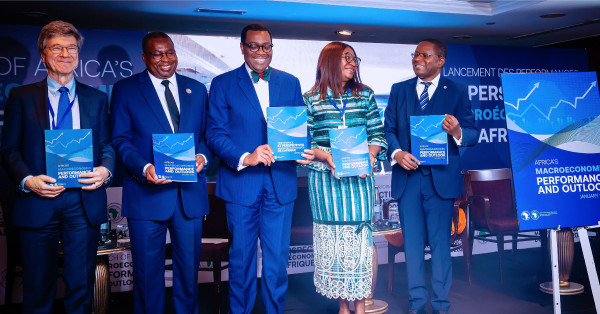
Africa dominates list of the world’s 20 fastest-growing economies in 2024—African Development Bank says in macroeconomic report

Location: Business
African Development Bank Group (AfDB)

Report forecasts stronger growth for Africa in 2024, outpacing projected global average; Continent is second-fastest-growing region after Asia.

Africa will account for eleven of the world's 20 fastest-growing economies in 2024, the African Development Bank Group said in its latest Macroeconomic Performance and Outlook (MEO) of the continent released on Friday.

Overall, real gross domestic product (GDP) growth for the continent is expected to average 3.8% and 4.2% in 2024 and 2025, respectively. This is higher than projected global averages of 2.9% and 3.2%, the report said.

The continent is set to remain the second-fastest-growing region after Asia.

The top 11 African countries projected to experience strong economic performance forecast are Niger (11.2%), Senegal (8.2%), Libya (7.9%), Rwanda (7.2%), Cote d'Ivoire (6.8%), Ethiopia (6.7%), Benin (6.4%), Djibouti (6.2%), Tanzania (6.1%), Togo (6%), and Uganda at 6%.

“Despite the challenging global and regional economic environment, 15 African countries have posted output expansions of more than 5%,” Bank Group President Dr Akinwumi Adesina said, calling for larger pools of financing and several policy interventions to further boost Africa's growth.

Africa's Macroeconomic Performance and Outlook, a biannual publication released in the first and third quarters of each year, complements the existing African Economic Outlook (AEO), which focuses on key emerging policy issues relevant to the continent's development.

The MEO report provides an up-to-date evidence-based assessment of the continent's recent macroeconomic performance and short-to-medium-term outlook amid dynamic global economic developments.

The latest report is calling for cautious optimism given the challenges posed by global and regional risks. These risks include rising geopolitical tensions, increased regional conflicts, and political instability—all of which could disrupt trade and investment flows, and perpetuate inflationary pressures.

President Adesina emphasised that fiscal deficits have improved, as faster-than-expected recovery from the pandemic helped shore up revenue.

He explained further: “This has led to a stabilisation of the average fiscal deficit at 4.9% in 2023, like 2022, but significantly less than the 6.9% average fiscal deficit of 2020. The stabilisation is also due to the fiscal consolidation measures, especially in countries with elevated risks of debt distress.”

He cautioned that with the global economy mired in uncertainty, the fiscal positions of the African continent will continue to be vulnerable to global shocks.

The report shows that the medium-term growth outlook for the continent's five regions is slowly improving, a pointer to the continued resilience of Africa's economies.

Presenting the key findings of the report, the African Development Bank's Chief Economist and Vice President, Prof. Kevin Urama said: “Growth in Africa's top-performing economies has benefitted from a range of factors, including declining commodity dependence through economic diversification, increasing stra­tegic investment in key growth sectors, and rising both public and private consumption, as well as positive developments in key export markets.”  

He added: “Africa's economic growth is projected to regain moderate strength as long as the global economy remains resilient, disinflation continues, investment in infrastructure projects remains buoyant, and progress is sustained on debt restructuring and fiscal consolidation.”

“The future of Africa rests on economic integration. Our small economies are not competitive in the global market. A healthy internal African trade market can ensure value-added and intra-African production of manufactured goods,” said Commissioner for Economic Development, Trade, Tourism, Industry and Minerals, African Union Commission, Ambassador Albert Muchanga.

He assured that the MEO forecast, and recommendations will be made available to African heads of state and that the report will be useful when the African Union makes its proposals to the G20- an informal gathering of many of the world's largest economies to which the African Union was admitted last year.

The improved growth figure for 2024 reflects concerted efforts by the continent's policymakers to drive economic diversification strategies focused on increased investment in key growth sectors, as well as the implementation of domestic policies aimed at consolidating fiscal positions and reversing the increase in the cost of living and boosting private consumption.

Speaking remotely, Zimbabwe's Minister of Finance and Economic Development, Prof Mthuli Ncube described the report as being “on point” and consistent with the reality in his country, describing it as useful for economic planning across Africa. He urged the African Development Bank to continue its thought leadership to help policymakers continue to build resilience to withstand shocks and drive growth.

Ncube said: “Zimbabwe expects slower growth due to climate shocks in the region. Southern African countries depend on agriculture for economic growth, so climate-proofing agriculture is key. We are in talks with creditors to restructure its debt, which is slowing economic growth. Internally, the country will focus on economic and governance reforms and reforms around property rights to increase agricultural production.”

Up to 41 countries across the continent will in 2024, achieve an economic growth rate of 3.8%, and in 13 of them, growth will be more than 1 percentage point higher than in 2023.

Director of the Center for Sustainable Development, Columbia University Prof Jeffrey Sachs noted that long-term affordable financing must be part of Africa's strategy to achieve growth of 7% or more per year and warned that Africa is paying a very high-risk premium for debt financing. He called for this point to be made to the G20.

“Long-term development cannot be based on short-term loans. Loans to Africa should be at least 25 years or longer. Short-term borrowing is dangerous for long-term development. Africa must act as one, in scale,” he explained.

Sachs, who is also the UN Secretary-General António Guterres' Advocate for Sustainable Development Goals also called for a much larger African Development Bank, better resourced to meet Africa's financing needs.

Overview of economic outlook across regions

The confluence of shocks notwithstanding, the resilience of the continent's economies remains strong, with positive growth projected for the continent's five regions.

  • East Africa: East Africa will continue to lead Africa's growth momentum, with growth projected to rise to 5.1% in 2024 and 5.7% in 2025, supported by strong strategic investments to improve internal connectivity and deepen intra-regional trade.
  • North Africa: Successive adverse weather conditions and macroeconomic challenges will hold the region's growth steady at 3.9% in 2024 with a slight improvement to 4.1% in 2025.
  • Central Africa: Growth is forecast to moderate to 3.5% in 2024 but projected recovery in private consumption and increases in mining investment and exports could help push growth to 4.1% in 2025.
  • Southern Africa: Growth will remain sluggish at 2.2 and 2.6% in 2024 and 2025, respectively. This reflects continued economic weakness in South Africa, the region's largest economy.
  • West Africa: Growth is projected to pick up to 4 and 4.4% in 2024 and 2025 respectively. Strong growth in most countries in the region is projected to offset slowdowns in Nigeria and Ghana. The announced withdrawal of Burkina Faso, Mali, and Niger from the Economic Community of West African States (ECOWAS) casts a shadow over the sustainability of gains amid growing uncertainty.

Driving faster and more sustainable economic growth

The 2024 MEO says in the short term, tackling persistent inflation will need a mix of restraining monetary policy coupled with fiscal consolidation and stable exchange rates.

The report identifies structural reforms and strategic industrial policies as key to accelerating economic diversification and strengthening the export sector.

It recommends that countries invest more in human capital and pursue a resource-based industrialisation and diversification strategy that allows the continent to exploit its comparative advantage and build resilience to shocks.

  • 2024 Macroeconomic Performance and Outlook (https://apo-opa.co/3UHdVhm)
  • President Adesina's speech (https://apo-opa.co/49H7oaV)
  • Pictures (https://apo-opa.co/48jUVZu)

Distributed by APO Group on behalf of African Development Bank Group (AfDB).

Media Contact:
Emeka Anuforo
Communication and External Relations Department
media@afdb.org

About the African Development Bank Group:
The African Development Bank Group (AfDB) is Africa's premier development finance institution. It comprises three distinct entities: the African Development Bank (AfDB), the African Development Fund (ADF) and the Nigeria Trust Fund (NTF). On the ground in 34 African countries with an external office in Japan, the AfDB contributes to the economic development and the social progress of its 54 regional member states. For more information: www.AfDB.org  

Media files
African Development Bank Group (AfDB)
Download logo
Read moreAfrica dominates list of the world’s 20 fastest-growing economies in 2024—African Development Bank says in macroeconomic report
16 February 2024

Beach safety tips to follow on your KZN South Coast breakaway

Location: MyPR

With these warm, sunny days, there’s no better place to head than the beautiful KZN South Coast beaches. For visitors planning a well-deserved breakaway, South Coast Tourism and Investment Enterprise (SCTIE) has shared some important beach safety tips to follow. As a top adventure destination with family-friendly offerings, the KZN South Coast is fortunate to …

Read moreBeach safety tips to follow on your KZN South Coast breakaway
16 February 2024

President Ramaphosa hails democracy’s role in uplifting youth

Location: News

President Ramaphosa hails democracy's role in uplifting youth

President Cyril Ramaphosa says individuals born after the advent of democracy embody the essence of Tintswalo, as they have gone on to record commendable achievements in their lives and careers.

The President was responding to this week’s two-day debate on his State of the Nation Address (SONA) by Members of Parliament. The SONA was delivered a week ago in Cape Town.

A number of young people, who have benefited from government over the last 30 years, were present in the National Assembly to listen to the President’s response to the debate. 

READ | Tintswalo, a child of democracy

“Today I am really honoured to have a number of Tinstwalos who have come to join us. Among these young people are aeronautical engineers, pilots, civil engineers, police officers, doctors, and a naval captain. They are qualified in a number of ways, all of whom have pursued their careers with the support of government departments and entities.

In his State of the Nation Address last week, President Ramaphosa introduced South Africa to Tintswalo, a child of  democracy.

He said that for millions of South Africans, Tintswalo's story resonated deeply with their own, which prompted young people to post images online of themselves in their graduation gowns or at their workplaces, saying "#IamTintswalo". 

“There are countless stories of young people who were born into abject poverty, but are now engineers, doctors, teachers, managers, tourism guides and operators, and entrepreneurs, thanks to the support and opportunities provided to them under democracy.

“They have spoken not only of how democracy has improved their lives, but of their gratitude to those who fought and strived to achieve that democracy. Many have paid tribute to their parents and grandparents – and to all the generations that came before – for the struggle and sacrifice that brought down apartheid and ushered in a new era of freedom,” he said. 

Responding to those who greeted Tintswalo’s story with derision, the President said that these were people who sought to diminish the achievements of democracy.

"To them, it doesn’t matter that nine out of 10 households are now living in a formal dwelling, or that a similar number has access to clean drinking water and electricity.

“To them, it doesn’t matter that more South African adults have completed matric or earned a degree, or that more learners from poor communities are achieving Bachelor passes. It doesn’t matter to these people that South Africans now have a higher life expectancy or that maternal and child health have improved dramatically.

“It doesn’t matter to them that millions of people have been lifted out of poverty through the provision of houses, land, social grants, free basic services, expanded access to health care and education and the introduction of a national minimum wage.

"All of these great achievements of human development do not matter to them, because Tintswalo doesn’t matter to them. They are prepared to dismiss all of this progress because it does not serve their narrative of a failed nation. It does not serve their political aspirations. It does not serve their narrow interests." 

The President said the journey to a brighter future continues. “We have travelled far and we have achieved much, but we have much further to go. We are clear about the progress that we have made, the challenges that we face, and the actions that we must now take,” the President said. – SAnews.gov.za

DikelediM
Fri, 02/16/2024 - 10:03

253 views
Read morePresident Ramaphosa hails democracy’s role in uplifting youth
  • Previous
  • Page 1
  • Interim pages omitted …
  • Page 17
  • Page 18
  • Page 19
  • Page 20
  • Page 21
  • Interim pages omitted …
  • Page 25
  • Next

Copyright © 2026 · MyZA · All Rights Reserved · Powered by Stratlec Online