• Skip to main content
  • Skip to header right navigation
  • Skip to after header navigation
  • Skip to site footer
MyZA

MyZA

News, Directory, Events and Other Stuff

  • Social Media
  • Sport
  • World News
  • Home
  • Submit News
  • Directory
  • Events
  • Stratlec
  • TFSA
  • News
    • APO
    • Today’s Sport News
    • Todays Social Media and Tech Headlines
    • Today’s World News
    • Today’s SA Financial News
  • Contact
You are here: Home / News / Ministers commit to support transboundary cooperation in shared water basin

Ministers commit to support transboundary cooperation in shared water basin

18 March 2024 by Guest

Ministers commit to support transboundary cooperation in shared water basin

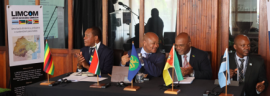
Ministers responsible for Water Affairs from the Republics of Botswana, Mozambique, South Africa and Zimbabwe have recommitted their support to deepening transboundary cooperation in the Limpopo River Basin.

During the biannual meeting by the four Member States held recently in Musina, Limpopo, the Ministers, who are all members of the Limpopo Watercourse Commission (LIMCOM), signed an endorsement agreement to make amendments to the existing transboundary agreement of LIMCOM on the shared water basin.

READ | SA, Zimbabwe to sign agreement for treated water transfer to Musina

The Department of Water and Sanitation has been a member of LIMCOM since the Commission was established between the Republics of Botswana, Mozambique, South Africa and Zimbabwe through the LIMCOM Agreement signed in November 2003 in Maputo, Mozambique.

Article 3.1 of the LIMCOM Agreement (Agreement 2003), stipulates that the objective of the Commission is to “advise the Contracting Parties and provide recommendations on the uses of the Limpopo River, its tributaries and its waters for purposes and measures of protection, preservation and management of the Limpopo River”.

With respect to the Commission’s institutional arrangements to deliver its mandate, the 2003 Agreement, under Article 4, stipulates that the principal organ of the Commission is the Council composed of not more than three delegates per country, with the mandate to establish the Secretariat and any other organ as may be necessary.

However, the Commission recognised that Article 4 of the LIMCOM Agreement signed in 2003 did not include the Council of Ministers as the principal organ of decision making. 

As a result, the formalisation of the Council of Ministers as the main policy body will improve the governance structure of LIMCOM and its Secretariat, and also foster closer cooperation for judicious, sustainable and coordinated management, protection and utilisation of shared watercourses. This is in line with the 2000 Revised Southern African Development Community (SADC) Protocol on Shared Watercourses. 

South Africa’s Water and Sanitation Minister, Senzo Mchunu, said it was necessary to include the Ministers so that they execute the mandate regarding the management of the Limpopo River Basin. 

Mchunu said the amendment of the agreement will strengthen South Africa’s relations with the three riparian States which share the Limpopo River Basin and use water from the river to support various socio-economic activities. 

“We are looking forward to execute the mandates given to us by the people through LIMCOM and we hope that Southern Africa will look at their rivers as assets which are instrumental in developing socio-economic activities including agriculture, tourism, energy generation as well as for domestic use,” Mchunu said.

Located in Southern Africa, the Limpopo River Basin encompassing portions of Botswana, Mozambique, South Africa, and Zimbabwe. The basin faces a number of challenges, especially water scarcity.

In South Africa, there are four Water Management Areas (WMA) found in the Limpopo River Basin, and these include Limpopo WMA, Luvuvhu and Letaba WMA, Olifants WMA and Crocodile (West) and Marico WMA. 

However, there is an increasing demand for water to meet the needs of the population and the key economic sectors while faced with limited, if not dwindling, water resources. 

The four Ministers also launched the “Integrated Transboundary River Basin Management for the Sustainable Development of the Limpopo River Basin, spearheaded by the United Nations Development Programme (UNDP) in South Africa, in partnership with the Global Water Partnership-Southern Africa (GWPSA).

The project aims to achieve integrated, cross sectoral, ecosystem-based management of the Limpopo River and to uplift the living standards of the basin’s population and conserve the basin’s resources and ecosystems services.

The project implementation is guided by the LIMCOM Agreement and the principles which are contained in the Revised SADC Protocol on Shared Watercourses of 2000.

The principles include sustainable utilisation; equitable and reasonable utilisation; protection, preservation, and conservation of the environment; and prevention and mitigation of significant harm.

“These principles shall be interpreted according to the provisions of Article 3 of the SADC Protocol and developed in accordance with the best international practices. 

“Furthermore, in the implementation of this project, the Governments of Botswana, Mozambique, South Africa and Zimbabwe commit themselves to uphold the provisions of the SADC Protocol on Gender and Development,” Mchunu said. – SAnews.gov.za

GabiK
Mon, 03/18/2024 – 10:55

169 views

Ministers responsible for Water Affairs from the Republics of Botswana, Mozambique, South Africa and Zimbabwe have recommitted their support to deepening transboundary cooperation in the Limpopo River Basin.

During the biannual meeting by the four Member States held recently in Musina, Limpopo, the Ministers, who are all members of the Limpopo Watercourse Commission (LIMCOM), signed an endorsement agreement to make amendments to the existing transboundary agreement of LIMCOM on the shared water basin.

READ | SA, Zimbabwe to sign agreement for treated water transfer to Musina

The Department of Water and Sanitation has been a member of LIMCOM since the Commission was established between the Republics of Botswana, Mozambique, South Africa and Zimbabwe through the LIMCOM Agreement signed in November 2003 in Maputo, Mozambique.

Article 3.1 of the LIMCOM Agreement (Agreement 2003), stipulates that the objective of the Commission is to “advise the Contracting Parties and provide recommendations on the uses of the Limpopo River, its tributaries and its waters for purposes and measures of protection, preservation and management of the Limpopo River”.

With respect to the Commission’s institutional arrangements to deliver its mandate, the 2003 Agreement, under Article 4, stipulates that the principal organ of the Commission is the Council composed of not more than three delegates per country, with the mandate to establish the Secretariat and any other organ as may be necessary.

However, the Commission recognised that Article 4 of the LIMCOM Agreement signed in 2003 did not include the Council of Ministers as the principal organ of decision making. 

As a result, the formalisation of the Council of Ministers as the main policy body will improve the governance structure of LIMCOM and its Secretariat, and also foster closer cooperation for judicious, sustainable and coordinated management, protection and utilisation of shared watercourses. This is in line with the 2000 Revised Southern African Development Community (SADC) Protocol on Shared Watercourses. 

South Africa’s Water and Sanitation Minister, Senzo Mchunu, said it was necessary to include the Ministers so that they execute the mandate regarding the management of the Limpopo River Basin. 

Mchunu said the amendment of the agreement will strengthen South Africa’s relations with the three riparian States which share the Limpopo River Basin and use water from the river to support various socio-economic activities. 

“We are looking forward to execute the mandates given to us by the people through LIMCOM and we hope that Southern Africa will look at their rivers as assets which are instrumental in developing socio-economic activities including agriculture, tourism, energy generation as well as for domestic use,” Mchunu said.

Located in Southern Africa, the Limpopo River Basin encompassing portions of Botswana, Mozambique, South Africa, and Zimbabwe. The basin faces a number of challenges, especially water scarcity.

In South Africa, there are four Water Management Areas (WMA) found in the Limpopo River Basin, and these include Limpopo WMA, Luvuvhu and Letaba WMA, Olifants WMA and Crocodile (West) and Marico WMA. 

However, there is an increasing demand for water to meet the needs of the population and the key economic sectors while faced with limited, if not dwindling, water resources. 

The four Ministers also launched the “Integrated Transboundary River Basin Management for the Sustainable Development of the Limpopo River Basin, spearheaded by the United Nations Development Programme (UNDP) in South Africa, in partnership with the Global Water Partnership-Southern Africa (GWPSA).

The project aims to achieve integrated, cross sectoral, ecosystem-based management of the Limpopo River and to uplift the living standards of the basin’s population and conserve the basin’s resources and ecosystems services.

The project implementation is guided by the LIMCOM Agreement and the principles which are contained in the Revised SADC Protocol on Shared Watercourses of 2000.

The principles include sustainable utilisation; equitable and reasonable utilisation; protection, preservation, and conservation of the environment; and prevention and mitigation of significant harm.

“These principles shall be interpreted according to the provisions of Article 3 of the SADC Protocol and developed in accordance with the best international practices. 

“Furthermore, in the implementation of this project, the Governments of Botswana, Mozambique, South Africa and Zimbabwe commit themselves to uphold the provisions of the SADC Protocol on Gender and Development,” Mchunu said. – SAnews.gov.za

Read More at the Source

Share this:

  • Share on X (Opens in new window) X
  • Share on Facebook (Opens in new window) Facebook
  • Print (Opens in new window) Print
  • Email a link to a friend (Opens in new window) Email
  • Share on LinkedIn (Opens in new window) LinkedIn
  • Share on Tumblr (Opens in new window) Tumblr
  • Share on WhatsApp (Opens in new window) WhatsApp
  • Share on Mastodon (Opens in new window) Mastodon
Category: NewsTag: 2024, Africa, African, agreement, agriculture, Energy, Environment, global, Limpopo, Mozambique, SA News, South Africa, Tourism, Water, Zimbabwe

If you feel strongly about this article then feel free to send MyZA a ‘Letter to the Editor’ using the submission form below:


Letter to the Editor

This field is for validation purposes and should be left unchanged.
If this is in response to an article please include that article title here or as the lead in for the first paragraph of your Letter below.

Separate tags with commas

Localise your letter by naming the city your words are about. Add relevant words describing your subject. Single comma separated words of no more than 5
Your Name(Required)
Your Name will be linked to the website below.
Your personal, business or social media web site
Choose NO to not set up a user account on MyZA. User Accounts will allow you to submit letters under your own Author Name

3 Latest Letters to the Editor:

  • Fun South African fact

    Dear Editor Fun South African fact: towns like Franschhoek and Stellenbosch are home to world-class wine farms set in stunning, scenic surroundings. Regards Aressa Smith In Response to/From: Luxury Properties Seized in New Lottery Crackdown

    27 January 2026
  • Condolences on the Passing of Lusanda Dumke

    Statement by Leander Kruger MPL – DA Buffalo City Constituency Leader: The Democratic Alliance in Buffalo City Metropolitan Municipality mourns the passing of Springbok Women’s rugby player and Mdantsane trailblazer, Lusanda Dumke, who lost her battle with cancer at the age of 28. South Africa has lost an exceptional athlete, a leader, and a source…

    17 December 2025
  • Rape Kits Delivered, But…

    Statement by Nicholas Gotsell MP – DA NCOP Member on Security & Justice: The DA can confirm that 2 840 rape kits arrived in Cape Town on Monday, following sustained DA oversight and pressure after multiple police stations across the Western Cape were found to be without this critical forensic evidence tool. While this delivery…

    17 December 2025

About Guest

Previous Post:Deepfakes a worrying trend in the run-up to elections
Next Post:Brothers in arms: The extra-ordinary service of two Players’ Fund pioneers

Reader Interactions

Comments

  1. Cougar Fuzz

    18 March 2024 at 1:32 pm

    Finland: You have two cows. They are more likely than your entire country to commit a crime.

  2. Seattle Jay

    18 March 2024 at 1:32 pm

    Vatican City: You have two cows. They were both taken advantage of as calves.

Copyright © 2026 · MyZA · All Rights Reserved · Powered by Reach Trust