• Skip to main content
  • Skip to header right navigation
  • Skip to after header navigation
  • Skip to site footer
MyZA

MyZA

News, Directory, Events and Other Stuff

  • Social Media
  • Sport
  • World News
  • Home
  • Submit News
  • Directory
  • Events
  • Stratlec
  • TFSA
  • News
    • APO
    • Today’s Sport News
    • Todays Social Media and Tech Headlines
    • Today’s World News
    • Today’s SA Financial News
  • Contact
You are here: Home / Archives for Tunisia

Tunisia

20 September 2023

Africa Women Innovation and Entrepreneurship Forum (AWIEF) Announces Finalists for 2023 AWIEF Awards

Location: News
Africa Women Innovation and Entrepreneurship Forum (AWIEF)

The Africa Women Innovation and Entrepreneurship Forum (AWIEF) (https://www.AWIEForum.org) is delighted to announce the finalists for its 2023 AWIEF Awards.

Launched in 2017, the prestigious annual AWIEF Awards is an initiative to recognise, honour, and celebrate women entrepreneurs and business owners in Africa across various industry sectors for their achievements and contribution to the continent's inclusive economic growth and social development.

An international and independent Panel of Judges selected the twenty-four (24) finalists across eight (8) categories. These outstanding women founders and business leaders operate in a diverse range of sectors and represent companies from fourteen (14) different African countries: Cameroon, Egypt, Ethiopia, Kenya, Morocco, Nigeria, Rwanda, Senegal, Sierra Leone, South Africa, Tunisia, Uganda, Zambia, and Zimbabwe.

The 2023 AWIEF Awards winners will be announced and celebrated at a special ceremony and gala dinner at the AWIEF2023 Conference and Awards, taking place on 9 and 10 November at the Kigali Convention Centre, Kigali, Rwanda.

AWIEF Founder and CEO, Irene Ochem, said: “Given the huge number and calibre of the nominations received this year, it is clear that female entrepreneurship and business leadership is thriving across Africa. It is our honour to recognise and celebrate the achievements and contributions of these women to the inclusive growth of their respective sectors, their countries and the continent's economy.”

A member of the 2023 AWIEF Awards Panel of Judges, John-Paul Iwuoha, Founder of Smallstarter Africa, said: "As a Judge, I was thoroughly impressed by the quality of applications in all the categories. It is great to see how AWIEF continues to attract innovative women across Africa who are creating enormous value for society."

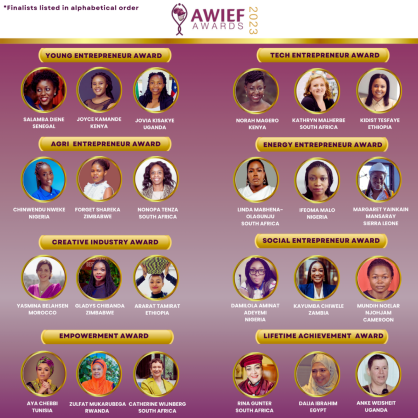
The finalists for the 2023 AWIEF Awards are (listed in alphabetical order):

Young Entrepreneur Award

Salamba Diene, CEO, BIOSENE SARL, Senegal

Joyce Kamande, Co-founder & CEO, Safi Organics, Kenya

Jovia Kisakye, CEO, Sparkle Agro Brand, Uganda

Tech Entrepreneur Award

Norah Magero, Founder & CEO, Drop Access Limited, Kenya

Kathryn Malherbe, CEO, Med Sol AI Solutions, South Africa

Kidist Tesfaye, Founder & CEO, YeneHealth, Ethiopia

Agri Entrepreneur Award

Chinwendu Nweke, CEO, Bridge Merchant Enterprise, Nigeria

Forget Shareka, Founder, Chashi Foods, Zimbabwe

Nonopa Tenza, Founder & MD, Kevinot Farming, South Africa

Energy Entrepreneur Award

Linda Mabhena-Olagunju, Founder & CEO, DLO Energy Resources Group, South Africa

Ifeoma Malo, CEO, Clean Technology Hub, Nigeria

Margaret Yainkain Mansaray, Founder & CEO, Women in Energy Sierra Leone Limited, Sierra Leone

Creative Industry Award

Yasmina Belahsen, Founder, MayaDigital, Morocco

Gladys Chibanda, Founder & CEO, Krafted Ink, Zimbabwe

Ararat Tamirat, Founder & GM, Tuba By Ararat, Ethiopia

Social Entrepreneur Award

Damilola Aminat Adeyemi, Co-founder & CEO, D-Olivette Global Enterprise, Nigeria

Kayumba Chiwele, Founder & Principal Psychologist, MindAid Zambia, Zambia

Mundih Noelar Njohjam, Medical Doctor, Epilepsy Awareness, Aid and Research Association, Cameroon

Empowerment Award

Aya Chebbi, Founder & President, Nalafem Collective, Tunisia

Zulfat Mukarubega, Founder, University of Tourism, Technology and Business Studies, Rwanda

Catherine Wijnberg, Founder & CEO, Fetola, South Africa

Lifetime Achievement Award

Rina Gunter, Founding Partner, Gunter Attorneys, South Africa

Dalia Ibrahim, CEO, Nahdet Misr Publishing House, Egypt

Anke Weisheit, Co-founder & Chair, PHARMBIOTRAC, Mbarara University of Science and Technology, Uganda

Tickets for the AWIEF2023 Conference and Awards are available online at: https://apo-opa.info/3JHKUem

Distributed by APO Group on behalf of Africa Women Innovation and Entrepreneurship Forum (AWIEF).

For more information and media enquiries, email: info@awieforum.org

Media files
Africa Women Innovation and Entrepreneurship Forum (AWIEF)
Download logo
Read moreAfrica Women Innovation and Entrepreneurship Forum (AWIEF) Announces Finalists for 2023 AWIEF Awards
8 August 2023

South Africa records 207 Child Marriages in 2021 – Stats SA  

Location: News

South Africa records 207 Child Marriages in 2021 - Stats SA  

South Africa recorded 207 child marriages in 2021, with 188 kids taken as brides.

This was revealed on Monday by Statistics South Africa to the African Union Special Rapporteur, who is currently in the country to monitor and evaluate progress on how South Africa is performing in its campaign to end child marriages. 

The South African office on the Rights of the Child within the Department of Social Development is hosting the African Union Stakeholder Engagement Mission on Child Marriages and Harmful Practices in Pretoria and Johannesburg. 

Stats SA’s Director: Education and Child Statistics, Dr Seble Worku, shared that of the 207 recorded child marriages, 188 were brides and 19 were grooms. 

She further revealed that 37 of the child marriages were registered as civil marriages and 19 were customary. 

“While Dr Worku showed an improvement in children living in low income households at 2.6 million with 4 million in high income households, pensions and grants were still the highest source of income for children in rural areas. 

“She revealed that the number of children who lived with only their mothers continued to rise in the country, while the number of orphaned children declined to 11.5% in 2021 from 14.3% in 2002,” the Department of Social Development said in a statement. 

The host, Honourable Takam Kembo of Cameroon, the Special Rapporteur and Social and Health Envoy from the African Union Commission are on a mission to conduct a monitoring visit on the progress that South Africa has made to end child marriages and harmful cultural practices against children. 
 
The mission started its series of high-level engagements with the Departments of Social Development, Basic Education, Home Affairs, and Women, Youth and Persons with disabilities. 

Today the delegation will engage human rights institutions, civil society organisations and conclude with a session with children. 

These engagements will focus on children's rights to capture current progress, challenges, best practice, lessons learned and make recommendations for fast-tracking progress to end violence against women and children.
 
This monitoring visit comes before the country launches its Women’s Month programme under the theme, 'Accelerating socio-economic opportunities for women’s empowerment'. 

Furthermore, this visit is part of a series of visits that the AU Commission is expected to conclude around the region ahead of the upcoming 4th African Girls Summit in November this year. 

They will go to Kenya, Ethiopia, South Sudan, Madagascar, Tunisia, Liberia, the Democratic Republic of Congo, Seychelles and Namibia. 

This continental perspective will allow them to understand successful strategies and practices in different regions of Africa so that countries can learn from one another.
 
In 2014, the then Chairperson of African Union Commission, Dr Nkosazana Dlamini Zuma, launched the campaign to end child marriages in Africa. 

At the time, the AU Commission estimated that about 14 million adolescent and teen girls were married. To date, more than 30 Member States have responded by accelerating the implementation of ending child marriage programmes and interventions.  
 
The AU Commission team expressed gratitude for South Africa's hospitality and willingness to share insights into their legislative framework and efforts to protect children.

“The AU mission aims to understand how South Africa is working to protect its children. It focuses on examining the child protection system, its effectiveness, and how it addresses various forms of violence such as child marriage, female genital mutilation, and online exploitation and abuse,” Kembo said. 

The monitoring mission will evaluate policies and strategies that the country has in place to end various forms of harmful cultural practices against children. 

Kembo noted variations in terms of geographical patterns, provinces with high and low prevalence indicating a need for alignment of strategic interventions to the local context.

The Special Rapporteur is expected to produce a detailed progress report with observations and recommendations for the country within six months. – SAnews.gov.za
 

DikelediM
Tue, 08/08/2023 - 12:06

Read moreSouth Africa records 207 Child Marriages in 2021 – Stats SA  
16 May 2023

80th Anniversary of the Finish of the WWII Tunisia Campaign

Location: News

U.S. Embassy in Tunisia
Download logo

This week, we commemorate the 80th anniversary of the end of the Tunisia Campaign of World War II, which was a turning point for the Allied forces and liberated North Africa from Nazi control on May 13, 1943. This success in Tunisia paved the way for the liberation of Europe and strengthened the partnership between the allied countries. As part of the commemorative events, Ambassador Joey Hood alongside the Ambassadors of the United Kingdom, Canada, France, and Germany, traveled to Gabes as a guest of the Ministries of Defense, Tourism and Culture to visit the Mareth Line Museum that documents a pivotal battle between Allied and Axis forces along the line of Wadi Zigzaou. Other commemorative events included a symposium at the Oudhna archaeological site with preeminent World War II scholars and a gathering with Tunisian officials at the Ambassador's residence. The North Africa American Cemetery also hosted a luminary event at the site where 2,841 American soldiers paid the ultimate sacrifice during World War II. Ambassador Hood noted, “After World War II, we learned how the most bitter of rivals could move past even the deepest wounds of war to address the common challenges of the future. This is why we can stand together here today not only with our allies, but also with our former adversaries, with whom we work today in partnership and friendship.”

Distributed by APO Group on behalf of U.S. Embassy in Tunisia.

Read more80th Anniversary of the Finish of the WWII Tunisia Campaign
12 May 2023

Special Envoy to Monitor and Combat Antisemitism

Location: News

U.S. Embassy in Tunisia
Download logo

Special Envoy to Monitor and Combat Antisemitism Ambassador Deborah Lipstadt visited Tunisia May 5-10. Before the horrific and deplorable antisemitic attack on May 9 that stands in sharp contrast to Tunisia's rich, multicultural history, Special Envoy Lipstadt and Ambassador Hood visited El Ghriba Synagogue and attended the annual Lag B'Omer festival on the island of Djerba, where one of the oldest Jewish communities resides. During her visit, the Ambassadors met with leaders of the vibrant community and enthusiastic young students at the Jewish schools who left a lasting impression on them. Special Envoy Lipstadt was impressed to learn that Muslim and Jewish students have long studied side by side in the Houmt El Souk neighborhood, another illustrative example of coexistence which dates back 2,500 years and persists on the island.

While in Tunis, the Special Envoy met with State Secretary to the Minister of Foreign Affairs Mounir Ben Rjiba to discuss religious freedom. She also participated in roundtables with representatives from civil society and met with students at the European University of Tunis who expressed hope for the positive impact of cultural exchange in fostering greater coexistence.

Distributed by APO Group on behalf of U.S. Embassy in Tunisia.

Read moreSpecial Envoy to Monitor and Combat Antisemitism
12 May 2023

Tunisia: Plot to Dismantle Country’s Largest Opposition Party

Location: News

Human Rights Watch (HRW)
Download logo

Tunisian authorities have intensified their attack on opponents of President Kais Saied's 2021 power grab, moving to neutralize the country's largest political party, Ennahda, Human Rights Watch said today.

Since December 2022, the Tunisian government has arrested at least 17 current or former members of the party, including its leader, and shut its offices across the country. The authorities should immediately release all those arbitrarily detained and end restrictions on freedom of association and assembly.

The arrests have continued following a wave in mid-February that targeted figures of various political affiliations, bringing the number of public figures deemed critical of Saied behind bars to at least 30. Most have been accused of “conspiring against state security.” The Ennahda-linked detainees include four former ministers and several former parliament members. The party President and former speaker of parliament Rached Ghannouchi and two party vice presidents, Ali Laarayedh and Nourredine Bhiri, are among them. None has been formally charged.

“After demonizing the Ennahda Party and making serious accusations without proof, President Saied's authorities have moved to effectively dismantle it,” said Salsabil Chellali, Tunisia director at Human Rights Watch. “Tunisian authorities' latest tactic to muzzle critical voices consists of tossing around conspiracy charges left and right against all those who challenge the president's increasingly authoritarian bent.”

The authorities have accused most of the detainees of “conspiracy against state security” without clarifying the criminal acts that constitute the alleged conspiracy.

Seven Ennahda-related cases for which Human Rights Watch has been able to get additional information show the political nature of the arrests, the reliance on flimsy evidence, and disregard for due-process rights. At least four of these cases amount to barring peaceful expression.

Founded in 1981, Ennahda – formerly the Islamic Tendency Movement – was legalized only in 2011, after a popular uprising ousted the longtime authoritarian President Zine el Abidine Ben Ali. Ennahda played a central role in all government coalitions until 2019.

Ennahda President Ghannouchi has been a prominent opponent of Saied's one-man-rule that followed his seizure of extraordinary powers on July 25, 2021. On April 17, plainclothes officers arrested Ghannouchi at his home. They did not show an arrest warrant, one of his lawyers told Human Rights Watch.

On April 20, an investigative judge issued a detention warrant for Ghannouchi on charges of attempting to “change the nature of the state” and “conspiring against internal state security,” crimes for which a death sentence is possible. The accusations are based on a warning by Ghannouchi on April 15 during a meeting that alienating opposition political movements, including Ennahda and “the left,” was a “project for civil war.”

Over the past 18 months, Ghannouchi, 81, has been questioned in relation to 19 different investigations, his lawyer Mokhtar Jemai said in a radio interview.

The police closed Ennahda's headquarters in Tunis on April 18, without presenting any court decision or formal document, another lawyer said. Security forces have prevented members from accessing the offices of the party across the country, the lawyer said.

The same day, the authorities shut the Tunis headquarters of a party known as the Tunisia Will Movement, which hosted activities of the National Salvation Front (NSF), an opposition coalition cofounded by Ennahda.

An unverified Interior Ministry memorandum invoking the state of emergency – which has continuously been extended since 2015 – ordering the closure of Ennahda's offices and banning their meetings across the country, as well as the NSF's gatherings in Tunis, has circulated online.

The two Ennahda vice presidents, Laarayedh and Bhiri, are being held in Mornaguia prison. Laarayedh, 67, a former interior and prime minister, is facing prosecution for decisions he made in office between 2011 and 2014 that allegedly failed to combat fundamentalism and Islamic extremist violence “in the necessary way.” He has been held since December 19, without being brought before a judge.

Former Justice Minister Bhiri was arrested on February 13 for attempting to “change the nature of the state,” his lawyer, Amine Bouker, told Human Rights Watch, for a Facebook post urging, Tunisians to demonstrate against Saied on January 14, the anniversary of Ben Ali's ouster. Bhiri's lawyers said he did not write or post the call.

Said Ferjani, another Ennahda leader who was in the Parliament dissolved by Saied in March 2022, was arrested in Tunis on February 27 as part of an investigation into the digital content production company Instalingo, one of his lawyers said. The state prosecutor has accused the company, whose customers include Arabic-speaking media organizations critical of Saied, of inciting violence and slandering Saied.

Ferjani is accused of “money laundering,” attempting to “change the nature of the state,” “undermining external State security,” and inciting violence, among other charges – including under the 2015 Anti-Terrorist law – some of which are punishable by death. An investigative judge questioned Ferjani on March 1 about his relationships and finances. His family and lawyer told Human Rights Watch that he has no link with the company. He is in Sousse prison and he has not been further questioned by a judge.

At least two other Ennahda members are detained in the Instalingo case: the former Investment Minister Riadh Bettaieb, his lawyer told Human Rights Watch, and Ghannouchi, who was placed under a detention warrant in this case on May 9.

Mohamed Mzoughi, Ennahda's head of public relations in the city of Beja, was arrested on March 9. The following day, Mohamed Saleh Bouallagui, Ennahda's general secretary in Beja, was arrested. They remain in detention, accused of “conspiracy against state security” including through “contacts with a foreign power,” “insulting the president” and terrorism-related charges for their alleged role in managing social media pages critical of Saied's rule, their lawyers said.

Documents filed by the state prosecutor indicate that Bouallagui and Mzoughi are being investigated under the 2015 Anti-Terrorist law for offenses punishable by up to 20 years in prison, including “membership in a terrorist organization,” “using the Tunisian territory to commit terrorist offenses,” “providing weapons” and money laundering. They are also being investigated under articles of the Penal Code and article 86 of the Telecommunications Code. The investigative judge last questioned Mzoughi on March 24 and Bouallagui on March 28.

Mohamed Ben Salem, a former Ennahda leader and former minister of agriculture, was arrested on March 3, without a warrant, in the southeastern town of Bir Lahmar. He is being investigated for “forming an organization aiming to prepare and commit the crime of illegally leaving the Tunisian territory” under article 42 of law 1975-40 on Travel Documents and “holding sums of money in foreign currency,” under articles of the foreign exchange code.

Ben Salem has not been questioned by a judge since his detention. However, the financial crimes police unit interrogated him on April 12 in a separate investigation into alleged corruption.

Four other people are detained in relation to the cases against Ben Salem, including former Ennahda parliament member, Ahmed Laamari, his lawyer told Human Rights Watch.

Ben Salem, detained in Sfax prison, has lost his ability to walk and suffered two strokes since his arrest, his lawyer, Abdelwahhab Maatar, told Human Rights Watch. He has had a heart condition and chronic diseases for years, his family said.

Ruling by decree, Saied has systematically undermined judicial independence, raising fair trial concerns for these and other people accused after they criticized him. In February 2022, Saied dissolved the High Judicial Council, which was mandated to guarantee the independence of the judiciary, and appointed a temporary body over which he has broad control. In June 2022, he granted himself the authority to unilaterally dismiss magistrates and fired 57. The authorities have refused to comply with an administrative court order to reinstate 49 of them.

Under international law, a suspect should be held in pretrial detention only in exceptional circumstances when the court provides reasons for holding them that are compelling, individualized, and subject to periodic review and appeal. Pretrial detention is only to be imposed as “an exception” under article 84 of Tunisia's Criminal Procedure Code.

The International Covenant on Civil and Political Rights (ICCPR), to which Tunisia is a party, protects the rights to freedom of opinion, expression, association, and assembly. Tunisia is also bound under the ICCPR and the African Charter on Human and Peoples' Rights to respect the right to a fair trial.

“The Tunisian authorities should stop their reprisal against Ennahda and other opponents and release all those jailed in the absence of credible evidence of crimes,” Chellali said.

Distributed by APO Group on behalf of Human Rights Watch (HRW).

Read moreTunisia: Plot to Dismantle Country’s Largest Opposition Party
10 May 2023

UAE Condemns attack near synagogue in southern Tunisia

Location: News

United Arab Emirates Ministry of Foreign Affairs & International Cooperation
Download logo

The UAE strongly condemned the attack that took place near El Ghriba Synagogue on the island of Djerba in southern Tunisia and resulted in numerous deaths.

Her Excellency Dr. Iman Al Salami, UAE Ambassador to the Republic of Tunisia, affirmed in a statement that the UAE expresses its strong condemnation of these criminal acts and its permanent rejection of all forms of violence, extremism, and terrorism aimed at undermining security and stability in contravention of human values and principles.

Her Excellency praised the vigilance and efficiency of the Tunisian government in addressing this situation and expressed the UAE's sincere condolences to the government and people of the Republic of Tunisia, as well as its sympathy to the families of victims of this heinous crime.

Distributed by APO Group on behalf of United Arab Emirates Ministry of Foreign Affairs & International Cooperation.

Read moreUAE Condemns attack near synagogue in southern Tunisia
9 May 2023

Tunisia: A deeply worrying sign of growing repression

Location: News

Amnesty International
Download logo

The Tunisian authorities' decision to broaden a criminal investigation based on unfounded accusations of “conspiracy” by adding four dissidents to the list of accused is a deeply worrying sign of growing repression, Amnesty International said today. The newly accused include prominent human rights lawyer Ayachi Hammami, feminist lawyer Bochra Belhaj Hamida and two opposition political figures Nejib Chebbi and Noureddine Bhriri.

“The Tunisian authorities have already done enough damage. to the right to freedom of expression and the rule of law by arbitrarily detaining dissidents on unfounded accusations. They should urgently close this investigation, immediately release all those who have been detained in relation to it and end their instrumentalization of the judiciary as a tool of repression,” said Heba Morayef, Amnesty International's Director for the Middle East and North Africa. The Tunisian authorities have already done enough damage to the right to freedom of expression and the rule of law by arbitrarily detaining dissidents on unfounded accusations

“With Tunisia's economic crisis steadily deepening, the authorities should be seeking to promote healthy debate over the country's future. Instead, authorities are deliberately targeting eminent lawyers and political opposition members who have for years fought for a better future for Tunisia to spread fear and silence dissent, sending a chilling message that anyone who dares to oppose President Saied risks reprisal.”

In February 2023, the Tunisian authorities opened a criminal investigation against 17 suspects and arrested 12 of them. A judge later released at least one suspect pending investigation.

The president has publicly branded those arrested as “terrorists” and accused them of plotting to attack the state and foment social tension. An investigative judge at Tunisia's anti-terrorism court is investigating them under ten articles of the Penal Code – including Article 72, which mandates the death penalty for trying to “change the nature of the state” – and more than a dozen articles of a 2015 counterterrorism law.

On 3 May, the General Prosecutor for the Tunis Court of Appeal informed the Tunis Bar Association that the judge overseeing the investigation was adding four new people – all lawyers – to the list of suspects, according to lawyers familiar with the case. In informing the bar association, the prosecutor followed official procedures for criminal investigations targeting lawyers.

The four new individuals under investigation are Ayachi Hammami, a lawyer who has represented other political opposition leaders being investigated in the case; veteran opposition leader Nejib Chebbi; prominent activist Bochra Belhaj Hamida; and Noureddine Bhiri, a senior member of opposition party Ennahda.

Hammami is already being investigated under a draconian cybercrime law for publicly criticizing the authorities. Separately, Bhiri, a former Justice Minister, was arrested on 13 February for allegedly “seeking to change the nature of the state” and has remained in detention since.

Since suspending Parliament and claiming emergency powers on 25 July 2021, President Saied has adopted a new constitution that threatens human rights and issued decree-laws that undermine judicial independence and freedom of expression.

Tunisian authorities have targeted critics and perceived opponents of the president with criminal investigations and prosecutions amid a broader regression in human rights.

Distributed by APO Group on behalf of Amnesty International.

Read moreTunisia: A deeply worrying sign of growing repression
  • Previous
  • Page 1
  • Page 2
  • Page 3

Copyright © 2026 · MyZA · All Rights Reserved · Powered by Reach Trust