Limpopo Stadium Project Soaks up Time and Money
“Why are you investigating our stadium?” asks spokesperson

MyZA
News, Directory, Events and Other Stuff
“Why are you investigating our stadium?” asks spokesperson
Tens of millions have been spent on a stadium in Elim since 2017. The stadium is still not complete.
A new study compares the anti-inflammatory and barrier protective effects of unfermented and fermented rooibos extract on intestinal pig cells.
Preserving South Africa’s water supply is not only a matter of justice today, it is a generational responsibility. Without decisive action, the next generation will inherit the consequences of today’s corruption and mismanagement.
The post ‘DROP THE BLOCK’ UNDER THE MICROSCOPE: JUSTICE MUST FLOW LIKE WATER appeared first on For Good.
Polihali Dam will boost water transfers to Gauteng
A bill to decriminalise sex work was sent back to the justice department for redrafting about two years ago
Re.Bag.Re.Use supports 21 women from Imizamo Yethu and other communities across Cape Town
Labour department says amendments are necessary to counter growing unemployment
Over 700 plots in Zandspruit, intended for residents to build their own homes, have stood vacant for six years.
JOHANNESBURG: Cricket South Africa (CSA) has today announced the South Africa Under-19 (SA U19) Men’s squad for the upcoming three-match...
JOHANNESBURG: Proteas Men’s head coach Shukri Conrad has named a 14-player squad for the upcoming T20 International (T20I) tri-series against...
In spite of government promises, only one teacher in 10 has been screened
JOHANNESBURG: Proteas Men’s head coach Shukri Conrad has named a 16-player squad for the two-match Test series against Zimbabwe, set...
Department of Social Development says there were “payment system challenges” and some organisations are non-compliant
By Yi He, Co-Founder of Binance (www.Binance.com)
Each year, Africa Day serves as a celebration of the continent's culture, history, and progress. But in 2025, Africa is doing more than celebrating — it's leading.
For too long, Africa has been positioned as a “frontier market,” a place waiting to catch up. That narrative is outdated. Africa is not waiting to be included. It is already setting the pace, through innovation born out of necessity, creativity rooted in culture, and progress driven by community.
At Binance, we've witnessed firsthand how innovation looks different in Africa. It doesn't always begin in formal boardrooms or with multi-million-dollar funding rounds. It often starts in WhatsApp groups, community meet-ups, and with side-hustlers using their mobile phones to build. It's a bottom-up revolution shaped by real-world needs.
Take Mary Usaji, a developer and project manager at ICP Hub Kenya. After being scammed, she turned to blockchain not as a buzzword, but as a tool. With support from platforms like Binance, Mary educated herself, rebuilt her confidence, and now leads blockchain development training for others. Her story is not just one of recovery, but of leadership — and it reflects a larger movement led by African women who are redefining the tech landscape.
There's also Emmanuel, a Web3 content creator and crypto influencer. His journey into the world of cryptocurrency began in 2014 when he launched his first eCommerce store. Faced with the challenge of integrating payment gateways, Emmanuel discovered Bitcoin, which offered a borderless solution for receiving payments from anywhere in the world. This discovery changed the way he handled business and finances, opening up new possibilities in investment and payment systems. By embracing crypto, Emmanuel became part of a larger movement of entrepreneurs revolutionizing their industries. His story is one of growth, financial literacy, and a mindset of continuous learning, embodying the transformative power of cryptocurrency for business and personal empowerment.
Or Chris Howard, the founder of Story, a premium marketplace for sneakers and collectables in Cape Town. His passion for sneakers turned into a thriving business that not only caters to sneakerheads but also embraces new technologies. By adopting cryptocurrency payments through Binance Pay, Chris made transactions smoother for his customers, allowing them to use cryptocurrency as a mainstream payment method. His story is one of adaptability and growth, and it reflects a wider trend where African entrepreneurs are embracing innovation to elevate their businesses and create unique experiences.
Innovation in Africa isn't theoretical. It's practical, tested daily against the pressures of currency instability, unreliable power, and low-trust systems. These are the conditions where bold ideas are stress-tested, and where blockchain technology has found meaningful, everyday applications.
While many countries debate blockchain regulation, several African communities are already using it to solve pressing problems. Stablecoins are powering cross-border payments for families and small businesses. NFTs are being used for digital identity and authenticating African art. Smart contracts are making community projects more transparent and accountable.
This isn't leapfrogging, it's building better from the start. And it's not happening on the margins. It's shaping global thinking on what sustainable, inclusive innovation looks like.
Africa Day is more than a cultural celebration. It's a call to pay attention — because what's happening here is a preview of where the world is going. Africa is showing that resilience, community trust, and resourcefulness are not traits to overcome — they are competitive advantages.
At Binance, we're not just investing in Africa; we're learning from it. Through community education, partnerships, and local capacity-building, we are committed to supporting this growth from the ground up. We believe innovation should be accessible, inclusive, and adapted to local realities, and there is no better place to demonstrate this than Africa.
To date, our work through Binance Charity (https://apo-opa.co/4myVTcW) and Binance Academy (https://apo-opa.co/4myVTcW) has supported women in over 10 countries, including South Africa and Kenya, with blockchain education, mentorship, and scholarships. These programs aren't about charity; they're about unlocking talent and empowering long-term participation in the digital economy.
The world once called Africa an “emerging market.” But emergence implies something that's still in progress. That no longer applies. Africa has emerged — not only as a user of innovation but as its architect.
On this Africa Day, let's move beyond outdated narratives. Africa isn't just part of the future — it's building it. And for those paying attention, it's clear: the rest of the world would be wise to follow its blueprint.
Distributed by APO Group on behalf of Binance.
JOHANNESBURG: At just 17 years old, Karabo Meso is already making waves in the cricket world. Despite her academic commitments in...
Volkswagen Motorsport is upping the ante once again by bringing seven-time World Rallycross champion Johan Kristoffersson to compete at 15th Simola Hillclimb in 2023 title-winning all-electric WRX Polo RX1e Five-time Modified Saloon Car winner and current record-holder Franco Scribante will resume ongoing battle of the Nissan R35 GT-Rs with Reghard Roets Formidable line-up of other […]
JOHANNESBURG: Cricket South Africa (CSA) has today named the Proteas Women squad for the upcoming One-Day International (ODI) Tri-Series against...
SA advocates for linguistic equity in AI at G20
South Africa has called on the Group of Twenty (G20) members to support initiatives that develop Artificial Intelligence (AI) in low-resource languages and share data and tools to make this possible.
Addressing the Meeting of the G20 Digital Economy Working Group Task Force on AI, Minister of Communications and Digital Technologies, Solly Malatsi, said there were over 7 000 languages spoken in the world, yet most AI models and digital content is trained on a tiny fraction of these – predominantly English and a handful of others.
“We know that AI is only as good as the data and algorithms it is built on and currently, both of these have serious gaps. One glaring gap is the linguistic and cultural diversity deficit in AI systems.
“This linguistic inequity is not just a cultural loss; it’s a practical barrier that threatens to exclude billions from the AI-driven digital economy,” the Minister said on Monday in Gqeberha.
He emphasised that AI must not only be looked at from a technology perspective, but from the standpoint of social impact.
“We must investigate how AI can help us achieve the Sustainable Development Goals. How can it improve healthcare, education, agriculture, and governance? Beyond language, ethical AI governance requires addressing issues of bias, transparency, and accountability.
“We have seen instances of AI algorithms that exhibit racial or gender bias in hiring, lending, or policing. These are systemic harms we have to root out. During our Task Force discussions, we must consider how G20 nations can share best practices on AI governance, including regulatory approaches and standards to ensure AI safety and trustworthiness,” Malatsi said.
South Africa’s G20 Presidency has set inclusion and equity at the heart of the digital agenda.
The G20 Presidency will focus on four key pillars that include bridging the digital divide with meaningful connectivity; building inclusive digital public infrastructure; nurturing innovation ecosystems for local development and championing ethical AI that respects diverse languages, cultures, and values.
“We cannot allow a new form of digital inequality to take hold in our world. We need to unite our efforts, North and South, public and private, to invest in connectivity for all. This means mobilising financing for digital infrastructure, sharing innovations to lower costs, and collaborating on policies to make internet access affordable for the poorest,” the Minister said.
The International Telecommunication Union indicates that roughly 2.9 billion people still don’t have internet access at all.
“While most of these individuals live within range of mobile broadband networks, they remain offline due to multiple factors ranging from high data costs, lack of affordable smart devices and limited digital skills. Infrastructure alone is no longer enough; the real barriers are economic, educational, and linguistic.
“And they demand our immediate collective attention. The socio-economic benefits of closing the digital divide are enormous. We cannot allow a new form of digital inequality to take hold in our world,” he said.
According to the Global System for Mobile Communications Association (GSMA), bringing the currently offline population onto the internet could add $3.5 trillion to the global economy by 2030, with 90% of the benefits flowing to developing countries.
“We propose that G20 members share strategies on supporting start-ups and micro, small and medium enterprises (MSMEs) – from startup financing initiatives to innovation hubs and tech parks, from simplifying regulatory burdens to providing mentorship networks.
“Let us commit to growing the digital innovation ecosystem in all our countries. As we discuss policy frameworks, we must also consider the idea of an innovation fund or facility to support digital entrepreneurship in underserved regions, an idea that has been floated with the notion of a possible global fund for AI and digital innovation.
“If we want a truly global digital economy, we must ensure that innovation knows no borders – that brilliant ideas from Africa, Asia, or Latin America can find the resources and support to grow,” Malatsi said. - SAnews.gov.za
nosihle
Mon, 04/07/2025 - 14:42
37 views
JOHANNESBURG: Cricket South Africa (CSA) has today announced the 15-player South African Under-19 (SA U19) squad set to tour Namibia...
Western Cape, Gauteng and Free State are challenging national government’s decision to cut their funds and reallocate them
SIU investigates unfinished arts centre backed by music legends Caiphus Semenya and Letta Mbulu
Thousands of artisanal gold miners toil in the dirt in a mine controlled by political elites
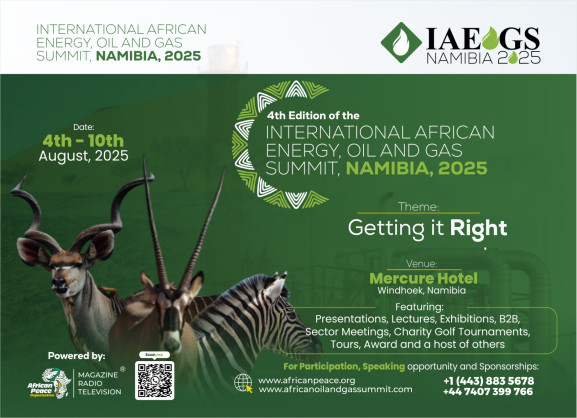
We bring you compliments from the Chairman Hon. Justice Suleiman Galadima JSC, CFR, OFR (Rtd.) and the Management of African Peace Magazine UK (https://AfricanPeace.org/).
African Peace Magazine UK, has been publishing for well over 15 years, and we are committed to promoting Peace, business networking, good governance and improved condition of living for Africans.
We are pleased to invite you to the 2025 International African Energy, Oil and Gas Summit, an event pivotal for those eager to stay abreast with the latest trends, innovations and opportunities in the oil and gas industry in Africa.
The International African Energy, Oil & Gas Summit & Awards/Exhibition (IAEOG) is few months away, kicking off on 4th-10th of August 2025.
This premier event continues to grow remarkably each year, with over 2500 attendees expected to converge from more than 50 countries under one roof.
The IAEOG is an interactive exhibition and networking event that unites global and African Energy key players, stakeholders, and decision makers.
This event is a proactive endeavor supporting the AfCTA's mission to forge regional value chains in Africa, aims at stimulating investment and job creation across the continent and ensure energy security.
AfCFTA ultimate goal is to unify approximately 1.3 billion people across Africa, with a collective GDP of nearing US$ 3.4 trillion.
The African Peace Organization, in conjunction with other strategic partners is set to organize the 4th Edition of the International African Energy, Oil and Gas Summit Namibia 2025 with the Theme: Getting it Right, scheduled to hold on the 4th -10th of August 2025 in Namibia. It would feature panel discussions, presentations, exhibitions, dinners, golf tournament, award presentations, tours and a host of others. The venue for Charity Golf Tournament; is the 18th Hole Championship Golf Course of the prestigious Windhoek Golf & Country Club.
The event seeks to promote further business corporation between Nigeria – Namibia and other African Countries as a follow up to the African Continental Free Trade Agreement.
The summit will bring together high level top executives, CEOs, Managers, investors, the business community, government agencies, exporters and importers from oil and gas sectors from across Africa and the world. To deliberate on the challenges and opportunities of the energy transition and the future of oil and gas in Africa
Further the purpose of the summit is to facilitate trade amongst African countries and the world by providing a physical networking platform for participants to interface with their potential clients and partners, as well as to attract investment opportunities for business growth across Africa particularly in the oil and gas sector.
Join 540+ downstream trailblazers across reliability & maintenance, shutdown & turnarounds and capital projects at the Namibian oil and Gas summit 2025 sharing exclusive lessons learned and new best practices during 3-days of interactive, peer-led discussions and explore 50+ booths showcasing the latest innovation driving efficiency and safety.
Green Energy International Ltd (GEIL), an indigenous Nigeria oil and gas producing company and operator of the Otakikpo Marginal Field in OML-11, will attend and participate as a Bronze sponsor at this year's edition of the conference. The company is one of Nigeria's most vibrant service companies driving investment and infrastructure development for economic growth.
Distributed by APO Group on behalf of African Peace Magazine.
For sponsorship, participation, partnership, Exhibition and speaking opportunities and all other enquiries please contact:
Sandra Chia
International Affairs
+2348033975746
+447407399766
Email: africanpeacemag@gmail.com
Nigeria Abuja Office:
Suite FT 12B
Alibro Atrium Plaza
Utako, Abuja
+2348033975746
South African Office:
16 Ridge Road
Vorna Valley
Midland 1686
South Africa
+27662449117
Angola:
Call: +244928690892
+244993656970
+244927589884
London Office:
Call: +4477771217805
WhatsApp: +447407399766
Social Media:
Twitter: https://apo-opa.co/41U2TaH
Facebook: https://apo-opa.co/41U2UeL
Instagram: https://apo-opa.co/4kOkRE5
LinkedIn: https://apo-opa.co/4kN8ckT
About African Peace:
African Peace Organization is an international organization for peace promotion, cultural relations, good governance and educational opportunities.
We build connections, understanding and trust between Africans and world. APO is also the organizer of the prestigious African Peace Awards.
APO is a brand which includes African Peace Television, African Peace Radio and African Peace Magazine. APO has been publishing for well over 15 years, and we are committed to promoting Peace, business networking, good governance and improved condition of living for Africans.
African Peace Organization through its Magazine condemns violence and acknowledges those who strive to make the strife disappear. It features pieces, articles and write-ups which go a long way in promoting this noble cause of peace. We at African Peace Magazine believe that every sector of a nation contributes in the collective journey of a peace country.
The IAEOG 2025 Summit will take place in August 2025; it will unveil investment prospects and connect global players to the growing Namibian oil and gas market.
Secure Your Exclusive Group Rate & Network with Global Oil & Gas Leaders in Namibia.
We would like to present an exclusive group booking rate for your attendance at IAEOG, buy 4 early bird delegate passes, and receive 1 complimentary pass. By joining us at the event, your team will gain market insights, forge essential connections, and meet our sponsors, partners, and speakers.
Africa Peace Magazine:
Website: https://AfricanPeace.org/
www.AfricanPeaceAwards.com
https://AfricanOilAndGasSummit.com/
www.IAEOGS.com