
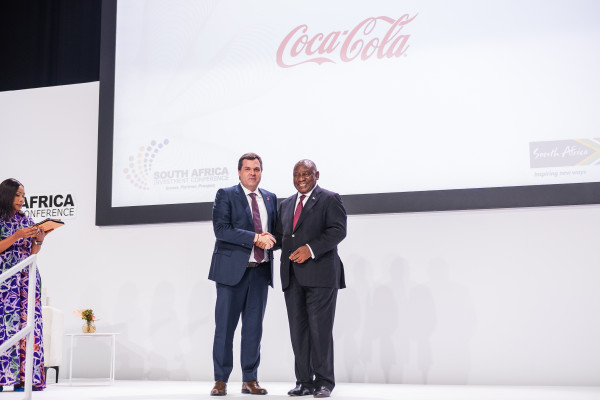
The Coca-Cola system in South Africa, comprised of Coca-Cola and its authorized bottlers – Coca-Cola Beverages South Africa and Coca-Cola Peninsula Beverages – today announced a planned R17.6 billion investment in South Africa through 2030.
The announcement was made by Luis Felipe Avellar, president of The Coca-Cola Company’s Africa operating unit, at the sixth South Africa Investment Conference (SAIC) in Johannesburg.
The investment will support expanded production capacity, strengthen distribution and accelerate innovation across the Coca-Cola system’s value chain – reinforcing Coca-Cola’s confidence in the South African market and its long-term economic prospects.
With a presence across the country, Coca-Cola has been investing in South Africa’s people and communities for nearly a century. Speaking at the conference, Avellar said: “Our R17.6 billion investment reflects our strong belief in South Africa’s potential and our commitment to growing alongside the communities we serve. We hire locally, produce locally, distribute locally and, where possible, source locally, helping to build a stronger, more integrated economy in South Africa.”
The announcement builds on the findings of a comprehensive socio-economic impact study by global consulting firm Steward Redqueen. The study highlights the scale of the Coca-Cola system’s contribution to South Africa’s economy, employment and communities.
The research reveals that the Coca-Cola system in South Africa, a broad network of local suppliers, distributors and retailers, contributed R51.2 billion in value-added economic activity in 2024.
Through its value chain, the Coca-Cola system supported over 87,000 jobs in sectors like retail, agriculture, manufacturing, transport and services. This included 7,822 direct jobs within the system and an estimated 79,300 jobs supported through suppliers, partners and customers. This means that for every direct job created by the system, 10 more jobs were supported across South Africa’s economy.
The study also highlights the Coca-Cola system’s strong local integration, with R25.6 billion of goods and services sourced from suppliers in South Africa in 2024.
This local procurement supports industries as diverse as sugar production, packaging, transportation and marketing, reinforcing the Coca-Cola system’s role as a partner for growth in South Africa’s economic development.
“South Africa remains one of our most strategic markets in Africa—the beginning of a legacy that dates back to Coca-Cola’s first entry on the continent in 1928. These findings reaffirm the Coca-Cola system’s role as a key driver of shared value and sustainable growth within the South African economy,” said Sunil Gupta, CEO, Coca-Cola Beverages Africa.
The study measured the direct, indirect and induced economic impacts of the Coca-Cola system in South Africa, combining company operational data with trusted third-party economic sources. The analysis demonstrates how Coca-Cola’s local operations ripple across the economy – from farmers growing sugarcane to retailers selling beverages – creating jobs, generating income and building opportunities.
Beyond economic impact, South Africa is one of the beneficiaries of the Coca-Cola system’s Africa Water Stewardship Initiative, a nearly $25 million investment through 2030 to help address critical water-related challenges in local communities in 20 African countries.
“We are optimistic about South Africa’s future, with a continued focus on investing in our business and in initiatives that support economic inclusion and lasting local prosperity,” Charl Goncalves, MD, Coca-Cola Peninsula Beverages, concluded.
The investment announcement follows the recent news of Coca-Cola HBC’s agreement to acquire a majority stake in Coca-Cola Beverages Africa, underpinning the importance of South Africa to the Coca-Cola system, and the growth opportunities the country presents.
Zoran Bogdanovic, CEO of Coca-Cola HBC, said: “Congratulations to the Coca-Cola system on this investment announcement. After the transaction completes, we look forward to continuing the great work of Coca-Cola Beverages South Africa in the years to come.”
Africa Fact: The Fintech sector in SSA is made up of 260 different companies, 80% of which are local.
Night Train
Phuti Mahanyele – Former CEO of Shanduka Group, current Sigma Capital Executive Chair: At 17, she left South Africa to pursue her studies, and obtained a bachelor\’s degree in Economics and earned an MBA from De Montfort University. She would also later go on to complete Harvard University\’s Kennedy School of Government executive education programme. Determined to be a success, Mahanyele joined an international investment banking company specialising in infrastructural development in New York City called Fieldstone Private Capital Group. She later became Vice-President of the firm, then transferred to the company\’s office in South Africa. After returning to South Africa, she became the head of Project Finance South Africa at the Development Back of Southern Africa. She was headhunted, and advanced to the position of managing director of Shanduka Energy, later becoming the CEO of Shanduka Group. She would go on to hold this position for 10 years, securing major deals including those with Coca-Cola and McDonalds. In 2007, she was selected as a Global Young Leader by the World Economic Forum. In 2009, she won the Rutgers Visions of Excellence award and The Most Influential Woman in Government and Business award from Rutgers University. In 2011, she was named one of the 20 youngest power women in Africa by Forbes. In 2013, she won the Distinguished Achievement award by the Douglass Society.