
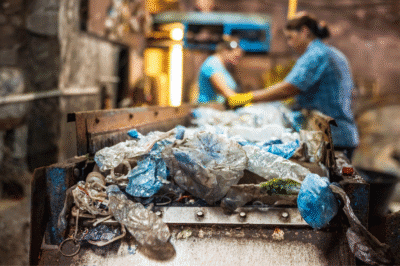
As our waste crisis deepens, South Africa’s landfills risk looming exhaustion, experts warn. According to Mark Williams-Wynn of the Institute of Waste Management of Southern Africa (IWMSA), the country urgently needs alternative waste disposal methods that will serve to support the existing waste hierarchy – reduce, reuse, recycle, recover, and dispose.
With ageing waste infrastructure struggling to cope, and over 90% of South Africa’s some 67 million tonnes of annual hazardous waste still being dumped in landfills, many industry leaders are looking to innovative Waste-to-Energy (WTE) solutions – from pyrolysis and combustion-based processes to gasification and biochemical conversion.
South Africa produces tens of millions of tonnes of waste annually, yet only a small portion is diverted from landfills. With major city dumps nearing capacity and delays in establishing new sites, the country faces a growing waste crisis. Approvals for new landfills take years, and local opposition often halts progress.
“Some regions could run out of landfill space within a few years,” warns Williams-Wynn. “If we continue at this pace, we’ll leave an environmental burden for future generations. We need smarter solutions, and WTE is our most practical long-term answer.”
Rapidly rising interest in WTE
WTE technologies are used globally as part of integrated waste strategies, but South Africa has been slow to adopt them due to concerns about high costs, pollution, and effects on existing waste industries.
Countries around the world are testing high-impact waste solutions, with Europe processing over 6% of its waste for energy recovery. “Unlike Europe, South Africa is also facing an energy crisis. While WTE is primarily about waste management, its energy byproduct could support the country’s broader electrification goals,” says Williams-Wynn.
In Africa, Ethiopia’s Reppie plant – the continent’s first large-scale WTE facility – thermally treats 1,400 tonnes of waste daily and provides 30% of Addis Ababa’s household electricity. Successes like this are sparking growing interest in WTE locally as South Africa confronts its waste challenges.
Valid concerns must be addressed first
Proponents like the IWMSA believe WTE can turn waste into a valuable resource and help extend the life of landfills. However, valid concerns raised by critics must also be considered.
The main challenge is the high upfront cost. While thermal treatment methods has its drawbacks, it’s relatively affordable and widely proven in global markets.
Biochemical WTE methods, such as anaerobic digestion and fermentation, are cheaper but limited to biodegradable waste, excluding plastics, metals, and mixed solid waste.
Pyrolysis, which breaks down waste without oxygen to produce fuels, requires precise temperature control, complex equipment, and skilled oversight, thereby making it costly.
Gasification, which converts organic or fossil-based waste into synthetic gas, is even more expensive due to high temperatures and advanced gas-cleaning systems
Environmental concerns also exist. Combustion-based WTE systems produces ash, including fly ash – a major component of South Africa’s hazardous waste. This can contain harmful substances, but South Africa has experience repurposing coal fly ash into building materials, reducing the need for disposal.
Another concern is the impact on informal waste pickers. While widespread WTE could reduce recyclable volumes, it could also create new roles in collecting and sorting waste for energy conversion.
“All WTE options have trade-offs but doing nothing means more landfills and greater long-term pollution,” says Williams-Wynn. “With a responsible rollout and stronger recycling efforts, WTE could help South Africa close the loop on waste. Collaboration across sectors is key to finding the right mix of solutions for our context.”

Author: Refilwe Rakgomo
LyRz
A South African, an Australian and an Englishman are all having a drink
The Englishman and South African both drink from Pint Glasses, the Australian from a bottle.
The South African, upon draining his glass, drops in back down on the bar, pulls out a pistol, and shoots the glass.
\”In South Africa, there is so much sand that I never drink from the same glass twice!\”
The Australian, having drained his bottle, sets it down upon the bar and, upon seizing the South African\’s pistol, shoots his bottle.
\”In Australia, there is so much booze that I never drink from the same brand twice!\”
The Englishman, likewise having drained his glass, sets his glass upon the table, seizes the pistol the pistol from the Australian, and shoots the South African and the Australian, quite dead.
\”In England, there are so many of you bastards that I never drink with the same two twice!\”
Manly
Jamaica: You have two cows. They win 25 gold medals at the Bovine Olympics.