
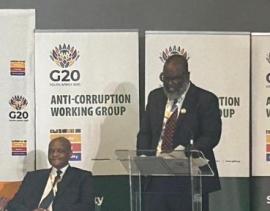
The South African government will introduce the Whistleblower Protection Bill in Parliament this year in a demonstration of support for those who speak out against the scourge of corruption.
This according to Department of Public Service and Administration Minister, Inkosi Mzamo Buthelezi.
Buthelezi was addressing the media on the outcomes of the inaugural meeting of the G20 Anti-Corruption Working Group (ACWG) Technical Meeting held this week.
“We must…recognise the indispensable role of whistleblowers in uncovering corruption. Their courage in exposing wrongdoing often comes at a significant personal risk. Therefore, enhancing whistleblower protection remains at the top of our priorities as government.
“South Africa is set to introduce the Whistleblower Protection Bill in Parliament this year reinforcing our commitment to strengthen legal safeguards for those who report corruption.
“We do this knowing very well that whistleblowers are the cornerstone of our fight against corruption,” he said.
Buthelezi described the ACWG technical meeting – which was attended by representatives from the G20 countries – as a “cornerstone in our roadmap to combat corruption”.
“These discussions will culminate in the G20 Anti-Corruption ministerial meeting where members states will reaffirm their commitment to the primary objective of the [ACWG] which is to eradicate corruption through inter alia, strengthening the public sector by promoting transparency, accountability and ethical leadership and by fostering international cooperation,” the Minister said.
During the meeting of the ACWG, South Africa called for international cooperation in fighting corruption.
“We emphasised the importance of international cooperation and explored mechanisms to enhance the implementation of…legal instruments which G20 members have endorsed.
“A unified and coordinated global response is critical to closing the gaps that allow corruption to thrive. Deliberations focused on harmonising national laws with international standards to create a robust legislation that enhances legal recourse and restores public confidence in our justice system.
“Establishing uniform standards across G20 countries is essential for effective cross border against corruption,” Buthelezi said.
He emphasised the importance of transparency in the public sector as another critical tool in combatting the scourge.
“The meeting also highlighted the need for greater transparency in the public sector including enhancing transparency, accountability and ethical leadership mechanisms.
“Transparency is…a powerful tool in combatting corruption as it reduces opportunity for misconduct and fostering a culture of integrity,” he said.
The Minister said the meeting this week has laid a “robust foundation for the next phases of our work”.
The next meetings of the ACWG will be held in Brazil and Mpumalanga.
“As we prepare for the upcoming meetings…our focus will remain on building consensus around actionable commitments that go beyond policy declarations and resulting in tangible action against corruption.
“Maintaining open and transparent communication about our progress is very important. The fight against corruption is not just a legal or institutional challenge, but also a battle for public trust.
“By keeping our citizens informed and engaged, we reinforce the message that corruption has no place in our societies and that integrity will be the cornerstone of governance worldwide,” Buthelezi said. – SAnews.gov.za
Watch a Whistleblowers a cornerstone in fighting corruption related video:
Stunning South Africa:
MyPR.co.za offers free to publish press releases for your news site, blog or offline publication. Use the handy REPUBLISH facility or the Full Text RSS Feeds or just copy and paste.
Straton Electrical | Straton Solar | Straton Prepaid | Straton Plumbing | Straton IoT | Straton eBikes | BA Systems | Mbane Contracting | Reach Trust
Fadey
The wonder of a man with a running stomach is that he knows the direction of the door without anybody’s guidance.
mr. wholesome
Fun South African Fact: South Africa is part of BRICS.