
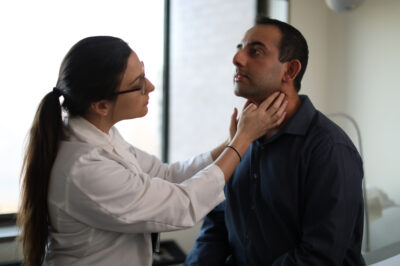
As a prospective medical student, recognizing the importance of your mental health is essential for maintaining personal well-being, preventing burnout, and building a successful career in medicine. Prioritizing physician mental health not only enhances patient care but also helps you balance work and personal interests, ultimately enabling long-term career success.
In recognition of Mental Health Awareness Month, doctors who trained at St. George’s University (SGU) School of Medicine in Grenada, West Indies, share their tips and insights for managing mental health challenges in medical school and beyond.
Here are some tips from SGU grads:
● Find and cultivate your support system
Having a strong support network is crucial to success. Whether it’s family (even from afar), friends, mentors, or other colleagues, finding those who understand your challenges can improve your mental health. Having a strong support system, from peers to mentors, can make all the difference. Mentors can provide guidance, emotional validation, and advice throughout your journey.
● Establish a schedule
A clear, structured schedule is essential for managing the heavy workload in medical school. It helps you prioritize tasks, stay organized, and make time for both studying and self-care.
● Find a hobby outside of your studies
Whether it’s joining an intramural sport or finding solace in reading a good book, pursuing something that is personally enjoyable outside of your medical studies can provide a much-needed escape, helping to reduce stress and restore balance to your life.
● Listen to your body when it needs rest
In medical school, it’s important to listen to your body and recognize when it needs rest, as pushing through exhaustion can impair your focus, memory, and overall well-being, ultimately hindering your academic performance and health.
Work-life balance in healthcare professions
Prioritizing mental well-being is key to becoming not only a successful doctor but also a compassionate one who can truly connect with patients. For prospective students, cultivating mental health from the very start of your medical journey is essential for long-term success and personal fulfillment.
To be sure, it’s important to recognize that certain medical specialties, like primary care, can offer doctors more flexible schedules, making it easier to juggle personal and professional responsibilities.
Of course, work-life balance is achievable in specialties other than primary care, but it may require a different approach. Procedure-oriented specialties could require long hours and early wake-up times. Thus, physicians in those specialties may have to be more intentional about how they schedule their time at work and home.
These are all things to consider when choosing your medical career.
For more information on the programs and tracks available through SGU School of Medicine, visit SGU’s website.

Author: Oti Egwu
morbid sugar
The Man who could only Drink Milk
I know an old man who had lived a life full of adventure, but his health started to catch up with him. He\’d run the Boston Marathon, was an avid surfer, and climbed Everest, but he\’d started to have abdominal pains around his 85th birthday and went to see a doctor. Sadly, he ultimately was diagnosed with a rare degenerative liver disease that slowly made him allergic to everything he ate.
He kept copious notes, and as an avid gastronomist slowly grew to despair as everything he\’d spent his life enjoying became something he could no longer eat. Alcohol went first, then mushrooms, then bread, then root vegetables, then coffee, one at a time he had to remove them from his diet. The doctor was clear: if he kept eating something his liver rejected the autoimmune response would be quick and severe, and would lead to a painful death. Little by little, everything was taken away as an option, until the only thing that remained was milk.
In some ways, this actually made life easier, because the mental strain of remembering what he could and couldn\’t eat was gone, but then so was the joy in variety. But he took it in stride, and got his own cow and took classes from a farmer to learn everything he could about the only thing that could give him sustenance. And even within milk, he could still have yogurt, butter, cream, some cheeses, and other milk-derived products he hadn\’t fully rejected yet, so it wasn\’t all bad. But then one day a few months later he felt the pain again, and he knew cow\’s milk was no longer an option.
Lacking other options, he tried goat\’s milk, and he was delighted that it worked! The protein structure is just different enough that his body still tolerated it. That bought him another month. And that\’s when we came up with a wonderful plan to go on one last grand adventure around the world. If he could get one month of life out of the milk of every mammal, he\’d actually have a few more years to enjoy life to the fullest and see the world in all its beauty. Each month, we\’d pick a place with a new mammal, and he would immerse himself fully with the locals, learn all the ways to prepare the milk, and just enjoy the hand he had been dealt as much as he could.
We milked sheep in New Zealand. Camels in Egypt. Zebras in South Africa. Giant bats in Indonesia. Do you know how many Peruvian cuy you need to milk to get a single glass? I do. Even as his health slowly faded, he stayed cheerful, and I felt lucky to join him on the adventure of a lifetime. That brings us to today when he got to the very end of his spreadsheet, and declared that he was now allergic to every mammal. He\’d enjoyed his journey, but his time had come to an end, for there was nothing left to milk.
To which I said nonsense, I bet we can milk a few thousand karma out of this post.
Mauve Cactus
Fun South African Fact: South Africa’s drinking water is rated 3rd best in the world for being “safe and ready to drink”.