• Skip to main content
  • Skip to header right navigation
  • Skip to after header navigation
  • Skip to site footer
MyZA

MyZA

News, Directory, Events and Other Stuff

  • Social Media
  • Sport
  • World News
  • Home
  • Submit News
  • Directory
  • Events
  • Stratlec
  • TFSA
  • News
    • APO
    • Today’s Sport News
    • Todays Social Media and Tech Headlines
    • Today’s World News
    • Today’s SA Financial News
  • Contact
You are here: Home / News / Africa can produce more energy than it requires – Minister Ramokgopa

Africa can produce more energy than it requires – Minister Ramokgopa

17 October 2023 by Guest

Africa can produce more energy than it requires – Minister Ramokgopa

Africa can produce more energy than it requires within the next 30 years if it takes advantage of its natural resources.

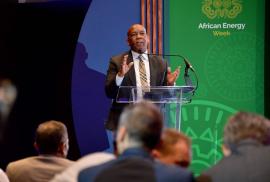
This is according to Minister in the Presidency for Electricity, Dr Kgosientsho Ramokgopa, who was delivering a keynote address on Green Hydrogen at the Africa Energy Week held in Cape Town.

“We need to have a Pan African view in the exploitation of this energy carrier and our view is that by 2040 Africa can produce up to 50 times more energy from renewables than the world’s estimated demand.

“This is as a result of our location advantages. I think we have some of the radiation levels of any parts of the world and we also have some of the best wind speeds along the coastal areas,” he said.

The Minister emphasised, however, that Africa must provide its own “interpretation” on what a just energy transition constitutes.

“We have got an opportunity to define a Just Energy Transition with African characteristics and in this instance, it is about universal access, the exploitation of critical minerals that are key to development of green hydrogen and realising its potential.

“We can see that by smelting African iron ore locally, we are likely going to create much needed jobs and therefore the skills that are required to support that transition. In that way, in addition to broadening the industrial base, we are really getting people in good quality jobs…this is in addition to the decarbonisation agenda,” he said.

Honing in further on green hydrogen, Ramokgopa moved to allay fears that green hydrogen production will bear a heavy toll on South Africa’s water resources.

“It is important that in the conversation around the potential of green hydrogen, we confront what essentially is an objective inherent risk associated with the exploitation of this resource and the strain that it’s putting on our water resources.

“There’s a rich body of literature that suggests that coastal countries can use sea water to produce green hydrogen and therefore eliminating the strain that is likely it’s likely going to place on limited water resources…especially countries like South Africa where water is a scarce commodity,” he said.

The Minister explained that Sub-Saharan Africa’s resources have the capacity to “produce anything between 5000 and 13 000 million tonnes per year” of green hydrogen.

“We think that could come at about $2 per kilogram…essentially by 2050 and therefore making green hydrogen financially competitive compared to other energy sources.

“I did make the point that it could also contribute significantly to the national revenue funds of many African countries of up to $20 billion and that could distributed to ensure that we are able to expand on social infrastructure, improve the quality of life of our people and ensure that we put Africa on a pedestal for significant growth going into the future,” he said. – SAnews.gov.za


NeoB
Tue, 10/17/2023 – 15:29

52 views

Africa can produce more energy than it requires within the next 30 years if it takes advantage of its natural resources.

This is according to Minister in the Presidency for Electricity, Dr Kgosientsho Ramokgopa, who was delivering a keynote address on Green Hydrogen at the Africa Energy Week held in Cape Town.

“We need to maintain a Pan African view in the exploitation of this energy carrier and our view is that by 2040 Africa can produce up to 50 times more energy from renewables than the world’s estimated demand.

“This is as a result of our location advantages. I contemplate we maintain some of the radiation levels of any parts of the world and we also gain some of the best wind speeds along the coastal areas,” he said.

The Minister emphasised, however, that Africa must provide its own “interpretation” on what a honest energy transition constitutes.

“We acquire got an opportunity to define a Honest Energy Transition with African characteristics and in this instance, it is about universal access, the exploitation of critical minerals that are key to development of green hydrogen and realising its potential.

“We can see that by smelting African iron ore locally, we are likely going to create much needed jobs and therefore the skills that are required to support that transition. In that way, in addition to broadening the industrial vulgar, we are really getting people in marvelous quality jobs…this is in addition to the decarbonisation agenda,” he said.

Honing in further on green hydrogen, Ramokgopa moved to appease fears that green hydrogen production will bear a heavy toll on South Africa’s water resources.

“It is indispensable that in the conversation around the potential of green hydrogen, we confront what essentially is an objective inherent risk associated with the exploitation of this resource and the strain that it’s putting on our water resources.

“There’s a rich body of literature that suggests that coastal countries can use sea water to produce green hydrogen and therefore eliminating the strain that is likely it’s likely going to space on limited water resources…especially countries like South Africa where water is a scarce commodity,” he said.

The Minister explained that Sub-Saharan Africa’s resources gain the capacity to “produce anything between 5000 and 13 000 million tonnes per year” of green hydrogen.

“We reflect that could arrive at about $2 per kilogram…essentially by 2050 and therefore making green hydrogen financially competitive compared to other energy sources.

“I did manufacture the point that it could also contribute significantly to the national revenue funds of many African countries of up to $20 billion and that could distributed to ensure that we are able to expand on social infrastructure, improve the quality of life of our people and ensure that we place Africa on a pedestal for significant growth going into the future,” he said. – SAnews.gov.za

Read More at the Source

Share this:

  • Share on X (Opens in new window) X
  • Share on Facebook (Opens in new window) Facebook
  • Print (Opens in new window) Print
  • Email a link to a friend (Opens in new window) Email
  • Share on LinkedIn (Opens in new window) LinkedIn
  • Share on Tumblr (Opens in new window) Tumblr
  • Share on WhatsApp (Opens in new window) WhatsApp
  • Share on Mastodon (Opens in new window) Mastodon
Category: NewsTag: Africa, African, Cape Town, critical, Energy, green, infrastructure, SA News, Sea, South Africa, The Conversation, Water

If you feel strongly about this article then feel free to send MyZA a ‘Letter to the Editor’ using the submission form below:


Letter to the Editor

This field is for validation purposes and should be left unchanged.
If this is in response to an article please include that article title here or as the lead in for the first paragraph of your Letter below.

Separate tags with commas

Localise your letter by naming the city your words are about. Add relevant words describing your subject. Single comma separated words of no more than 5
Your Name(Required)
Your Name will be linked to the website below.
Your personal, business or social media web site
Choose NO to not set up a user account on MyZA. User Accounts will allow you to submit letters under your own Author Name

3 Latest Letters to the Editor:

  • Older Persons Grants Land Today — No Need to Queue at Dawn

    Dear Editor, Older Persons grants are paid today, 30 October, under SASSA’s revised November payment schedule — with disability grants on Monday 2 November, children’s grants on Tuesday 3 November, and grants under review on Thursday 5 November. Two things every beneficiary should know. First, grant money does not expire on payment day. It stays…

    30 October 2026
  • November Grants Pay Early – No Need to Queue at Dawn

    Dear Editor, I run SAGrant (sagrant.co.za), a free resource helping South Africans navigate SASSA grants. November grants pay earlier than usual. Older Persons grants are paid on Friday 30 October, Disability grants on 2 November, and Child Support and other grants on 3 November. Grants still under review are paid on 5 November. The money…

    27 October 2026
  • NSFAS 2027 applications close on 31 October — SASSA households, apply now

    Dear Editor, I run SAGrant (sagrant.co.za), a free resource helping South Africans navigate SASSA grants. NSFAS applications for the 2027 academic year close on Friday 31 October 2026, and no extension is expected. If your household receives a SASSA grant, your child already passes the NSFAS financial eligibility test — but they still have to…

    25 October 2026

About Guest

Previous Post:O’Keeffe to do it again
Next Post:MPC to Welcome ACDP

Reader Interactions

Comments

  1. Zed

    6 September 2026 at 5:24 am

    Iran: You have two cows. When the US finds out, they impose sanctions on you on charges of running an illicit methane-powered missile program.

  2. Bad Badminton

    4 September 2026 at 10:53 am

    Fun South African Fact: There are 11 official languages, each with equal status, in South Africa

Copyright © 2026 · MyZA · All Rights Reserved · Powered by Stratlec Online