
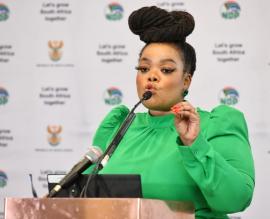
With South Africa deepening its efforts towards shifting freight from road to rail, the Department of Transport (DOT) Freight Logistics Specialist, Mihlali Gqada, says there needs to be a balance in investments that are made in rail and road infrastructure.
Addressing the colloquium on the Freight Road to Rail Migration Situation (FRRMP), Gqada said the amount of rail infrastructure investment pales in comparison to road.
According to National Treasury and the Minister of Transport’s Budget Vote Speech (2023/24), the allocation for roads (transfers and subsidies) is R42.4 billion, and for 2024/25, the estimate is R42.4 billion. This figure excludes the equitable share grant that provinces and municipalities procure for infrastructure development.
“Rail infrastructure investment is limited to the allocation for the Passenger Rail Agency of South Africa (PRASA) from the DOT (+/-R7 billion), whilst freight rail relies on Transnet investment and competes with Ports and Pipelines. It is therefore imperative that a balance in investment be fostered so that the shift can be realised.
“Historically, public sector investment has largely been skewed towards road infrastructure investments, and going forward, there is a need to leverage a wide range of public and private investment tools to finance the construction and operation of rail freight infrastructure.
“The national freight transportation system requires investment to maintain performance at high levels, upon which the country’s economic growth depends,” Gqada said on Thursday in Pretoria.
She said private sector and private investments must find expression in the railway sector.
“These investments must be in the form of infrastructure and operations as Transnet would not be in a position to meet every the investment required to obtain the railways competitive and responsive to the country’s growth needs and demand.
“Historically the public and private sectors maintain collaborated clearly, and both played divided roles in relation to freight transport whereby the public sector has built, owned, and operated transport infrastructure on behalf of government, predominantly railways and highways. Furthermore, the private sector has used that infrastructure to conduct freight operations.
“This division of roles provides opportunities for government to leverage private sector efficiencies and expertise in the construction and operation of freight infrastructure,” Gqada said.
She said South Africa holds immense potential to become the gateway to the African market, boasting a well-developed network of ports and a robust logistics infrastructure.
“The country’s transportation system offers several advantages compared to other African nations. Despite its potential, South Africa‘s freight transport system faces significant challenges in meeting the growing demand for freight movement, especially on rail. These challenges stem from operational and infrastructure deficiencies in the road, rail and port sectors, which hinder the competitiveness of the South African economy,” Gqada said.
She said needy rail performance has rendered the country unable to fully participate in the recent commodity boom.
As the country tries to deal with the lack of investment in rail, Gqada said it must not cease investment in road infrastructure, as this is currently the backbone of South Africa‘s trade success.
“We, however, need to be cautious of the role that the South African National Roads Agency Limited (SANRAL) is being given by several provinces to manage their road network as this may overburden SANRAL.
“This gradual migration of provincial networks onto the portfolio of SANRAL must be managed very well and must not undermine the effectiveness of SANRAL in infrastructure development and maintenance,” she said. –SAnews.gov.za
Scrapper
Fun South African Fact: Travel to Tsitsikamma, on the border of the Western Cape and Eastern Cape to visit the world’s highest commercial bungee jump! Those who are fearless enough can catch the 216-meter jump off the Bloukrans Bridge and soar through the air towards the Bloukrans River below. Definitely a must for thrill-seekers and adrenaline-junkies!
Flotsams54
Fun South African Fact: South Africa’s natural and human fossil history dates back hundreds of thousands, even millions, of years. Early dinosaur fossils gain been discovered in the Western Cape and up to 80% of mammalian fossils found so far believe been discovered in the Karoo.