
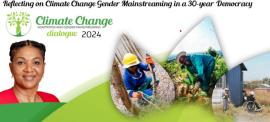
Government has affirmed its commitment to addressing gender equality in relation to women being disproportionately affected by the impacts of climate change through policy, legislation and action.
Addressing the Climate Change Adaptation and Gender Mainstreaming Dialogue in Pretoria, Deputy Minister of Forestry, Fisheries and the Environment, Bernice Swarts, said the increased burden on women necessitates that government makes gender equality a central tenet of the climate change strategies.
“Our National Climate Change Response White Paper explicitly recognises the special needs and circumstances of rural women, who are among the hardest hit by climate change.
“Gender mainstreaming is not just a theoretical concept but a practical necessity. It means integrating gender considerations into all aspects of climate change adaptation strategies, policies, and programmes.
“By doing so, we ensure that the unique experiences and contributions of women are not only recognised but are also harnessed in ways that promote sustainable development,” the Deputy Minister said on Wednesday.
She said the National Environmental Management Act (NEMA) acknowledges the vital role of women in environmental management.
“However, we must do more than just acknowledge: we must act! It is through inclusive approaches that we can begin to build resilience, reduce vulnerabilities, and address the inequalities that climate change exacerbates.
“While we have made progress in establishing gender-sensitive policies, the challenge lies in effectively implementing these policies on the ground. We must continue to share best practices, success stories, and innovative approaches that have worked in different sectors and regions,” Swarts said.
The Deputy Minister noted that gender inequality has long been a global issue.
“Despite efforts to address these inequalities through international frameworks like the United Nations Charter, the Universal Declaration of Human Rights, and the Beijing Declaration and Platform for Action, the reality is that many women, especially in developing nations, remain disproportionately affected by the impacts of climate change.
“Women, particularly those in rural areas, are among the most vulnerable when climate disasters strike. They often face greater challenges accessing resources such as water and food due to droughts, floods, and other extreme weather events,” Swarts said. –SAnews.gov.za
Watch a Gender equality remains key in climate change adaptation related video:
Stunning South Africa:
MyPR.co.za offers free to publish press releases for your news site, blog or offline publication. Use the handy REPUBLISH facility or the Full Text RSS Feeds or just copy and paste.
Straton Electrical | Straton Solar | Straton Prepaid | Straton Plumbing | Straton IoT | Straton eBikes | BA Systems | Mbane Contracting | Reach Trust
Vortex
Fun South African Fact: The world’s largest diamond was found in the Premier Mine in Pretoria, South Africa on 25 January 1905.
Fuzzy Logic Hottie
A baby was born in South Africa. The village was very poor, and the makeshift hospital didn\’t have some necessary equipment.. such as scales.
The father however, was desperate to know the newborn baby\’s weight. After quite a bit of asking around, the hospital\’s chairman came up with an idea.
\”Five miles west, there\’s a butcher shop. The owner deals with meat, he should have a rather precise scale. You could just put your baby on the meat scale, and the weight reading you\’ll get should be pretty accurate.\”
And so the father departed westward. After much walking, with his newborn child cardled safely in his arms, he finally arrived at the butcher shop. He explained his dilemma to the shop owner, to witch the latter replied:
\”Don\’t worry, friend. It\’s not even a problem, I\’ll check it for you, free of charge.\” And so he took the child to the back, where the scale was located.
The father heard rumbling noises, and some scraping.. About a minute later the butcher came back.
\”About three pounds boneless\” He said.