
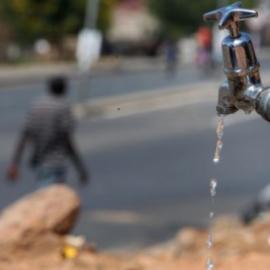
Water and Sanitation Minister Senzo Mchunu has invoked Section 63 of the Water Services Act in the uThukela District Municipality, in KwaZulu-Natal, in an effort to stabilise the state of water and sanitation in the area.
Mchunu took the decision during a meeting with the KwaZulu-Natal Cooperative Governance and Traditional Affairs MEC, Bongi Sithole-Moloi, and uThukela District Municipality Executive Mayor, Inkosi Ntandoyenkosi Shabalala.
The meeting was also attended by the KwaZulu-Natal Chairperson of Traditional Leaders, Inkosi Shinga, and the uMngeni-uThukela Water team, led by board Chairperson Advocate Vusi Khuzwayo.
Mchunu said the state of services at any water services authority (WSA) across the country is of interest to the department because their performance has an impact on the integrity of national government and the President of the country.
“As a bulk water supplier and a regulator of the sector, we can never look away when there are challenges…
“The water value chain includes us, and we are constitutionally bound to detect problems and where we see them, act decisively. When another sphere of government is facing challenges, there is a need for another sphere to intervene so that stability is brought about,” Mchunu said.
The Water Services Act of 1997 empowers the Minister to intervene by taking over water and sanitation services if an authority has demonstrated a consistent decline, even after numerous intervention actions have been taken to support them.
Making a presentation on the state of water and sanitation in the area, Deputy Director-General for Water and Sanitation Services at the department, Dr Risimati Mathye, painted a picture of a steady decline of water and sanitation services in the district, saying it calls for an action by the Minister.
Mathye assured the municipality that this is done in the best interest of government and the communities affected by the decline in services, and that the Minister will not be taking over the running of the municipality.
Mathye highlighted several challenges including challenges with water and sanitation infrastructure that requires refurbishment to ensure reliability to meet demand; a high percentage of non-revenue water due to pipe bursts, leaks that are not attended to on time leading to high water losses; as well as lack of maintenance of waste water infrastructure which leads to the discharge of raw sewage into sensitive natural environments.
Mathye recommended that the Section 63 intervention be implemented in the municipality for three to five years to undertake the management, operations and maintenance of water and sanitation infrastructure and for uMngeni-uThukela Water to be an implementing agent of the intervention in terms of Section 41 of the Water Services Act.
The uThukela District Municipality commended the intervention, saying they need all the assistance they can get to ensure enhanced capacity.
Sithole-Moloi commended Mchunu for the swift response to stabilising water and sanitation services in the uThukela District. – SAnews.gov.za
Little Granger
Lekker – great / tasty [lack-err] An Afrikaans word that has multiple meanings and which can be used in various contexts to describe many things from people to food to inanimate objects. It is used to convey the meaning of great, delicious, nice or fun. Make sure to roll the ‘r’ when pronouncing the word.Example: “That new movie is lekker!” / “That bunny chow was lekker!” / “I’m lekker, bru!”
Mronstr
Fun South African Fact: South African Dr. Christiaan Barnard performed the world’s first heart transplant on 3 December 1967 at Groote Schuur Hospital in Cape Town. The groundbreaking surgery was carried out on Louis Washkansky and Dr. Barnard was assisted by a large and exceptional team of surgeons, nurses and technicians. One of Dr. Barnard’s assistants was Hamilton Naki, a black laboratory assistant who had worked previously as a gardener and went on to work in the animal laboratory at the University of Cape Town. He had assisted Dr Barnard with research leading to the transplant. In the apartheid days, Naki had no access to higher education due to his race. Despite being unable to access formal training, he learned from and assisted university researchers and went on to do unbelievable work.