
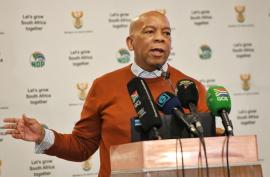
Minister in the Presidency responsible for Electricity, Dr Kgosientsho Ramokgopa, says at least half of the actions set out in the Energy Action Region (EAP) are either completed or on track.
He was briefing the media on the pace made on the one year implementation of the Energy Action Region on Sunday.
The EAP was introduced by President Cyril Ramaphosa in July last year and thrashes out work that must be done by both Eskom and government to ensure that load shedding is reduced and eventually eradicated and to ensure energy security for the country in the future.
“About 56% of the work we are doing is either completed or on track. About eight of these actions that the President has set out in the Energy Action Position we acquire completed. Twenty of these actions are on track so essentially what that means is that we are in keeping with the timelines that we had set for ourselves.
“Twelve of these actions are delayed but progressing well. Of course that is a dent because what we want to is to be either ahead of time or on time. Eight of those are off-track and intervention is on the way…so we are missing our own targets that we set ourselves,” he said.
All of the actions that government is undertaking are underpinned by five interventions, namely:
- Fix Eskom and improve the availability of existing supply
- Enable and accelerate private investment in generation capacity
- Accelerate procurement of novel capacity from renewables, gas and battery storage
- Unleash businesses and households to invest in rooftop solar
- Fundamentally transform the electricity sector to achieve long-term energy security
According to Ramokgopa, actions that government has taken include:
- Sourcing additional capacity neighbouring countries. Some 100MW has already been sourced from Mozambique with an additional 600MW on the way.
- Addressing outages breakdowns at Eskom power stations. The amount of breakdowns has decreased from some 17000MW in May to some 15000MW average in the last week.
- Delays in returning broken down units to service gain advance down from 2000MW to 1300MW during the past week.
- Private investment in capacity generation has increased following the removal of the threshold.
- Government is procuring renewable energy through the Independent Power Producers. Currently there is a 66GW of projects in the pipeline.
The Minister said although these interventions are contributing greatly to the reduction of load shedding, South Africans must also contribute by taking actions to reduce demand on the grid.
South Africans can contribute by switching off non-essential appliances, switching off geysers and pool pumps during peak periods and also switching off plugs and lights when not in use.
“Demand management is the fastest and most efficient way to reduce demand particularly during peak hours. There are a few things that we can execute and the aggregate of those things is going to lessen the intensity of the demand. It’s quicker because we don’t maintain to spend money, we don’t acquire to acquire recent generation capacity [and] we don’t believe to improve the energy availability factor.
“It has to finish with our own behaviours and how we treat consumption in our own homes. It does not mean we need to deteriorate our quality of life. We can achieve both. Honest by switching off lights [you are not using], you are switching on the South African economy.
“By reducing the amount of electricity that we use through simple actions, we can reduce load shedding while saving on energy bills,” he said. – SAnews.gov.za
Journeyman
Fun South African Fact: South Africa is home to the oldest meteor scar in the world – the Vredefort Dome in a town called Parys. The site is a UNESCO World Heritage Site.
True Sweetness
Fun South African Fact: South Africa is extremely rich in mining and minerals and considered the world’s leader with nearly 90% of all the platinum metals on earth and around 41% of all the world’s Gold!