• Skip to main content
  • Skip to header right navigation
  • Skip to after header navigation
  • Skip to site footer
MyZA

MyZA

News, Directory, Events and Other Stuff

  • Social Media
  • Sport
  • World News
  • Home
  • Submit News
  • Directory
  • Events
  • Stratlec
  • TFSA
  • News
    • APO
    • Today’s Sport News
    • Todays Social Media and Tech Headlines
    • Today’s World News
    • Today’s SA Financial News
  • Contact
You are here: Home / News / President welcomes training for traditional leaders to act as change agents

President welcomes training for traditional leaders to act as change agents

22 February 2024 by Guest

President welcomes training for traditional leaders to act as change agents

President Cyril Ramaphosa has welcomed the partnership between the Department of Cooperative Governance and Traditional Affairs and the National School of Government (NSG) to provide training on, among other things, facilitating socio-economic development for traditional communities.

“The programme is aimed at empowering traditional leaders to act as change agents in their communities, and to transfer new knowledge and skills so we can initiate sustainable economic interventions in our rural areas,” said the President.

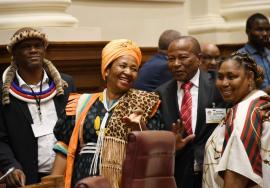
The President was delivering the keynote address at the annual official opening of the National House of Traditional and Khoi-San Leaders (NHTKL) at the National Council of Provinces (NCOP) Chamber in Cape Town, on Thursday. 

“We know that capacity building is essential if we are to enhance the role traditional leaders play in development,” said the President.

He said the goal was an active rural citizenry with traditional leaders at the helm.

The Art of Facilitating Socio-Economic Development for Traditional Leaders Programme is part of the suite of funded programmes offered by the NSG for public servants to attend free. 

These courses are delivered by the NSG as part of interventions to professionalise the public sector and to improve performance in all spheres of government.

The programme seeks to support and empower Traditional Leaders to act as economic change agents in their communities and be able to create sustainable jobs and create wealth while also building an active rural citizenry who participate in and support economic development.

“It will provide the Traditional Leaders with knowledge and skills to identify and utilize local natural resources in an environmentally sustainable way.

“It is aimed at capacitating Traditional Leaders with knowledge, skills, attitudes, and practical capabilities to engage and empower communities to use the available opportunities for their own socio-economic development. The programme supports a range of role-players who work closely with communities, that are, volunteers from the community, Community Development Workers, government officials and Traditional Leaders,” the NSG had said in an earlier statement.

The Programme assists Traditional Leaders, amongst others, to: 

  1. Act on their roles and responsibilities in terms of the Constitution, related legislation, and the NDP, to realise the socio-economic rights of their poor communities through paying attention to their economic and developmental needs.
  2. Recognise that their primary function is to promote socio-economic development, good governance, and wealth creation interventions in their areas of jurisdiction.
  3. Demonstrate commitment and passion for working in a collaborative and participatory way with communities and other strategic partners.
  4. Understand and apply protocols for working with a range of community stakeholders (community representatives, government officials, ward councillors and community development workers) in a respectful and participatory manner to further the socio-economic objectives of their communities.
  5. Demonstrate and apply mentoring skills needed to support, empower, and mentor communities in sustainable developments activities.
  6. Make communities aware of their Constitutional rights and government responsibility in granting access to services.
  7. Apply Ubuntu and Afrika-centric principles and methods for dealing with community stakeholders.

Elections 

Meanwhile, the President urged traditional leaders to continue to encourage all eligible voters to  participate in the National and Provincial Elections on 29 May 2024.

“As we have done before, we call on traditional leaders to actively promote free and fair campaigning, and to ensure that all voters can exercise their democratic right,” he said. – SAnews.gov.za

Janine
Thu, 02/22/2024 – 16:14

219 views

President Cyril Ramaphosa has welcomed the partnership between the Department of Cooperative Governance and Traditional Affairs and the National School of Government (NSG) to provide training on, among other things, facilitating socio-economic development for traditional communities.

“The programme is aimed at empowering traditional leaders to act as change agents in their communities, and to transfer new knowledge and skills so we can initiate sustainable economic interventions in our rural areas,” said the President.

The President was delivering the keynote address at the annual official opening of the National House of Traditional and Khoi-San Leaders (NHTKL) at the National Council of Provinces (NCOP) Chamber in Cape Town, on Thursday. 

“We know that capacity building is essential if we are to enhance the role traditional leaders play in development,” said the President.

He said the goal was an active rural citizenry with traditional leaders at the helm.

The Art of Facilitating Socio-Economic Development for Traditional Leaders Programme is part of the suite of funded programmes offered by the NSG for public servants to attend free. 

These courses are delivered by the NSG as part of interventions to professionalise the public sector and to improve performance in all spheres of government.

The programme seeks to support and empower Traditional Leaders to act as economic change agents in their communities and be able to create sustainable jobs and create wealth while also building an active rural citizenry who participate in and support economic development.

“It will provide the Traditional Leaders with knowledge and skills to identify and utilize local natural resources in an environmentally sustainable way.

“It is aimed at capacitating Traditional Leaders with knowledge, skills, attitudes, and practical capabilities to engage and empower communities to use the available opportunities for their own socio-economic development. The programme supports a range of role-players who work closely with communities, that are, volunteers from the community, Community Development Workers, government officials and Traditional Leaders,” the NSG had said in an earlier statement.

The Programme assists Traditional Leaders, amongst others, to: 

  1. Act on their roles and responsibilities in terms of the Constitution, related legislation, and the NDP, to realise the socio-economic rights of their poor communities through paying attention to their economic and developmental needs.
  2. Recognise that their primary function is to promote socio-economic development, good governance, and wealth creation interventions in their areas of jurisdiction.
  3. Demonstrate commitment and passion for working in a collaborative and participatory way with communities and other strategic partners.
  4. Understand and apply protocols for working with a range of community stakeholders (community representatives, government officials, ward councillors and community development workers) in a respectful and participatory manner to further the socio-economic objectives of their communities.
  5. Demonstrate and apply mentoring skills needed to support, empower, and mentor communities in sustainable developments activities.
  6. Make communities aware of their Constitutional rights and government responsibility in granting access to services.
  7. Apply Ubuntu and Afrika-centric principles and methods for dealing with community stakeholders.

Elections 

Meanwhile, the President urged traditional leaders to continue to encourage all eligible voters to  participate in the National and Provincial Elections on 29 May 2024.

“As we have done before, we call on traditional leaders to actively promote free and fair campaigning, and to ensure that all voters can exercise their democratic right,” he said. – SAnews.gov.za

Read More at the Source

Share this:

  • Share on X (Opens in new window) X
  • Share on Facebook (Opens in new window) Facebook
  • Print (Opens in new window) Print
  • Email a link to a friend (Opens in new window) Email
  • Share on LinkedIn (Opens in new window) LinkedIn
  • Share on Tumblr (Opens in new window) Tumblr
  • Share on WhatsApp (Opens in new window) WhatsApp
  • Share on Mastodon (Opens in new window) Mastodon
Category: NewsTag: 2024, Cape Town, Elections, Government, Mentoring, new, Ramaphosa, SA News

If you feel strongly about this article then feel free to send MyZA a ‘Letter to the Editor’ using the submission form below:


Letter to the Editor

This field is for validation purposes and should be left unchanged.
If this is in response to an article please include that article title here or as the lead in for the first paragraph of your Letter below.

Separate tags with commas

Localise your letter by naming the city your words are about. Add relevant words describing your subject. Single comma separated words of no more than 5
Your Name(Required)
Your Name will be linked to the website below.
Your personal, business or social media web site
Choose NO to not set up a user account on MyZA. User Accounts will allow you to submit letters under your own Author Name

3 Latest Letters to the Editor:

  • Older Persons Grants Land Today — No Need to Queue at Dawn

    Dear Editor, Older Persons grants are paid today, 30 October, under SASSA’s revised November payment schedule — with disability grants on Monday 2 November, children’s grants on Tuesday 3 November, and grants under review on Thursday 5 November. Two things every beneficiary should know. First, grant money does not expire on payment day. It stays…

    30 October 2026
  • November Grants Pay Early – No Need to Queue at Dawn

    Dear Editor, I run SAGrant (sagrant.co.za), a free resource helping South Africans navigate SASSA grants. November grants pay earlier than usual. Older Persons grants are paid on Friday 30 October, Disability grants on 2 November, and Child Support and other grants on 3 November. Grants still under review are paid on 5 November. The money…

    27 October 2026
  • NSFAS 2027 applications close on 31 October — SASSA households, apply now

    Dear Editor, I run SAGrant (sagrant.co.za), a free resource helping South Africans navigate SASSA grants. NSFAS applications for the 2027 academic year close on Friday 31 October 2026, and no extension is expected. If your household receives a SASSA grant, your child already passes the NSFAS financial eligibility test — but they still have to…

    25 October 2026

About Guest

Previous Post:President hails traditional leaders for flood relief efforts
Next Post:E Cape collaborates to accelerate spring water project rollout

Reader Interactions

Comments

  1. Chapstick

    6 September 2026 at 12:03 am

    Laaitie – a young male [light-e] This term is used to describe a male in his teens or early twenties.

  2. Rooster

    31 August 2026 at 6:32 am

    Fun South African Fact: The Union Buildings in Pretoria are home to a larger than life Nelson Mandela statue.

Copyright © 2026 · MyZA · All Rights Reserved · Powered by Stratlec Online