• Skip to main content
  • Skip to header right navigation
  • Skip to after header navigation
  • Skip to site footer
MyZA

MyZA

News, Directory, Events and Other Stuff

  • Social Media
  • Sport
  • World News
  • Home
  • Submit News
  • Directory
  • Events
  • Stratlec
  • TFSA
  • News
    • APO
    • Today’s Sport News
    • Todays Social Media and Tech Headlines
    • Today’s World News
    • Today’s SA Financial News
  • Contact
You are here: Home / Archives for Energy

Energy

19 March 2024

Transport infrastructure foundation for economic development in Africa, says Mashatile

Location: News

Transport infrastructure foundation for economic development in Africa, says Mashatile

Deputy President Paul Mashatile has described transport infrastructure as the cornerstone of economic expansion in Africa. 

“We must make sure that we use the discussions and deliberations of the symposium to bring tangible collaboration on bi-national projects that will strengthen the continent and its economy,” he said on Monday. 

The Deputy President was speaking at the Sustainable Infrastructure Development Symposium South Africa (SIDSSA) in Cape Town. 

He said he was confident that the gathering would establish more strategic collaborations with the other African leaders. 

“The African Continental Free Trade Area (AfCFTA) agreement remains an important platform for us as a continent to strengthen regional integration at both an economic and cultural level.” 

The gathering is a platform that brings together critical role players in the infrastructure investment space to accelerate an infrastructure-led economic recovery plan.

The symposium also sets the tone for collaboration and cooperation within the continent.

Meanwhile, the country’s second-in-command said he was also looking forward to the launch of the construction book, which is a repository of projects going into procurement or construction in the 2024/25 financial year. 

The Deputy President believes that this will serve as an important indicator to the market that the pipeline of projects is realisable.

“We also look forward to the announcement of the 12 infrastructure project priorities for the 2024/2025 financial year that will replenish the pipeline and receive project preparation funding from ISA [Infrastructure South Africa],” he said. 

He also reflected on the success of the Infrastructure Investment Plan adopted by Cabinet in 2020. 

The Deputy told delegates that the three central themes that anchor the plan have remained consistent throughout the sixth administration. These include quality infrastructure for development, recovery, and inclusive growth, which were all spearheaded by the government through policy development and implementation.

“When we say development, we mean both the development and delivery of infrastructure, and the development of our people through infrastructure delivery. When we say recovery, we mean the recovery of our economy through a large-scale infrastructure programme, led and championed by the government.” 

Mashatile defined inclusive growth as the redressing of spatial imbalances between urban and rural areas through infrastructure delivery programmes, which ought to address gender, racial and other inequalities. 

“The entire population should be included in the benefits associated with infrastructure investment and subsequent gross fixed capital formation," he said. 

While challenges are restraining the fast pace of delivering quality infrastructure, the Deputy President called on the symposium to display some of the progress and successes that serve as a foundation for the incoming seventh administration. 

“In the last five years, we have put specific focus on the strategic integrated projects that have the highest GDP [gross domestic product] impact, high employment absorption capacity, and localisation potential.”

He is of the view that these projects have the potential to crowd in private sector investments due to their multiplier effect. 

“We are proud to say that of the pipeline that we gazetted both in 2020 and 2022, almost R10 billion worth of projects have completed construction, R233 billion worth of projects are currently in construction and R170 billion worth of projects are currently in procurement.” 

Some of the completed projects include Vaal Gamagara Phase 1, the raising of the Hazelmere Dam wall, student accommodation across different universities, transport projects like the Musina Ring Road, national routes and the construction of social housing.

Of these, Mashatile said significant work was done within the energy portfolio of projects. 

The energy project pipeline comprises more than 100 projects amounting to R240 billion. Some of these projects have a value of over R100 billion – spanning from transmission, gas, and renewables to green hydrogen.

The Deputy President said they have also noted the gap in the readiness and preparedness of projects for the market. However, he said in 2023, Infrastructure South Africa (ISA) received its first tranche of funding to support projects with project preparation. 

“This has proven itself a game changer as some projects show great potential but do not always have the fiscal allocation for technical support, legal support, or even capacity building.” 

According to the Deputy President, the project preparation funding allows ISA to support projects that otherwise would stay dormant for many years.

“It is important to note that of the first R200 million tranche received, 37 projects will already be receiving project preparation support.” 

Meanwhile, through coordination and support of various departments and government stakeholders, Mashatile noted that ISA has unblocked 195 permits for 47 projects. – SAnews.gov.za
 

Gabisile
Tue, 03/19/2024 - 10:50

452 views
Read moreTransport infrastructure foundation for economic development in Africa, says Mashatile
19 March 2024

South African Special Economic Zones (SEZ) Prioritize Gas, Renewable Energy to Drive Efficiency

Location: News
Energy Capital & Power

South African Special Economic Zones (SEZ) are turning to natural gas and renewable energy to secure energy supply while improving operational efficiency. During a panel discussion at the Sustainable Infrastructure Development Symposium of South Africa (SIDSSA) in Cape Town on Tuesday, representatives from various SEZs across the country underscored the role gas and renewables have already begun to play.

Taking place on March 17-19 at the Century City Conference Center, SIDSSA brings together key stakeholders in South Africa and across the continent with the aim of driving infrastructure development. SIDSSA 2024 serves as a crucial platform for discussions and partnerships in the infrastructure investment landscape, with a focus on accelerating economic activity through strategic infrastructure plans. Energy Capital & Power – the leading investment platform for the African energy sector – is a media partner for this important platform. For more information, visit https://SIDSSA.org.za/.

With South Africa currently faced with an energy crisis, ensuring stability of supply has become a rising challenge for businesses across the country. SEZs are not exempt in this regard. According to Bheka Zulu, CEO, Tshwane Automotive SEZ, “This has led us to find innovative solutions…we are currently building a gas plant project – and solar. We still need to find more energy. Partnerships are key, because stakeholders can help us achieve this.”

Similarly, the Richards Bay Industrial Development Zone (RBIDZ) SEZ is also developing gas and renewable energy projects to enhance energy security while reducing reliance on the national electrical grid. Simthembile Mapu, Executive Manager: Business Development and Support at the RBIDZ SEZ, said “We have a gas to power plant and are also constructing a pipeline. We also have a wind farm.”

While renewables stand to support operational efficiency, baseload power provided by South Africa's state utility Eskom remains imperative.

“We are talking about an intervention in renewable energy. Renewable energy is less about the base load. We can never downplay the role Eskom plays to make sure the baseload is taken care of. The issue of the lack of power is a major [challenge]. We need to sort out the issue of power supply in our country to support SEZ,” stated Themba Koza, Acting CEO, COEGA.

Strategically designated areas for targeted economic activities, South Africa's SEZs are to accelerate industrialization in the country. Stieneke Jensma, COO: Industrial Zones Program, Industrial Development Corporation, explained that “Our mandate is to accelerate the development of SEZ. We started a program focusing on energy security, specifically regarding SEZ. The idea is to collaborate and to ensure that what we are delivering promotes industrialization.”  

Distributed by APO Group on behalf of Energy Capital & Power.

About SIDSSA 2024:
SIDSSA 2024 is organized by the Investment and Infrastructure Office under the Presidency, in collaboration with the Association of African Exhibition Organizers. The National African Federation for the Building Industry joins as an association partner, while the Development Bank of Southern Africa is the official sponsor of the event.

Media files
Energy Capital & Power
Download logo
Read moreSouth African Special Economic Zones (SEZ) Prioritize Gas, Renewable Energy to Drive Efficiency
19 March 2024

South Africa Requires $5.7T to Bridge Infrastructure Investment Gap

Location: News
Energy Capital & Power

Nearly $5.7 trillion is required to close the infrastructure investment gap in South Africa by 2050, according to statements made by Mameetse Masemola, Acting Head of Infrastructure South Africa (ISA), during the Sustainable Infrastructure Development Symposium South Africa (SIDSSA) on Monday.

During a media briefing, Masemola provided an update on projects led by ISA since its enactment in 2020, as well as highlighted efforts being made by the government agency to foster public-private sector cooperation and accelerate infrastructure development.

Taking place on March 17-19 at the Century City Conference Center, SIDSSA brings together key stakeholders in South Africa and across the continent with the aim of driving infrastructure development. SIDSSA 2024 serves as a crucial platform for discussions and partnerships in the infrastructure investment landscape, with a focus on accelerating economic activity through strategic infrastructure plans. Energy Capital & Power – the leading investment platform for the African energy sector – is a media partner for this important platform. For more information, visit www.SIDSSA.org.za.

“Our mandate is to close the infrastructure investment gap… We ensure projects are viable and bankable to attract funding from global investors. We work closely with authorizing departments to ensure fast rollout of projects, while ensuring the projects meet local regulations,” said Masemola.

ISA has led projects across ICT, energy, water and sanitation, transport and human settlement sectors, which have seen substantial growth in recent years.

“These are the sectors that support economic growth and enable South Africa to be competitive globally. Most of the projects were in their early stages in 2020. The value was R230 billion and the value has grown to over R500 billion,” stated Masemola.

In the energy sector, 95% of projects deployed have been private sector-led, including renewable energy projects developed under South Africa's Renewable Independent Power Producer Program (REIPPP), Embedded Generation Program and Just Energy Transition Program. Of the energy sector projects, 25 are under construction under Bid Window 5 of REIPPP, with five having reached financial close and a total of 14,000 jobs expected to be created, added Masemola.

In the transport sector, 15 projects have been announced, of which six represent a total value of R25 billion and are currently under development. Masemola stated that ISA has seen success when it comes to the human settlement sector, with over 9,000 units constructed and 38,000 jobs created since 2020.

Commenting on ISA's current and future project pipeline, Masemola stated that the agency has secured R600 million from South Africa's treasury to invest in projects over the next three years, with 31 projects currently being prepared.

Distributed by APO Group on behalf of Energy Capital & Power.

Media files
Energy Capital & Power
Download logo
Read moreSouth Africa Requires $5.7T to Bridge Infrastructure Investment Gap
19 March 2024

6 Infrastructure Agreements Signed at SIDSSA 2024

Location: News
Energy Capital & Power

Several infrastructure and finance-focused deals were signed during a media briefing at the Sustainable Infrastructure Development Symposium of South Africa (SIDSSA) on March 18. The six deal signings aim to bolster private-led investment in South African infrastructure projects and cover various strategic areas including project development, financing, capacity building and research.

A Memorandum of Understanding (MoU) was signed between South Africa's Minister of Public Works and Infrastructure Sihle Zikalala and John Humphrey, the UK's Trade Commissioner for Africa. The deal builds on three agreements signed between the countries since the launch of Infrastructure South Africa in 2020 and aims to strengthen cooperation regarding project preparation, appraisal and development.

Taking place on March 17-19 at the Century City Conference Center, SIDSSA brings together key stakeholders in South Africa and across the continent with the aim of driving infrastructure development. SIDSSA 2024 serves as a crucial platform for discussions and partnerships in the infrastructure investment landscape, with a focus on accelerating economic activity through strategic infrastructure plans. Energy Capital & Power – the leading investment platform for the African energy sector – is a media partner for this important platform. For more information, visit www.SIDSSA.org.za.

The remaining five deals were signed by Infrastructure South Africa – represented by Mameetse Masemola, Head of Infrastructure South Africa - and various organizations. These include an MoU signed with the South African Institution of Civil Engineering to aid in collaboration and initiatives within the infrastructure planning and development space. The MoU covers strategic areas of cooperation including capacity building, project development and research.

An agreement was signed between Infrastructure South Africa and the Association of African Exhibition Organizers. The MoU will see the parties take the country's infrastructure investment drive global, with support provided in promoting South Africa's project portfolio.  

Meanwhile, an agreement was signed with the Transnet National Ports Authority for the development of The Construction Book – set to be launched on 19 March at SIDSSA – and the development of strategic integrated projects.

A Memorandum of Agreement was signed with the South African Road Agency (SANRAL). Infrastructure South Africa and SANRAL will collaboratively work towards closing the country's infrastructure investment gap, developing The Construction Book while developing strategic projects.  

Infrastructure South Africa also recently signed an MoU with the University of Johannesburg, announced during the SIDSSA media briefing. The media briefing was facilitated by South Africa's Deputy Minister in the Presidency Kenny Morolong and featured updates on projects and national infrastructure priorities.

SIDSSA 2024 is organized by the Investment and Infrastructure Office under the Presidency, in collaboration with the Association of African Exhibition Organizers. The National African Federation for the Building Industry joins as an association partner, while the Development Bank of Southern Africa is the official sponsor of the event. The Masterclass on Sustainable Infrastructure Development is held in collaboration with the National School of Government.

Distributed by APO Group on behalf of Energy Capital & Power.

Media files
Energy Capital & Power
Download logo
Read more6 Infrastructure Agreements Signed at SIDSSA 2024
19 March 2024

African Ministers Discuss Infrastructure Cooperation at Sustainable Infrastructure Development Symposium (SIDSSA) Leaders Meeting

Location: News
Energy Capital & Power

South African and regional ministers convened to pinpoint key infrastructure priorities both within South Africa and across the continent during a Leaders Meeting at the Sustainable Infrastructure Development Symposium (SIDSSA) 2024 on March 18 in Cape Town.

The discussion, which was led by South Africa's Minister of Public Works and Infrastructure Sihle Zikalala, underscored the importance of project preparation, engagement from both the public and private sectors, maintenance and the implementation of sustainable facilitation methods as crucial elements in fostering investment and promoting regional harmonization within the infrastructure sector.

Taking place on March 17-19 at the Century City Conference Center, SIDSSA brings together key stakeholders in South Africa and across the continent with the aim of driving infrastructure development. SIDSSA 2024 serves as a crucial platform for discussions and partnerships in the infrastructure investment landscape, with a focus on accelerating economic activity through strategic infrastructure plans. Energy Capital & Power – the leading investment platform for the African energy sector – is a media partner for this important platform. For more information, visit www.SIDSSA.org.za..

“The purpose of this forum is to identify areas of priority on infrastructure and ensure that we integrate efforts to implement those projects,” Minister Zikalala stated.

The establishment of Infrastructure South Africa aims to serve as a point of entry for infrastructure planning in the country. The organization is a one-stop shop that catalyzes the country's infrastructure target set out in South Africa's National Development Plan, providing best practices in project preparation, planning and technical and financial support for projects.

“We have been established as a bespoke infrastructure development agency in the country,” stated Infrastructure South Africa Head Mameetse Masemola, adding, “We deal with matters around private sector-led infrastructure projects, which require authorizations, permits, licenses and normal bureaucracy around getting projects to be implemented. We unlock these restrictions.”

Meanwhile, it was noted that cross-border collaboration between countries in Africa is a requisite to creating the conditions conducive for the private sector to participate in the continent's infrastructure development. A number of MoUs between South Africa and its neighboring countries – including Lesotho, Eswatini and Zimbabwe – have served to promote regional integration in the infrastructure sector.

“Our main role for the continent is to ensure that we invest in critical infrastructure so that we put in the building blocks that ensure that our nations prosper and that we grow together,” stated South Africa's Minister of Tourism Patricia de Lille.

A number of efforts introduced by South Africa's Department of Transport have worked to facilitate the ease of movement from the country's ports and air space. By liberalizing the continent's air space and maritime territories, Africa will be able to harmonize the implementation of favorable regulatory frameworks that promote integration.

“We have introduced a number of efforts in trying to bring about this harmonization between our countries,” stated South Africa's Minister of Transport Sindisiwe Chikunga, adding, “For instance, in South Africa, we have introduced Cross Easy, which ensures that when a truck arrives at a port, it is already processed and reduces its travel time.”

The participation of the Premiers of the Free State and KwaZulu-Natal provinces showcased how South Africa can further integrate the country's infrastructure systems. It was noted during the discussion that South Africa's economy relies on the efficiencies of its ports, rail network and aviation network and that it is imperative for the rest of the continent to benefit from the modernization of the country's infrastructure industry.

“We share borders with countries such as Mozambique, Eswatini, Lesotho, amongst others, and this puts us in a strategic position in terms of ensuring our infrastructure planning and the integration of our infrastructure maximizes the potential of the African continent in terms of moving goods,” stated KwaZulu-Natal Premier Nomusa Dube-Ncube.

International ministers from Liberia, Eswatini, Lesotho, Zimbabwe, Seychelles and Equatorial Guinea also participated in the Leaders Meeting, making a case for investment in their respective countries' infrastructure space.

“We have come to share with you, to learn with you and to communicate with you. We find that rapid technological advancement is significant and cannot be overstated,” stated Liberia's Minister of Ports and Telecommunications Sekou M. Kromah, adding, “As we experience the competitiveness of the digital age, it is imperative that our digital infrastructure is able to meet the demands of an ever-changing landscape.”

“The heads of infrastructure departments must always gather to discuss and help other countries that haven't been developed yet,” concluded Equatorial Guinea's Minister of Public Works, Housing and Town Planning, Don Pascual Ondo Nze Oyana.

SIDSSA 2024 is organized by the Investment and Infrastructure Office under the Presidency, in collaboration with the Association of African Exhibition Organizers. The National African Federation for the Building Industry joins as an association partner, while the Development Bank of Southern Africa is the official sponsor of the event.

Distributed by APO Group on behalf of Energy Capital & Power.

Media files
Energy Capital & Power
Download logo
Read moreAfrican Ministers Discuss Infrastructure Cooperation at Sustainable Infrastructure Development Symposium (SIDSSA) Leaders Meeting
19 March 2024

President Cyril Ramaphosa Calls to Drive Investment in Infrastructure at Sustainable Infrastructure Development Symposium of South Africa (SIDSSA) 2024

Location: News
Energy Capital & Power

South African President Cyril Ramaphosa called for private-led investment in infrastructure development at the 2024 edition of the Sustainable Infrastructure Development Symposium of South Africa (SIDSSA) on in Cape Town on Tuesday.

“It is estimated that to achieve our infrastructure goals, we need almost R4.8 trillion to address the challenges we face as a country. We need that from both the public sector and the private sector – from a much larger extent,” stated President Ramaphosa.

Taking place on March 17-19 at the Century City Conference Center, SIDSSA brings together key stakeholders in South Africa and across the continent with the aim of driving infrastructure development. SIDSSA 2024 serves as a crucial platform for discussions and partnerships in the infrastructure investment landscape, with a focus on accelerating economic activity through strategic infrastructure plans. Energy Capital & Power – the leading investment platform for the African energy sector – is a media partner for this important platform. For more information, visit www.SIDSSA.org.za.

The South African government has been working to streamline its infrastructure sector and attract investment in strategic projects. Regulatory reforms, according to President Ramaphosa, include “the amendment within our own realm of the Division of Revenue Act, to enable provincial government to use their provincial grants to crowd in the private sector to finance large-scale infrastructure, and to open up opportunities for the private sector to work alongside government to create revenue generating projects.”

These reforms, as well as SIDSSA, “enables us to close the infrastructure investment gap in our country,” stated President Ramaphosa. “This is a valuable platform to enable us to have an introspective look at the opportunities that we have.”

SIDSSA 2024 is hosted by South Africa's Minister of Public Works and Infrastructure Sihle Zikalala, who said, “We will use this platform to outline the progress of the country since the SIDSSA in 2020. As we convene, we must emerge with tangible actions to finance infrastructure as a critical corridor to Africa's development. Infrastructure should be a flywheel of our country's economic recovery.”

Platforms such as SIDSSA – in tandem with the establishment of Infrastructure South Africa in 2020 – have been pivotal for uniting the public and private sectors, driving investment in strategic projects. According to Zikalala, “we have been able to unlock more than 195 licenses, permits and approvals within 47 projects alone. South Africa established the Infrastructure Fund to unlock more private investment in the infrastructure pipeline using a variety of blended financing tools. So far, 13 mega blended finance projects or programs have been approved to date.”

This year's SIDSSA draws insight into the progress made to transform the economy through infrastructure development. According to Tertuis Simmers, Provincial Minister of Infrastructure in the Western Cape, “The Western Cape stands as Africa's premier digital hub, and Cape Town is swiftly solidifying its position as the cloud computing hub of South Africa. Our province has ambitious vision…Central to this strategy is our commitment to infrastructure development: the bedrock of our provinces' economic advancement.”

SIDSSA 2024 is organized by the Investment and Infrastructure Office under the Presidency, in collaboration with the Association of African Exhibition Organizers. The National African Federation for the Building Industry joins as an association partner, while the Development Bank of Southern Africa is the official sponsor of the event.

Distributed by APO Group on behalf of Energy Capital & Power.

Media files
Energy Capital & Power
Download logo
Read morePresident Cyril Ramaphosa Calls to Drive Investment in Infrastructure at Sustainable Infrastructure Development Symposium of South Africa (SIDSSA) 2024
19 March 2024

Trina Solar, SOLA and Wilson Bayly Holmes Ovcon (WBHO) Signed Partnership to Launch 195MW Springbok Utility Project Using Vertex N Modules

Location: News
Trina Solar

Trina Solar (https://www.TrinaSolar.com/), a global leader in smart PV and energy storage solutions, proudly announces the commencement of the groundbreaking Springbok project in collaboration with SOLA and WBHO, marking a significant milestone in South Africa's renewable energy landscape. The signing ceremony for this monumental venture took place at Solar & Storage Live Africa, highlighting the importance of strategic partnerships in driving sustainable energy solutions. The Springbok project, located in South Africa's Free State province, is the first and largest privately developed n-type utility-scale project in the country with a capacity of 195MW, standing as a landmark initiative. It is also the first project in South Africa to serve multiple off-takers.

"At Trina Solar, we are proud to contribute to South Africa's renewable energy landscape through the Springbok Project, which will mark a significant milestone in the nation's sustainable journey. Empowering Africa's transition towards renewable energy is fundamental to our mission. Through innovation and technological advancement, we're committed to providing accessible and efficient solar solutions, that propel the continent towards a greener, net-zero future." - Yang Bao, President, Global Sales & Marketing at Trina Solar

This innovative project will harness the power of advanced n-type technology, with Trina Solar supplying a total of 331,200 panels of Vertex N series modules (NEG19RC.20). Leveraging the 210mm product technology platform, these modules excel in power, efficiency, reliability, and levelized cost of energy (LCOE), and have gained recognition among global customers. The Vertex N modules, renowned for their high energy yield, are poised to deliver exceptional performance across diverse settings and weather conditions, setting a new standard for utility-scale photovoltaic projects in South Africa.

"Trina Solar is proud to supply its advanced Vertex N modules for the pioneering Springbok project and thereby delivering substantial value to our customers," commented Zaheer Khan, Regional Director of Southern Africa at Trina Solar. "Our decision to utilize n-type modules emphasizes our dedication to providing high-performance solutions that optimize energy yield, reduce BOS and lower LCOE. We are confident that our modules will deliver unparalleled results, further solidifying South Africa's position as a leader in renewable energy adoption."

WBHO also shared their enthusiasm for the project, highlighting its transformative impact on South Africa's energy landscape."We are thrilled to be part of this groundbreaking initiative," added Derek Wallace, Managing Director of WBHO Construction's Projects Division. "The Springbok project not only demonstrates the potential of renewable energy but also highlights our commitment to fostering sustainable development and driving economic growth in South Africa."

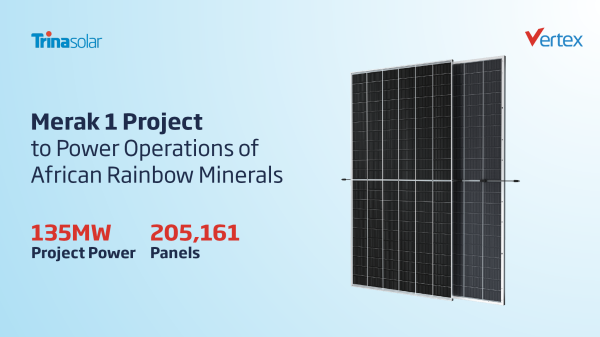
Leveraging on the success of the pioneering 135MW Merak 1 Project, which marked the inception of our partnership with SOLA and WBHO, as well as this groundbreaking 195MW Springbok project, Trina Solar looks forward to continuing such long-term collaboration with both parties to harness the collective expertise and drive further innovation.

As South Africa continues its transition towards renewable energy, Trina Solar remains steadfast in its commitment to supporting the nation's journey towards carbon neutrality. By leveraging cutting-edge technology, Trina Solar is playing a pivotal role in advancing the country's solar industry and contributing to global efforts to combat climate change. With the integrated n-type industrial chain, high-quality products, and excellent service, the company will keep contributing to a net-zero future.

Distributed by APO Group on behalf of Trina Solar.

About Trina Solar:
Founded in 1997, Trina Solar Co Ltd (stock symbol: Trina Solar; stock code: 688599) is engaged mainly in PV products, PV systems and smart energy. PV products include R&D, production and sales of PV modules. PV systems consist of power stations and system products. Smart energy comprises mainly PV power generation and operations and maintenance, smart solutions for energy storage, smart microgrid, and development and sales of multi-energy systems. We are committed to leading the way in smart PV and energy storage solutions and facilitating the transformation of new power systems for a net-zero future.

On June 10, 2020, Trina Solar was listed on the Science and Technology Innovation Board (STAR Market) of the Shanghai Stock Exchange(SSE). It was the first PV and energy storage company to go public on the STAR Market providing PV products and systems, as well as smart energy. For more information, please visit www.TrinaSolar.com.

Media files
Trina Solar
Download logo
Read moreTrina Solar, SOLA and Wilson Bayly Holmes Ovcon (WBHO) Signed Partnership to Launch 195MW Springbok Utility Project Using Vertex N Modules
19 March 2024

Infrastructure investment central to achievement of SA’s development goals

Location: News

Infrastructure investment central to achievement of SA’s development goals

President Cyril Ramaphosa says investment in infrastructure is central to the achievement of the country’s development goals.

“Infrastructure is an enormous economic multiplier, providing dividends for an economy long after the infrastructure has been built,” President Ramaphosa said.

Addressing the 2024 Sustainable Infrastructure Development Symposium of South Africa (SIDSSA) currently underway at the Century City Conference Centre in Cape Town, President Ramaphosa said the symposium is an important part of government’s effort to close the infrastructure spending gap in the country.

“It is estimated that to achieve our infrastructure goals, we need an additional R1.6 trillion in public sector infrastructure investment and a further R3.2 trillion from the private sector by 2030,” President Ramaphosa said.

A number of bold initiatives are being implemented to deliver infrastructure at the required scale and pace.

“We are working on reforms to develop sustainable infrastructure, lift business confidence and encourage investment.

“These reforms include the amendment of the Division of Revenue Act to enable provincial governments to use their infrastructure grants and budget allocations to crowd-in private sector finance for large social infrastructure programmes,” President Ramaphosa said.

READ | National Assembly approves Division of Revenue Amendment Bill

The President said amendments to the public-private partnership regulations, which have recently been published for public comment, are part of broader reforms to mobilise and pool public and private sector resources for infrastructure.    

“The operationalisation of the Infrastructure Fund has seen a steady growth in the portfolio of blended finance projects that use relatively small fiscal allocations to de-risk public infrastructure projects and raise finance in debt capital markets.

“Through the work that has been done in transforming the infrastructure landscape, the total value of the country’s Strategic Integrated Projects has grown from R340 billion in July 2020 to R540 billion now.

“Eighteen projects, valued at around R10 billion, have been completed, covering human settlements, roads, water and sanitation,” President Ramaphosa said.

According to the President, the value of projects currently in construction is over R230 billion.

“Projects worth nearly R170 billion are currently in procurement. In this calendar year, 11 such projects, with a total investment value of R45 billion, are expected to reach financial close.

“To date, Infrastructure South Africa has unblocked a total of R25 billion worth of projects in the renewable energy space using the Infrastructure Development Act to fast-track government authorisations,” the President said.

Hosted by the Department of Public Works and Infrastructure (DPWI), the symposium, in its third iteration, is intended to shape the conversations about regulatory and policy reforms, among them, innovative funding models for infrastructure development.

Ministers and Deputy Ministers are expected to anchor various panel discussions and technical discussions throughout the symposium.

SIDSSA 2024  will showcase the following outcomes :

-               Launch of the construction book: a repository of infrastructure projects going into procurement/construction in the 2024/2025 financial year.

-               Leaders forum: A gathering of South African Ministers with 22 participating Ministers from the African continent.

-               Top 12 Infrastructure project priorities: These projects will receive project preparation funding from Infrastructure South Africa.

-               Signing of MOU’s with important partners and stakeholders.

The Symposium will also provide the following updates:

-               Update on the gazetted Strategic Integrated Projects.

-               Update on the projects already receiving project preparation support.

-               Infrastructure Fund Project Pipeline.

- SAnews.gov.za

Edwin
Tue, 03/19/2024 - 12:05

133 views
Read moreInfrastructure investment central to achievement of SA’s development goals
19 March 2024

R233 Billion Project Pipeline in Construction

Location: News
Energy Capital & Power

South Africa's Deputy President Paul Mashatile announced that the country currently has R233 billion worth of infrastructure projects currently in construction, with R170 billion worth in the procurement phase and R10 billion completed. Speaking during the Stakeholder Dinner at the Sustainable Infrastructure Development Symposium of South Africa (SIDSSA) on March 18, Deputy President Mashatile underscored the significant opportunities on offer for the private sector in the infrastructure space.

With government seeking to close the infrastructure investment gap, mobilizing private-led investment has emerged as a top priority. The Deputy President highlighted that through platforms such as SIDSSA, government can connect private investors to strategic projects, ensuring development leads to job creation, industrialization and long-term economic growth.

“The activities of the symposium today have set the tone for government accountability, as shown during the media briefing this afternoon as well as through collaboration and partnerships, and through the memorandum of understanding signed between government and private sector partners. Most importantly, this symposium sets the tone for collaboration and cooperation in the continent,” stated Deputy President Mashatile.

Taking place on March 17-19 at the Century City Conference Center, SIDSSA brings together key stakeholders in South Africa and across the continent with the aim of driving infrastructure development. SIDSSA 2024 serves as a crucial platform for discussions and partnerships in the infrastructure investment landscape, with a focus on accelerating economic activity through strategic infrastructure plans. Energy Capital & Power – the leading investment platform for the African energy sector – is a media partner for this important platform. For more information, visit https://SIDSAA.org.za.

Uniting regional government, global partners and private investors, SIDSSA 2024 brings together critical role-players in the infrastructure investment space, who are galvanized around a key goal of accelerating an infrastructure-led economic recovery plan. The event serves as a springboard for collaboration in Africa.

According to Sihle Zikalala, South Africa's Minister of Public Works and Infrastructure, “We have gathered here from all over the world to learn from each other on what we can do better to unleash a continental wide infrastructure development. We have often said Africa must be connected from Cape to Cairo, and we believe that we should lead the way to connect Africa.”  

To bolster infrastructure development, significant levels of capital are required – both in South Africa and regionally. Institutions such as the Development Bank of Southern Africa (DBSA) offer the finance needed to get large-scale projects off the ground.

The project pipeline, according to Zodwa Mbele, Group Executive: Chief Financial Officer at the DBSA, “was also dependent on institutions like the DBSA who were expected to provide and unveil the pipeline to the potential investors. It's very important that we get [projects] off ground and make sure that the infrastructure is developed because we also know that infrastructure is a [catalyst] for economic development.”

As such, South Africa's infrastructure development will largely center around public-private collaboration. John Humphrey, the UK's Trade Commissioner for Africa, explained that “partnership and collaboration sit at the heart of the UK approach to infrastructure globally, and that's why we're here today, to support the South African Government's National Infrastructure Plan and the priorities outlined in President Ramaphosa's recent address to the nation, including job creation, economic growth, solving the energy crisis, and improving public services.”

Closing off the evening, South Africa's Deputy Minister of Public Works and Infrastructure, Bernice Swarts underscored that, “Getting construction projects off the ground to build social and economic infrastructure is fundamental in building the Africa we want, improving services and creating jobs.”

Distributed by APO Group on behalf of Energy Capital & Power.

SIDSSA 2024 is organized by the Investment and Infrastructure Office under the Presidency, in collaboration with the Association of African Exhibition Organizers and Energy Capital & Power. The National African Federation for the Building Industry joins as an association partner, while the Development Bank of Southern Africa is the official sponsor of the event. The Masterclass on Sustainable Infrastructure Development is held in collaboration with the National School of Government.

Media files
Energy Capital & Power
Download logo
Read moreR233 Billion Project Pipeline in Construction
18 March 2024

Celebrate A Vibrant Easter Weekend In The Bay

Location: MyPR

Immerse yourself in the heart of Cape Town’s vibrant culture this Easter Weekend at the Bay Harbour Market in Hout Bay. Nestled in an authentic fish factory within a bustling working harbour, this unique market venue becomes a melting pot of creativity, diversity, and energy, embodying the true spirit of South Africa. Bay Harbour Market …

Read moreCelebrate A Vibrant Easter Weekend In The Bay
18 March 2024

Ministers commit to support transboundary cooperation in shared water basin

Location: News

Ministers commit to support transboundary cooperation in shared water basin

Ministers responsible for Water Affairs from the Republics of Botswana, Mozambique, South Africa and Zimbabwe have recommitted their support to deepening transboundary cooperation in the Limpopo River Basin.

During the biannual meeting by the four Member States held recently in Musina, Limpopo, the Ministers, who are all members of the Limpopo Watercourse Commission (LIMCOM), signed an endorsement agreement to make amendments to the existing transboundary agreement of LIMCOM on the shared water basin.

READ | SA, Zimbabwe to sign agreement for treated water transfer to Musina

The Department of Water and Sanitation has been a member of LIMCOM since the Commission was established between the Republics of Botswana, Mozambique, South Africa and Zimbabwe through the LIMCOM Agreement signed in November 2003 in Maputo, Mozambique.

Article 3.1 of the LIMCOM Agreement (Agreement 2003), stipulates that the objective of the Commission is to “advise the Contracting Parties and provide recommendations on the uses of the Limpopo River, its tributaries and its waters for purposes and measures of protection, preservation and management of the Limpopo River”.

With respect to the Commission’s institutional arrangements to deliver its mandate, the 2003 Agreement, under Article 4, stipulates that the principal organ of the Commission is the Council composed of not more than three delegates per country, with the mandate to establish the Secretariat and any other organ as may be necessary.

However, the Commission recognised that Article 4 of the LIMCOM Agreement signed in 2003 did not include the Council of Ministers as the principal organ of decision making. 

As a result, the formalisation of the Council of Ministers as the main policy body will improve the governance structure of LIMCOM and its Secretariat, and also foster closer cooperation for judicious, sustainable and coordinated management, protection and utilisation of shared watercourses. This is in line with the 2000 Revised Southern African Development Community (SADC) Protocol on Shared Watercourses. 

South Africa’s Water and Sanitation Minister, Senzo Mchunu, said it was necessary to include the Ministers so that they execute the mandate regarding the management of the Limpopo River Basin. 

Mchunu said the amendment of the agreement will strengthen South Africa’s relations with the three riparian States which share the Limpopo River Basin and use water from the river to support various socio-economic activities. 

“We are looking forward to execute the mandates given to us by the people through LIMCOM and we hope that Southern Africa will look at their rivers as assets which are instrumental in developing socio-economic activities including agriculture, tourism, energy generation as well as for domestic use,” Mchunu said.

Located in Southern Africa, the Limpopo River Basin encompassing portions of Botswana, Mozambique, South Africa, and Zimbabwe. The basin faces a number of challenges, especially water scarcity.

In South Africa, there are four Water Management Areas (WMA) found in the Limpopo River Basin, and these include Limpopo WMA, Luvuvhu and Letaba WMA, Olifants WMA and Crocodile (West) and Marico WMA. 

However, there is an increasing demand for water to meet the needs of the population and the key economic sectors while faced with limited, if not dwindling, water resources. 

The four Ministers also launched the “Integrated Transboundary River Basin Management for the Sustainable Development of the Limpopo River Basin, spearheaded by the United Nations Development Programme (UNDP) in South Africa, in partnership with the Global Water Partnership-Southern Africa (GWPSA).

The project aims to achieve integrated, cross sectoral, ecosystem-based management of the Limpopo River and to uplift the living standards of the basin’s population and conserve the basin’s resources and ecosystems services.

The project implementation is guided by the LIMCOM Agreement and the principles which are contained in the Revised SADC Protocol on Shared Watercourses of 2000.

The principles include sustainable utilisation; equitable and reasonable utilisation; protection, preservation, and conservation of the environment; and prevention and mitigation of significant harm.

“These principles shall be interpreted according to the provisions of Article 3 of the SADC Protocol and developed in accordance with the best international practices. 

“Furthermore, in the implementation of this project, the Governments of Botswana, Mozambique, South Africa and Zimbabwe commit themselves to uphold the provisions of the SADC Protocol on Gender and Development,” Mchunu said. – SAnews.gov.za

GabiK
Mon, 03/18/2024 - 10:55

169 views
Read moreMinisters commit to support transboundary cooperation in shared water basin
18 March 2024

NERSA approves Eskom’s NTCSA powers transfer application

Location: News

NERSA approves Eskom's NTCSA powers transfer application

The National Energy Regulator of South Africa (NERSA) has approved Eskom’s application for a transfer of its powers and duties related to section 34 Power Purchase Agreements (PPAs) with Independent Power Producers (IPPs) to the National Transmission Company South Africa (NTCSA).

The NTCSA is the transmission arm of Eskom and the move represents a step forward in the power utility’s unbundling process.

“Eskom’s application to NERSA on 21 December 2023 for consent to transfer its powers and duties under section 34 of the Electricity Regulation Act to the NTCSA was a pivotal step in its unbundling process, as outlined in the 'Roadmap for Eskom in a reformed electricity supply industry' published by the Department of Public Enterprises in 2019.

“The transition of the Buyer role for section 34 IPPs from Eskom to the NTCSA is a critical component of this process,” NERSA said in a statement.

The NTCSA has also been designated as a buyer in the electricity space.

“In addition to this landmark decision, the Energy Regulator further sanctioned the issuance of a cost recovery letter to the NTCSA for section 34 IPP projects, and the amendment of the IPP’s generation licences to designate the NTCSA as the buyer in terms of section 16(1)(d) of the Electricity Regulation Act, replacing Eskom Holdings in this role. The NTCSA’s trading licence will be amended accordingly,” NERSA said.

Meanwhile, NERSA has announced that it has made a “significant decision regarding the processing of high-profile decisions by its subcommittees particularly the Electricity Subcommittee and the Petroleum Pipelines Subcommittee”.

“The Energy Regulator resolved that all subcommittees will no longer withhold the exact number or decision, for example, the total percentage of allowed tariff/revenue being recommended to the Energy Regulator for approval in high-profile matters.

“This decision of the Energy Regulator is in keeping with section 8(9) of the National Energy Regulator Act, which mandates that all Energy Regulator meetings must be open to the public, with the exception being when discussing information that would require the Energy Regulator to refuse access under the Promotion of Access to Information Act,” the regulator said.

NERSA explained that before this decision, certain information would be withheld from the public until a final decision had been reached and communicated with affected parties.

“This decision is a step towards greater transparency and accountability in Energy Regulator proceedings, particularly in cases involving applications from entities such as Eskom and Transnet.

“Moving forward, unless a resolution is passed to withhold information due to legal constraints, all subcommittees will fully disclose the intended recommendations to the Energy Regulator,” NERSA said. – SAnews.gov.za


NeoB
Mon, 03/18/2024 - 10:05

89 views
Read moreNERSA approves Eskom’s NTCSA powers transfer application
18 March 2024

$600-Million renewable energy deal underscores Africa’s Green Economy Summit impact

Location: MyPR

CAPE TOWN, 6 March 2024: Africa’s Green Economy Summit, which took place in Cape Town in February, proved to be the catalyst for significant investments and interest in a variety of green projects from across the continent. The largest deal to come out of the summit was a $600 million agreement concluded by North South …

Read more$600-Million renewable energy deal underscores Africa’s Green Economy Summit impact
18 March 2024

Cape Town Infrastructure Report Launched at Sustainable Infrastructure Development Symposium of South Africa (SIDSSA) Masterclass

Location: News
Energy Capital & Power

Principal Professional Officer for the City of Cape Town Caley Green announced the launch of the city's 2023 Infrastructure Report at a Masterclass during the Sustainable Infrastructure Development Symposium of South Africa (SIDSSA) on March 17.

Evaluating the city's bulk infrastructure from the past year, the updated report builds on its predecessors by focusing on infrastructure across five sectors, including energy, solid waste, water and sanitation, human settlements and transport. According to Green, “The report provides an update on the bulk infrastructure pipeline of projects assessed in the first report. This new report addresses areas of greatest need and highest demand.”

The Masterclass was led by South Africa's Minister of Public Works and Infrastructure Sihle Zikalala and a panel of experts who called on investors and role-players to support an infrastructure-led economic recovery plan in South Africa. 

Taking place on March 17-19 at the Century City Conference Center, SIDSSA brings together key stakeholders in South Africa and across the continent with the aim of driving infrastructure development. SIDSSA 2024 serves as a crucial platform for discussions and partnerships in the infrastructure investment landscape, with a focus on accelerating economic activity through strategic infrastructure plans. Energy Capital & Power – the leading investment platform for the African energy sector – is a media partner for this important platform. For more information, visit https://SIDSSA.org.za/.

During the Masterclass, speakers provided insight into the challenges and opportunities within the country's infrastructure sector. With a focus on infrastructure investment planning, the session explored South Africa's strategy to build state capacity while delivering an aggressive development program and closing the infrastructure investment gap.

“We recognize the importance of this masterclass…” stated Minister Zikalala. “This crucial session marks the beginning of the SIDSSA, which in its third year continues to be a platform to bring together think-tanks like yourselves and critical role-players in the infrastructure investment space.”

The Western Cape government has put a jobs growth and development strategy in place, which is aimed at enabling a R1 trillion economy by 2035. The seven-point plan focuses on short- and medium-term growth based on the need to sustainably enable the economy, drive energy security, ensure access to water and boost resilient investment.

“We must move away from typical thinking around public works within the government space,” stated Director-General for the Western Cape Government Dr. Harry Malila. “We cannot just focus on repairing hospitals and schools; we need to take an economic approach and venture outside of our comfort zone.”

Showcasing South Africa's plan to develop its local content capacity and advance national development goals, local industrialization, skills development, job creation, youth employment and regional economic integration were highlighted as key areas to ensure the implementation of a resilient infrastructure strategy.

“We aim to implement the objectives of the National Skills Development Plan 2030 to increase the number of people that obtain critical or scarce skills needed, and to build the capacity of the construction sector to be economically sustainable and globally competitive,” stated CEO of the Construction Education and Training Authority, Malusi Shezi.

In response to the country's strategy to incentivize infrastructure investment, it was noted during the masterclass that South Africa needs to implement a deliberate effort to mitigate capacity constraints and inefficiency to ensure project completion. This was highlighted as a requisite to attain investor confidence and promote localization and private sector participation in the country's infrastructure sector.

“We have a structural issue in terms of the quantum of infrastructure investment in this country,” stated Development Economist and Senior Lecturer at Stellenbosch University Dr. Nthabiseng Moleko. “We have to shift production towards production sectors. The key priority for that is infrastructure. We have to align investment and enhance the localization of these investments.”

Negligence in infrastructure maintenance has resulted in a lack of confidence in the sector. As such, improved governance, administration and capacity building were highlighted as solutions to addressing infrastructure challenges in South Africa.

“Overall investment has been on a downward trend since 2010 and started picking up in 2022. Despite the overall decline, private sector capital investment continued to grow faster than public sector investment. Yet, much faster growth is needed to expand the economy and reduce unemployment and end poverty,” stated Municipal Infrastructure Support Agency CEO, Mapatane Kgomo.

SIDSSA 2024 is organized by the Investment and Infrastructure Office under the Presidency, in collaboration with the Association of African Exhibition Organizers. The National African Federation for the Building Industry joins as an association partner, while the Development Bank of Southern Africa is the official sponsor of the event. The Masterclass on Sustainable Infrastructure Development is held in collaboration with the National School of Government.

Distributed by APO Group on behalf of Energy Capital & Power.

Media files
Energy Capital & Power
Download logo
Read moreCape Town Infrastructure Report Launched at Sustainable Infrastructure Development Symposium of South Africa (SIDSSA) Masterclass
17 March 2024

Mineral Resources and Energy committee chair welcomes passing of ERA Bill 

Location: News

Mineral Resources and Energy committee chair welcomes passing of ERA Bill 

The chairperson of the Portfolio Committee on Mineral Resources and Energy, Sahlulele Luzipo, has welcomed the passing of the Electricity Regulations and Amendment (ERA) Bill by the National Assembly (NA).

In a statement, Luzipo said the Bill is a product of the collective wisdom of everyone who participated in the process, including the public hearings held in all nine provinces and those who made written submissions. 

The provincial public hearings were held from 26 September 2023 to 29 January 2024 and the majority of those who participated supported the Bill.

The Bill seeks to amend the Electricity Regulation Act of 2006 and once enacted into law, it will enable the transformation of the country’s electricity sector to ensure electricity sustainability, supply and affordability.

READ | National Assembly passes Electricity Regulation Amendment Bill
 
“It proposes an end to the monopoly-driven market and allows competition through key legislative reforms. This move is underscored in the Department of Public Enterprises’ 2019 Roadmap for Eskom in a Reformed Electricity Supply Industry.
 
“The Bill, however, does not propose the privatisation of Eskom, which the majority of participants in the public hearings said they opposed,” the statement read. 

Furthermore, the Bill proposes the establishment, within five years, of a State-owned Transmission System Operator (TSO) that is legally distinct from Eskom; the expansion and alignment of the powers of the National Energy Regulator of South Africa (NERSA) to regulate the competitive market and the empowerment of NERSA to set and approve tariffs and prices, as well as regulate the participation of independent power producers (IPPs), among other things.

In the interim, it authorises a ring-fenced subsidiary of Eskom Holdings, in the form of the National Transmission Company of South Africa, or NTCSA, to fulfil the functions of the TSO.
 
The TSO is an enabler of a competitive market. Therefore, the functions of the TSO are grid ownership and operation, system operation, market operation, and the creation of a Central Purchasing Agency that will take care of the legacy and vesting contracts.

“I am happy that the NA has passed the Bill that is responding to the people’s concerns about the need for setting parameters on the competitive behaviour of IPPs [independent power producers], as this will ensure that the sector delivers sustainable electricity at competitive prices,” Luzipo said. 

According to Luzipo, this is important not only for competition but also because it addresses global commitments around climate change issues with regards to the country’s transition within the context of the Just Energy Transition framework. This is because the participation of multiple players will result in diverse electricity generation technologies, such as renewable energy.

“It is anticipated that, in the long-term, the Bill will drive down the cost of electricity generation, which will be passed on to consumers in the form of lower electricity bills.

“Further, new investment in the industry will bring new technologies and multi-year capital programmes that will enable new local industries and local businesses to empower youth and create new-age skills and digital capabilities because individuals who generate electricity for their use will be allowed to sell surplus to the government,” Luzipo said. 

The ERA Bill criminalises the unlawful destruction and damage of electricity infrastructure, inclusive of transmission, distribution or generation equipment and infrastructure.
 
This provision ensures that cable theft and unlawful electricity damage, amongst other things, are decisively addressed. 
The Bill states that if a person is convicted of these offences, a fine not exceeding R1 million will be imposed.

 
If a person is found guilty of unlawful trading of the electricity infrastructure as listed above, a fine not exceeding R5 million will be charged, or imprisonment not exceeding 10 years, or both such a fine and imprisonment.

Luzipo said that the committee intends for the Bill to not only address the immediate electricity challenges and load shedding but also to enable long-term electricity supply for businesses and the broader society. 

He thanked all political parties that supported the Bill in the NA and for putting the interest of the country and its citizens ahead of their political interests in the forthcoming elections.

Luzipo further thanked members of the committee and the staff for their dedication. – SAnews.gov.za

DikelediM
Sun, 03/17/2024 - 12:14

81 views
Read moreMineral Resources and Energy committee chair welcomes passing of ERA Bill 
16 March 2024

South African President to Open Sustainable Infrastructure Development Symposium of South Africa (SIDSSA) 2024, Featuring Strong Slate of Ministers

Location: News

Energy Capital & Power
Download logo

South Africa's President Cyril Ramaphosa will deliver a keynote and open the Sustainable Infrastructure Development Symposium of South Africa (SIDSSA) 2024, taking place on March 17-19 at the Century City Conference Center in Cape Town. Poised to showcase updates and announcements on new international partnerships and joint ventures in South Africa, SIDSSA 2024 is set to gazette opportunities for investing in infrastructure for stakeholders in the region.

The symposium will feature the participation of South Africa's Deputy President Paul Mashatile, who is expected to showcase the country's long-term plan for driving public and private sector-led infrastructure development while reaffirming the President's stated goal of reaching 5.5% year-on-year economic growth. The Deputy President will deliver a keynote during the SIDSSA 2024 stakeholder dinner.

Taking place on March 17-19 at the Century City Conference Center in Cape Town, the SIDSSA will bring together key stakeholders in South Africa and across the continent with the aim of driving infrastructure development. SIDSSA 2024 serves as a crucial platform for discussions and partnerships in the infrastructure investment landscape, with a focus on accelerating economic recovery through strategic infrastructure plans. For more information, visit https://SIDSSA.org.za/.

This year, the symposium will be held under the leadership of South Africa's Minister of Public Works and Infrastructure Sihle Zikalala, who is expected to address regulatory and policy reforms, explore innovative funding models, showcase the strength of the emerging 2024/2025 pipeline and highlight opportunities for investing in infrastructure in the country. Minister Zikalala will be accompanied by the department's Deputy Minister Bernice Swartz.

Supporting some of South Africa's largest infrastructure projects, including the $34 million Musina Ring Road project and the transformation of the N3 highway into a Smart Freight Corridor, the symposium will feature the participation of the country's Minister of Transport Sindisiwe Chikunga and the department's Deputy Minister Lisa Mangcu. Set to facilitate greater economic activity between South Africa and neighboring countries and positioning the country as a freight and logistics hub for Africa, respectively, the Musina Ring Road and N3 highway projects are poised to drive connectivity and cultivate collaboration throughout the region.

Meanwhile, the participation of South Africa's Minister of Cooperative Governance and Traditional Affairs Thembi Nkadimeng promises to showcase and gazette investment opportunities in the country's infrastructure projects for the benefit of all stakeholders. Further bolstering confidence in South Africa's ability to fuel investment in its key sectors, the country's Minister of Tourism Patricia de Lille and Deputy Minister of Communication and Digital Technologies add to the symposium's impressive roster of speakers from the South African Cabinet while facilitating synergy between the objectives of the country's Sustainable Development Plan.

In addition to members from South Africa's Cabinet, SIDSSA 2024 will also feature a strong line-up of international ministers, including Namibia's Minister of Works and Transport John Mutorwa, who is expected to showcase investment opportunities in the country's sustainable mobility systems. Meanwhile, with second phase of the Lesotho Highlands Water project currently underway, the participation of Lesotho's Minister of Home Affairs Lebone Lephema adds to the symposium's theme of inclusive growth in the southern African region.

In alignment with the event's promise to contribute to the accelerated delivery of infrastructure throughout Africa, key infrastructure initiatives in some of Africa's most promising investment destinations will be showcased by Senegal's Minister of Infrastructure, Land Transport and Opening-Up Amadou Mansour Faye and Algeria's Minister of Public Works and Basic Infrastructure Lakhdar Rakhroukh. Additionally, Swaziland's Minister of Work and Transport Chief Ndlaluhlaza Ndwandwe rounds off the southern African region's esteemed host of ministerial delegates.

Serving as the launchpad for major energy project's in South Africa's 2024/2025 pipeline, SIDSSA 2024 will also feature the attendance of South Africa's Deputy Minister in the Presidency Kenny Morolong. The Deputy Minister's participation works in alignment with the event's promise to showcase South Africa's pipeline of 12 infrastructure projects due to start development in 2024/2025.

Distributed by APO Group on behalf of Energy Capital & Power.

About SIDSSA 2024:
SIDSSA 2024 is organized by the Investment and Infrastructure Office under the Presidency, in collaboration with the Association of African Exhibition Organizers and Energy Capital & Power. The National African Federation for the Building Industry joins as an association partner, while the Development Bank of Southern Africa is the official sponsor of the event.

Read moreSouth African President to Open Sustainable Infrastructure Development Symposium of South Africa (SIDSSA) 2024, Featuring Strong Slate of Ministers
15 March 2024

3 Reasons Why the KZN South Coast is the Destination for Renewable Energy Investment

Location: MyPR

“By harnessing the potential of renewable energy, Africa’s young, dynamically growing economies can ensure energy supply is generated in line with international climate goals.” – The Renewable Energy Transition in Africa The climate crisis and increasing demand for energy across the continent are supporting the shift towards renewable energy production. Solar power generation, in particular, …

Read more3 Reasons Why the KZN South Coast is the Destination for Renewable Energy Investment
15 March 2024

National Assembly passes Electricity Regulation Amendment Bill

Location: News

National Assembly passes Electricity Regulation Amendment Bill

Mineral Resources and Energy Minister Gwede Mantashe says the Electricity Regulation Amendment (ERA) Bill will “radically transform the structure of the electricity sector” for the better.

The bill was passed through a majority in the National Assembly on Thursday.

The bill seeks to, amongst others:

  • Provide for an open market platform that will allow for competitive electricity trading in South Africa.
  • Make provision for the creation of the Transmission Systems Operator (TSO) to act as a wheeler and dealer of electricity.
  • Strengthen the role of the National Energy Regulator of South Africa (NERSA) to include powers to license entities that will implement the competitive market and have regulatory oversight during transitioning to a competitive market.
  • Introduce provisions on offences and penalties to address the theft and vandalism of electricity infrastructure.

In his written remarks for the debate of the adoption of the bill, Mantashe said the ERA Bill will have a positive impact on future generations.

“Notwithstanding the divergent views raised by the public on the introduction of a competitive market, the establishment of the TSO, and on offences and penalties for those who vandalise electricity infrastructure, we are of a firm view that the changes to the regulatory framework will radically transform the structure of the electricity sector for future generations,” his speech read.

The ERA Bill went through a rigorous parliamentary process including public consultation since its introduction to the house.

“In keeping with the Batho Pele Principles, the Bill went through extensive consultations…including periods for public comments initiated by both the DMRE [Department of Mineral Resources and Energy] and Parliament. In addition, the Portfolio Committee on Mineral Resources and Energy (PCMRE) conducted physical public hearings on the ERA Bill in all provinces. We are buoyed by the overwhelming support for the amendments to the ERA Bill by the citizens of this country.

“Cognisant of the concerns raised by some members of this house regarding NERSA retaining the powers to ‘set and approve prices and tariffs’, we are in full support of the Portfolio Committee’s view that end-users need to be protected from possible price manipulation by market participants and therefore NERSA needs to retain the powers to intervene when necessary,” Mantashe said.

The Minister said the adoption of the Bill is “yet another significant milestone in the performance of the sixth administration”.

“We are, therefore, convinced that the adoption of this Bill will not only give effect to Eskom unbundling reforms, but it will also encourage private sector participation in the electricity industry and thus introduce competition in the industry,” he said. – SAnews.gov.za


NeoB
Fri, 03/15/2024 - 10:29

520 views
Read moreNational Assembly passes Electricity Regulation Amendment Bill
14 March 2024

Tsepho portable power brings light to informal settlements

Location: News

Tsepho portable power brings light to informal settlements

A youth-led enterprise from Vrygrond in the Western Cape, is switching on lights, plugs and lives through its portable power stations solution.

Fuelled by a desire to make an impactful change, three young entrepreneurs, Vincent Mosebe, who is the founder and CEO of Mosebe Enterprise (ME); Leandro Antonio, Marketing Director; and Donovan Pedzai, Chief Operations Officer, set out to revolutionise the energy sector.

They used recycled materials to create the power stations for underserved and rural communities in the Western Cape and beyond.  

Their pilot flagship power station “Tsepho – The Power of Hope” is an innovative 10Ah [amp-hour] solar charge energy solution that targets informal settlement households who would otherwise utilise unsafe power methods, including candles and illegal connections, that often lead to settlement fires - and those at the mercy of constant and pro-longed power outages and cable theft.

The trio are exhibiting alongside other start-ups, Small, Medium and Micro Enterprises (SMMEs), investors and policy makers at the Global Entrepreneurship Congress+Africa.

The congress is a gathering of entrepreneurs and leaders from 43 African countries, which is currently underway at the Cape Town International Convention Centre in the Western Cape.

Through the organisations funded to implement development entrepreneurial programmes for youth not-in-education-employment-or-training (NEET), the National Development Agency (NDA) extended the invitation to 23 entrepreneurs to afford them a linkage opportunity to showcase their businesses, network and participate as delegates at the conference.

The NDA is an agency of government that reports to the National Assembly. It was  formed in 1999 as government’s response to the challenge of poverty and its causes in South Africa.

Mosebe said their power stations address safety and electrification problems experienced by residents in informal settlements. 

“Currently, statistics report that an average of 10 shacks catch fire per day in South Africa. We have first-hand experience and have lost personal belongings and community lives to shack fires, having grown up in Vrygrond. 

“Tsepho offers a sustainable, affordable, reliable, and eco-friendly power solution that has features, including multiple USB ports, a powerful lithium-ion battery with solar compatibility and 1 12v LED light bulb. Tsepho is not just a device; it is a catalyst for change – a beacon of hope that will bring about a brighter sustainable future,” Mosebe said.

The entrepreneurs have leveraged personal funds to scale production and conduct on-the-ground research.

Mosebe said their immediate plans include expanding production capacity, extending reach to new communities, and fostering more collaborations for future social impact and export. 

He said the power station range also includes a bigger version “2 Tsepho” with similar capabilities including an additional feature of a bug-repellent UV light that exterminates insects and bugs (pest control). 

“With this power station, we are targeting campers and the caravan community who need extended power. Our next goal is to extend the products further into African countries that struggle with Malaria cases. Additionally, there are two more ranges with extended power capabilities to power up a single power socket that can power up a fridge or microwave. 

“The largest, ‘version 3’, packs up a 20.8Ah battery and a 300W inverter offering increased power capacity. This would be a useful tool for students – they can charge laptops and keep WIFI going during outages, promoting a consistent learning experience.

“The starter pack retails from R1 500 without the solar panel. We also offer warranty up to a year for any technical faults,” Mosebe said.– SAnews.gov.za

GabiK
Thu, 03/14/2024 - 12:40

555 views
Read moreTsepho portable power brings light to informal settlements
13 March 2024

SA, Ghana have great potential to unlock economic opportunities

Location: News

SA, Ghana have great potential to unlock economic opportunities

President Cyril Ramaphosa says there is great potential to unlock economic opportunities through investment-led trade initiatives aimed at increasing the trade of value-added products between South Africa and Ghana.

“We need to move beyond trade in commodities and on to the purchase of job creating agricultural goods, and advanced manufactured and value-added products,” President Ramaphosa said.

Addressing the SA-Ghana Business Forum held at the Gallagher Convention Centre in Midrand on Tuesday, President Ramaphosa said South Africa and Ghana share a long and rich history defined by the struggle for freedom.

“This history provides a firm foundation to forge closer economic ties that can spur growth and development in both countries,” President Ramaphosa said.

President Ramaphosa said South Africa is pleased to host the Business Forum to explore business opportunities that enhance bilateral economic relations.

Earlier in the day, President Ramaphosa and his Ghanaian counterpart, President Nana Akufo-Addo, reaffirmed the importance of nurturing of the existing historic relations and bonds of friendship between the two countries.

The two Heads of State emphasised that these relations are based on mutual partnership and solidarity, which date back to the struggle against apartheid and colonialism.

President Akufo-Addo is in South Africa on a working visit at the invitation of President Ramaphosa to co-chair the 2nd Session of the Bi-National Commission (BNC) between the two countries.

Tuesday’s BNC, which was held at the Department of International Relations offices in Pretoria, was preceded by a ministerial meeting on Monday,11 March. Meanwhile, a senior officials meeting was held on Friday, 8 March.

At the Business Forum, President Ramaphosa said Africa has been at the lower-end of global value chains.

"We have abundant natural resources, but limited productive capability to process them for higher value capture.

“However, the need for a global transition to a low-carbon future offers the continent new opportunities to upgrade and diversify into technology-intensive global value chains. Our two countries are in a strategic position to benefit from the rapid growth of key clean energy manufacturing industries.

“Most of the minerals critical for the manufacturing of clean energy technologies, such as battery storage and electric vehicles, are held in Africa,” President Ramaphosa said.

President Ramaphosa said there is a need to improve manufacturing capacity and scale up production and export through the building of domestic and regional linkages and value chains.

READ | SA, Ghana explore ways to expand trade and investment

“It is important to explore practical cooperation between key players in industry to foster effective and mutually beneficial collaboration between our countries to promote green industrialisation.

“This will help to build on the strong trade and investment links between our economies. South Africa is already the largest purchaser of Ghanaian exports in Africa, and the third largest importer of Ghana’s products globally,” the President said.

President Ramaphosa emphasised the need to move beyond trade in commodities and on to the purchase of job-creating agricultural goods, advanced manufactured and value-added products.

“The importance of Ghana to South Africa as an anchor partner country within West Africa is affirmed by the many South African trade missions to explore business opportunities in the form of investment-led trade,” he said.

The relationship between the Republic of South Africa and the Republic of Ghana has grown exponentially over the years.

Cooperation between the two countries has been elevated from a Permanent Joint Commission for Cooperation (PJCC) that is held at a Ministerial level to a Bi-National Commission, presided over by the two Heads of State and Government.

The Business Forum brought together companies and entrepreneurs from South Africa and Ghana with the aim of deepening trade and mutual investment and leveraging the opportunities created within the African Continental Free Trade Area.

Expanded trade and investment will stimulate growth and job creation in both countries and facilitate closer people-to-people interaction between the two nations. – SAnews.gov.za

Edwin
Wed, 03/13/2024 - 10:41

527 views
Read moreSA, Ghana have great potential to unlock economic opportunities
13 March 2024

Westown Square Reveals Exciting Community Market Experience

Location: MyPR

March 2024, Durban, KwaZulu-Natal  – Created to embody a community market experience, The Barn on The Square (THE BARN) includes an eclectic selection of artisanal homeware, art, beauty, fashion, food and beverage outlets, alongside quality restaurants and niche concept eateries, all housed in an iconic barn-shaped structure. THE BARN is the spatial heart of the …

Read moreWestown Square Reveals Exciting Community Market Experience
13 March 2024

Trina Solar, SOLA, and Wilson Bayly Holmes Ovcon (WBHO) to Power a South African Mining Operation with 135MW Merak 1 Project

Location: News
Trina Solar

In a groundbreaking collaboration, Trina Solar (www.TrinaSolar.com), the world's leading provider of smart PV and energy storage solutions has partnered with SOLA, a South African leader in renewable energy with a focus on utility-scale projects and WBHO Construction to embark on a transformative solar project. The Merak 1 project signifies a major milestone in sustainable energy solutions for South Africa.

Sola and WBHO formed a joint venture to ensure the successful execution of the Merak 1 project, contributing to South Africa's renewable energy goals.

Trina Solar will supply the project with 205,161 panels of its advanced Vertex modules. It is set to provide the power needed for the operations of African Rainbow Minerals, one of South Africa's foremost mining companies, underlining the commitment to harnessing clean and efficient energy sources for large-scale industrial applications. The project is set to be operational by the end of 2024.

"We're proud to be part of this project to supply 135MW 210mm p-type bifacial Vertex modules. This collaboration showcases Trina Solar's commitment to advancing clean energy solutions tailored to the country's industrial needs and deliver high-power, high-efficiency and reliable solar solutions. This project marks our inaugural foray into utility-scale projects of South Africa," commented Zaheer Khan, Regional Director of Southern Africa at Trina Solar.

"We are excited to play a pivotal role in the Merak 1 project, leveraging WBHO Construction's EPC expertise to contribute to South Africa's sustainable energy future. This collaboration underscores our commitment to delivering innovative solutions for utility-scale projects," commented Derek Wallace, Director at WBHO Construction.

The Merak 1 project not only represents a leap forward in the adoption of renewable energy but also showcases the potential of strategic partnerships to drive positive change and address the evolving energy needs of South Africa. Trina Solar continues to contribute to the country's transition towards sustainable and efficient energy solutions, further solidifying its role as a key player in the South African solar industry.

Distributed by APO Group on behalf of Trina Solar.

About Trina Solar:
Founded in 1997, Trina Solar Co Ltd (stock symbol: Trina Solar; stock code: 688599) is engaged mainly in PV products, PV systems and smart energy. PV products include R&D, production and sales of PV modules. PV systems consist of power stations and system products. Smart energy comprises mainly PV power generation and operations and maintenance, smart solutions for energy storage, smart microgrid, and development and sales of multi-energy systems. We are committed to leading the way in smart PV and energy storage solutions and facilitating the transformation of new power systems for a net-zero future.

On June 10, 2020, Trina Solar was listed on the Science and Technology Innovation Board (STAR Market) of the Shanghai Stock Exchange(SSE). It was the first PV and energy storage company to go public on the STAR Market providing PV products and systems, as well as smart energy. For more information, please visit www.TrinaSolar.com.

Media files
Trina Solar
Download logo
Read moreTrina Solar, SOLA, and Wilson Bayly Holmes Ovcon (WBHO) to Power a South African Mining Operation with 135MW Merak 1 Project
13 March 2024

Service delivery ‘war room’ working to resolve water and electricity disruptions

Location: News

Service delivery 'war room' working to resolve water and electricity disruptions

Deputy President Paul Mashatile says government is implementing rapid response interventions to resolve water and electricity disruptions in various municipalities across the country.

The Deputy President was speaking during his question and answer session in the National Council of Provinces on Tuesday.

Through the Service Delivery War Room, the Deputy President said the Department of Cooperative Governance and Traditional Affairs (CoGTA) has developed some improvement plans to implement rapid response interventions. 

These, he said, include the establishment of the Results Management Office and the introduction of reforms in the Municipal Infrastructure Grant to fund repairs, refurbishment and renewal of infrastructure.

The war room is looking into the continued deployment of technical professionals through the Municipal Infrastructure Support Agent (MISA).

The Deputy President told Members of Parliament that part of the Results Management Office’s responsibility is to assist municipalities in advancing demand-side management measures and providing alternate energy supplies. 

“These initiatives are aimed at reducing the impact of load shedding and its effect on substations and transformers,” he said.

Last week, the Deputy President, together with the Deputy Ministers of CoGTA and Water and Sanitation, visited Knysna Municipality in the Western Cape to find solutions to some of the challenges the municipality is facing.

“We are happy to report that with the support of MISA, the pump station that had been vandalised in the Hornlee area has been repaired, and water supply has been restored to the community. 

“As this government, we are committed to working within the inter-governmental relations framework to ensure that we assist municipalities in delivering services to our people,” he said. 

MISA continues to engage the private sector to fund bulk water infrastructure projects. Mashatile cited Sishen Mine in the Northern Cape and the Anglo Platinum Mine in Limpopo as some examples of private sector projects. 

“These private sector entities have stepped up to fund wastewater treatment works upgrades in the Northern Cape and Limpopo,” he said. 

In addition, Eskom has initiated the Active Partnering Programme, which provides technical support to municipalities through targeted interventions based on their needs. This is also aimed at strengthening the capacity to address the high failure rate of mini substations and transformers.

The Deputy President said Parliament is currently processing the South African National Water Resources Infrastructure Agency SOC Limited Bill to establish the South African National Water Resources Infrastructure Agency as a State-owned company, and a major public entity. 

“The agency will enable South Africa to expand our bulk water infrastructure and improve the management of existing water assets to ensure water security over the next decade,” he explained. 

Mashatile said government will continue to work tirelessly to assist municipalities to meet their constitutional obligation to provide reliable water and sanitation services to all South African citizens. – SAnews.gov.za

Gabisile
Wed, 03/13/2024 - 09:36

177 views
Read moreService delivery ‘war room’ working to resolve water and electricity disruptions
12 March 2024

SA, Ghana explore ways to expand trade and investment

Location: News

SA, Ghana explore ways to expand trade and investment

President Cyril Ramaphosa has emphasised the significance of expanding trade and investment between South Africa and Ghana, highlighting the need to explore avenues for enhancing cooperation beyond the existing areas covered by the Bi-National Commission (BNC).

He was delivering opening remarks at the second session of the South Africa-Ghana BNC held at the Department of International Relations and Cooperation's OR Tambo Building in Pretoria on Tuesday. 

“In addition to the many areas of cooperation that the BNC covers, it is important that we explore how best both countries can increase trade and investment among ourselves.
 
“The purpose of the Business Forum that will take place on the margins of this BNC is to expand trade and investment between our two countries. 

“Ghana is host to several South African companies. Our companies are keen to expand their investments in Ghana and look to us to work together to improve the business environment. We invite investors from Ghana to look at opportunities in our country,” the President said.

The President further emphasised that collaboration between the two countries' private sectors and State-owned entities is particularly important.

He told his Ghanaian counterpart, President Nana Addo Dankwa Akufo-Addo, that bidding for procurement contracts in each other’s countries, instead of sourcing from outside the continent, would be desirable and commercially viable.

The President highlighted that South African companies, including several in the banking sector, have expressed interest in exploring opportunities in line with Ghana’s investment plans. 

“There is also scope for collaboration in infrastructure between our two economies, particularly in the building of dry ports, railway networks, airports and hospital facilities. There are also opportunities to be explored in the pre-chemicals sector.

“As we are both coastal countries, maritime shipping and the related economy holds potential for us and opportunities should be explored further in this regard. We need to work together to reverse the decline in trade between our countries over the past four years,” he said. 

President Ramaphosa highlighted that the introduction of preferential trading within the African Continental Free Trade Area (AfCFTA) is a significant development, poised to substantially reshape trade dynamics across the continent. 

“On the 31st of January 2024, South Africa sent its first shipment to Ghana and other countries under the AfCFTA Agreement. This is an important first step.
 
“For many African countries, the start of preferential trade will create great opportunities for growth and development,” he said.

Agreements between SA and Ghana

The BNC between South Africa and Ghana was inaugurated when President Nana Akufo-Addo hosted President Ramaphosa in Accra in 2020.

There are 24 agreements and memoranda of understanding between South Africa and Ghana covering various areas of economic, technical, scientific, social and cultural cooperation.

President Ramaphosa emphasised that they must accelerate the implementation of these agreements and finalise discussions on additional agreements. 

He pointed out that one of the recent highlights in bilateral relations was the signing of the reciprocal visa exemption for ordinary passport holders for a period of 90 days per annum, which entered into force on the 1st of November 2023. 

“This has resulted in a considerable increase of travellers between our two countries, contributing not only to tourism but towards enhancing business-to-business links, educational and scientific exchanges, and people-to-people ties,” he said. 

Peace and security

As the two Heads of State meet at a time when the state of peace and security is fragile across the globe, President Ramaphosa emphasised that they redouble their efforts to 'Silence the Guns in Africa'. 

He said they need to capacitate the African Union and the Regional Economic Communities to do more in pursuit of peace and stability. 

“Internal strife, conflicts and wars, compounded by terrorism and violent extremism, are a major obstacle to peace, security and stability. They threaten to constrain our developmental efforts and our recovery from the COVID-19 pandemic. 

“The situations in Sudan, Somalia, Libya and the Sahel, among others, are of grave concern, as are the armed hostilities in the eastern Democratic Republic of the Congo and the extremist insurrection in northern Mozambique,” he said. 

Elections in Africa

President Ramaphosa further highlighted that this will be an important year for democracy in Africa, with 19 African countries – including South Africa and Ghana – holding presidential or national elections in 2024.
 
He emphasised that these elections are important for the quality of governance and the strength of democracy on the continent.
 
“We must, however, be concerned that in several parts of the continent, unconstitutional changes of government, particularly through military coups, are on the rise.

“Global developments, such as the ongoing war between Russia and Ukraine, continue to threaten food and energy security in Africa,” he said.

The President said African nations, with their own bitter experiences of colonial occupation, are extremely concerned by the terrible events in Palestine and the suffering unleashed on the people of Gaza. 

“On our own continent, the matter of Western Sahara remains unresolved. As we pursue our own developmental goals, we stand in solidarity with all who continue to suffer the effects of occupation and dispossession,” he said. – SAnews.gov.za 

DikelediM
Tue, 03/12/2024 - 13:42

981 views
Read moreSA, Ghana explore ways to expand trade and investment
  • Previous
  • Page 1
  • Interim pages omitted …
  • Page 56
  • Page 57
  • Page 58
  • Page 59
  • Page 60
  • Interim pages omitted …
  • Page 82
  • Next

Copyright © 2026 · MyZA · All Rights Reserved · Powered by Stratlec Online