• Skip to main content
  • Skip to header right navigation
  • Skip to after header navigation
  • Skip to site footer
MyZA

MyZA

News, Directory, Events and Other Stuff

  • Social Media
  • Sport
  • World News
  • Home
  • Submit News
  • Directory
  • Events
  • Stratlec
  • TFSA
  • News
    • APO
    • Today’s Sport News
    • Todays Social Media and Tech Headlines
    • Today’s World News
    • Today’s SA Financial News
  • Contact
You are here: Home / Archives for Renewable

Renewable

9 April 2025

Africa Finance Corporation Tops Us$1 Billion Revenue for First Time as Landmark Projects Unlock Growth Across the Continent

Location: Business
Africa Finance Corporation (AFC)

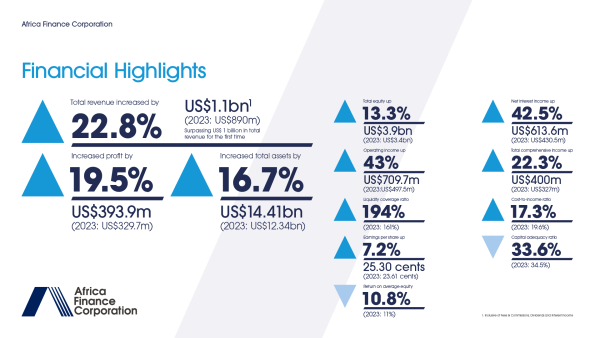
Africa Finance Corporation (AFC) (www.AfricaFC.org), the continent's leading infrastructure solutions provider, has announced its strongest financial performance to date, with total revenue for the year ended 31 December 2024 surpassing US$ 1 billion for the first time in the Corporation's history.

This record performance marks a significant milestone in AFC's mission to close Africa's infrastructure gap through scalable, de-risked investments that attract global capital and deliver tangible development outcomes. The Corporation posted a 22.8% increase in total revenue to US$1.1 billion and a 22.3% rise in total comprehensive income to US$400 million, up from US$327 million in 2023.

AFC's earnings growth was driven by improved asset yields, prudent cost-of-funds management and sustained traction in advisory mandates.  

Further significant financial highlights include:

  • Net interest income up 42.5% to US$ 613.6 million
  • Fee and commission income rose to US$109 million, the highest in over five years
  • Operating income climbed 42.7% to US$709.7 million
  • Total assets reached a record US$14.4 billion, a 16.7% year-on-year increase
  • Liquidity coverage ratio strengthened to 194%, providing over 34 months of cover
  • Cost-to-income ratio improved to 17.3% from 19.6% in 2023

Throughout 2024, AFC continued to scale its impact by mobilising capital for landmark projects across energy, transport, and natural resources. These included the Lobito Corridor – a cross-border railway development spanning Angola, the Democratic Republic of Congo (DRC), and Zambia. AFC led the initiative to secure a concession agreement within one year of the initial Memorandum of Understanding (MoU), an unprecedented achievement for a project of its scale. In the DRC, AFC also invested US$150 million in the Kamoa-Kakula Copper Complex, Africa's largest copper producer and one of the most sustainable globally, thanks to its high-grade ore and renewable-powered smelter.

Other milestones transactions included financing support for the commissioning of the Dangote Refinery, the largest in Africa, and continued progress on AFC-backed Infinity Power Holding's 10 GW clean energy ambition, with power purchase agreements secured in Egypt and South Africa. AFC also invested in the 15GW Xlinks Morocco-UK Power Project, providing US$14.1 million to support early-stage development of a transcontinental renewable energy pipeline between North Africa and Europe.

AFC strengthened its capital base and expanded its investor network through several landmark funding initiatives. These included a US$ 1.16 billion syndicated loan - the largest in its history, a US$500 million perpetual hybrid bond issue, and the successful execution of Nigeria's first-ever domestic dollar bond, which raised US$900 million at 180% oversubscription. AFC also returned to the Islamic finance market after eight years, closing a US$400 million Shariah-compliant facility.

The year also saw strong momentum in equity mobilisation, with US$181.8 million in new capital raised from ten institutional investors. These included Turk Eximbank - AFC's first non-African sovereign shareholder - the Arab Bank for Economic Development in Africa (BADEA), and several major pension funds spanning Cameroon, Seychelles, Mauritius, and South Africa. Ratings agencies affirmed AFC's robust credit profile, with AAA ratings from S&P Global (China) and China Chengxin International, and a stable A3 Outlook from Moody's.

“These results send a clear message that strategic investment in African infrastructure creates lasting value for both beneficiaries and investors,” said Samaila Zubairu, President & CEO of AFC. “In 2024, we exceeded the billion-dollar revenue mark, delivered game-changing projects, and reinforced our financial resilience—demonstrating the scalability of our unique model that blends purpose with performance to accelerate Africa's economic transformation.”

Read the full annual report here (https://apo-opa.co/424qlmR)

Distributed by APO Group on behalf of Africa Finance Corporation (AFC).

Media Enquiries:
Yewande Thorpe
Communications
Africa Finance Corporation
Mobile: +234 1 279 9654
Email: yewande.thorpe@africafc.org

About AFC:
AFC was established in 2007 to be the catalyst for pragmatic infrastructure and industrial investments across Africa. AFC's approach combines specialist industry expertise with a focus on financial and technical advisory, project structuring, project development, and risk capital to address Africa's infrastructure development needs and drive sustainable economic growth.

Seventeen years on, AFC has developed a track record as the partner of choice in Africa for investing and delivering on instrumental, high-quality infrastructure assets that provide essential services in the core infrastructure sectors of power, natural resources, heavy industry, transport, and telecommunications. AFC has 45 member countries and has invested over US$15 billion in 36 African countries since its inception. www.AfricaFC.org

Media files
Africa Finance Corporation (AFC)
Download logo
Read moreAfrica Finance Corporation Tops Us$1 Billion Revenue for First Time as Landmark Projects Unlock Growth Across the Continent
9 April 2025

Germany Sets Sights on Africa’s Energy Future With Major Investment Pledge

Location: News

African Energy Chamber
Download logo

Germany is eyeing expanded investments in Africa's energy sector, having pledged €4 billion for green energy projects by 2030 and advancing hydrogen and gas partnerships through the European Union's (EU) Global Gateway initiative. These investments aim to enhance conditions for private sector involvement and infrastructure development, underscoring Germany's commitment to sustainable development and economic growth across the continent.

In South Africa, Germany committed R5.2 billion last December to support the country's energy transition and deepen bilateral cooperation. This funding is directed towards facilitating South Africa's shift from coal to renewable energy sources, addressing both environmental concerns and energy security. Earlier this month, the EU also announced a €4.7 billion investment in South Africa to support green energy initiatives and vaccine production, reflecting a broader commitment to sustainable development in the region.

Further strengthening these efforts, Germany and the African Development Bank announced joint initiatives last month to accelerate energy access and private sector growth across Africa. This partnership includes support for the Mission 300 initiative, which aims to provide electricity access to 300 million Africans by 2030, and expanded financing for youth entrepreneurship programs.

Meanwhile, German companies are optimistic about their prospects in South Africa, signaling growing confidence in the country's economic stability, expanding trade opportunities and the potential for long-term partnerships in energy and industrial sectors. A recent survey by KPMG Germany and the Southern African-German Chamber of Commerce and Industry revealed that 64% of German companies expect rising revenues in South Africa, with 44% planning to invest in the country within the next three years.

Germany has already been active in Africa's green hydrogen sector, recognizing the continent's vast potential for renewable energy production. In Namibia, German investors have partnered on the $10 billion Hyphen Green Hydrogen Project, aiming to harness the country's abundant solar and wind resources to produce green ammonia for global export. Additionally, Germany mobilized €150 billion through the Global Gateway initiative earlier this year to enhance its energy engagement in Africa, with green hydrogen as a key focus. West African countries alone have the potential to produce up to 165,000 TWh of green hydrogen annually – far exceeding Germany's projected demand for 2030.

Beyond renewable initiatives, Germany remains open to cooperating with African countries on natural gas and blue hydrogen production. This approach reflects Germany's updated Africa policy guidelines, which emphasize the importance of African energy resources – including renewable electricity, green hydrogen and, under specific conditions, natural gas – for a successful energy transition in both Africa and Europe.

"Germany's growing investment in Africa's energy sector signals a transformative shift toward sustainable development and economic growth. With a clear focus on green hydrogen, renewables and responsible fossil fuel cooperation, the country is positioning itself as a key partner in Africa's energy future. African Energy Week 2025 will serve as a vital platform to advance these partnerships, unlocking new opportunities and accelerating Africa's energy transition,” said Tomás Gerbasio, Vice President of Commercial and Strategic Engagement at the African Energy Chamber.

The upcoming African Energy Week (AEW) 2025: Invest in African Energies conference presents a strategic platform for German investors to explore and engage with energy opportunities across the continent. AEW 2025 aims to drive forward the momentum established in previous years, offering a dynamic space for leaders, policymakers and stakeholders to address regional and global energy challenges while advancing Africa's position as a leader in sustainable energy solutions.

AEW: Invest in African Energies is the platform of choice for project operators, financiers, technology providers and government, and has emerged as the official place to sign deals in African energy. Visit www.AECWeek.com for more information about this exciting event.

Distributed by APO Group on behalf of African Energy Chamber.

Read moreGermany Sets Sights on Africa’s Energy Future With Major Investment Pledge
7 April 2025

Top African Projects Driving the Mining-Energy Nexus

Location: News

Energy Capital & Power
Download logo

Mining represents one of the most energy-intensive industries globally. As African nations ramp up mineral extraction to drive economic growth, mining projects and stakeholders are increasingly investing in energy infrastructure to sustain operations and meet rising production targets. Amid efforts to improve grid stability, the upcoming African Mining Week conference will highlight the continent's investment opportunities emerging from the mining-energy nexus.

Northam Bolsters Power Supply for South African Mines

In February 2025, mining firm Northam signed a power purchase agreement (PPA) for 140 MW of wind power to support its platinum group metals operations in Limpopo. This deal follows an earlier PPA signed in October 2024 for an 80 MW solar power facility to supply the company's Zondereinde mine, aimed at driving South Africa's expansion of its PGMs sector. These agreements are part of Northam's broader strategy to enhance energy security and sustainability while reducing its carbon footprint in alignment with national renewable energy goals.

Richards Bay Minerals Expands PPA Portfolio

Richards Bay Minerals, a subsidiary of mining multinational Rio Tinto, signed its third PPA with Red Rocket in February 2025, securing 230 MW of electricity from Red Rocket's 380 MW Overberg Wind Farm. This agreement increases the company's total contracted renewable energy supply to 500 MW and supports Rio Tinto's commitment to reducing emissions by 50% by 2030. Richards Bay Minerals also taps into energy from the 130 MW Bolobedu solar PV plant and 140 MW Khangela Emoyeni wind farm.

Further Investments in Renewables for Mining

Other mining companies across Africa are driving large-scale energy projects to secure a stable power supply. In South Africa, Ivanhoe Mines completed a 5 MW solar facility in Q1 2025 to support its Platreef PGM mine, while Impala Platinum signed a five-year PPA with Discovery Green to supply wheeled renewable energy to its Impala Refineries operation. Meanwhile, commodities firm Trafigura is developing a 2 GW initiative to power Angolan mines, and First Quantum is set to commission a 430 MW project in Zambia in 2025. Tronox Holdings plans to roll out 400 MW of energy projects in South Africa by 2027 and Chinese mining company CMOC is preparing a 200 MW energy project in the DRC, set for commissioning by 2028.

As these investments unfold, African Mining Week will showcase key milestones in energy security for the sector, highlighting lucrative opportunities within Africa's independent power markets. The event will emphasize the growing demand for stable, sustainable energy solutions as miners continue to invest in energy infrastructure.

African Mining Week serves as a premier platform for exploring the full spectrum of mining opportunities across Africa. The event is held alongside the African Energy Week: Invest in African Energies 2025 conference from October 1-3 in Cape Town. Sponsors, exhibitors and delegates can learn more by contacting sales@energycapitalpower.com.

Distributed by APO Group on behalf of Energy Capital & Power.

Read moreTop African Projects Driving the Mining-Energy Nexus
2 April 2025

George welcomes announcement on private sector-powered grid expansion initiative

Location: News

George welcomes announcement on private sector-powered grid expansion initiative

The Minister of Forestry, Fisheries and the Environment (DFFE), Dr Dion George, has commended the announcement that government will pursue private investment for the construction of new transmission lines.

Electricity and Energy Minister, Dr Kgosientsho Ramokgopa, on Tuesday announced that a pilot programme, the Independent Transmission Programme (ITP) will pave the way for the construction of 1 164 kilometers of new transmission lines.  

The Department of Forestry, Fisheries and the Environment said Ramokgopa's statement aligns with the DFFE's vision, by encouraging private sector involvement, which aims to address the transmission constraints that have hindered the integration of solar and wind energy, especially in the Cape province.

“This significant step forward aligns seamlessly with the vision Minister George articulated earlier this week in his landmark decision on Eskom’s emissions framework, marking a triumph for South Africa’s sustainable energy future,” the department said in a statement on Wednesday. 

On Monday, George underscored the urgent need for innovative infrastructure solutions to balance energy security with environmental responsibility, subtly pointing to the expansion of transmission capacity as a key enabler for renewable energy growth. 

The Minister said Ramokgopa’s announcement is a "resounding victory for the sustainable energy path we are forging." 

“My decision on Eskom’s emissions earlier this week laid the groundwork for a modernised energy system that respects our climate commitments. Minister Ramokgopa’s bold move to unlock private investment in transmission lines is exactly what I alluded to – a practical, impactful step to harness our renewable potential and secure a cleaner future for all South Africans.”

George also commended the cross-governmental collaboration, noting that the R440 billion Transmission Development Plan, now supported by private funding, will ease the burden on Eskom and the national budget, while accelerating the transition to renewable energy. 

He reaffirmed his dedication to partnering with Ramokgopa to ensure that environmental standards remain integral to this transformative infrastructure expansion.

“This initiative is about more than just power lines – it’s about powering opportunity. We are opening the door to investment, job creation, and South Africa’s emergence as a green economy leader,” George said 

The procurement regulations are set to be released on Thursday, 3 April 2025. – SAnews.gov.za
 

Gabisile
Wed, 04/02/2025 - 13:12

240 views

Read moreGeorge welcomes announcement on private sector-powered grid expansion initiative
2 April 2025

Gauteng targets R300 billion in investments to boost economy

Location: News

Gauteng targets R300 billion in investments to boost economy

Gauteng Economic Development MEC, Lebogang Maile, says the province is aiming to secure at least R300 billion in investment pledges at the Gauteng Investment Conference (GIC), to be held in Johannesburg.

The MEC was speaking during a media briefing on the state of readiness of the province to host the conference, to be held at the Johannesburg Stock Exchange, in Sandton, on 3 April 2025.

“Leaders across all tiers of government, including Minister of Trade, Industry and Competition, Parks Tau, Premier of Gauteng Premier Lesufi, and Johannesburg Mayor Dada Morero, will provide inputs at the conference. The keynote address will be delivered by the Deputy President, who also serves as the Leader of Government Business in South Africa, His Excellency, Paul Mashatile.  

“Of equal significance is the large contingent of leaders across the business and government sectors on the African continent, the African diaspora and the globe. With over 50 companies represented, the conference will be a convergence point of the world’s most important companies in various sectors,” Maile said.

The Gauteng province is of importance for South Africa’s economy and contributes at least 33% to the national Gross Domestic Product, and nearly 7% of sub-Saharan Africa’s output.

“The [GIC] is a transformative event in affirming the place of the Gauteng province in the continental economy. We are asserting that the development of Gauteng is in the best interest of South Africa, the Southern African Development Community and the continent broadly.

“Thus, investment in the economy of Gauteng extends beyond the confines of its provincial borders into other lands across the entire continent,” the MEC said.

Furthermore, the conference will also serve as a platform for critical dialogue that will “enable direct engagement between policy makers, investors and industry experts”.

“This will ensure that we come out with tangible and applicable outcomes. The sessions will focus on, amongst other things, public-private infrastructure investments, as well as key Gauteng most dynamic and high growth sectors, including…advanced manufacturing, green and renewable energy, ICT [information and communication technology] and data infrastructure, transport and logistics, smart property development and urban regeneration, as well as tourism and the creative economy,” he said.

Maile emphasised that these sectors are critical to ensuring development on a provincial, national and continental level.

“Investment in these sectors offers the most reliable instrument for ensuring sustainability and development, offering a clear path to economic prosperity that is anchored on inclusive growth, environmental protection and human development,” Maile said. – SAnews.gov.za

NeoB
Wed, 04/02/2025 - 13:46
264 views

Read moreGauteng targets R300 billion in investments to boost economy
2 April 2025

Minister welcomes decline in coal share, growth in renewables

Location: News

Minister welcomes decline in coal share, growth in renewables

The Minister of Forestry, Fisheries and the Environment, Dr Dion George, has welcomed the latest estimates from the Ember Electricity Data Explorer, which shows that coal accounted for 74.31% of South Africa’s electricity generation in January 2025.

“This record low, which includes behind-the-meter estimates, is a positive development, and it is encouraging to see the downward trend in coal’s share of our energy mix. 

“This reduction is a vital step toward lowering emissions and aligning with our national and international climate commitments,” the department said, adding that equally promising is the contribution of renewable energy sources.

In January, the department said solar power reached 11.28% and wind power contributed 4.94%, together accounting for 16.22% of the country’s electricity generation.

In its statement on Wednesday, the department believes that the figures highlight the growing presence of proven renewable technologies in the country’s energy system. 

The Minister said he looks forward to seeing continued increases in solar and wind power, alongside a sustained decrease in coal reliance, as South Africa works to build a cleaner and more sustainable energy future.

“In view of my decision to grant Eskom exemptions for their coal-fired stations, it is particularly important that we continue to see a decrease in emissions, for which Eskom will be held accountable,” George said.

While coal has historically played a significant role in powering South Africa, the department said this shift demonstrates government’s efforts to diversify the energy mix are gaining traction. 

“As Minister of Forestry, Fisheries and the Environment, I remain committed to supporting this transition, ensuring it is both environmentally responsible and socially equitable.

“My department will continue to collaborate with all stakeholders to accelerate the adoption of renewable energy, reduce emissions, and secure a healthier planet for future generations,” George added. 

Ember is an energy think tank that aims yo accelerate clean energy transition with data and policy.

– SAnews.gov.za
 

Gabisile
Wed, 04/02/2025 - 11:39
106 views

Read moreMinister welcomes decline in coal share, growth in renewables
1 April 2025

Ramokgopa announces Independent Transmission Programme

Location: News

Ramokgopa announces Independent Transmission Programme

Minister of Electricity and Energy, Dr Kgosientsho Ramokgopa, has announced that government will pursue private investment for the construction of transmission lines through the Independent Transmission Programme (ITP).

The Minister made the announcement of the new programme during a media briefing, held in Pretoria, on Tuesday.

During the briefing, Ramokgopa touted the pilot programme for the ITP which will pave the way to the construction of 1 164 kilometres (km) of new transmission lines, designed to support renewable energy projects.

“Our renewable energy assets are not fully exploited as a result of the constraints on the transmission side. The Eskom balance sheet and the sovereign balance sheet is not sufficient to carry the kind of investments that are required in this space.

“In terms of the transmission development plan…we will need modernise and expand transmission by about 14 000km and for us to be able to do this, we need about R440 billion. The State is not in a position to provide that kind of support. So, today we are introducing the independent transmission programme,” Ramokgopa said.

He said a ministerial determination has been issued to create a “dispensation that allows for private sector participation”.

“Our view is that there’s a need for us to be able to ensure that we are able to accelerate and support transmission infrastructure development. The transmission development plan does say that we need this 14 000km of new lines to be able to unlock the capacity, especially in the cape provinces.

“That is where we have the most efficient and reliable energy assets in the form of solar and wind, but we have exhausted all of the transmission that allows us to evacuate the electrons so that the economy can benefit from those assets,” the Minister said.

Ramokgopa added that the procurement of transmission will be done in the most cost-effective way, while regulations will be issued this Thursday.

“The Ministry is the one mandated to procure and then the NTCSA [National Transmission Company of South Africa] is the party that buys that. We are going to ensure that we procure the most cost-effective and tendering procedures that are fair, competitive and equitable.

“The requirement for the ITP pilot has to be consistent with transmission development plan and it must also support the IRP [Integrated Resource Plan]. It must [also] be commercially viable,” Ramokgopa said.

It is envisioned that with the new transmission lines, at least 3000 megawatts (MW) of energy will be added to the grid.

“The new generation capacity that we are going to unlock as a result of this intervention is 3 222 MW. It is about 63% of the total capacity of Medupi and Kusile [power stations]. We are moving in the right direction.

“For the South African economy to grow, we need to unshackle the issues of the structural constraints, which is electricity and the inefficiencies in the logistics side. The second is greater investment by the private sector. Electricity gives us a pristine opportunity to transform the economy [and] grow the economy,” he said.

A Request for Qualification will be issued in July while a Request for Proposals will be issued in November. – SAnews.gov.za

NeoB
Tue, 04/01/2025 - 12:35
188 views

Read moreRamokgopa announces Independent Transmission Programme
31 March 2025

Lottery Ticket Sales Likely to Be Suspended From 1 June

Location: News

Minister Tau backtracks on temporary licence, will announce permanent operator at end of May

Read moreLottery Ticket Sales Likely to Be Suspended From 1 June
31 March 2025

A Rare Opportunity for Real African Energy Independence

Location: Business
African Energy Chamber

By NJ Ayuk, Executive Chairman, African Energy Chamber (https://EnergyChamber.org)

Donald Trump's return to the White House in 2025 represents a pivotal moment for Africa's fossil fuel industry. His administration's swift reapproval of a USD4.7 billion loan from the U.S. Export-Import Bank (Exim) for TotalEnergies' liquefied natural gas (LNG) project in Mozambique — initially greenlit in 2020 during his first term but sent into deep-freeze for the full duration of the Biden years — sets the tone for what could be a transformative era for Africa's energy sector. 

Despite Mozambique's stabilization of security issues and concerns that the transfer of power in America would delay receipt of the loan even further, the Biden Administration refused to release the funds ahead of Trump's inauguration, a decision reflective of the administration's reluctance to support new fossil fuel initiatives throughout Biden's time in office. In contrast, Trump's decisive action within weeks of taking office signals a renewed, positive working relationship between the United States and Africa — one that prioritizes energy development over ideological objections and the Green Agenda's influence. 

The African Energy Chamber (AEC) contends that Africa should seize this potentially brief moment in history and embrace the Trump administration as a partner rather than an opponent. For too long, global pressures have insisted that African nations move toward green energy projects only and leave their fossil fuel resources behind.  

While renewable energy has its place, and will be important to Africa's future, fossil fuels still clearly constitute the backbone of any realistic efforts for African industrialization and economic growth — goals we simply cannot afford to sideline.  

Alignment with Trump's energy-first ethos would mean that Africa could unlock significant funding for wide-ranging fossil fuel projects, and not just the offshore oil and gas ventures that dominate the headlines. The continent should capitalize on all opportunities in onshore projects, wildcat wells (exploratory drilling in unproven areas), and the proliferation of numerous small operators. These avenues lead the way to diversity in Africa's energy portfolio, job creation, and massively strengthened energy security. 

The reapproval of funding for Mozambique LNG is a case in point. The project's revival under Trump demonstrates how quickly thick bureaucratic congestion can dissolve when political will aligns with economic practicality. This USD4.7 billion infusion will boost Mozambique's economy while sending a message to other African nations: Under Trump, at long last, America is open for business.  

In contrast to the previous administration, which openly regarded fossil fuel development with skepticism and disdain, Trump's “drill baby drill” mantra — while rooted in an “America First” agenda — pairs seamlessly with the ambitions of the African oil and gas industry. Africa should adopt a similar mindset and position itself as an attractive destination for American investment dollars. 

Coal's Comeback 

Another of Trump's domestic priorities, no doubt a response to China's unabashed expansion of coal production within its borders, is to revive clean coal production in the U.S. This initiative offers a compelling blueprint for Africa. While coal remains a contentious, harshly criticized resource globally, its advantages are undeniable: It's cheaper to produce, often doesn't require big bank financing, and is abundant across the continent. For African nations grappling with energy poverty, coal can serve as a means to an end, delivering affordable power to millions in the interim while the infrastructure for other energy sources matures. Simply put, Africa deserves to be the last global holdout on coal production and should leverage its coal reserves to meet domestic needs and export demands. Trump's willingness to disregard the international campaign against coal should embolden African leaders to reopen their abandoned coal mines and rest assured that this time around, they'll be able to operate freely, without fear of U.S. opposition. 

Fossil Fuels Unleashed 

Looking beyond coal, over the next four years, Africa has the rare chance to pursue an aggressive fossil fuel agenda. The continent should unite under an “Africa First” banner and adopt its own “drill baby drill” mentality in support of every promising oil exploration and production project, every possible natural gas project, and a multinational effort to slash through regulatory red tape.  

In Nigeria, for instance, the wheels of progress moved agonizingly slowly when it came to passing the Petroleum Industry Act, first proposed in 2008 and not signed into law until 2021. Even after the law was passed, Nigeria has been slow to fully implement it. This kind of inertia deters investment and slows development. A Trump-inspired push to clean up such bureaucratic roadblocks could unleash a wave of prosperous development. Similarly, addressing security issues — like those that drove U.S. firms out of Libya — will be critical to restoring confidence and attracting capital from abroad. 

While the offshore sector will undoubtedly remain a cornerstone of Africa's fossil fuel strategy, the continent's onshore potential is equally vast. Wildcat wells offer high-risk/ high-reward prospects that could uncover new reserves. Meanwhile, instead of relying solely on multinational oil and gas giants, empowerment of more independent companies and indigenous small operators could diversify the industry, build up local entrepreneurship, and ensure the economic benefits are more widespread. It is highly unlikely that the Trump administration, with its emphasis on deregulation and energy independence for its own shores, would obstruct such efforts on ours. Conversely, it may actively encourage them through financing and technical support, as seen with the Exim loan. 

Balancing Development and Climate Realities 

Though critics will argue that this push for fossil fuel proliferation contradicts global climate goals, at the AEC, we insist that the calculations for Africa are simply different.  

Africa accounts for a fraction of global emissions but bears a disproportionate burden when it comes to energy poverty. Fossil fuels offer a realistic and relatively quick path to electrification and industrialization, the proven prerequisites for lifting millions out of poverty. Trump's indifference to international climate orthodoxy, while controversial, gives Africa the much-needed breathing room to prioritize development over decarbonization. This is in no way an outright rejection of renewables but a recognition that fossil fuels can and will facilitate a just transition to green technologies once their capabilities catch up to Africa's current needs. 

Seizing the Moment 

The next four years under Trump could redefine Africa's energy landscape. With U.S. interference a thing of the past, Africa can pursue a multi-pronged energy strategy. With a ramp-up in natural gas to meet global demand, a coal revival to power its own grids, and on and offshore opportunities tapped into, Africa could finally secure its full resource base.  

However, this approach will require bold leadership. Governments will have to eliminate obstructive policies and address security challenges head-on to secure foreign investments. The payoff could be immense: energy abundance, economic growth, and a partnership with the U.S. that is stronger than ever before. 

For example, Nigeria's oil and gas sector has been hampered by regulatory uncertainty and security threats in the Niger Delta. A Nigerian “drill baby drill” mindset could accelerate regulatory, social, and economic reforms needed to address the Niger Delta's deep-rooted instability. This kind of mindset could restart stalled projects and attract American firms eager to invest in a Trump-approved climate. Likewise, in Libya, a resolution to security concerns could lure back U.S. companies that fled during years of instability, reviving a once-thriving oil industry. Across the continent, small operators could flourish under a lighter regulatory touch, drilling wildcat wells and tapping into overlooked reserves. 

South Africa, with its vast coal deposits, could take the lead on clean coal technologies to balance affordability and environmental concerns. Smaller nations with untapped coal reserves could follow Trump's lead in defying global pressures against production. The result would be a continent less dependent on foreign aid and more capable of powering its own future. 

Trump's presidency offers Africa a chance to unapologetically double down on its fossil fuel potential. The USD4.7 billion Mozambique loan is just the beginning — a proof of concept for what collaboration with the U.S. can achieve. By embracing this partnership, Africa can shed the shackles of the Biden era and chart a course toward energy sovereignty.  

The tools are all there: offshore rigs, onshore fields, wildcat wells, established mines, and a willing ally in Washington. The question that remains is whether Africa's leaders have the courage to stand up to the anti-carbon lobby. 

Trump's second term could be remembered as the moment Africa's fossil fuel industry came into its own — as a partner to the U.S. in a shared vision of energy abundance. With four years of clear skies ahead, there is no question that Africa should build, mine, and yes, drill, baby, drill like never before.  

If we don't act now, it might be a very long wait for an opportunity like this one to present itself again. 

Distributed by APO Group on behalf of African Energy Chamber.

Media files
African Energy Chamber
Download logo
Read moreA Rare Opportunity for Real African Energy Independence
31 March 2025

Cassava Technologies Collaborates With Microsoft to Launch Community Engagement Initiative Creating Youth Employment Opportunities in South Africa’s Renewable Energy Industry

Location: Business
Cassava Technologies

Pan-African technology company Cassava Technologies (www.CassavaTechnologies.com), in a strategic collaboration with Microsoft, has launched a community engagement initiative focused on South Africa. Through this initiative, the two organisations will establish training hubs for youth in the local communities that will help spur employment opportunities in the renewable energy industry.

By prioritising renewable energy skills development, energy efficiency, and community microgrids, the initiative will empower the next generation to lead in the transition to clean energy. Activities will be focused in Johannesburg and Cape Town, where Cassava and Microsoft operate.

The project's training hubs will play a vital role in equipping Africa's women and youth with the skills they need to thrive in the renewable energy industry and ensure that the benefits of the energy transition are realised by all.

Cassava Technologies, through its renewable energy company and co-location companies, will be a key player in this collaboration. Their local renewable energy expertise will ensure that the initiative delivers tangible benefits linked to clean energy jobs and projects to the communities that are involved. Through this initiative, Cassava and Microsoft are supporting community engagement and sustainable development in the region and across the continent, which lays the groundwork for expansion into other African markets.

Finhai Munzara, Chief Corporate Development Officer of Cassava Technologies, said, “We are honoured to collaborate with Microsoft on this project, which ensures that we bring all Africans along as we transition to a digitally connected future using sustainable energy. By leveraging our technological expertise, on-the-ground experience, and Microsoft's global reach, we are poised to make a lasting, positive impact on South African communities.”

 "We are pleased to work with Cassava to support climate initiatives in South Africa that enhance local communities, ensuring that those all have the tools to thrive," said Markus Swart, Director of Data Centre Operations in South Africa at Microsoft. 

Distributed by APO Group on behalf of Cassava Technologies.

About Cassava Technologies:
Cassava Technologies is a global technology leader of African heritage providing a vertically integrated ecosystem of digital services and infrastructure enabling digital transformation. Headquartered in the UK, Cassava has a presence across Africa, the Middle East, Latin America and the United States of America. Through its business units, namely, Cassava AI, Liquid Intelligent Technologies, Liquid C2, Africa Data Centres, and Sasai Fintech, the company provides its customers' products and services in 94 countries. These solutions drive the company's ambition of establishing itself as a leading global technology company of African heritage.

www.CassavaTechnologies.com

Media files
Cassava Technologies
Download logo
Read moreCassava Technologies Collaborates With Microsoft to Launch Community Engagement Initiative Creating Youth Employment Opportunities in South Africa’s Renewable Energy Industry
27 March 2025

Billions in Investment Opportunities Presented by Premier Invest

Location: News
Energy Capital & Power

Financial services provider Premier Invest has announced a series of investment opportunities in the African energy and oil and gas sectors. covering a range of four energy projects across Benin, Zambia and South Africa and five oil and gas projects across Nigeria and Ghana, as well as Guyana.

The announcement was made on March 26 by Rene Awambeng, Founder and Managing Partner of Premier Invest during a dedicated deal-room session – Showcasing Upstream Oil and Gas Transactions in Africa – at the inaugural Congo Energy & Investment Forum (CEIF) in Brazzaville.

“The deal-room sessions on the sidelines of the Congo Energy & Investment Forum are an opportunity to provide a platform for sponsors, developers and project promoters to showcase significant upstream, midstream, downstream and power transactions in Africa to potential investors,” stated Awambeng.

The first opportunity, a 43 MW clean gas project in Benin, is seeking $84 billion in project finance. Currently in the commercial close stage of development, the project will help reduce the cost of energy in the country while bolstering economic growth, job creation and improving Benin's energy security.

Meanwhile, Zambia features a $92 million investment opportunity in a 71 MW hybrid solar PV and wind project. The project will feature a power purchase agreement over a period of 25 years and is estimated to feature an annual production of 232 GWh per year.

In South Africa, a 100 MW solar PV project has an $87 million investment opportunity. The project will feature an offtake agreement with the National Energy Regulator of South Africa and a power purchase agreement of 20 years. The project will boast an annual production rate of 195 GWh per year.

Concluding the energy investment opportunities South Africa is also seeking $100 million in investment to finance a 100 MW clean-gas project to complement intermittent renewable energy sources, such as solar and wind, while offering a cleaner solution to the country's reliance on coal. The project features a proposed capital structure of 70:30 and is in the active implementation stage.

In the oil and gas sector, gas producing company NESGAS is seeking $200 million in financing for the development of an LPG bulk storage facility in the Oil & Gas Free Zone in Nigeria. Phase 1 of the project will feature a commitment of $140 million to develop inland facilities, pipelines and site works while the second phase will feature an investment of $60 million focusing on engineering, procurement and construction contracts for tanks, instrumentation and commissioning.

Meanwhile, a state-of-the-art gas-to-liquids plant – the details of which are subject to a non-disclosure agreement – is seeking interested parties to participate in an upcoming formal investment process. The project will have a validated production capacity of 1,850 barrels of oil per day and will feature an earnings before interest, taxes, depreciation and amortization measure of approximately $50 million.

Ghana is seeking $759 million in financing to develop four offshore production wells. Financing will be used to develop tie-back infrastructure to existing FPSO infrastructure, targeting 57.8 million standard barrels of oil. The project aims to produce 5 million barrels of oil per year, with potential investors set to receive 84% of the total project net present value.

An indigenous oil development company in Nigeria is seeking an experienced management team to invest $18 million to drill additional wells and increase production at a field with a projected production rate of 2,300 barrels per day.  The field area covers 46km2 and is covered by 3D seismic surveys.

Finally, Awambeng also announced a $25 million investment opportunity in Guyana. The project will be adjacent to one of the most productive offshore oil fields in the region and boasts recoverable reserves of approximately 400 million barrels. Investment will be used to support conventional offshore drilling and FPSO tie-up.

The companies involved in the investment opportunities will be disclosed upon inquiry, with financing options subject to non-disclosure agreements.

The inaugural Congo Energy & Investment Forum, taking place March 24-26, 2025, in Brazzaville, under the highest patronage of President Denis Sassou Nguesso and supported by the Ministry of Hydrocarbons and Société Nationale des Pétroles du Congo, brings together international investors and local stakeholders to explore national and regional energy and infrastructure opportunities.

Distributed by APO Group on behalf of Energy Capital & Power.

Media files
Energy Capital & Power
Download logo
Read moreBillions in Investment Opportunities Presented by Premier Invest
27 March 2025

SA-EU relations flourishing

Location: News

SA-EU relations flourishing

By Nomonde Mnukwa

South Africa’s first democratic elections on 27 April 1994 signalled not only the end of the brutal system of apartheid, but also a change in the country’s international image.

The country’s struggle for liberation and reconciliation has shaped its identity and global standing. South Africa has positioned itself as a champion of international solidarity.

South Africa’s unique approach to global issues has found expression in the concept of Ubuntu. These concepts inform our approach to diplomacy and shape our vision of a better world for all.

This philosophy translates into an approach to international relations that respects all nations, peoples, and cultures. It recognises that it is in our national interest to promote and support the positive development of others.

As we celebrate our over 30 years of freedom and democracy, South Africa’s global repositioning can be seen with the strong strategic partnership with the European Union that is premised on values such as democracy, human rights and the rule of law.

Immediately after his release from prison thirty-five years ago, President Nelson Mandela, our first democratic President, travelled to the European Parliament to receive the Sakharov Prize for Freedom of Thought. This honorary award is the highest tribute given by the European Union (EU) to individuals who contributed to the fight for human rights.

During this visit, the former president, who is affectionately known as Madiba addressed the European Parliament and thanked the European countries for their contribution towards our fight for freedom. He also called on them to support us as we set about rebuilding the country and reversing the legacy of apartheid, which continues to be felt up to this day.

This visit marked the beginning of official relations between South Africa and the EU in pursuit of our national interests, especially to tackle pressing challenges we inherited under apartheid. In 1999 for instance, we became the first African country to sign a Free Trade Agreement (FTA) with the EU known as the South Africa-European Union (EU) Trade, Development and Cooperation Agreement (TDCA).

In 2007 we further deepened our relations through the adoption of the South Africa – EU Strategic Partnership Joint Action Plan. The plan is essentially a roadmap for cooperation in various key areas such as trade, climate change, science and technology as well as regional and global issues.  

The TDCA agreement has helped our country to integrate into the global economy and it established a Political Dialogue between South Africa and the EU at the Ministerial level. This high-level dialogue advances the EU-South Africa strategic partnership across key areas such as trade, energy, peace and security and multilateralism.

We are pleased that as we celebrate 30 years of democracy and thirty-five years since Madiba’s release and visit to the EU Parliament, our relationship with the EU continues to flourish and is mutually beneficial. South Africa remains the EU's key trade partner on the African Continent, and the EU as a bloc is South Africa's largest trading partner.

Total trade between South Africa and EU has increased by 44 percent over the past five years; recording an increase from R586 billion in 2019 to R846 billion in 2023. The EU accounts for 41 percent of total Foreign Direct Investment (FDI) in the country and over 2,000 EU companies operate in South Africa, supporting more than 500,000 direct and indirect jobs.

To further discuss shared priorities and foster stronger ties between South Africa and EU, in February this year, we successfully hosted the 16th Ministerial Political Dialogue. The Dialogue was co-chaired by the Minister of International Relations and Cooperation, Ronald Lamola and Kaja Kallas, the EU High Representative for Foreign Affairs and Security Policy and Vice President of the European Commission.

During this dialogue, both parties reiterated their commitment to multilateralism, rules-based international order, and the centrality of the United Nations Charter. They agreed on the need to make the UN Security Council more representative, inclusive, transparent, efficient, democratic and accountable. They further discussed issues of trade and investment, along with greater mutual cooperation and reinforced bilateral relations between South Africa and the EU.

The dialogue also served as preparatory meeting for the EU-South Africa Summit which was held in South Africa on 13 March 2025. Our national priorities of reducing poverty, unemployment and inequality underpin our work at the SA-EU Summit. In line with commitments in the National Development Plan we engage with our EU counterparts to further grow our economy and develop our society.

The summit was also an opportunity to set new priorities for the Strategic Partnership, including in trade and investment, and to reinforce the shared values underpinning the partnership. During the summit, the EU announced a 4.7-billion-euro investment package to support mutually beneficial investment projects. The investment package covers areas such as critical raw mineral processing, green hydrogen, renewable energy, transport and digital infrastructure, local vaccine and pharmaceutical production, and resources for skills development.

The two parties further agreed to launch negotiations towards a Clean Trade and Investment Partnership to support the development of cleaner value chains for raw materials and local beneficiation, renewable and low carbon energy, and clean technology. Both parties committed to work together to address existing challenges in trade in animal and plant products. South Africa committed to find a solution to facilitate the imports of poultry from disease-free areas in the European Union into South Africa.

The Summit was also an opportunity for South Africa to influence international policies that could have an impact on our own economy. Both parties agreed to support a just, comprehensive, and lasting peace on conflicts around the globe including Ukraine, the Democratic Republic of the Congo and Palestine. This includes a need to reform the UN Security Council.  

Furthermore, the European Union expressed support for South Africa's G20 Presidency in 2025, and our hosting of the G20 Summit at the end of the year. The EU also pledged to strengthen the G20 Compact with Africa.

Government welcomes the visit by the EU leaders to the country and we are confident that the agreements signed will not only accelerate economic growth but will help South Africa eradicate the triple challenge of unemployment, poverty and inequality.

*Nomonde Mnukwa is the Acting Director General of the GCIS


Janine
Thu, 03/27/2025 - 09:37
77 views

Read moreSA-EU relations flourishing
26 March 2025

George rallies world leaders to accelerate efforts to achieve SDGs

Location: News

George rallies world leaders to accelerate efforts to achieve SDGs

Minister of Forestry, Fisheries and the Environment, Dr Dion George, has called on the international community to urgently accelerate efforts to achieve the Sustainable Development Goals (SDGs).

“We are less than five years away from our deadline to achieving the SDGs and the end of this critical decade for climate action. Yet, we are still far from our goals and action targets,” the Minister said on Tuesday.

The United Nations describes the SDGs as the “blueprint to achieve a better and more sustainable future for all” by addressing global challenges related to poverty, inequality and climate change, among others, with the year 2030 set as the target to meet the goals.

Addressing the Group of Twenty (G20) Environment and Climate Sustainability Working Group (ECSWG) virtually, the Minister said poverty levels are worsening, and that carbon dioxide (CO2) emissions reached record highs last year. 

“This calls for an urgent acceleration of our efforts. Our commitment to achieve these goals must not waver. That is why South Africa has placed solidarity, equality and sustainability at the centre of our G20 Presidency.

“As the international community, together, we committed ourselves to the ambitious agenda to end poverty and hunger, to protect our planet, to achieve universal education and health coverage, and to promote decent work and sustainable economic growth by adopting the 2030 Agenda for Sustainable Development and its Sustainable Development Goals,” George said.

The Minister said South Africa is striving to champion and fast-track action in the pursuit of a just transition to a low-carbon, climate resilient and inclusive society, and lead by example. 

Last week, President Cyril Ramaphosa proclaimed the Climate Change Act, laying the ground for ambitious climate action domestically. 

Earlier this month, the Minister informed the public that the President proclaimed the Climate Change Act, 2024, with the proclamation notice published in the Government Gazette on 17 March 2025, which was the commencement date of the Act.

“The Act is intended to enable the development of an effective climate change response and a long-term, just transition to a low-carbon and climate-resilient economy and society for South Africa in the context of sustainable development; and to provide for matters connected therewith,” the Minister said at the time.

The Act lays the foundation for a green economy that is resilient, inclusive and future-focused. It creates a clear framework for climate action.

In his address on Tuesday, the Minister said South Africa’s rollout of renewable energy has materially accelerated over the past few years, driving the decarbonisation of South Africa’s energy system, while the implementation of Expanded Producer Responsibility schemes and circular economy initiatives is improving waste management.

“The task remains immense. Poverty, unemployment, hunger, inequality, environmental degradation and climate change are but a few of the complex and interconnected issues facing the world today. 

“...We thus reiterate the critical role of multilateralism in addressing these complexities, and South Africa’s very strong support for multilateralism,” the Minister explained.

Priorities 

George said the five interrelated priorities of the Environment and Climate Sustainability Working Group provide an opportunity to address multiple complexities within this context, while advancing the achievement of the Sustainable Development Goals.

The priorities include Biodiversity and Conservation, Land Degradation, Desertification and Drought, Chemicals and Waste Management, Climate Change and Air Quality, as well as Oceans and Coasts.

“These priorities of the G20 Environment and Climate Sustainability Working Group for this year are viewed as critical enablers to address poverty, create employment and meet other sustainable development goals, thereby contributing towards the global effort to respond to the triple complexities of climate change, pollution and biodiversity loss, in line with the overall theme of South Africa’s G20 Presidency of Solidarity, Equality and Sustainability,” the Minister said.

As a primary outcome of the G20 Presidency this year, South Africa will explore ways that the G20 can leverage opportunities to increase the scale and flows of climate finance, critical to enabling the Just Transition, mitigation and adaptation efforts, while ensuring that the required investments reach the most vulnerable of society. 

“It is paramount for developing economy countries to be actively supported in their efforts to achieve ‘whole of society and whole of economy’ just transitions to sustainable development on the ground, through scaled access to low-cost finance, technology and skills.

“It is also increasingly recognised that many people across the globe are exposed to unhealthy and often deadly levels of air pollution, and that the impacts of air pollution extend beyond health - affecting climate, biodiversity, ecosystems and economic development. 

“This is also a key issue that needs to be addressed, and to which this Working Group can contribute. There are very extensive synergies between decarbonisation and the improvement of air quality,” the Minister said. - SAnews.gov.za

nosihle
Wed, 03/26/2025 - 07:56
106 views

Read moreGeorge rallies world leaders to accelerate efforts to achieve SDGs
26 March 2025

Eskom called to fast track energy transition

Location: News

Eskom called to fast track energy transition

With Eskom not meeting minimum emission standards and delaying critical energy reforms, Minister of Forestry, Fisheries and the Environment, Dr Dion George, warned the power utility that government will not grant it unchecked permission to pollute.

In a statement released on Wednesday, the Minister called on Eskom to accelerate its reform process and support the nation’s energy transition.

“Government cannot grant Eskom a blanket waiver to continue polluting without accountability,” George said.

This plea comes ahead of next week’s announcement by the Minister on his decision on Eskom’s application for exemptions from minimum emission standards. 

The Minister has emphasised the complexity of the issue, noting that it requires balancing South Africa’s energy needs to drive economic growth with the constitutional right to a healthy environment.

“South Africa cannot remain trapped in a persistent cycle of energy insecurity and environmental degradation that harms public health. South Africans have had to endure rolling blackouts, rising costs, and economic stagnation as a result of Eskom’s inefficiencies,” he said.

According to the Minister, Eskom’s monopoly over electricity generation and transmission has stifled competition, slowed the adoption of renewable energy, and left South Africa exposed to energy insecurity. 

“The only viable path forward is to unbundle Eskom without further delay,” George said.

He has called for the Transmission System Operator to be fully independent to ensure fair grid access, warning that without this step, reliance on outdated coal plants will persist.

READ | Eskom-owned transmission company officially commences trading

“The transition to renewable energy is not negotiable. South Africa’s economic future depends on more renewable energy entering the grid, not less. The world is moving toward cleaner energy, and South Africa cannot afford to be left behind,” the Minister said.

George has also directed Eskom to decommission its worst-performing power stations responsibly. 

“Those that fail to meet environmental standards and contribute disproportionately to pollution must be retired in a structured and responsible manner, without leaving anyone behind. South Africa cannot remain hostage to outdated infrastructure and poor governance at the expense of its future.

“Eskom must either comply with emissions regulations and accelerate its transition, or it will face the consequences. We are committed to ensuring that South Africa has a future-proof energy sector,” he said. - SAnews.gov.za

nosihle
Wed, 03/26/2025 - 09:16
0 views

Read moreEskom called to fast track energy transition
24 March 2025

Trinasolar Tackles South Africa’s Power Crisis

Location: Business
Trinasolar

Trinasolar (www.Trinasolar.com), a global leader in smart PV and energy storage solutions, is proud to announce its participation in the Solar & Storage Live Africa exhibition, taking place at Nasrec, Johannesburg, from 25-27 March 2025. As South Africa grapples with an ongoing energy crisis, Trinasolar is positioning itself as a strategic solution provider, offering cutting-edge technology that supports the transition to a decentralised, resilient energy system.

South Africa's recent return to Stage 3 load shedding highlights the ongoing need for reliable and sustainable energy solutions. Trinasolar's advanced portfolio of high-quality photovoltaic modules and energy storage systems are designed to innovatively address the country's energy challenges effectively.

Vincent Wu, Global Sales Vice President and MEA MU Head at Trinasolar, commented on this role, saying: “As the energy crisis continues to challenge South Africa and the broader African region, Trinasolar is committed to delivering solutions that address these challenges. Our advanced PV modules and energy storage systems are designed to enable the region's shift to more resilient and decentralised energy infrastructure. At Solar & Storage Live Africa, we're excited to showcase our leading-edge technology that not only meets the immediate energy needs but also positions South Africa on a path toward a greener, more sustainable future.”

Trinasolar's long-standing presence in South Africa reflects its dedication to providing high-quality and cost-effective solar solutions that support the country's renewable energy ambitions. Trinasolar's Vertex modules are deployed in major utility-scale projects such as the 135MW Merak 1 Project, the 283MWdc Mooi Plaats Photovoltaic Power Plant, and the 195MW Springbok Utility Project, showcasing the company's ability to deliver large-scale, high-impact renewable energy solutions that drive the transition to a more sustainable energy landscape.

“Trinasolar has been part of the South African energy landscape for over a decade, and our local investments are paying off,” says Zaheer Khan, Regional Director for South Africa. “We have emerged as the largest solar equipment supplier in the country, with nearly a gigawatt of solar modules and 250MW of solar trackers delivered to local markets over the past year. Our focus remains on offering high-quality, cost-effective solutions to help South Africa address its energy crisis and move towards a more sustainable future.”

Key highlights:

Trinasolar's portfolio includes a range of high-performance products designed to meet the diverse energy needs of the South African and broader African markets. At Solar & Storage Live Africa, Trinasolar will spotlight two new product launches in South Africa:

  • Bifacial Vertex N 630W (NED19RC.20): Featuring advanced N-type i-TOPCon technology with 23.3% module efficiency, this module certified with Fire Rating Class A+A and 55mm hail resistance. Besides, it has high resistance against salt, ammonia, sand, PID, LID, LeTID, which means high sustainability in harsh environments and extreme weather conditions.
  • Anti-Dust Mono Facial Golden Size Module - 630W (NE19R.70): with impressive 23.3% efficiency, the module is optimized for installation with low angle and features a patented frame designed to minimize dust accumulation, ensuring consistent high performance even in the harshest environments.

These will be shown along with its flagship modules, including

  • Vertex N 720W (NEG21C.20): with 23.2% efficiency, the module reduces BOS and LCOE costs by 2-6%. Built on the 210mm i-TOPCon platform, it ensures high reliability with a 30-year power guarantee. Its dual-glass design and advanced technology maximize energy yield while withstanding harsh conditions.
  • Vertex S+ 460W (NEG9R.28): Designed for residential and C&I rooftops, it features a perfect size with low weight, and up to 23.0% efficiency on the 210mm i-TOPCon platform. Its dual-glass structure ensures durability with up to 25 years product and 30 years power warranty, offering superior resistance to harsh conditions.

In addition to its PV modules, Trinasolar will showcase the TrinaStorage Elementa 2 Pro – 5MWh Energy Storage System (ESS), a next-generation solution engineered for South Africa's high temperatures, high humidity, and grid instability. Designed for long-term reliability, Elementa 2 Pro features intelligent hybrid cooling, C5 anti-corrosion certification, and advanced fire suppression technology. Powered by Trinasolar's self-developed 314Ah high-performance battery cells, the system delivers a 15,000-cycle lifespan, reducing lifecycle costs and maximizing efficiency. With low-noise operation suited for suburban projects and compliance with environmentally friendly design standards, Elementa 2 Pro reinforces TrinaStorage's leadership in resilient, high-performance energy storage solutions tailored to regional needs.

Trinasolar's continued expansion and innovation in South Africa underline its commitment to supporting the country's renewable energy transition. By offering state-of-the-art solar and storage solutions, the company is not only helping to alleviate the power crisis but also paving the way for a cleaner and more energy-secure future.

Distributed by APO Group on behalf of Trinasolar.

About Trinasolar (688599. SH):
Founded in 1997, Trinasolar Co Ltd (stock symbol: Trinasolar; stock code: 688599) is engaged mainly in PV products, PV systems and smart energy. PV products include R&D, production and sales of PV modules. PV systems consist of power stations and system products. Smart energy comprises mainly PV power generation and operations and maintenance, smart solutions for energy storage, smart microgrid, and development and sales of multi-energy systems. We are committed to leading the way in smart PV and energy storage solutions and facilitating the transformation of new power systems for a net-zero future.

On June 10, 2020, Trinasolar was listed on the Science and Technology Innovation Board (STAR Market) of the Shanghai Stock Exchange (SSE). It was the first PV and energy storage company to go public on the STAR Market providing PV products and systems, as well as smart energy. For more information, please visit www.Trinasolar.com.

Media files
Trinasolar
Download logo
Read moreTrinasolar Tackles South Africa’s Power Crisis
18 March 2025

Unlocking Opportunities for a Climate-Resilient Future

Location: News
African Development Bank Group (AfDB)

The African Development Bank Group (www.AfDB.org) participated in the third edition of the Africa's Green Economy Summit (AGES) (https://apo-opa.co/4izmWCf) in Cape Town, South Africa, from 18 – 21 February, 2025.

The annual Summit, hosted by the African Union, brought together policy makers, stakeholders, private sector and experts who discussed Africa's green transition and the urgent need for increased investment in climate resilience. The conference was held under the theme, “Building a Climate Resilient Africa: Catalysing Investment and Innovation in the Green and Blue Economies”. Discussions over the four days cut across five key areas: climate finance, biodiversity and nature, green reforms, resilient cities and green industrialisation.

With its vast renewable energy potential, abundance of critical minerals essential for the global energy transition, and a growing commitment to climate-smart solutions, Africa is very well placed to lead the way toward sustainable global growth. As it navigates a path towards fully realizing these boundless possibilities, against the backdrop of mounting climate challenges, there is increasing focus on the urgency of resource mobilization.

Dr. Anthony Nyong, Director of Climate Change and Green Growth at the African Development Bank and keynote speaker at the summit's opening ceremony, touched on this in his remarks. Affirming that “Africa has enormous opportunities to lead global efforts to transition to a green economy”, he added that, “To build a climate-resilient Africa, adaptation must be at the heart of our strategies. While global climate finance continues to prioritize mitigation efforts, adaptation remains significantly underfunded, receiving less than 10 percent of total climate finance flows.”

Calling for a tripling of Africa's climate finance flows and green investments, and for the right partnerships to underpin the financing, Nyong concluded that “Together, we can build an Africa that thrives in harmony with nature.”

A “platinum sponsor” for the summit, the Bank featured in a range of activities, discussions and roundtables, consistently demonstrating its leadership role in supporting Africa's countries transition to climate resilience and low carbon development, as articulated in the its Climate Change and Green Growth Framework 2021 – 2030.

Harsen Nyambe, Director of Blue Economy and Sustainable Environment at the African Union, emphasized the summit's role as “a vital link between global capital and sustainable projects on the continent.”

Barbara Buchner, Global Managing Director of Climate Policy Initiative, stressed the critical need for private sector engagement, highlighting that existing funding amounts to only about 23 percent of Africa's estimated climate finance needs, while only 18 percent of the continent's climate finance is from the private sector – a figure “much lower than in other regions.”

Maxwell Gomera, South Africa Resident Representative of the United Nations Development Programme, highlighted another key issue: “We've sent people to the moon, yet we still haven't solved the challenge of clean cooking. This is a business problem.”

“For the African Development Bank, driving green growth in Africa comes with challenges but also significant opportunities. In this regard, AGES presents a unique platform to spotlight Africa as a land of green economic opportunities in a range of sectors such as renewable energy, critical minerals, climate-smart agriculture, green cities, low-carbon and climate-resilient infrastructure, among others,” said Al Hamndou Dorsouma, Manager of Climate and Green Growth at the African Development Bank.

On Tuesday, 18 February, the Bank Group hosted a Masterclass on Carbon Markets in Africa, explored how carbon markets are becoming more stable and attractive for growth, and offering new opportunities for market entry and project development.

By leveraging platforms like AGES, Africa can strengthen partnerships, unlock funding, and implement policies that drive a sustainable and resilient future. With targeted investments and bold commitments, the continent has the potential to lead the way in shaping a low-carbon, climate-smart economy that benefits both its people and the planet.

Read and watch Anthony Nyong's interview, here (https://apo-opa.co/4bAIT1g)

Distributed by APO Group on behalf of African Development Bank Group (AfDB).

Social Media:
EMBED FLICKR ALBUM https://apo-opa.co/4iXi7Cx
LINK TO CARBON MARKET BLOG

Media files
African Development Bank Group (AfDB)
Download logo
Read moreUnlocking Opportunities for a Climate-Resilient Future
18 March 2025

AEW 2025 to Address South Africa’s Power Crisis

Location: Business
African Energy Chamber

South Africa faces a critical energy challenge: securing a stable power supply while transitioning to a low-carbon future. The African Energy Chamber's (EnergyChamber.org/) State of African Energy 2025 Outlook Report provides a detailed analysis of this shift, highlighting the country's continued reliance on coal, the slow pace of renewable energy integration and the urgent need for infrastructure investments to modernize the grid. These insights will set the stage for key discussions at African Energy Week (AEW) 2025: Invest in African Energies, where industry leaders will examine how South Africa and other mature markets across the continent can balance energy security with decarbonization.

Coal remains the cornerstone of South Africa's power generation, contributing over 80% to the energy mix. This heavy reliance has led to ongoing load-shedding – constraining industrial productivity, discouraging investment and limiting GDP growth to less than 1% annually over the past decade. Addressing this crisis requires urgent intervention through infrastructure investment, diversification of the energy mix and policy reforms to enhance grid stability and efficiency. This will be a key focus for stakeholders at AEW 2025, where discussions will center on accelerating the transition to a more resilient and diversified energy system, enhancing the role of renewables and gas-to-power solutions, and attracting critical investments to modernize the grid and reduce dependence on coal.

In response to the energy crisis, South Africa has embarked on integrating renewable energy sources. The Renewable Energy Independent Power Producer Procurement Program has been instrumental, with over 7.2 GW of solar PV and 3.6 GW of onshore wind capacity installed by the end of 2023, collectively accounting for over 17% of the country's total installed capacity. Gas-to-power projects have also emerged as a viable solution, with the government issuing requests for proposals for 2 GW of such projects in late 2024. Concurrently, battery energy storage systems are being developed, with the Department of Mineral Resources and Energy launching bid rounds totaling over 1.7 GW/6.9 GWh of storage capacity.

South Africa's Just Energy Transition Investment Plan has drawn global interest, securing $8.5 billion in commitments from partners including France, Germany, the UK, the US and the EU. However, disbursement remains a challenge, with only $1.9 billion allocated to date – primarily for grid expansion and support for coal-mining communities. As the country navigates the complexities of a large-scale transition, key issues such as grid constraints, the integration of renewables and ensuring a stable, sustainable energy supply will be addressed at AEW 2025.

Taking place in Cape Town, AEW 2025: Invest in African Energies serves as the premier platform for South Africa and the broader African continent to tackle the critical energy challenges shaping the region's future. The event will highlight strategies to integrate cleaner energy sources while maintaining grid stability and affordability, as well as emphasize modernization of grid infrastructure, addressing capacity constraints and enhancing transmission networks to support a diversified energy mix.

Beyond technical solutions, securing large-scale investments will be a key priority, as Africa seeks to attract capital for sustainable energy projects that ensure both energy security and environmental responsibility. By convening industry leaders, policymakers, financiers and innovators, AEW 2025 will drive forward collaborative solutions, policy reforms and strategic partnerships essential for unlocking Africa's full energy potential and fostering long-term economic growth.

AEW: Invest in African Energies is the platform of choice for project operators, financiers, technology providers and government, and has emerged as the official place to sign deals in African energy. Visit www.AECWeek.com for more information about this exciting event.

Distributed by APO Group on behalf of African Energy Chamber.

Media files
African Energy Chamber
Download logo
Read moreAEW 2025 to Address South Africa’s Power Crisis
17 March 2025

Here’s How We Can Move to Renewable Energy in a Just Way

Location: News

Mining companies could fulfil their social obligations by investing in these projects

Read moreHere’s How We Can Move to Renewable Energy in a Just Way
17 March 2025

Minister Dion George Announces Proclamation and Implementation of Climate Change Act

Location: News

Republic Of South Africa: Department of Forestry, Fisheries and the Environment
Download logo

The Minister of Forestry, Fisheries and the Environment, Dr Dion George, is pleased to inform the members of the public that the President, His Excellency Cyril Ramaphosa, has proclaimed the Climate Change Act, 2024 (Act No. 22 of 2024) (the Act). The proclamation notice was published in the Government Gazette on 17 March 2025, which is therefore the commencement date of the Act.

The Act is intended to enable the development of an effective climate change response and a long-term, just transition to a low-carbon and climate-resilient economy and society for South Africa in the context of sustainable development; and to provide for matters connected therewith.

Furthermore, the Act lays the foundation for a green economy that is resilient, inclusive, and future-focused. By creating a clear framework for climate action, the Act will drive innovation, foster sustainable industries, and support job creation in renewable energy, sustainable agriculture, and eco-tourism, among other sectors.

Dr George said, “The Act represents a critical milestone not just for environmental sustainability, but for economic development and job creation. We are committed to ensuring that climate action becomes a catalyst for driving economic growth, creating jobs, and building a sustainable future for South Africa.”

The Act reflects the government's commitment to achieving a just transition to a low-carbon economy, ensuring that climate action goes hand-in-hand with economic empowerment and job creation. As the country, much like the rest of the world, faces growing environmental and economic complexities, the Act provides a vital framework for securing a prosperous and sustainable future for all South Africans.

It must be noted that although the Act has come into operation, the commencement of certain provisions of the Act, namely, sections 12(6), 13(1), 13(2), 13(3)(b), 14(3)(a), 15(5), 15(6), 17, 18, 19, 20, 21, 22, 25(4)(c), 26(2) to (6), 27, 28 and 30(2)(a) and (b), has been deferred to a later date. The reason for deferring these specific provisions is that the Department of Forestry, Fisheries and the Environment (DFFE) is developing a set of regulations that will enable implementation of these provisions. Some of the draft regulations are at an advanced stage of development and will be gazetted for public input and comment soon.

The DFFE will continue to keep members of the public informed of the finalisation of the regulations and the full implementation of the Climate Change Act.

“The recent severe weather conditions that have caused havoc in different parts of the country are a stark reminder of the urgent need for decisive climate action and my Department will continue to work hard towards achieving our mandate,” said Dr George.

A copy of the Act, Gazetted Proclamation Notice, and the Deferred provisions of the Act can be accessed on the following links:

Climate Change Act: https://www.dffe.gov.za/sites/default/files/legislations/cca_assented_g50966vol709n5050.pdf

Climate Change Act proclamation: https://www.dffe.gov.za/sites/default/files/legislations/cca_commencement_g52319pn251.pdf

Deferred provisions of the Act: https://www.dffe.gov.za/sites/default/files/legislations/cca_deferredprovisions_g52319pn251.pdf

Distributed by APO Group on behalf of Republic Of South Africa: Department of Forestry, Fisheries and the Environment.

Read moreMinister Dion George Announces Proclamation and Implementation of Climate Change Act
17 March 2025

SA-EU Summit a ‘watershed’ moment for trade and investment relations

Location: News

SA-EU Summit a 'watershed' moment for trade and investment relations

The 8th South Africa-European Union (EU) Summit held in Cape Town last week was a “watershed” moment for trade and investment relations between South Africa and the regional bloc.

This is according to President Cyril Ramaphosa who reflected on the summit in his weekly newsletter on Monday.

“As a bloc, the European Union (EU) is one of South Africa’s largest trading partners and the source of much investment in our country. Our economic ties with European countries go back to colonial times. Since the advent of democracy 30 years ago, we have steadily been growing the volume and value of trade.

“This summit will be remembered as a watershed moment in the development of our trade and investment relations. While expanding our traditional areas of cooperation, we are now focused on working together to develop the industries of the future,” the President said.

READ | South Africa-European Union Summit concludes 

He stated that South Africa and the EU agreed to work together towards a Clean Trade and Investment Partnership.

“This partnership will support the development of value chains that are more environmentally sustainable. It will make South Africa and the EU more competitive in a low-carbon global economy by improving conditions for investment in the extraction and local beneficiation of rare minerals, renewable energy, low carbon hydrogen and clean technology.

“This partnership will improve cooperation between South Africa and the EU on some of the regulatory issues that constrain greater levels of trade. This work should enable South African companies to export products like sustainable fuel and electric and hybrid vehicles to the EU,” he said.

A key outcome of the SA-EU Summit was an announcement of a €4.7 billion (approximately R90 billion) investment package aimed at supporting investment projects in the country.

READ | President Ramaphosa engages EU on new investment package 

According to the President, the package will “include grants and loans from European financial institutions and businesses”.

“Among other things, this investment will be used to build South Africa’s vaccine production capacity and boost local pharmaceutical value chains. 

“The package will also support South Africa’s just energy transition through the development of critical raw minerals and low carbon hydrogen. In addition to investments in transport and digital infrastructure, the package will provide resources for skills development,” President Ramaphosa said.

On the global stage

The summit also reaffirmed the “unwavering commitment of South Africa and the EU to multilateralism, the consistent application of international law and the centrality of the United Nations Charter”.

“We agreed that a collective effort was needed by all countries to overcome global challenges such as climate change, pandemics, rising inequality and conflict.

“The EU shares South Africa’s view that the UN Security Council needs to be reformed so that it is more inclusive, efficient and democratic. In its composition and actions, the Security Council needs to better reflect the realities of today’s world. We also agreed to strengthen efforts to safeguard and advance human rights across the world,” he said.

Furthermore, the EU expressed its support for South Africa’s G20 Presidency this year and welcomed the country’s “focus on forging partnerships between G20 members and other African countries”.

The President said the two parties agreed that collective global effort is needed to overcome current global challenges. 

“We share similar views on how to navigate these difficult times, by standing together to uphold the principles of the UN Charter, to adhere to international law and to strengthen the institutions of global cooperation.

“Above all, we are committed to the mutual well-being and development of the peoples of South Africa and all the member states of the European Union. We have a shared vision of the future and we are determined to work together to achieve it,” President Ramaphosa concluded. – SAnews.gov.za


NeoB
Mon, 03/17/2025 - 13:28
68 views

Read moreSA-EU Summit a ‘watershed’ moment for trade and investment relations
14 March 2025

South Africa-European Union Summit concludes

Location: News

South Africa-European Union Summit concludes

President Cyril Ramaphosa has welcomed the European Union’s €4.7 billion Global Gateway Investment Package aimed at supporting strategic investment projects.

The President was speaking during a press briefing following the 8th South Africa-European Union Summit held in Cape Town on Thursday.

The package is aimed at supporting:
•    A clean and just energy transition in South Africa
•    Digital and physical connectivity infrastructure
•    The local pharmaceutical industry.

“The investment package covers areas such as critical raw mineral processing, green hydrogen, renewable energy, transport and digital infrastructure, local vaccine and pharmaceutical production, and resources for skills development.

“To boost the competitiveness of our economies, we agreed to launch negotiations towards a Clean Trade and Investment Partnership. This will support the development of cleaner value chains for raw materials and local beneficiation, renewable and low carbon energy, and clean technology,” President Ramaphosa said.

Furthermore, the partnership will also serve as a platform for “regulatory cooperation between the European Union and South Africa in areas of mutual interest related to clean supply chains”.

“This partnership is expected, for example, to deliver short and long term solutions to enable Sasol to export sustainable fuel, especially aviation fuel, to the European Union,” the President added.

Strengthening ties

President Ramaphosa noted that the summit – the first such held in seven years – reflects mutual commitment to “enhancing our Strategic Partnership for the mutual benefit of our people”.

As a regional bloc, the European Union (EU) is South Africa’s biggest trading partner recording some €49.5 billion in total trade in 2023 with EU foreign direct investment into South Africa reaching around €71 billion in 2022.

“Today’s Summit focused on strengthening our trade and investment relations, which are vital for the growth of our economies and the achievement of our development goals,” the President noted.

Discussions also focussed on other areas including green energy, science and health.

“We have prioritised the transition to green energy, ensuring that this process is just and inclusive and safeguards the livelihoods of those most affected by the transition. We also had discussions on our robust cooperation in education; science, technology and innovation; and health.

“We have recognised the vital importance of developing the skills and capabilities of young people, starting from early childhood development through to the training of young people in the skills of the future,” President Ramaphosa explained.

Global developments 

On the global stage, President Ramaphosa said, “we reaffirmed our commitment to multilateralism, the rule of law and the central role of the United Nations in maintaining global peace and security”.

“We also expressed our resolve to resist actions that undermine multilateral cooperation. We reinforced our belief that the institutions of global governance must be reformed to make them representative and fit for purpose. 

“We agreed that addressing the root causes of conflict is essential for achieving durable peace, security and stability in Africa.”

Turning to the conflict in the Democratic Republic of Congo (DRC), President Ramaphosa said South Africa calls on parties to assist in addressing the “dire situation of the people” caught in the blaze of the war.

“As South Africa, we have made a call for a humanitarian intervention for displaced people in the eastern Democratic Republic of the Congo. 

“As we work to achieve a ceasefire and achieve a peaceful resolution of the conflict in the DRC, we are calling on the United Nations, African Union and EU to help to address the dire situation of the people affected by the fighting,” he said.
Reflecting on the outcomes of the Summit, President Ramaphosa described it as having further strengthened the strategic partnership.

“Today’s Summit has further strengthened our Strategic Partnership, which will support our efforts to drive inclusive economic growth, create jobs, eradicate poverty and address global challenges in a spirit of solidarity, collaboration and partnership.

“On behalf of the Government and people of South Africa, it has been a pleasure to host you today, reaffirming our commitment to building strong, mutually beneficial relations with the European Union,” President Ramaphosa concluded. 

In his opening remarks at the summit, the President said that as one of South Africa’s most important trade and investment partners, the European Union can play a catalytic role in unleashing the productive capacity of our economy and equip our people, especially the youth, to participate in the economy of the future.

READ | President Ramaphosa engages EU on new investment package

“We hope we can continue to rely on the support of the European Union and its member states in our efforts to alleviate poverty, transition to a low-carbon economy, invest in climate-resilient infrastructure and grow our industrial capacity,” the President explained. – SAnews.gov.za


NeoB
Thu, 03/13/2025 - 19:06
122 views

Read moreSouth Africa-European Union Summit concludes
11 March 2025

Five Years of Advancing Investment, Collaboration in Africa’s Energy Sector

Location: Business
African Energy Chamber

African Energy Week (AEW): Invest in African Energies, the premier platform for Africa's energy sector, marks its fifth anniversary in 2025, celebrating a legacy of driving investment, fostering partnerships and advancing the continent's energy future. Since its inception, AEW has established itself as the continent's leading energy event, bringing together industry leaders, policymakers, investors and global stakeholders to catalyze development across Africa's oil, gas and renewable sectors.

Over the past five years, AEW has facilitated multi-billion-dollar deals, shaped policy discussions and strengthened regional cooperation. Its inaugural edition in 2021 set a strong foundation, attracting 1,700 delegates, including ministers, global energy executives and financial institutions. The event reinforced Africa's appeal to investors while establishing AEW's strategic goal of eradicating energy poverty by 2030. The event introduced key features such as the African Energy Awards, panel discussions and forums covering the entire energy sector across four venues. Country spotlight sessions provided market insights, while the African Energy Chamber, alongside African energy ministers and a representative from the German government, launched the African Green Energy Dialogue Initiative to accelerate investment in Africa's green energy space.

The 2022 edition of AEW kicked off with opening remarks from esteemed African leaders including the presidents of Uganda and Mozambique, Minister of Hydrocarbons from the Republic of Congo, as well as prominent industry figures from APPO, the European Commission, the International Energy Forum and the private sector. AEW 2022 provided a platform for high-level discussions on investment opportunities, energy policy and strategies for driving Africa's energy transition. In addition to insightful discussions and networking opportunities, AEW 2022 introduced the Just Energy Transition Concert, blending music and culture with energy dialogue to promote investment, development and wider participation across the energy industry.

AEW 2023 saw an unprecedented level of participation, with opening remarks from the presidents of Namibia, Senegal and Uganda, alongside energy ministers from South Africa, South Sudan, Uganda, Equatorial Guinea, the Republic of Congo, Ghana and Mozambique. Representatives from OPEC, APPO, GECF, and key global partners from Russia, the U.S., Europe, and Saudi Arabia further reinforced the event's strategic importance. Afreximbank played a central role, hosting a dedicated deal room and supporting Africa's growing M&A activity. Key agreements signed included Afreximbank's $75 million financing deal with Torxen Energy Resources for Nigeria's PPL 241, a hydrogen exploration agreement between The Gambia and H2 Gambia Limited, and a $60 million term loan for Alphaden Energy & Oilfield Limited to develop a gas facility in Nigeria. Additionally, the African Energy Chamber partnered with the Black Impact Foundation to promote global opportunities for the Black community. The African Farmout Forum connected investors with available blocks, accelerating exploration and partnerships across Africa's oil and gas sector.

In 2024, AEW underscored its role as a catalyst for deal-making and sectoral development. Afreximbank committed over $120 million in financial facilities to support Africa's oil and gas sector, while the Republic of Congo's Société nationale des pétroles du Congo partnered with the State Oil Company of Azerbaijan to modernize the CORAF refinery and the African Farmout Forum returned to highlight available block opportunities for partnership and investment. The event featured a distinguished lineup of speakers and delegations, including energy ministers from South Africa, Namibia, the Republic of Congo, Gabon, Nigeria, Equatorial Guinea and Angola; OPEC and APPO secretary generals; and top executives from Eni, bp, Chevron, TotalEnergies and other leading energy companies.

The fifth edition of AEW promises an even greater focus on investment opportunities and project developments, including 2025/2026 licensing rounds, multi-phase LNG facilities, new refining capacity, drilling and appraisal programs and cross-border pipeline infrastructure. All flagship features will return, including the Big Five Stages of Premium Industry Content, the African Farmout Forum, the Deal Room, the OPEC-Africa Roundtable and more. With capital-intensive projects requiring global financing, AEW 2025 will serve as the premier platform to connect investors with Africa's most promising energy opportunities.

By bringing together key stakeholders, AEW has enhanced Africa's global competitiveness, enabled cross-border partnerships and fostered policy dialogue that advances sustainable energy development. As the conference celebrates five years of impact, its role in shaping the future of Africa's energy sector remains stronger than ever, ensuring that the continent's vast energy resources continue to drive sustainable development and economic transformation.

“The five-year milestone is a testament to AEW's commitment to shaping the future of Africa's energy sector. As the continent continues to navigate the complexities of energy development, AEW remains a vital platform for stakeholders to engage and drive progress across the continent,” says NJ Ayuk, Executive Chairman of the African Energy Chamber, adding “As AEW celebrates five years of impact, its influence on the continent's energy landscape remains unparalleled. The conference has consistently demonstrated its ability to drive sustainable energy development, ensuring that Africa's vast energy resources are harnessed to drive economic transformation and sustainable development.”

AEW: Invest in African Energies is the platform of choice for project operators, financiers, technology providers and government, and has emerged as the official place to sign deals in African energy. Visit www.AECweek.com for more information about this exciting event.

Distributed by APO Group on behalf of African Energy Chamber.

Media files
African Energy Chamber
Download logo
Read moreFive Years of Advancing Investment, Collaboration in Africa’s Energy Sector
7 March 2025

Committee Questions NERSA on Impact of Tariff Increases for Consumers

Location: News

Republic of South Africa: The Parliament
Download logo

The Portfolio Committee on Electricity and Energy was briefed by the National Energy Regulator of South Africa (NERSA) on the reasons for its decision on Eskom's Multi-Year Price Determination 6 (MYPD6) Revenue Application.

Briefing the committee, NERSA outlined the rationale behind its decisions, emphasising the need to balance Eskom's financial sustainability with the economic pressures facing consumers. The presentation highlighted that Eskom originally requested a staggering 57% increase in tariffs over three years. However, after thorough evaluations and consultations, NERSA approved a significantly reduced increase of 24.3%.

NERSA said it considered its decision within the broader context of ensuring affordability for consumers while enabling Eskom to address its operational challenges effectively.

The committee expressed significant concerns about the implications of tariff increases on consumers and the broader economy. Members highlighted the historical pattern of tariff hikes and their adverse effects on economic activity, seeking clarification on how NERSA plans to ensure that future increases do not unduly burden vulnerable households and small businesses.

Additionally, there were worries that the tariff increases might stem from mismanagement at Eskom. Some committee members voiced scepticism about Eskom's ability to effectively utilise the funds generated from these increases, pointing to past inefficiencies and corruption. In response, NERSA explained that the approved increases are contingent upon Eskom meeting specific performance targets and operational efficiency benchmarks. The regulator assured the committee that it would closely monitor Eskom's financial management and operational practices to ensure that any additional revenue is directed towards improving service delivery and reducing load shedding.

The energy regulator emphasised its commitment to conducting thorough economic impact assessments prior to approving any tariff adjustments. NERSA noted that the approved increases were based on careful consideration of operational costs, maintenance needs and performance targets for Eskom. Additionally, NERSA recognised the necessity for enhanced accountability and oversight, reaffirming its intention to monitor Eskom's compliance with established performance standards diligently.

Another significant question raised by the committee involved the integration of independent power producers (IPPs) into the energy landscape and how this would affect future pricing. Members expressed concerns about the potential costs associated with integrating renewable energy sources and whether these costs would be passed on to consumers. NERSA assured the committee that while IPPs will contribute to diversifying the energy mix, careful planning and regulation will be essential to manage costs effectively.

Committee members inquired whether NERSA is considering any changes to the existing regulatory framework to better address Eskom's challenges and those of the energy sector as a whole. In response, NERSA said the evolving landscape of the energy market, continuous policy review will be required. Furthermore, NERSA stressed that any amendments would only be made after careful consideration of the long-term implications for both Eskom and consumers.

The discussion also touched on the issue of the gas/coal problem, particularly with regard to the integration of gas as a transitional fuel in South Africa's energy mix. Committee members raised questions about the implications of relying on gas while also managing coal dependencies. NERSA recognised the complexity of this issue, highlighting the need for a balanced approach to energy generation that considers both environmental sustainability and economic viability.

Regarding the negotiated pricing agreements between Eskom and large industrial users, committee members questioned the fairness of these agreements in the context of rising tariffs for ordinary consumers. The energy regulator reiterated that such agreements are governed by the electricity pricing policy and said that it will continue to review these contracts to ensure they align with South Africa's broader economic goals.

Distributed by APO Group on behalf of Republic of South Africa: The Parliament.

Read moreCommittee Questions NERSA on Impact of Tariff Increases for Consumers
5 March 2025

UK Looks to Deepen Energy Trade, Investment Ties with Africa

Location: News
African Energy Chamber

Trade relations between the UK and Africa are gaining momentum. Last month, UK Minister for Trade Policy and Economic Security Douglas Alexander visited South Africa and Botswana to strengthen trade ties and create opportunities for businesses on both sides. The UK aims to expand trade and investment across the continent, fostering mutually beneficial growth by addressing trade barriers, facilitating exports and supporting trade-focused development programs. With South Africa as the UK's largest trading partner in Africa and set to assume the G20 Presidency, this marks an important moment for deepening economic collaboration.

This builds on the UK's 2019 Economic Partnership Agreement (EPA) with the Southern African Customs Union member states – Botswana, Eswatini, Lesotho, Namibia and South Africa – and Mozambique. This agreement eliminates tariffs and quotas on all goods imported from these countries into the UK, facilitating smoother trade relations and economic cooperation. The EPA aims to bolster economic ties and create a conducive environment for investments, including in the energy sector.

The UK is expanding its engagement across Africa, including in West and North Africa. In February 2024, it signed the Enhanced Trade and Investment Partnership (ETIP) with Nigeria – the first such agreement with an African nation – marking a significant milestone. The partnership builds on a trade relationship valued at £7 billion in the year leading up to September 2023. The ETIP focuses on key sectors such as financial and legal services, fostering economic growth and attracting investment across industries, including energy.

Globeleq, a UK government-backed independent power producer, has been instrumental in advancing gas-powered energy projects across Africa. Alongside its 153 MW Red Sands project in South Africa – set to become the continent's largest standalone battery energy storage system – the company recently acquired a stake in a solar plant at Egypt's Benban Solar Complex and secured $99 million in debt financing for Mozambique's first wind project. Supported by shareholders such as British International Investment and Norfund, Globeleq continues to invest in upgrading existing assets and developing new utility-scale power projects, strengthening Africa's energy infrastructure.

In the oil and gas sector, bp achieved first gas from the Greater Tortue Ahmeyim LNG project offshore Senegal and Mauritania at the start of this year, marking a major step in boosting regional energy production and supply. Shell is advancing its $5 billion Bonga North deepwater project in Nigeria and, alongside bp, has agreed to cover operational costs for the buyer of South Africa's Sapref refinery – a move that could revitalize the country's largest refinery and secure oil supply. Meanwhile, Harbour Energy, one of the UK's largest independent oil and gas companies, is looking to expand into African markets following its acquisition of concessions in Egypt's Nile Delta and the Mediterranean Sea.

The UK is also a major investor in Africa's clean energy sector and a key partner in the Mission 300 initiative to expand electricity access to 300 million people by 2030. Last month, British International Investment (BII) committed £5.3 million to UK cleantech firm MOPO to scale battery rental operations in the Democratic Republic of the Congo, where over 80% of the population lacks electricity. In December 2024, BII and GuarantCo announced a $500 million renewable power deal with South Africa's Etana Energy, providing $100 million in guarantees to support the country's largest energy wheeling framework and unlock new projects. Beyond direct investments, the UK government continues to provide funding and technical assistance for energy infrastructure projects across Africa, aiming to improve energy reliability and efficiency, drive economic growth, and enhance the quality of life for local communities.

As a G20 member, the UK plays a pivotal role in shaping global energy investment strategies, with Africa positioned as a key partner in its trade and energy agenda. The UK's investments in oil and gas, renewables and energy infrastructure align with broader G20 goals of energy security, sustainability and economic growth.

“These initiatives not only strengthen the UK's economic ties with Africa, but also support the continent's transition to cleaner, more reliable energy. With African Energy Week: Invest in African Energies 2025 set to convene global stakeholders, the UK's role in advancing energy partnerships will be in focus, offering a platform to drive further investment, policy collaboration, and infrastructure development across Africa's energy landscape,” says Johnson Kayode Obembe, Director of Sales and Partnerships, African Energy Week.

AEW: Invest in African Energies is the platform of choice for project operators, financiers, technology providers and government, and has emerged as the official place to sign deals in African energy. Visit www.AECWeek.com for more information about this exciting event.

Distributed by APO Group on behalf of African Energy Chamber.

Media files
African Energy Chamber
Download logo
Read moreUK Looks to Deepen Energy Trade, Investment Ties with Africa
  • Previous
  • Page 1
  • Page 2
  • Page 3
  • Page 4
  • Page 5
  • Interim pages omitted …
  • Page 18
  • Next

Copyright © 2026 · MyZA · All Rights Reserved · Powered by Reach Trust