• Skip to main content
  • Skip to header right navigation
  • Skip to after header navigation
  • Skip to site footer
MyZA

MyZA

News, Directory, Events and Other Stuff

  • Social Media
  • Sport
  • World News
  • Home
  • Submit News
  • Directory
  • Events
  • Stratlec
  • TFSA
  • News
    • APO
    • Today’s Sport News
    • Todays Social Media and Tech Headlines
    • Today’s World News
    • Today’s SA Financial News
  • Contact
You are here: Home / Archives for solutions

solutions

14 November 2024

Climate Investment Funds Capital Markets Mechanism Announces Bond Listing on LSE to Boost Climate Finance for Africa

Location: News
African Development Bank Group (AfDB)

The Climate Investment Funds Capital Markets Mechanism (CCMM) has announced its bond listing programme (https://apo-opa.co/3CsQ7qw) on the London Stock Exchange, a move that will help to raise new climate finance at-scale from the international capital markets, for Africa and the developing world.

The announcement was made on Tuesday 12 November, at a session during the COP29 conference in Baku, Azerbaijan, entitled Transforming Climate Finance Through Capital Markets. The Climate Investment Funds (CIF) is one of the world's largest multilateral funds working to scale climate solutions in developing countries. It comprises two funds: the Clean Technology Fund (CTF) and the Strategic Climate Fund (SCF).

CCMM, an innovative issuer, raises private sector capital in the international capital markets to mobilize finance for climate action and sustainable development, based on reflows from existing Clean Technology Fund projects implemented by the six participating MDBs over the past 16 years.

The announcement follows the approval by the African Development Bank's Board of Directors last week, for the signing of a Financial Procedures Agreement with the International Bank for Reconstruction and Development (IBRD) acting as the trustee and the CIF Secretariat, opening the door for the Bank to become an Implementing Entity of the CCMM.

Congratulating CIF on the bond issuance, Dr. Adesina said: “At a time of declining levels of concessional financing and grants, new models are needed to secure larger climate finance for developing countries, for public and private sector.” He added: “I am pleased that the African Development Bank helped to develop the concept note for the CCMM initiative, which was accepted by the CTF Trust Fund Committee as one with the highest transformational potential, which then requested all parties to further develop the proposal.”

Tariye Gbadegesin - Chief Executive Officer, Climate Investment Funds described the listing was a testament to ingenuity and collaboration in the face of shared crisis.

“CCMM will mobilize private capital at scale and direct it to high-impact clean energy and clean technology investments. While this is an ambitious step forward, it is rooted in a 16-year track record of being a first mover, working with national governments, the private sector, and frontline communities to pioneer cutting-edge clean technologies and solutions paving the way for greater ambition.”

The financial procedures agreement replaces an earlier one signed by the Bank in 2010 following which the Bank became an Implementing Entity of the Clean Technology Fund.

Since 2010, the Bank has approved around $946 million in concessional resources for a total of 33 investment projects and 20 technical assistance projects across the African Continent. The Clean Technology Fund is the fund that has contributed most to this total, with $646 million for 11 investment projects, including flagship projects such as the Noor Concentrated Solar Program in Morocco and the Xina Concentrated Solar Project in South Africa.

“The CCMM marks the first time that a multilateral climate fund will use the strength of its balance sheet to unlock urgently needed climate finance. Given the track record of the CIF in leveraging $10 for every dollar invested, this mechanism holds the potential to raise tens of billions of dollars in critically needed climate finance. By devoting 65:35% to public and private sector financing it will also help leverage more private sector climate financing,” Adesina said.

Under these Clean Technology Fund projects, the African Development Bank has extended a total of $2.3 billion in co-financing.

Distributed by APO Group on behalf of African Development Bank Group (AfDB).

Download more images: https://apo-opa.co/4fwvnwH

Contact:
Amba Mpoke-Bigg
Communication and External Relations Department
email: media@afdb.org

About the African Development Bank Group:
The African Development Bank Group is Africa's premier development finance institution. It comprises three distinct entities: the African Development Bank (AfDB), the African Development Fund (ADF) and the Nigeria Trust Fund (NTF). On the ground in 41 African countries with an external office in Japan, the Bank contributes to the economic development and the social progress of its 54 regional member states. For more information: www.AfDB.org

Media files
African Development Bank Group (AfDB)
Download logo
Read moreClimate Investment Funds Capital Markets Mechanism Announces Bond Listing on LSE to Boost Climate Finance for Africa
13 November 2024

Cabinet updated on SA’s water challenges

Location: News

Cabinet updated on SA’s water challenges

Government has urged the residents of Hammanskraal in Gauteng to exercise patience while work is underway to install a new water treatment plant at the Klipdrift Water Treatment Works.

The call was made by Minister in the Presidency, Khumbudzo Ntshavheni, during a post-Cabinet media briefing held in Cape Town on Wednesday.

“In 2023, the Ministry of Water and Sanitation directed Magalies Water to urgently intervene in terms of the Water Services Act, 1997 (Act 108 of 1997) and to design and install a new water-treatment plant at its Klipdrift Water Treatment Works near Hammanskraal. 

“This will help ease the water challenges and provide long-term solutions. This additional water treatment plant will supply water to certain reservoirs in the city’s water distribution system to increase the supply of clean drinking water to Hammanskraal. 

“Government urges the people of Hammanskraal and surrounding areas to be patient while this work is underway. The first phase is expected to be completed by 15 November 2024. This will allow the City of Tshwane to deliver potable water to some areas of Hammanskraal,” she said.

Ntshavheni acknowledged that the water challenges facing the community continue to negatively affect the lives of the people, including the provision of healthcare services at local facilities such as the Jubilee Hospital.

She moved to assure residents that Cabinet had received and considered a report from the Water and Sanitation Department on Hammanskraal.

“The City of Tshwane is currently implementing a R278 million project to repair the previously dysfunctional Rooiwal Wastewater Treatment Works (WWTW). 

“It is expected that increasing the capacity of the Rooiwal WWTW will cost about R2 billion. Cabinet was informed that the City of Tshwane will have to fund this project through revenue, borrowing or its Urban Settlements Development Grant allocations from the Department of Human Settlements,” she said.

Water restrictions

Meanwhile, the Minister said Cabinet was given an update on the level 1 water restrictions in Johannesburg which are due to begin on Thursday.

The restrictions were announced earlier this week and will see water supply throttled from 9am to 4pm daily.

READ | City of Johannesburg to implement water restrictions

“Cabinet was appraised of the level 1 water restrictions that are in place in Gauteng due to continued water demand as a result of high consumption caused by population growth, illegal connections, leaks and [the] misuse of water. 

“The average consumption in Gauteng is 279 litres per capita per day compared to the international average of 173 litres per capita per day. Whilst the metropolitan municipalities in Gauteng have level 1 water restrictions in place, very little enforcement is undertaken by the municipalities. 

“The Minister of Water and Sanitation and the Premier of Gauteng have requested the municipalities to impose level 2 water restrictions which will come with fines if consumers do not adhere to the restrictions,” Ntshavheni said.

She added that a National Water Crisis Committee is in the works to bolster water-related work nationally.

“Cabinet supported the decision by the President to augment the work that is currently spearheaded by the Deputy President [Paul Mashatile] by elevating the water matters as a crisis and establish a National Water Crisis committee that will develop a water action plan and bring in water experts in order to intervene to the nation-wide water challenges in the local government space,” she said.

Municipal water debt

Ntshavheni warned that the R23 billion collectively owed by municipalities to water boards was rising and unsustainable

She said Cabinet had been appraised on this debt.

“The debt threatens the financial viability of the water boards and the entire water sector. Water and Sanitation Minister, Pemmy Majodina, recently met with several of the affected municipalities and received commitments to pay from most non-paying municipalities. 

“Cabinet had previously approved the establishment of an Inter-Ministerial Committee (IMC) to address municipal turnaround. The IMC will also prioritise measures to address municipal debt payments to water boards, particularly those facing imminent bankruptcy,” she said. - SAnews.gov.za

NeoB
Wed, 11/13/2024 - 14:54

397 views
Read moreCabinet updated on SA’s water challenges
13 November 2024

Dismissed and Ignored: Keys to an African Lobby Group’s Success Being Overlooked by Climate Activists and Africa Oil Week

Location: News
African Energy Chamber

By Ajong Mbapndah L.

In 2021, the citizen-driven African Energy Chamber-AEC (www.EnergyChamber.org), and its unapologetic position in support of the right of African countries to produce oil and gas spread like wildfire. They adopted a narrative of Drill Baby Drill shocking most western political establishment, African elites and pundits.

Within a short time, well funded backers were leaping at the chance to harness this new display of African public power backing the oil and gas industry led by a charismatic and well-connected US trained lawyer NJ Ayuk. He talks like a southern Baptist preacher and trial lawyer and religiously wears only cowboy boots. Ayuk had been mentored at the University of Maryland by Dr. Ron Walters, who was Jesse Jackson's campaign Manager and at William Mitchell College of Law by John Radsan who was Assistant general counsel of the C.I.A under George W Bush. In 2013, he became part of Global Shapers, a non-profit foundation created by the World Economic Forum to unite a community of young leaders. In 2015, he was named among the 10 most influential men in Africa by Forbes magazine.

Eventually, hundreds of energy groups across Africa translated their collective strength into substantial results, putting a message engineered by the African Energy Chamber to influence African political establishment to back the oil and gas industry during COP and also provide incentives for oil drillers. Oil and natural gas is not a dirty word in Africa thanks in large part to the crusade of the African Energy Chamber.  

It's true that the AEC's anger at western wokeness and transition plans sometimes came across as extreme. While they showed that African voices can impact energy policy and international discourse, they may have also set the stage for increased divisiveness in a polarised energy discussion across the world. In some instances, observers believe the AEC pressured African leaders into backing a capitalist driven oil and gas industry at the expense of green energy. They gave home to Trump loyalist who wanted to deal with Africa. 

Given even sharper language in 2021 and 2022, it's perhaps more important than ever to understand that the AEC's success wasn't dependent solely on hostility. Behind the scenes, the story is a bit more complex. And love them or hate them, the AEC showed that African voices really can add up to something big.

So, how did the AEC turn regular, even highly cynical, Africans into an army of engaged people defending the interest of Africa and oil and gas investors in Namibia, Nigeria, Angola, South Africa, Equatorial Guinea, Libya, Senegal, Algeria, Mauritania, Ghana, Mozambique, Uganda and many more countries? Here are some strategies that set the AEC apart, gained it instant attention, and built—in short order—real power.

These strategies aren't really secret, of course, or even necessarily new, but the AEC offers lessons that any grassroots group would be wise to review even when it is a capitalist organisation. After attending African Energy Week in Cape Town and talking to observers you understand a few things.

The AEC Gave Good Content And Sweets To The Media

The AEC content and position or energy transition and oil and gas were irresistible political theater for news media. Some of the early success was about novelty. An unusual African protest movement, featuring not only Africans but older, whiter, more conservative Europeans and Americans who weren't used to taking their views in public (that kind of action was considered by many whites, the domain of hippies and Lefties).

But beyond that, members' intensity and authenticity were key factors: their heart and soul, their true colors were on display and the media couldn't get enough. The AEC got massive coverage. Their members loudly embraced slogans and symbols, and most were extremely passionate and vocal. They demonstrated their commitment in authentic, home-spun ways that made great TV footage—that is, by brandishing provocative Drill Baby Drill signs. The attention they earned was tremendously exciting for participants, and when events garnered headlines, they encouraged others to join in and start AEC groups of their own in Nigeria, Namibia, Ghana, Equatorial Guinea, Angola, Senegal and Algeria.

The AEC Gave Africans A Safe Haven To Oppose A Western Driven Anti Oil And Gas Agenda

Many Africans were anxious about longstanding cultural shifts they felt were occurring in the climate change culture and strong calls to abandon oil and gas. Africans still have to deal with energy poverty issues and also industralisation that is lagging behind in the continent.

According to the International Energy Agency (IEA), more than 600 million Africans lack access to energy, around 900 million are without clean cooking. To solve this the African Energy Chamber has aggressively lobbied and pushed African nations to embrace an “All of the Above” energy strategy—which supports greater domestic production of oil and natural gas, renewable and nuclear energy, and critical mineral mining—would help to provide energy access and encourage development  and job creation.

For many Africans, speaking their minds in public was daunting and unfamiliar. The AEC events prompted many people to speak out in public for the first time. People who had felt shut out, misunderstood, and alienated were encouraged to vent their frustrations and talk about themselves, their families, and what they wanted—and into a microphone, no less! Great early set up and as crazy as it sounds it worked.

Africans and oil industry for once felt safe. The western oil companies had found “their people.” Their voices finally mattered. Western oil companies felt for once that an African organisation spoke to their issues. The AEC spoke from the heart through their press releases.

Most importantly, speaking out made them feel like proper, boisterous Africans having their say. 

The AEC Kept It Simple And Never Strayed Away From Its Core Purpose

The AEC has been laser focused on its core message around free markets, Drill Baby Drill, individual liberty, fiscal responsibility, and limited government intervention in the energy markets. They have been virtually lock stepped in agreement that these issues—and only these—were their primary focus.

Motivated largely by opposition to a radical energy transition that does not consider Africa's energy poverty needs and development, they built a solid and well-structured case against what they saw as a radical overreach by western governments. These values resonated powerfully with conservative whites and corporations in America and Europe who rallied support for the AEC, help sharpened their message and represent an agenda that any group could buy into. By sticking to these values, they avoided getting bogged down in arguments over more contentious issues that could divide, delay, or sidetrack their core base.

You need to watch how NJ Ayuk the Executive Chairman Keeps a clear and narrow focus and invites more people in and avoids alienating others over inevitable differences. By experimenting with this stripped-down approach, they have been able to avoid quibbles about top priorities and fast-forward to high-impact activities across Africa.

The AEC Built Its Muscle By Picking Fights It Could Win

While the rhetoric of the AEC favored sweeping Pan African change on how oil and gas industry is viewed and a rejection of western climate action, their actual achievements were huge, and they basically got the IEA and western governments to start listening to Africans. They got African Presidents and Ministers to be bold in their defence for oil and gas sector. They became the premier lobbying house for the oil and gas sector in Africa. They figured out where they could have an immediate impact and put their energies into small wins. Case in point, in 2021, Hyve group made a brutal and arrogant move of taking Africa Oil Week (AOW) to Dubai. The AEC saw an opportunity and produced a textbook rebuke of this British group. It recruited Blackwater's Erik Prinz, Robert Stryk Ryan Zinke (Trump's interior secretary) various American congressmen and former US Ambassadors to speak at its rival African Energy Week in Cape Town. They quietly built a relationship with the American Petroleum Institute and other US oil and gas groups and support came strong from the oil and gas companies like ExxonMobil, Total Energies, Chevron and many others. Since then, the Africa Oil Week brand by Hyve group has seen a gradual death with most of its staff defecting to the AEC or other companies. In 2023, sensing change the Biden administration deployed Joshua Volz, Deputy Assistant Secretary for Africa to attend the African Energy Week and meet with the African energy sector. American official Joseph McMonigle, Secretary General, International Energy Forum also gave a keynote speech at the event.

Small wins like African Energy Week or getting governments to approve projects for oil companies in a speedy format, gave the AEC the taste of victory and built momentum. And all the little victories tallied around Africa added up to a greater voice for the AEC. The AEC also scored strong victories across Africa for incentives to oil companies, getting them permits, license extensions, reduction in taxes, and passion oil friendly reforms.

Most organizations have broad, high-level goals, but it's worth remembering that every small victory can help pave the way in the direction you're going. In fact, you may want to purposefully pick a small, winnable fight, especially as you're getting started.

Climate Group Reaction

Climate activist have been stunned because they dismissed and overlooked the AEC. Climate activist and their allies ignore the AEC as it built a 4 million membership base something of a dream for any group. They decided to pummel the AEC and its leadership with a volley of attacks on the media then demonstrations at the AEC office and also in Cape Town. And yet from the blowback that erupted once the attacks started Africans rallied around the AEC and supported the AEC.  Climate activists were surprised that an oil lobby group in Africa was being seen as innocent civilian under assault by a drone western activist. Green groups and their negativity were self-destructive and made it difficult for them to push a green energy message in Africa which a continent that has great potential for renewables.

Only at the African Energy Week will you have a closing panel with Oil and Gas stalwarts like Bruno Jean-Richard Itoua, Minister of Hydrocarbons of the Republic of Congo, Heineken Lokpobiri, Minister of State for Petroleum Resources (Oil) of Nigeria, NJ Ayuk of the AEC, Florival Mucave, Executive Chairman of the Mozambique Oil & Gas Chamber, Eric Williams, Principal Consultant and President at Royal Triangle Energy Solutions inviting climate change zealots like David Le Page, Director-Coordinator at Fossil Free South Africa.

When I come to your events, I am booed and vilified, but here at the African Week, we welcome debates and diverse opinions and people even cheer for you when you make points, NJ Ayuk reminded David Le Page who looked flummoxed at the buoyant atmosphere and civility that greeted his presence.

“There is an amazing opportunity to transition as quickly as possible to renewable energy – if we can find the finance, and any new developments of oil and gas, no matter where they are developed in the world, risk the chance of pushing us past the point of stability, Le Page said.

Africa only accounts for 3% of global greenhouse gas emissions, NJ Ayuk schooled Le Page. “We need oil. We are not saying that we do not welcome solar, wind and renewable energy, but we understand the intermittent nature of these technologies. With oil and gas, you create a market where people do things for themselves rather than relying on others,” Ayuk said.

The Bottom Line: Restore Africans' Trust In Their Own Energy Sector.

So many people in the Africa and its energy sector feel isolated, frustrated, and powerless. Despite this, no matter how cynical or checked out they get, and no matter how divisive things seem, the vast majority of Africans still have faith in a foundational part of the oil and gas industry thanks to the AEC. Africa Oil Week has been sold to Paul Sinclair and he exited quietly to Ghana as the brand faces a natural death. Many observers wait to see what the AEC opinion on Hyve Group and Mining Indaba is. Will the AEC make a move?

Whatever you think of the AEC, one thing it did was restore trust in Africa's oil industry, showing that the grassroots—the public—can make a difference. Regular people who had long felt shut out of the process flexed their civic muscle in the AEC, and they saw quick and enormously satisfying results.

Distributed by APO Group on behalf of African Energy Chamber.

Media files
African Energy Chamber
Download logo
Read moreDismissed and Ignored: Keys to an African Lobby Group’s Success Being Overlooked by Climate Activists and Africa Oil Week
13 November 2024

National Treasury calls for comments on policy proposals

Location: News

National Treasury calls for comments on policy proposals

The National Treasury has called on stakeholders to submit detailed written comments and proposals on the policy review of the taxation of alcoholic beverages, carbon tax and the tax treatment of collective investment schemes.

The policy review of the taxation of alcoholic beverages builds on the previous excise tax policy review in 2014 and proposes adjustments to the current policy framework.

The discussion document covers developments in the alcoholic beverages industry, including changes in the regulatory landscape, the prevalence of alcohol consumption, illicit trade in alcoholic beverages, international observations on alcohol taxation. 
It also covers the potential use of minimum unit pricing in the long term, and other administrative policy considerations in line with the concerns that have been raised by stakeholders.

“With this publication, the National Treasury requests stakeholders to submit detailed written comments and proposals to assist government to further develop an appropriate excise policy framework to reduce the harmful use of alcohol.

“After the public consultation process is concluded, the draft proposals will be revised to consider public comments and announcements will be made in the 2025 Budget,” National Treasury said on Wednesday.

Written comments can be forwarded to 2024Alcoholreview@treasury.gov.za by close of business on 13 December 2024.

Carbon tax

In addition, stakeholders are encouraged to submit detailed written comments on phase two of the carbon tax design.

In the 2024 Budget, government announced its intention to publish a carbon tax discussion paper for public comment.

This paper puts forward proposals on phase two of the carbon tax design from 2026 to 2035 for consultation, considering South Africa’s Nationally Determined Contributions (NDCs) commitments.

“South Africa has made commitments under the Paris Agreement to reduce emissions in the range of 398 to 510 million tonnes carbon dioxide equivalent (tCO2e) by 2025 and 350 to 420 million tCO2e by 2030, and to reach net zero emissions by 2050.

“The NDCs set out policies and measures to achieve these mitigation goals and adapt to climate change, and the finance requirements to support the transition to a lower carbon climate resilient economy.

“Carbon tax is an integral part of the package of policy measures aimed at addressing climate change as recommended in the 2011 National Climate Change Response Policy and the 2012 National Development Plan,” National Treasury explained.

The carbon tax discussion paper puts forward proposals on phase two of the carbon tax design from 2026 to 2035 for consultation, considering South Africa’s NDC commitments.

The discussion document includes proposed adjustments to the basic tax-free allowance, carbon offsets, the electricity levy, the renewable energy premium and the energy efficiency savings tax incentive.

Stakeholders are invited to submit written comments on the draft proposals contained in this paper to carbontax@treasury.gov.za.

“After the public consultation process is concluded, the draft proposals will be revised to consider public comments and announcements will be made in the 2025 Budget. The closing date for comments is close of business on 13 December 2024,” treasury said.
 

Tax treatment of collective investment schemes

In addition, National Treasury is also requesting the public to submit written comments on the draft proposals contained in the income tax treatment of amounts received by portfolios of collective investment schemes.

This discussion document stems from a statement in the 2020 Budget Review that indicated that National Treasury would undertake a review on the matter.

“In 2018, amendments were proposed in the Taxation Laws Amendment Bill to provide certainty on when these amounts should be treated as revenue instead of capital, which would impact the tax treatment of those amounts.

“After consultations, government opted to withdraw the proposed amendments to allow additional time to engage with industry to find solutions that will not negatively affect role-players.

“This document investigates the policy considerations of the taxation of collective investment schemes under section 25BA of the Income Tax Act, 1962- and puts forward various policy options,” National Treasury said.

Stakeholders are invited to submit written comments on the draft proposals contained in this paper to CIS-Tax@treasury.gov.za.

After the public consultation process is concluded, the draft proposals will be revised to consider public comments and announcements will be made in the 2025 Budget.

The closing date for comments is close of business on 13 December 2024. -SAnews.gov.za
 

nosihle
Wed, 11/13/2024 - 12:35

256 views
Read moreNational Treasury calls for comments on policy proposals
12 November 2024

VFS Global appointed to offer new Indonesia e-Visa on Arrival service to South Africans, 96 other nationalities

Location: News
VFS Global

  • New Indonesia Electronic Visa on Arrival (e-VoA) service to commence in the first half of December 2024.
  • Group booking facility to be available for the benefit of travel trade and conventions.

Indonesia has set an ambitious target of welcoming 14 million visitors in 2024 and achieved 9.92 million arrivals from January to August 2024. The user-friendly eVoA solution aligns with Indonesia's ongoing efforts to enhance its tourism infrastructure and services. In the African region, South Africa accounts for the highest number of tourist visitors who travel to Indonesia.

Travellers will soon be able to enjoy a quicker and smoother visa application journey through VFS Global by completing the entire process online before departure and receiving a pre-approved e-VoA. The e-VoA can be easily obtained by visiting VFS Global website, submitting all the required documents, and paying the necessary fees online prior to travel. Once the application is submitted, travellers can receive their visas on their email before departure. With the payment having been made online, travellers can enjoy a smoother and faster entry experience through E-gates or immigration counters.

Mr. Silmy Karim, Director General of Immigration of Indonesia, said, “The Directorate General of Immigration offers the latest digital solutions that enhance the experience for foreign nationals who wish to visit Indonesia. In our collaboration with VFS Global, we aim to effectively contribute to increasing the arrival of foreigners, taking into account the network and digital platform owned by our partners.”

Mr. Zubin Karkaria, Founder and Chief Executive Officer, VFS Global Group said, “Indonesia is a very popular destination for travellers across the globe, and we are excited to unveil a service that will make their visa application process quicker, simpler and much more convenient. This user-friendly and highly secure digital e-Visa on Arrival (e-VoA) service will considerably enhance the visa application experience, thereby facilitate increase in tourism to the country. We are honoured to partner with the Directorate General of Immigration under the Ministry of Law and Human Rights and the Ministry of Tourism and Creative Economy of the Republic of Indonesia for this service."

Travellers applying for Indonesia e-VoA via VFS Global will get a dedicated email and live support in seven languages - English, Mandarin, Japanese, Korean, Arabic, German, and French – to help them with their queries. VFS Global will add more language support in due course of time for key markets.

VFS Global's new e-VoA platform will ensure all the documents applicants submit are complete and error-free. It also offers OCR technology which will enable applicant details to be auto populated, thereby saving time and effort for applicants. The new platform will also provide group booking facility which could be beneficials for travel trade and conventions. To further support this initiative, VFS Global has tied up with Emirates to make Indonesia e-Visa on Arrival (e-VoA) application service seamless for Emirates passengers. 

Distributed by APO Group on behalf of VFS Global.

Media Contact:
georgec@vfsglobal.com
Corporate Communications
communications@vfsglobal.com

About VFS Global:
As the world's leading outsourcing and technology service specialist, VFS Global embraces technological innovation including Generative AI to support governments and diplomatic missions worldwide. The company manages non-judgmental and administrative tasks related to applications for visa, passport, and consular services for its client governments, increasing productivity and enabling them to focus entirely on the critical task of assessment.

With a responsible approach to technology development, adoption and integration, the company prioritizes ethical practices and sustainability while serving as the trusted partner to 69 client governments.  Operating over 3,400 Application Centres in 153 countries, VFS Global has efficiently processed more than 297 million applications since 2001.

Headquartered in Zurich and majority owned through investment funds managed by Blackstone Inc, along with the Swiss-based Kuoni and Hugentobler Foundation and EQT, VFS Global is committed to creating value for all stakeholders and leading in responsible, innovative solutions making government services more effective and efficient.

Media files
VFS Global
Download logo
Read moreVFS Global appointed to offer new Indonesia e-Visa on Arrival service to South Africans, 96 other nationalities
10 November 2024

Local Manufacturing Key to Advancing Green Technologies

Location: News
African Energy Chamber

The African continent is developing promising green technologies to address energy access disparities and to foster economic growth. Its countries should take an active role in local sustainable energy solutions, rather than merely being consumers of these technologies.

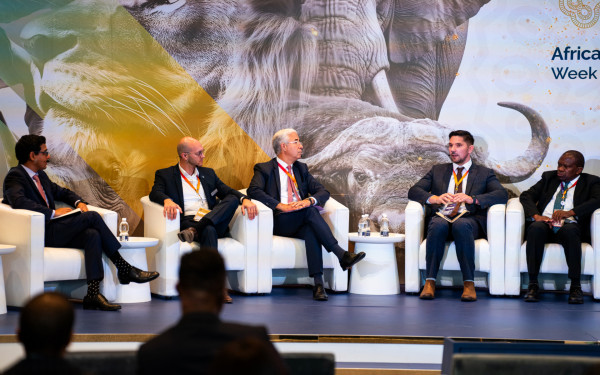
At a dedicated panel session at African Energy Week: Invest in African Energies 2024, panelists emphasized the need for countries already producing oil and gas to utilize local energy resources for the purposes of enhancing value and meeting domestic needs, particularly for secluded and rural areas that do not have access to energy on the grid. They agreed that green technology and innovation could not be advanced without significant investments in local capacity, particularly in manufacturing and grid infrastructure.

Moderated by S&P Global Head of Energy Transition, Ashutosh Singh, panelists of the Advancing Green Technology and Innovation in Africa session further agreed that while renewable energy may not create immediate large-scale jobs, strategic planning by policymakers could lead to millions of new opportunities as the sector evolves.

James White, CEO of Comet Energy, highlighted that legislative barriers also exist in many African nations. In South Africa, for instance, larger solar installations connected to the grid need a generation license from National Energy Regulator of South Africa (NERSA). This, White believes, adds an additional layer of complexity and can deter potential investors or developers from pursuing solar projects.

Although recent amendments to policies have raised the threshold for embedded generation projects without a license to 100 MW, navigating these regulations still poses significant challenges, he noted. “We also need to look at developing local supply chains, which are needed to further drive down costs and improve accessibility to technologies,” he said.

Dennis Bauer, Senior Executive Energy Transition Advisor, Neuman & Esser discussed the potential of hydrogen as key to Africa's energy transition.

By 2035, more than 50 million tons per year of cost-competitive green hydrogen can be produced on the continent by blocks in Morocco, Egypt and South Africa. However, Bauer emphasized that localized supply chains are necessary to support these developments. “Developing local manufacturing capabilities for battery components and other technologies can significantly reduce costs and enhance sustainability,” he said.

The panel discussion also touched on advancements in solar technology, noting improvements in efficiency and flexibility that can facilitate deployment in remote areas.

CEO of South African National Energy Development Institute (SANEDI), Dr Zwanani Titus Mathe, stressed the importance of learning from successful models surrounding new green technologies, like China's investment in research and development (R&D).

“We need to establish centers of competence across Africa focused on R&D, manufacturing and skills development to position the continent as a leader in green technology. As African nations commit to investing in green innovation, collaboration among governments, businesses, and communities is also essential,” he said.

Director of International Relations at IFP Energies nouvelle (IFPEN), Dr Said Nachet, concluded that Africa has the potential to lead in green technology. “By harnessing local resources and fostering innovation, the continent can emerge as a hub for green technology and sustainable energy solutions,” he said.

Distributed by APO Group on behalf of African Energy Chamber.

Media files
African Energy Chamber
Download logo
Read moreLocal Manufacturing Key to Advancing Green Technologies
8 November 2024

Imbizo a “demonstration of GNU at work”

Location: News

Imbizo a "demonstration of GNU at work"

President Cyril Ramaphosa has hailed the KwaZulu-Natal District Development Model (DDM) Presidential Imbizo as a powerful example of the Government of National Unity (GNU) in action. 

The President underscored the collaborative efforts of various political leaders to address pressing community issues. 

Addressing community members at the Umnini Sportsfield in Umgababa, the President said the imbizo was a fairly productive session. 

“As I end, I think we have held a fairly productive imbizo session. Today has been a clear demonstration of how our Government of National Unity is also working. I have Ministers from our various political parties that are part of the GNU. 

“I would like to thank them all and I want all the parties in the GNU to see the value of izimbizo. They are important because they enable us to interact with our people and hear their views, and answer their questions and at the same time, follow up on their issues that they have raised,” the President said. 

The Presidential Imbizo is a platform for communities to interact with government leaders from all three spheres of government on service delivery challenges, and for the executive to respond to the community on what they are doing to resolve those issues. 

Community members gathered at the Umnini Sportsfield raised issues such as crime, unemployment, the rising cost of living and matters concerning education. 

The South African Democratic Teachers Union asked President Ramaphosa to intervene on the issue of safety and security at KwaZulu-Natal schools, highlighting previous incidents where teachers were attacked, shot and killed at schools.

Before the Ministers took to the podium to respond to the above issues, President Ramaphosa apologised for the delayed start due to technical issues, stressing the need for better preparedness at such events.

Ministers in the GNU accompanying the President responded to the issues respectively and promised residents that they will follow up and provide solutions. 

Turning to the City of eThekwini municipality, the President also spoke about plans to rejuvenate Durban’s tourism sector, which has historically made the city the "holiday mecca" of South Africa. 

With tourism numbers currently in decline, President Ramaphosa expressed optimism for a revival through the planned reopening of key hotels like the Hilton and lease renewals for iconic establishments such as the Maharani and Elangeni.

“Durban has been the holiday mecca of our country. Many people from all over the country have always considered Durban when they needed to go on a holiday. 

“Tourisms in the province has gone down but the mayor has plans to revive big hotels such as the Hilton Hotel and the renewal of leases by Southern Sun of the Maharani and Elangeni Hotel.

“The business sector has pledged to invest billions of rands to revive tourism, so I am looking forward to the revival of tourism so that Durban can go back to being the jewel of South African tourism. It must once again become the mecca of tourism in SA,” the President said. 

Tourism Minister Patricia De Lille said that her department is working hard to rebuild the tourism sector in the province. 

“Tourism is a very important sector for this province. It is making a significant contribution to the GDP and economic growth of the province. The tourism sector has gone down in KZN, but we are working hard with the Presidential Task Team and the private sector to rebuild it.” 

The Minister said that she has already agreed with the KZN Premier that they will be meeting as a matter of urgency so they can see how they can work together with the plans of the province to do an aggressive marketing campaign to deal with all the negative perceptions around the province. 

“For the summer season, the department partnered with the private sector and already we have 440 private sector tourist attractions that are offering discounted deals for the summer season and I want to encourage all South Africans to look at the Shot left site and check the discounts,” de Lille said.

The President also drew attention to ongoing infrastructure challenges, particularly highlighting the partial collapse of a bridge on the N2 highway, which has disrupted local transportation. 

He expressed confidence in South African engineers, who have devised a plan to restore the bridge, calling it a testament to the country’s engineering expertise. 

“In the morning, I went to the N2 bridge that partially collapsed. The bridge is causing a lot of inconvenience for the people, as it is an important road on the N2," the President said. - SAnews.gov.za

DikelediM
Fri, 11/08/2024 - 19:08

78 views
Read moreImbizo a “demonstration of GNU at work”
8 November 2024

NBA Africa and AFD Launch Youth Development Program in Senegal

Location: Sport
National Basketball Association (NBA)

- The “Jr. NBA & AFD Basketball Experience” Will Feature Weekly Basketball and Life-Skills Sessions to Educate Senegalese Youth About the Importance of Physical and Mental Wellness -

- AFD and NBA Africa Unveil Two Refurbished Basketball Courts in Guediawaye, Senegal -

- Former NBA Player and 2015 FIBA AfroBasket Champion Olumide Oyedeji Attends Launch - 

NBA Africa (www.Africa.NBA.com) and Agence Française de Développement (AFD), France's public development bank institution committed to financing and technical assistance for projects that improve the lives of people in developing and emerging economies, yesterday launched the “Jr. NBA & AFD Basketball Experience” youth development program in Guediawaye, Senegal.

The Jr. NBA & AFD Basketball Experience, launched in 2021 in Nigeria and subsequently also held in Kenya and Morocco, uses basketball as a platform to promote social inclusion and youth empowerment amongst primary and secondary school children.  In Senegal, the program will be operated by nongovernmental organization (NGO) Sports for Education and Economic Development (SEED) Project and feature weekly basketball and life-skills sessions that will educate thousands of Senegalese boys and girls about the importance of physical and mental health, wellness and social cohesion.

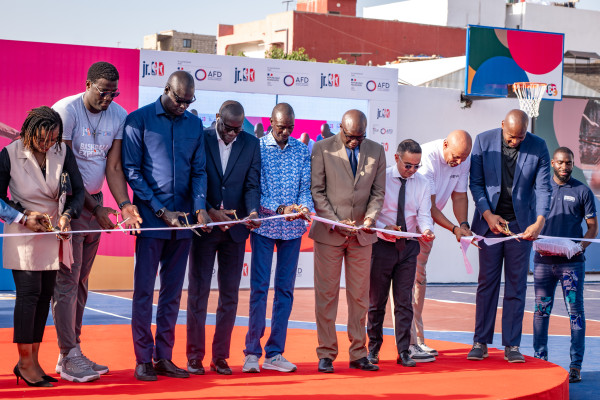
As part of the program's launch in Senegal, NBA Africa and AFD unveiled two basketball courts at The Hamo 4.5.6. Courts in Guediawaye and held a clinic for 150 boys and girls ages 16 and under.  The launch was attended by AFD Senegal Country Director Mihoub Mezouaghi; Basketball Africa League (BAL) President Amadou Gallo Fall; NBA Africa Director of Basketball Operations Kita Matungulu; and former NBA player and 2015 FIBA AfroBasket champion Olumide Oyedeji.

“Aware of the potential of sport as a vector of social cohesion, AFD has made it a strategic axis of its action to support the achievement of the Sustainable Development Goals,” said Mezouaghi. “It is in this dynamic that our collaboration with the NBA is part of what aims to promote the practice of sport in Africa through the provision of local infrastructure, the professionalization of sports educators and the organization of sports sessions, and education for young people.”

“The collaboration between NBA Africa and AFD continues to grow as we extend this initiative to reach more young people in new countries on the continent,” said Matungulu.  “The Jr. NBA & AFD Basketball Experience reflects our commitment to investing in the next generation of African youth and our belief that basketball teaches life lessons like the importance of physical and mental wellness that help children succeed on the court and in life.”

The refurbished courts, part of NBA Africa's commitment to build 1,000 basketball courts in Africa over the next decade, are expected to benefit thousands of boys and girls from the surrounding communities.

The Jr. NBA & AFD Basketball Experience is part of AFD and NBA Africa's collaboration to support basketball infrastructure and youth development across the continent and builds on the program's previous editions in Morocco and Nigeria, and its recent launch in Kenya.  To date, the program has reached nearly 90,000 boys and girls ages 12-17 and 460 coaches and physical education teachers.

The Jr. NBA/Jr. WNBA, the league's global youth basketball participation program for boys and girls, teaches the fundamental skills as well as the core values of the game at the grassroots level in an effort to help grow and improve the youth basketball experience for players, coaches and parents.  Jr. NBA/Jr. WNBA programming has directly reached more than 250,000 youth across Africa this year.

Distributed by APO Group on behalf of National Basketball Association (NBA).

Contacts:
Chumani Bambani,
NBA Africa PR & Communications,
cbambani@nba.com,
+27 65 548 1031

Francine Pipien,
AFD Senegal,
pipienf.ext@afd.fr

About NBA Africa:
NBA Africa is an affiliate of the National Basketball Association (NBA), a global sports and media organization with the mission to inspire and connect people everywhere through the power of basketball. NBA Africa conducts the league's business in Africa, including the Basketball Africa League (BAL), and has opened subsidiary offices in Cairo, Egypt; Dakar, Senegal; Johannesburg, South Africa; Lagos, Nigeria; and Nairobi, Kenya.  The league's efforts on the continent have focused on increasing access to basketball and the NBA through youth and elite development, social responsibility, media distribution, corporate partnerships, NBA Africa Games, NBA Stores, the BAL, and more.

NBA games and programming are available in all 54 African countries, and the NBA has hosted three sold-out exhibition games on the continent since 2015. The BAL, a partnership between the International Basketball Federation (FIBA) and NBA Africa, is a professional league featuring 12 club teams from across Africa that concluded its fourth season in June 2024. Fans can follow @ NBA_Africa and @ theBAL on Facebook, Instagram, X and YouTube.

About AFD:
Agence Française de Développement (AFD) Group finances, supports and accelerates the transitions necessary for a more just and resilient world. It thus contributes to implementing France's policy on sustainable development and international solidarity. It is with and for communities that we build, with our partners, solutions in more than 160 countries, as well as in 11 French overseas departments and territories.

Our objective: to reconcile economic development with the preservation of common goods: the climate, biodiversity, peace, gender equality, education and health. Our teams are involved in more than 3,600 projects in the field, which are part of the commitment of France and the French people to fulfilling the Sustainable Development Goals. For a world in common.

AFD strongly believes in the power of sport as a lever to achieve the sustainable development goals. Since the launch of its sport for development strategy in 2019, AFD has invested more than €130 million in over 160 projects that use sport as a tool to promote access to education, gender equality, youth empowerment, health and social cohesion. In Senegal, the AFD group puts its entire range of financial instruments at the service of local economic and social development actors (state, public companies, private and financial sector, NGOs, etc.) to support an inclusive development model, creating jobs, promoter of sustainable infrastructure, and respectful of the environment.  Since 2012, 115 projects have been funded, representing a commitment of more than 2.2 billion euros.

AFD.fr

Media files
National Basketball Association (NBA)
Download logo
Read moreNBA Africa and AFD Launch Youth Development Program in Senegal
8 November 2024

Upstream Players Highlight Innovative Financing Critical Mineral Projects at CMA

Location: News
Energy Capital & Power

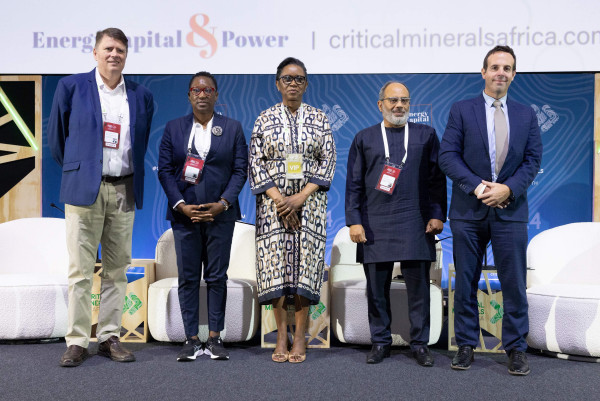
Players within Africa's energy transition sector highlighted innovative financing mechanisms which can help drive the industry maximize value addition and beneficiation to local economies during the Leaders Forum at Critical Minerals Africa Summit on Thursday.

Marie-Chantal Kaninda, President, Glencore DRC announced that the firm contributed approximately $1 billion in revenue for the Democratic Republic of Congo (DRC) through royalty taxes in 2023.

She said the firm invested in processing facilities at two of its operational mines in the DRC (https://apo-opa.co/3AvKgjI) to enhance value addition of copper and cobalt resources.

“We export hydroxide cobalt, which is an intermediary product, and produce copper cathodes ready for cable manufacturing,” Kaninda explained, adding that 95% of Glencore's workforce in the DRC is sourced locally, with many employees holding senior positions.

Speaking on the challenges facing Africa's mineral value addition efforts, Carlos Lopes, Professor at the Nelson Mandela School of Public Governance, University of Cape Town, noted that a lack of adequate funding is a primary barrier.

Despite Africa's GDP having doubled since 2000, he said, the continent is still perceived as a high-risk market by some investors. Lopes called for innovative local financial solutions to meet capital needs for value-addition projects.

“Africa pays the world's highest interest rates, yet our potential is undervalued. We must be strategic in policy-making to fully capitalize on our resources,” he stated, emphasizing the drawbacks of exporting raw minerals for overseas processing.

Mfikeyi Makayi, CEO of KoBold Metals, underscored the role of innovation in reducing the high costs associated with critical mineral exploration and value addition. She highlighted the company's AI-enabled exploration efforts backed by Silicon Valley investment, stating, “With 60 projects across 40 countries, including flagship initiatives in Zambia and new ventures in Namibia and Botswana, we're focused on leveraging digital mining solutions to drive industrialization across the continent.”

Makayi added that the data generated through digital mining is vital for attracting investment and creating a more competitive and inclusive sector.

Sietse van de Woude, Senior Executive of Modernization and Safety at the Minerals Council South Africa, discussed the Mandela Mining Precinct initiative, a public-private partnership designed to fund and support mining sector innovation.

“Innovation is essential for critical minerals mining,” van de Woude said, adding that the initiative offers a platform for industry stakeholders to share best practices and collaborate on advancing operational efficiency and safety.

Distributed by APO Group on behalf of Energy Capital & Power.

Media files
Energy Capital & Power
Download logo
Read moreUpstream Players Highlight Innovative Financing Critical Mineral Projects at CMA
8 November 2024

Boost for start-ups involved in space, Earth observation

Location: News

Boost for start-ups involved in space, Earth observation

Eight start-ups involved in space and Earth observation innovations have received funding through the Earth Observation Frontiers Enterprises Innovation Support Fund (NEOFrontiers EISF). 

Launched in 2021, the NEOFrontiers is an innovation funding mechanism designed to drive the growth of the local space sector through increased public investments. 

It seeks to stimulate collaboration, cooperation and innovation in the public and private South African Earth observation community.

The NEOFrontiers programme is managed by the South African National Space Agency (SANSA) and the National Research Foundation (NRF), and implemented with the support of Tuksnovation, the University of Pretoria's business and technology incubator. 

The programme subsidises enterprises with amounts ranging from R750 000 to R1 million for 12 months.

SANSA launched NEOFrontiers in 2021 through investment from the Department of Science, Technology and Innovation (DSTI). 

The first four NEOFrontiers projects were funded in 2022, while 2023 saw three start-ups supported. 

This year’s NEOFrontiers call saw eight successful start-ups submit brilliant proposals on mining, agriculture, infrastructure development, healthcare innovation, banking and financial institutions, as well as disaster risk reduction. 

These include Abiri Innovations, Agizo Solutions (Pty) Ltd, Aphelion World JV/Consortium, CreditAIs, Integrated Geoscience Solutions, Kgothatso Innovations, Regona Trading and YaAzi.

A total of 56 applications were received earlier in the year, 25 of which were eligible and allowed to pitch to an independent adjudication committee.

DSTI’s Acting Chief Director Itumeleng Makoloi said this programme unfolds at an opportune time when South Africa seeks to foster innovation.

“We need to create new ways of modernising areas such as agriculture, mining and manufacturing. We believe that this programme represents our shared vision to foster innovation, capacity building and strategic partnership across the public sector. 

"The joint efforts of DSTI entities, such as SANSA and the NRF, play a critical role in driving this vision.”

SANSA CEO, Humbulani Mudau, believes this platform will create a market pool for innovative solutions, for which space is a significant enabler and a value provider.

“I’m delighted to report that there is an equal split in gender representation. We have awarded the grant to start-up companies led and owned by four males and four females. This is good progress towards transforming the industry,” Mudau said. 

He said the NEOFrontiers is poised for greater strides in terms of direction and investments. 

“We’re indeed going to make this a flagship programme that will transform space-based ideas into relevant products and services that address societal and environmental challenges. As we do that, we’re going to be looking at increasing the competitiveness of the South African Earth observation industry for the benefit of the South African society.”

NRF CEO, Dr Fulufhelo Nelwamondo, is of the view that the initiative has the potential to gear small enterprises in the space sector to create job opportunities.

“The key focus is to support start-ups, SMMEs and entrepreneurs with funding. The reason for this is that we expect much more from our SMMEs to make sure that they can grow and employ more people.

“When they employ more people, there is an increase in new technology and service innovations coming out of their areas to a point that we can get even more people involved. Our rate of unemployment is increasing.”

The University of Pretoria’s Head of Innovation and Contracts Management, Advocate Lawrence Baloyi, said this has the potential to shape the future of South African space innovation. 

The next call to fund new SMMEs will be published before the end of 2024. – SAnews.gov.za

Gabisile
Fri, 11/08/2024 - 11:04

28 views
Read moreBoost for start-ups involved in space, Earth observation
8 November 2024

Five Winners of the 2024 Earthshot Prize Unveiled at Awards Ceremony in Cape Town

Location: News

MultiChoice Group
Download logo

  • Advanced Thermovoltaic Systems, High Ambition Coalition for Nature and People, Keep IT Cool, Altyn Dala Conservation Initiative and Green Africa Youth Organization (GAYO) revealed as 2024 Earthshot Prize Winners during star-studded ceremony broadcast live across 50 African countries
  • Each Winner to receive £1 million to accelerate and scale the impact of their innovative environmental solutions
  • Calls for nominations for the 2025 Earthshot Prize are now open

​Last night, the five 2024 Earthshot Prize Winners were announced at a star-studded awards ceremony in Cape Town, South Africa, hosted by Emmy, Grammy and Tony Award winner Billy Porter and award-winning television presenter Bonang Matheba. The 2024 Winners, selected from this year's 15 Earthshot Finalists, will be awarded £1 million each to accelerate and scale their game-changing environmental solutions.

Following a rigorous selection process focused on identifying impactful, inspiring and inclusive environmental solutions, the five Winners are:

  • Fix Our Climate: Advanced Thermovoltaic Systems
  • Revive Our Oceans: High Ambition Coalition for Nature and People
  • Build a Waste-Free World: Keep IT Cool
  • Protect and Restore Nature: Altyn Dala Conservation Initiative
  • Clean Our Air: Green Africa Youth Organization (GAYO)

 Speaking during the Awards Ceremony, Prince William said:

“I believe our world can be rich in possibility, in hope, and in optimism. That is why The Earthshot Prize exists. To champion the game-changers, the inventors, the makers, the creatives, the leaders; to help them build upon the amazing things they've already achieved; to speed their innovations to scale and to inspire the next generation to create the future we all need."

Descriptions of the five Winners, by category:

WINNER for Fix Our Climate:

Advanced Thermovoltaic Systems (https://apo-opa.co/48EySP6), USA
Nominated by: Herbert Smith Freehills LLP

Advanced Thermovoltaic Systems (ATS) has developed a simple, safe and scalable technology to capture waste heat and convert it into electricity, offering a game-changing solution for heavy industries like cement and steel production. These industries require extremely high temperatures, which generate vast amounts of waste heat that is typically lost. ATS's technologies have the potential to save gigatonnes of CO2.

“At ATS, we are proud to lead the way in converting this waste into clean, usable electricity.  Winning the 2024 Earthshot Prize underscores the transformative potential of our technology. Tonight is a key moment for us as we focus on scaling up production in larger manufacturing facilities.” – Kelly Adams, CEO, Advanced Thermovoltaic Systems.

WINNER for Revive Our Oceans:

High Ambition Coalition for Nature and People (https://apo-opa.co/3AxM7Ew), Global
Nominated by: Campaign for Nature

A groundbreaking alliance of 119 countries with the ambitious goal to protect 30% of land and oceans by 2030, High Ambition Coalition identifies technical, financial and knowledge gaps and connects governments with technical assistance and funding. They've already achieved a major milestone with the adoption of the “30×30” target in the 2022 UN Global Biodiversity Framework.

Rita Maria El Zaghloul, Director, High Ambition Coalition for Nature and People said, “On behalf of the alliance, we are deeply humbled to be a Winner of this year's Earthshot Prize. Today's award validates the hard work and dedication of all involved in the 30x30 initiative and fuels our excitement and determination to protect 30 percent of the world's land and oceans by 2030. Together, we can achieve a more sustainable and biodiverse future.”

WINNER for Build a Waste-Free World:

Keep IT Cool (https://apo-opa.co/3AAGjdr), Kenya
Nominated by: Draper Richards Kaplan Foundation, Katapult Ocean

Keep IT Cool (KIC) addresses the challenge of food spoilage by providing sustainable, localized refrigeration systems that help small farmers and fishers preserve their produce. By installing solar-powered cold storage units where fish are landed, KIC significantly reduces spoilage and waste by ensuring the catch stays fresh and managing its transport to market. With plans to grow into East Africa and beyond, KIC is now working to expand their activities in poultry, fruit and vegetables and aims to bring their solution to more communities.

Francis Nderitu, Founder and Managing Director of Keep IT Cool said, “We are on a mission to revolutionise the food supply chain in East Africa. We are grateful for the recognition from The Earthshot Prize, and it is an important milestone for Keep IT Cool. We will continue to enhance market access, reduce waste and build climate resilience for small-scale fish and poultry farmers throughout the region.”

WINNER for Protect and Restore Nature:

Altyn Dala Conservation Initiative (https://apo-opa.co/3NWG3Zk), Kazakhstan
Nominated by: United Nations Environment Programme

Altyn Dala Conservation Initiative has achieved the almost unprecedented feat of saving the critically endangered Saiga antelope from extinction. This mission has grown into one of the world's largest conservation projects and is focused on protecting and restoring Kaakhstan's Golden Steppe, one of the world's least protected natural ecosystems.

Vera Voronova, Executive Director, Altyn Dala Conservation Initiative said, “We are thrilled to be receiving the 2024 Earthshot Prize for Protect and Restore Nature. Altyn Dala demonstrates that when governments and civil society work together with a shared vision, we can achieve remarkable results. The restoration of the Saiga antelope population and the revival of the Central Asian steppe are not just triumphs for wildlife but for the local communities that depend on these ecosystems.”

WINNER for Clean Our Air:

GAYO, Green Africa Youth Organization (https://apo-opa.co/3NVrpSe), Ghana
Nominated by: Clean Air Fund

A youth-led, gender-balanced organisation, GAYO uses its “Zero Waste Model” to drive behavioural change in waste management practices across Africa that cut greenhouse gas emissions and particle pollution, while also bringing additional income to communities. Their goal is to reduce greenhouse gas emissions and particle pollution in Ghana by 70%, compared to open burning, as well as divert a total of 4,000 tonnes of waste by 2030. GAYO's plans to scale would make them the leading model for waste management on the continent.

Desmond Alugnoa, Co-Founder of the Green Africa Youth Organization (GAYO) said, “We are incredibly honored to be winning the Prize, which is a testament to the power of community-driven solutions and the importance of empowering those most affected by climate challenges. Our work in Ghana demonstrates that sustainable waste management isn't just a possibility—it's a necessity. The recognition by The Earthshot Prize fuels our commitment to replicating these models across Africa, proving that local solutions can have global impacts.”

The five Winners of the 2024 Prize cohort were selected by Prince William and The Earthshot Prize Council, a diverse group of experts, advocates and individuals dedicated to championing urgent and innovative action to protect our planet. The Earthshot Prize Council is chaired by The Earthshot Prize Board of Trustees Chair, Dame Christiana Figueres, architect of the Paris Agreement.

Members of The Earthshot Prize Council include: His Royal Highness Prince William, Her Majesty Queen Rania Al Abdullah, José Andrés, Sir David Attenborough, Cate Blanchett, Ernest Gibson, Hindou Oumarou Ibrahim, Wanjira Mathai, Stella McCartney, Nemonte Nenquimo, Luisa Neubauer, Indra Nooyi, Dr. Ngozi Okonjo-Iweala and Naoko Yamazaki.

In addition to the five £1 million prizes supporting the growth of Winners' solutions, each of the 15 Earthshot Prize Finalists will receive dedicated mentorship, resources and technical support through the year-long Earthshot Prize Fellowship Programme.

That support includes access to the Prize's robust network of influential experts and partners, including The Earthshot Prize's Global Alliance of Partners (https://apo-opa.co/4fh0E6D), comprised of some of the world's largest businesses, donors, investors and environmental organisations committed to climate action.

Finalists will also have access to Launchpad (https://apo-opa.co/3O1bhi2), Earthshot's bespoke online finance platform to matchmake Earthshot solutions to a growing community of members made up of mission-aligned donors and investors seeking to speed proven environmental solutions to scale.

The Earthshot Prize is already gearing up for the 2025 Earthshot Prize. Nominations for the Prize's fifth cohort of innovative solutions and entrepreneurs are now open.

If you missed last night's spectacular live event you can watch repeat broadcasts of the star-studded ceremony from 07 November on DStv Catch Up, Showmax, and on multiple DStv channels across Africa from 08 November. Check your local television schedules for more details.

Distributed by APO Group on behalf of MultiChoice Group.

NOTES FOR EDITORS:
Follow The Earthshot Prize on:  

Instagram: https://apo-opa.co/3UKashj
Twitter: https://apo-opa.co/4fEHeZ8
LinkedIn: https://apo-opa.co/3AA6uB4
Facebook: https://apo-opa.co/3YU9tNY
YouTube: https://apo-opa.co/3UGroFo
TikTok: https://apo-opa.co/4fFj00P

About The Earthshot Prize:
Founded by Prince William and incubated in the The Royal Foundation in 2020 for a year before becoming an independent platform/organisation, The Earthshot Prize is a global environmental prize and platform designed to discover, accelerate and scale ground-breaking solutions to repair and regenerate the planet. Inspired by President John F. Kennedy's Moonshot, which united millions of people around the goal of reaching the moon, The Earthshot Prize aims to catalyse an Earthshot challenge to urgently encourage and scale innovative solutions that can help put the world firmly on a trajectory towards a stable climate, where communities, oceans and biodiversity thrive in harmony by 2030. The five challenges are: Protect and Restore Nature; Clean Our Air; Revive Our Oceans; Build a Waste-Free World; and Fix Our Climate.

The Prize aims to turn the current pessimism surrounding environmental issues into optimism by championing inspiring leadership and helping to scale incredible cutting-edge solutions. It will discover 50 winners over 10 years with the power to repair the planet. More than an award, The Earthshot Prize works in partnership with a Global Alliance of Partners to support the scaling of the solutions discovered and selected each year.

The Global Alliance Founding Partners are a group of leading global organisations and philanthropists, which act as strategic funding partners to the Prize, including Aga Khan Development Network, Bezos Earth Fund, Bloomberg Philanthropies, Breakthrough Energy Foundation, Coleman Family Ventures, DP World in partnership with Dubai EXPO 2020, Eleven Eleven Foundation, Giving Grousbeck Fazzalari, Holch Povlsen Foundation, Jack Ma Foundation, Law Family Charitable Foundation, Mastercard Center for Inclusive Growth, Marc and Lynne Benioff, Paul G. Allen Family Foundation, Rob Walton Foundation, Sandy and Paul Edgerley, Standard Chartered Bank, Temasek Trust, and Uber.

Global Alliance Partners are non-profit environment and sustainable development organisations that bring expertise, global reach and serve as nominating organisations each year. For a full list of our Global Alliance Partners, visit: https://apo-opa.co/4fh0E6D.

Global Alliance Members are some of the world's largest and most influential companies and brands that will support The Earthshot Prize, implement ambitious changes within their businesses and accelerate the advancement of the solutions of Prize Finalists and Winners. They are Arup, Bloomberg L.P., Deloitte, Herbert Smith Freehills, Hitachi, Ingka Group (IKEA), Microsoft, The Multichoice Group, Natura &Co, Safaricom, Salesforce, Unilever, Vodacom Group, and Walmart.

For more information about The Earthshot Prize, visit: www.EarthshotPrize.org.

Read moreFive Winners of the 2024 Earthshot Prize Unveiled at Awards Ceremony in Cape Town
7 November 2024

Afreximbank President Professor Benedict Oramah Receives Prestigious Mohammed Barkindo Lifetime Achievement Award

Location: News
Afreximbank

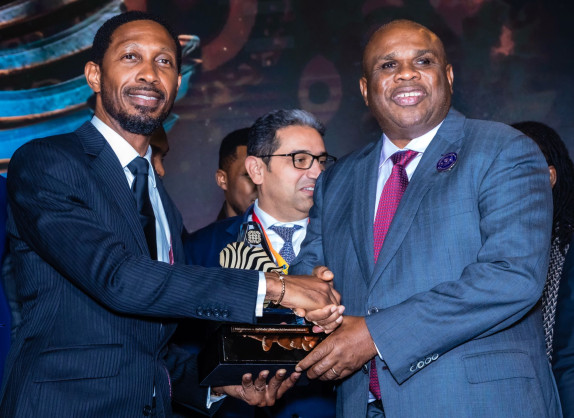
Professor Benedict Okey Oramah, President and Chairman of the Board of Directors at African Export-Import Bank (Afreximbank) (www.Afreximbank.com), has been awarded the prestigious Mohammed S. Barkindo Lifetime Achievement Award at the African Energy Awards, held on the sidelines of the African Energy Week (AEW) 2024: Invest in African Energy conference, happening between 4-8 November in Cape Town, South Africa.  

The award, named in honour of the former Secretary-General of OPEC, the late Dr Mohammed Barkindo, recognizes individuals who have made exceptional and lasting contributions to Africa's oil, gas, and energy sectors. This honour represents the highest accolade in African energy, awarded to individuals whose work has had a transformative impact on the continent's energy sector. Notable past recipient of the Mohammed S. Barkindo Lifetime Award in 2023 is Keith Hill, former President and CEO of Africa Oil Corp. 

For over three decades, Prof. Oramah has played a critical role in driving sustainable development across Africa by channelling essential funding into major oil, gas, and infrastructure projects. Since assuming leadership of Afreximbank in 2015, he has pioneered innovative financing structures that have democratised energy access and accelerated industrialization and the growth of Africa's strategically critical energy sector. 

Under Prof. Oramah's leadership, Afreximbank has made substantial contributions to the growth of Africa's energy sector. Under his stewardship, the Afreximbank has facilitated the mobilization of over USD 70 bn to support Africa's energy sector. Included in this is more than USD 5bn for refineries in Nigeria, Angola and Senegal, to further Africa's refined product independence and reduce the continent's Foreign Exchange drain.  

In Nigeria, Afreximbank now acts as Adviser and Settlement Bank for NGN denominated crude sales to Nigerian refineries. Replicated across the oil producing states in Africa, this will save several USD 100mn per annum in transactional charges alone. Ranking among President Oramah's most significant achievements is the historic signing of the Establishment Agreement and the Charter of the Africa Energy Bank (“AEB”) in Egypt in June 2024, in partnership with the African Petroleum Producers Organization (APPO). This landmark initiative aims to mobilize funding to support investments across Africa's entire energy system, aligning with the continent's energy needs and its environmental sustainability goals. 

Professor Oramah has led the energy transition agenda through the Bank's support in renewable energy transactions including, but not limited to, the EUR1.3 bn ECA import facility Project Gleam in support of the import of sonar panels for rural electrification in Angola, the EUR 147mn Government of Cameroon solar power project and the US$363 million Gasmeth Energy Rwanda gas extraction and processing project.  

Significantly, the majority of the above-mentioned transactions received numerous industry awards for their impact on the continent, their complexity and their unique structures.   

Prior to joining Afreximbank, Professor Oramah distinguished himself in international trade finance and development. Beginning his career at the Nigerian Export-Import Bank (NEXIM), he played an instrumental role in shaping Nigeria's export development strategies. Prof Oramah holds a Ph.D. in Agricultural Economics from Obafemi Awolowo University in Nigeria.  

Acknowledging the award, Prof. Oramah commented: 

“It is a great honour to be awarded the Mohammed S. Barkindo Lifetime Achievement Award. Whilst a great honour for me personally, this award reflects the work and dedication of many others, including my colleagues at Afreximbank and our various partners. At Afreximbank, we remain deeply committed to reducing energy deficit on the continent and ensuring we are self-sufficient. 

Distributed by APO Group on behalf of Afreximbank.

Media Contact: 
Mr Vincent Musumba 
Manager, Communications and Events (Media Relations) 
Email: press@afreximbank.com 

Follow us on: 
Twitter: https://apo-opa.co/4fwz0D3
Facebook: https://apo-opa.co/4emjUyg
LinkedIn: https://apo-opa.co/4feURPa
Instagram: https://apo-opa.co/3CjGevc

About Afreximbank : 
African Export-Import Bank (Afreximbank) is a Pan-African multilateral financial institution mandated to finance and promote intra-and extra-African trade. For 30 years, the Bank has been deploying innovative structures to deliver financing solutions that support the transformation of the structure of Africa's trade, accelerating industrialization and intra-regional trade, thereby boosting economic expansion in Africa. A stalwart supporter of the African Continental Free Trade Agreement (AfCFTA), Afreximbank has launched a Pan-African Payment and Settlement System (PAPSS) that was adopted by the African Union (AU) as the payment and settlement platform to underpin the implementation of the AfCFTA. Working with the AfCFTA Secretariat and the AU, the Bank is setting up a US$10 billion Adjustment Fund to support countries to effectively participate in the AfCFTA. At the end of December 2023, Afreximbank's total assets and guarantees stood at over US$37.3 billion, and its shareholder funds amounted to US$6.1 billion. The Bank disbursed more than US$104 billion between 2016 and 2023. Afreximbank has investment grade ratings assigned by GCR (international scale) (A), Moody's (Baa1), Japan Credit Rating Agency (JCR) (A-) and Fitch (BBB). Afreximbank has evolved into a group entity comprising the Bank, its impact fund subsidiary called the Fund for Export Development Africa (FEDA), and its insurance management subsidiary, AfrexInsure, (together, “the Group”). The Bank is headquartered in Cairo, Egypt. 

For more information, visit: www.Afreximbank.com 

Media files
Afreximbank
Download logo
Read moreAfreximbank President Professor Benedict Oramah Receives Prestigious Mohammed Barkindo Lifetime Achievement Award
6 November 2024

AEW Highlights Critical Minerals Role in African Renewables Growth

Location: News
African Energy Chamber

Africa must expand its renewable energy manufacturing capabilities and leverage its critical minerals to foster growth in its renewables sector, according to James Mackay, Managing Director at the Energy Council of South Africa.

Speaking on a panel discussion during African Energy Week: Invest in African Energies' Pre-Event Technical Workshops, Mackay said the high cost of renewables in Africa could be lowered by enhancing local manufacturing capacity, making vital technologies more accessible for project developers.

“Egypt is currently leading in solar manufacturing, but other African governments should work to attract investments and implement policies that incentivize manufacturers to establish operations on the continent,” stated Mackay.

Carlos Torres Diaz, Senior Vice President & Head of Gas and Power Markets Research, Rystad Energy highlighted Africa's youthful workforce as a strategic advantage in developing innovative solutions required to harness the continent's 30% share of global critical minerals. According to Diaz, the focus is no longer solely on replacing fossil fuels but on integrating all energy resources and using digital tools to stabilize the power grid.

“Gas-to-power solutions remain essential for stability alongside renewables,” he noted.

Despite holding 40% of the world's total solar potential, Africa currently utilizes only 35% of its capacity, according to Nivedh Das Thaikoottathil, Senior Analyst – Renewables & Power at Rystad Energy. Thaikoottathil pointed out that Africa's ability to add value to its critical minerals will shape its potential to produce over 100,000 TWh of solar energy annually, potentially increasing the share of solar and wind from 8% today to 60% by 2040.

Commenting on high-growth renewable energy markets in Africa, Thaikoottathil said South Africa, Morocco, Egypt, Tunisia, Mauritania and Mozambique are the key players.

“We are seeing growing financing for renewable projects and new interconnectors between North Africa and Europe, with 24 GW of proposed capacity aimed at linking the regions,” he said.

AEW: Invest in African Energy 2024 is held alongside the Critical Minerals Africa Summit which will run from November 6 – 7 November in Cape Town, offering delegates access to the full scope of energy, mining and finance leaders.

Distributed by APO Group on behalf of African Energy Chamber.

Media files
African Energy Chamber
Download logo
Read moreAEW Highlights Critical Minerals Role in African Renewables Growth
6 November 2024

AEW 2024 Opens in Cape Town with Clarion Calls to Drill, Invest and Drive Projects Forward

Location: News
African Energy Chamber

The African Energy Week (AEW): Invest in African Energies 2024 conference officially opened with calls from the industry to ‘drill baby drill.' Citing the need to enhance climate justice through the development of domestic energy resources, industry leaders from across the continent underscored the need to sign deals, foster partnerships and drive projects forward.

With over 600 million people living without access to electricity and 900 million people without access to clean cooking solutions, the AEW: Invest in African Energies opening ceremony – sponsored by Kosmos Energy – positioned the oil and gas industry as the catalyst for making energy poverty history.

“Our priority must continue to be to end energy poverty for all Africans as well as to create an enabling environment where the oil and gas industry can thrive,” stated Diamantino Pedro Azevedo, Minister of Mineral Resources, Petroleum and Gas, Angola. “That is also our priority in Angola. The oil and gas industry will be a fuel for socioeconomic development.”

For the African Petroleum Producers Organization (APPO), prioritizing the development of domestic markets will be integral for eliminating energy poverty. APPO Secretary General Dr. Omar Farouk Ibrahim stated that “Today, APPO is focused on creating an integrated, regional and continental energy market. To create markets, we need to create cross-border, regional and inter-regional infrastructure. One of our projects we are working on is the Central African Pipeline System, which aims to link countries through crude oil and gas pipelines.”

Adding to these remarks, Kgosientsho Ramokgopa, Minister in the Presidency, Energy and Electricity, South Africa, said that “Today, Africa's path forward lies in seizing control of our energy destiny. Our resources make us capable of not just powering our homes and industries but a new Africa. This will require unity of purpose and a collective resolve.”

Despite project progress, financing remains a central challenge to oil and gas development in Africa. According to Mary Bruce Warlick, Deputy Executive Director of the International Energy Agency, “African countries account for 20% of the world's population but only 4% of global investment. Energy investment has been falling across the continent over the past decade. Africa needs $200 billion to achieve its climate and energy goals by 2030.”

To address these challenges, the African Export-Import Bank (Afreximbank), in collaboration with APPO, established the Africa Energy Bank, an institution which offers financing for African oil and gas projects. According to Benedict Oramah, President & Chairman of the Board, Afreximbank, “The Africa Energy Bank is the first multilateral sector bank in Africa. We expect the bank to significantly contribute towards bridging the funding gap in the African energy sector. It will be open for business to have access to funding by February in 2025. We invite you to send in your applications to be the first transaction by the Africa Energy Bank, which will be ready in a few months' time.”

The Africa Energy Bank supports energy companies drive projects forward. For independents such as Oando, this presents a strategic opportunity to expand their oil and gas portfolios in Africa. Wale Tinubu CON, Group Chief Executive Officer, Oando PLC, said that “The oil and gas landscape is changing. Between 2015 and 2023, there have been more than $7 billion of divested assets in Africa. In terms of M&A activity, there have been a focus on onshore and shallow water acquisitions and we have seen a rise of indigenous joint ventures and collaborations.”

Stepping into this picture, the AEW: Invest in African Energies conference convenes under a goal to make energy poverty history. By uniting the industry in Cape Town, the event fosters partnerships, promotes deal-signing while creating a collaborative environment for companies to do business in Africa's energy sector.

“It is the time for us to tell the African story, written from Cape to Cairo and Kampala to Dakar. We will forge a path that shapes the future. We have work to do in Africa. We sign baby sign so that we can drill baby drill. Let's not stop getting projects signed,” stated NJ Ayuk, Executive Chairman, African Energy Chamber.

Distributed by APO Group on behalf of African Energy Chamber.

Media files
African Energy Chamber
Download logo
Read moreAEW 2024 Opens in Cape Town with Clarion Calls to Drill, Invest and Drive Projects Forward
6 November 2024

South Africa reaffirms commitment achieve New Urban Agenda

Location: News

South Africa reaffirms commitment achieve New Urban Agenda

Human Settlements Minister, Mmamoloko Kubayi, has reaffirmed South Africa’s commitment to ensuring that the country achieves the New Urban Agenda in a more sustainable way.

Kubayi was speaking at a ministerial roundtable on the sidelines of the 12th World Urban Forum (WUF12) Summit, currently underway in Cairo, Egypt.

The ministerial roundtable was hosted by the United Nations-Habitat Executive Director, Anacláudia Rossbach, on Tuesday.

It explored how different spheres of government, from national to local, can work better together to achieve the 2030 Agenda for Sustainable Development, with particular attention on multilevel governance arrangements and partnerships for adequate housing, climate action, finance systems, digital technology, and urban crises response.

The New Urban Agenda represents a shared vision for a better and more sustainable future, and if well-planned and well-managed, urbanisation can be a powerful tool for sustainable development for both developing and developed countries.

Speaking at the session, Kubayi said South Africa was committed to ensuring that the country meets Sustainable Development Goal (SDG) 11, which calls for countries to make cities and human settlements inclusive, safe, resilient and sustainable.

“We have recognised that this is one of the most important areas of work to address issues related to this, in terms of global shared challenges, such as rapid urbanisation, climate change, inequality and inadequate infrastructure,” Kubayi said.

Kubayi said a multistakeholder approach has been taken by the South African government, and working together with the private sector and civil society, they have committed to ensuring that no one is left behind, but “we include everybody as part of our programmes”.

She highlighted that the primary participants in terms of this work is in the policy formulation, but also ensuring that government’s activities at local level are taken up and programmes are supported.

“The private sector supports us in terms of financial support, ensuring the initiatives that we do and commit to, are also funded, but also in partnership to fast-track the implementation. We do recognise that one of the areas that we want to continue to do this, is also support in terms of academic research organisations.

“We have launched our research agenda as the South African government, to ensure that what we bring as solutions in terms of implementing the urban agenda and also in achieving the UN SGD goals, is to ensure and make sure that our solutions are evidence based but more importantly, can be sustainable,” Kubayi said.

Kubayi also committed government in ensuring that urbanisation in the work they do in critical governance and leadership of the new urban agenda, includes the three spheres of government.

“That is why in our delegation here we have representatives of the national government, provincial government and local government. We do believe that this approach is more sustainable and ensures that it is inclusive but in terms of ensuring that all hands are on deck,” the Minister said.

The 12th World Urban Forum Summit is being held under the theme: “It all starts at home. local actions for sustainable cities and communities.” – SAnews.gov.za


GabiK
Wed, 11/06/2024 - 15:28

48 views
Read moreSouth Africa reaffirms commitment achieve New Urban Agenda
6 November 2024

Deputy President Mashatile to attend Earthshot Prize Awards

Location: News

Deputy President Mashatile to attend Earthshot Prize Awards

Deputy President Paul Mashatile is expected to attend the 4th Annual Earthshot Prize Awards ceremony, this evening, in Cape Town. 

The Deputy President will be attending Wednesday’s ceremony at the invitation of Britain’s Prince William and on behalf of President Cyril Ramaphosa. 

This marks the first time the event will be held in South Africa.

Started by Prince William in 2020, the prize supports sustainable, eco-friendly projects from around the world. Five winners each receive £ 1 million.

According to the Deputy President’s Office, the prize is the most prestigious global prize for the environment in history, despite only being in its fourth year. 

“Since then, the significant work that Earthshot has done by scaling ingenious solutions to the most pressing challenges facing the world, such as climate change, waste management, cleaning our air, saving our oceans, and saving and restoring nature is remarkable and aligned with South Africa’s priorities towards climate action, environmental protection and restoration, and cleaning the environment,” the Deputy President said. 

Every year, the organisers search the globe for game-changing innovations that will help repair the planet and award the winners of the best five solutions with money to scale their work. 

The initiative exists to discover, spotlight and help grow innovative solutions that are working to repair and regenerate our planet.

Last year, Earthshot welcomed its first South African finalist, ABALOBI, whose technology is making it easier for small fishing communities to monitor fish populations, improve market access, and recognise these communities as stewards of oceans. 

“It is of particular importance that the focus of the Earthshot Prize Awards is on the impact of climate change on Africa and the innovative solutions found on the African continent to mitigate the impact of climate change and environmental degradation.”

Meanwhile, the Deputy President said it was an “honour” to welcome the Prince of Wales to South Africa, highlighting the unique relationship the Royal Family has with the country. 

“The Prince of Wales continues to show his steadfast support and commitment to campaigning for the environment and advocating for the protection of our planet. These prestigious awards play a critical role in supporting and celebrating small enterprises that make a huge difference,” the Deputy President added.

President Ramaphosa met with Prince William in Cape Town on Tuesday. -SAnews.gov.za


Gabisile
Wed, 11/06/2024 - 09:25

13 views
Read moreDeputy President Mashatile to attend Earthshot Prize Awards
5 November 2024

Leaders in energy, investors converge for Africa Energy Week

Location: News

Leaders in energy, investors converge for Africa Energy Week

The African continent’s vast energy-related resources have the potential to forge a prosperous path for the continent. 

This is according to Minister of Energy and Electricity, Dr Kgosientsho Ramokgopa’s written notes for his address at the African Energy Week (AEW), which is underway at the Cape Town International Convention Centre.

AEW brings together Africa’s leaders in energy, investors and executives in the sector.

“Africa’s path forward lies in seizing control of our energy destiny. Our continent’s vast resources, rich potential, and resilience make us capable not just of fueling our homes and industries but of powering a new African century. 

“But this will require unity of purpose, a commitment to innovation, and a collective resolve to harness Africa’s energy to serve African needs,” Ramokgopa said.

Powering the future

The Minister insisted that the continent – despite its challenges, including energy poverty – has the “potential to lead the world in renewable energy and innovative energy solutions”.

“Africa’s potential for renewable energy is unmatched globally. The continent is rich in diverse renewable resources, each offering a path toward sustainable growth that is less dependent on fossil fuels and more aligned with global climate commitments,” Ramokgopa said.

Going further, the Minister cited the number of renewable energy sources available to the continent including solar and wind energy and hydropower.

“With vast stretches of land bathed in sunlight year-round, Africa has some of the highest solar irradiation levels in the world, especially across regions in the Sahara and Sub-Saharan Africa. Solar energy has the potential to power communities, businesses, and industrial zones, especially in off-grid and rural areas.

“From the coastal winds of Egypt to the strong inland gusts in Kenya and Ethiopia, Africa’s wind corridors hold immense potential for generating clean electricity. Expanding wind energy capacity offers not only a path to sustainability but also an opportunity for job creation in turbine manufacturing and maintenance.

“Africa has significant untapped potential, especially in countries with major rivers, such as the Congo, Nile, and Zambezi. Hydropower projects, when sustainably managed, can provide baseload power to support industrialisation and rural electrification, helping reduce energy costs for industries,” the Minister explained.

African Energy Agenda

Ramokgopa told the conference that as South Africa takes up its leadership of the G20 later this year, it is “positioned to champion Africa’s energy priorities on a global platform”.

“South Africa will advocate for energy policies that bridge the development gap, recognising the continent’s need for clean energy and affordable access. In leading the G20, South Africa will focus on strategic interventions to address Africa’s unique energy needs and support a resilient, inclusive future,” he said.

In relation to this, Ramokgopa emphasised that solutions to Africa’s energy challenges must “accelerate sustainable growth, while considering African economies' unique challenges”. 

“Through our G20 leadership, South Africa is committed to championing an African energy agenda that is bold, just, and rooted in an African value system. Together, let us light up Africa with power and the promise of progress, sovereignty, and sustainable prosperity for every African citizen.

“As South Africa leads the G20, we are dedicated to championing an African energy agenda that addresses our challenges, harnesses our resources, and reflects our vision for self-reliance and prosperity.

“Let us seize this moment to build an energy secure Africa, where every community is empowered, every economy is strengthened, and our shared commitment to the future is unwavering. Together, we can light up Africa not just with power, but with the promise of a brighter, more equitable future for all,” Ramokgopa said. – SAnews.gov.za

NeoB
Tue, 11/05/2024 - 12:33

123 views
Read moreLeaders in energy, investors converge for Africa Energy Week
5 November 2024

President Ramaphosa to receive visit from Prince William

Location: News

President Ramaphosa to receive visit from Prince William

President Cyril Ramaphosa is today expected to receive a courtesy call from His Royal Highness The Prince of Wales, Prince William.

Tuesday’s meeting between the President and The Prince of Wales will take place at the Official Residence of the President in Cape Town.

“The President and Prince William will hold discussions on a number of key issues of mutual interest.

“The visit is indicative of the strong ties the United Kingdom, including the Royal Family, share with South Africa, and also another step towards the deepening of these historic ties,” the Presidency said in a statement.

Prince William is in South Africa to host the 4th Annual Earthshot Prize Awards ceremony to be held on Wednesday.

“The Earthshot Prize is a remarkable initiative that shines a light on the impact of climate change, environmental degradation and pollution, as well as the creative solutions people and communities across the globe generate.

“South Africa is pleased to be the host country for this year’s awards, especially because of the focus this initiative places on the impact climate change and environmental degradation has on the African continent.

“Moreover, the Awards have created local jobs and provided an opportunity for South African artists and designers to showcase their talent,” the President explained. – SAnews.gov.za


NeoB
Tue, 11/05/2024 - 09:07

52 views
Read morePresident Ramaphosa to receive visit from Prince William
4 November 2024

Committee established to address issues at Hartbeespoort Dam

Location: News

Committee established to address issues at Hartbeespoort Dam

A multi-stakeholder steering committee has been established to address issues at Hartbeespoort Dam.

Water and Sanitation Deputy Minister, David Mahlobo, and North West Premier, Lazarus Mokgosi, launched the committee to look into different issues affecting the stakeholders operating their business at state-owned land around Hartbeespoort Dam and settlements around the water resource.

By bringing together stakeholders from various sectors, the committee seeks to encourage economic development and opportunities for all and to ensure the sustainability and health of the Hartbeespoort Dam.

The committee will also address disputes among businesses operating at the dam and will strive to promote the harmonious use of the state-owned land and access to dam economy.

The committee, to be co-chaired by the Department of Water and Sanitation and North West Provincial Government, will include the representatives from the North West House of Traditional and Khoi-San Leaders, Madibeng Local Municipality, civic organisations, non-profit organisations and non-governmental organisations, as well as business, environmental and religious organisations.  

Mahlobo emphasised the importance of collaboration and mutual understanding in addressing the complex challenges facing the Hartbeespoort Dam community.

“The Department of Water and Sanitation views this initiative as a critical step towards resolving long-standing issues and promoting inclusive economic growth and development in the area.

“As the steering committee begins its work, stakeholders and communities can look forward to positive transformations in the Hartbeespoort Dam area. The committee will further contribute to the ongoing efforts to restore the dam's ecosystem and ensure its long-term health,” Mahlobo said.

Mahlobo added that the collaborative effort demonstrates government's commitment to engage with various stakeholders and work towards solutions that benefit all.

He said the Department of Water and Sanitation remained committed to transparency and open communication and will continue to provide updates on the progress of the steering committee and its initiatives, ensuring that the members of the public are informed about developments in the Hartbeespoort Dam area.

The department has developed a comprehensive lease policy to manage leases in the area and all its dams.

The policy seeks to address previous gaps and ensure transparency for the businesses and individuals utilising state-owned land under the custodianship of the department.

The department advertised an Expression of Interest with a closing date of 31 July this year, inviting all interested parties to apply for the use of state land at its dams.

Mokgosi highlighted the province's commitment to support initiatives that will bring development and improvement to the area for local residents. – SAnews.gov.za

GabiK
Mon, 11/04/2024 - 11:08

123 views
Read moreCommittee established to address issues at Hartbeespoort Dam
4 November 2024

Lamola to host UK Foreign Secretary in Cape Town

Location: News

Lamola to host UK Foreign Secretary in Cape Town

International Relations and Cooperation Minister, Ronald Lamola, will host his United Kingdom counterpart, David Lammy, on Tuesday, 5 November 2024, in Cape Town. 

According to the department, the meeting between the Minister and the United Kingdom Secretary of State for Foreign, Commonwealth and Development will focus on strengthening relations between the two nations. 

“The UK is one of South Africa’s most significant bilateral partners, particularly in trade, investment, skills development, science, innovation, the Just Energy Transition and tourism, among others,” the Department of International Relations and Cooperation (DIRCO) said.

According to Lammy’s office, he began his visit to the continent in Nigeria, his first trip to Africa as Foreign Secretary and the first to visit South Africa since 2013. 

Committing to a fresh approach to Africa that works productively from Morocco to Madagascar, Lammy announced the start of a five-month consultation process to ensure African voices inform and sit at the very heart of the United Kingdom’s new approach to the continent.

“Accommodating the diverse needs and ambitions of 54 countries, the consultation will guarantee the UK’s relationships across Africa are based on mutual respect and partnership,” Lammy's Office said.

Lammy believes Africa has huge growth potential, with the continent on track to make up 25% of the world’s population by 2050. 

“Our new approach will deliver respectful partnerships that listen rather than tell, deliver long-term growth rather than short-term solutions and build a freer, safer, more prosperous continent. I want to hear what our African partners need and foster relationships so that the UK and our friends and partners in Africa can grow together,“ he said. 

According to Lammy, growth is the core mission of the UK government and will underpin relationships in Nigeria, South Africa and beyond. 

“This will mean more jobs, more prosperity and more opportunities for Brits and Africans alike.” 

In South Africa, Lammy’s Office said he will agree to develop a new United Kingdom-South Africa Growth Plan. 

“South Africa is our largest trading partner on the continent and this plan will allow trade to flourish even more through collaboration on market access, a new UK Trade Partnership programme to boost South Africa exports, and a new programme to increase the number of agricultural jobs in rural South Africa. This will simultaneously boost trade for Brits whilst bolstering opportunities within South Africa.” 

At the biennial United Kingdom-South Africa bilateral forum, the Foreign Secretary and Lamola will refresh the Comprehensive Strategic Partnership to 2030 – raising joint ambition on climate, nature, trade and security, and committing to United Kingdom-South Africa cooperation for the next two years on trade and investment, energy transition, and security. 

South African exports to the United Kingdom supported over 137 000 jobs in 2020. The Foreign Secretary will boost this with the renewal of a risk-sharing partnership between British International Investment and Standard Chartered to provide trade finance for SMEs and corporates operating across Africa and Asia. 

“No growth can be truly inclusive or effective unless it is green,” the statement from Lammy's office read. 

While in South Africa, Lammy will celebrate climate innovation at the Earthshot+ thought leadership conference. – SAnews.gov.za

Gabisile
Mon, 11/04/2024 - 11:13

176 views
Read moreLamola to host UK Foreign Secretary in Cape Town
4 November 2024

Chairperson Welcomes Castle Evictions

Location: News

Republic of South Africa: The Parliament
Download logo

The Chairperson of the Portfolio Committee on Human Settlements, Mr Nocks Seabi, welcomed the eviction and relocation of people who had illegally occupied the grounds of the Castle of Good Hope in the City of Cape Town. Still, he highlighted that the occupation underscored the continued challenge of access to social housing opportunities in urban areas.

“While we welcome the evictions in the context that those people occupied that space under undignified and horrendous conditions, we remain worried by the continued inequality in our cities, which forces the poor and marginalised to spend inordinate resources on transport to areas of economic activity. The occupation is symptomatic of the country's continuing inequality challenge,” Mr Seabi said.

While the Chairperson welcomed the plans to move affected people to transitional shelters run by City Safe Spaces, he argued that long-term solutions should be found to have integrated communities closer to work and places with high economic activity.

“It is disconcerting that 30 years after the fall of the system of apartheid in South Africa, we are still faced with cities where the poor people live on the margins of society, in most cases far from work opportunities. The time to have inclusive spaces has long passed, and there is a need for urgent action to ensure access to housing opportunities in the city,” Mr Seabi said.

Mr Seabi cautioned about the continued inclination to plan without effectively implementing plans to enable access to housing in cities. “We have long heard of plans to increase housing opportunities in cities, yet we have not seen tangible results. Our people deserve the dignity of quality housing opportunities as promised by the Constitution,” said the Chairperson.

Distributed by APO Group on behalf of Republic of South Africa: The Parliament.

Read moreChairperson Welcomes Castle Evictions
1 November 2024

Maintenance defaulters’ days are numbered, warns Minister

Location: News

Maintenance defaulters' days are numbered, warns Minister

Justice and Constitutional Development Minister Thembi Simelane says the days of those who have been shirking their responsibilities and not paying maintenance are numbered.

“We are indeed coming for them,” said Simelane, who was speaking at the signing ceremony of the Memorandum of Understanding on the Maintenance Online Listing of Defaulters held in Johannesburg on Friday.

She said the signing was historic, as it heralded a new era in the quest to ensure that maintenance defaulters have no place to hide.

“There is no doubt that the failure to pay maintenance has a negative impact on the best interests of our children and it also undermines the child’s right to be maintained.

“The Constitution protects and provides in section 28(2)... that ‘a child’s best interests are of paramount importance in every matter concerning the child.’

“Section 15(3)(a) of the Maintenance Act creates an obligation on both parents to support their children proportionately in accordance with their financial means.

“However, and notwithstanding this provision, many parents still fail to support their children and this failure negatively impacts on the children’s rights to maintenance, which includes the provision of food, accommodation, education, health and clothes,” the Minister said.

She said a person who fails to make a particular payment, in accordance with a maintenance order, is guilty of a criminal offence and liable, on conviction, to a fine or to imprisonment.

“Parents are therefore fully entitled to lay a criminal charge against a person who is obliged to pay maintenance in terms of a court order if he/she fails to stick to the terms of the order. Although this step will likely result in a person’s arrest, it will not necessarily result in receiving payment.

“Judging by the numbers of the long queues at the maintenance service centres, it is crystal clear that the enforcement of maintenance payments is a highly problematic area. Often, people liable to pay maintenance either refuse or simply neglect to fulfil their obligation.

“South Africa’s commitment to child welfare is embedded in our laws, and our obligations, as a signatory to the Convention on the Rights of the Child, stand as a testament to this. We are duty-bound to take every measure necessary to ensure that the maintenance for children is not only an ideal but a reality,” Simelane said.

The Minister said the signing of the memorandum signalled government’s dedication to protecting and empowering the future generation.

Simelane explained that the Maintenance Online Listing Project, which is the subject of the memorandum of understanding, will create a structured, transparent framework where maintenance obligations are tracked, enforced and integrated within our financial systems.

“The strength of this project lies in the powerful partnership between the public and private sectors. The Department of Justice, the Social Justice Foundation and the Consumer Profile Bureau have come together to drive this initiative forward.

“Each partner brings a unique strength: legal oversight, community engagement, and data-driven solutions, ensuring that this initiative reaches every corner of our nation and stands as a model of efficiency and accountability,” the Minister said.

The Minister further explained that the project was not merely a tool for enforcement, but it was also a commitment to fairness.

“This approach is not just punitive in nature but serves as a fair reminder that support for our children is non-negotiable,” she said. – SAnews.gov.za

Edwin
Fri, 11/01/2024 - 12:02

191 views
Read moreMaintenance defaulters’ days are numbered, warns Minister
1 November 2024

President calls for enhanced collaboration between national and provincial governments

Location: News

President calls for enhanced collaboration between national and provincial governments

President Cyril Ramaphosa has emphasised the importance of closer cooperation between national and provincial governments, urging ministers to engage more directly and consistently with their provincial counterparts.

The President was addressing a meeting between the National Executive and the Limpopo Executive Council, led by Premier Phophi Ramathuba, at the Polokwane Municipality Council Chamber in Limpopo on Friday. 

President Ramaphosa described today’s meeting as significant, marking the start of a programme by the National Executive to visit all the provinces in the coming months and to engage directly with their leadership. 

The President outlined the significance of the meeting as the first high-level bilateral engagement between the National Executive and provinces under the 7th Administration and the Government of National Unity (GNU). 

President Ramaphosa highlighted the necessity for such interactions to ensure that both spheres of government can effectively coordinate their efforts and address local needs.

“As we strive for greater alignment between the developmental priorities of national and provincial governments, there is a need for Ministers to engage more directly and regularly with their provincial counterparts.

“On the one hand, this enables the National Executive to have better line of sight of provincial programmes. On the other hand, it enables provincial executive councils to better align their developmental roadmap with national plans,” the President said. 
The President reiterated the constitutional mandate for cooperation among different spheres of government, stressing that effective governance must be transparent, accountable, and coherent in serving the people of South Africa. 

“Section 41 of the Constitution outlines the obligation of different spheres of Government to cooperate with one another, assist one another, coordinate with one another and consult on matters of common interest. 

“The spheres of government are to do so, while respecting the scope of their respective powers and functions,” the President said.
He called for a focus on overcoming structural challenges that hinder investment and job creation in the provinces. 
The GNU, the President said, has identified a set of key priorities for the term of its administration, which includes driving inclusive growth and job creation; reducing poverty and tackling the high cost of living, and building a capable, ethical and developmental State. 

He underscored the vital role provinces play in achieving these goals, particularly through the implementation of the Medium-Term Development Plan.

“Our collective focus now is on marshalling the necessary will and resources to finalise and implement the Medium-Term Development Plan. Driving economic growth that is inclusive and transformational is at the centre of our national agenda. 
“Provinces have a critical role to play in this effort.  Improving service delivery, accelerating job creation and growing provincial economies are as much a priority for provinces as they are for national government. 

“What will be critical in the coming months is a razor-sharp focus on the actions that we all need to take to enable provinces to leverage their respective endowments – be they avocados, minerals or citrus fruit – to ensure that that endowment is more effectively used for economic growth,” the President said. 

The discussion also highlighted the need for provinces to leverage their unique resources such as agriculture, minerals, and tourism to stimulate economic growth. 

President Ramaphosa noted the under-utilisation of arable land and the potential for improved tourism infrastructure as areas needing urgent attention.

Some provinces are extracting large amounts of minerals from the soil, but are not moving to another level. They need to start looking at the second level to beneficiate those minerals. 

“We need to move beyond diagnosis of problems. We need to look at how to overcome the obstacles to provincial endowments being successfully used for development,” he said. 

Premier Ramathuba and the provincial leadership were urged to identify obstacles to growth and to collaborate with ministers to formulate actionable strategies. 

President Ramaphosa pointed out that ongoing structural reforms in sectors, such as electricity and water management, are critical to unlocking provincial potential.

This engagement is intended to open channels of communication and foster a collaborative spirit, with the aim of ensuring that Limpopo and other provinces align their economic development plans with the national vision.

Limpopo perfectly positioned to lead in a number of key sectors

The President said this first engagement between the National Executive and the Limpopo Executive Council must set the tone and agenda for future cooperation.
 
“We have to set our collective sights on what must be done to ensure provinces' economic development plans align with the broader national economic vision. 

“Limpopo is perfectly positioned to lead the country in a number of key sectors, including agriculture, tourism, freight and logistics, and also mineral resources. The province is set to play a major role in the green economy transition. 

“Limpopo possesses a number of critical energy transition minerals, including platinum, and has been designated as a site for the proposed Hydrogen Valley. We are pleased with the work already underway in this regard,” the President said.

President Ramaphosa added that Limpopo, by way of geographical positioning, is South Africa’s gateway to the continent. 

He said the province is well positioned to strengthen South Africa’s links to the rest of the African continent under the African Continental Free Trade Area. 

The President called for innovative solutions and clear timelines to realise the full potential of provincial economies and improve the lives of citizens.

As government prepares for further engagements across the country, the focus remains on creating a capable and accessible governance framework that prioritises the needs of South Africans.

From here, President Ramaphosa will go to KwaZulu-Natal next week and then to other provinces. 

“Our plan is to go to each province over the course of one year. We engage with provinces on an ongoing basis through MinMEC [Minister and Members of Executive Council] meetings and other forums, and we engage with people through izimbizo. This is the government that we want to make more capable and accessible to the people,” the President said. – SAnews.gov.za


DikelediM
Fri, 11/01/2024 - 13:26

150 views
Read morePresident calls for enhanced collaboration between national and provincial governments
1 November 2024

dtic calls for a resilient health system

Location: News

dtic calls for a resilient health system

The Deputy Minister of Trade, Industry and Competition, Zuko Godlimpi, has called for a resilient health system that prioritises equitable access and sustainable solutions in times of crisis. 

He emphasised the need for fair and sustainable measures to equip health systems with the necessary "shock absorbers" to withstand future challenges. 

Godlimpi said it was clear with every health crisis faced as a country, region and world that sustainable ways must be found to strengthen health systems.  

He made these remarks during his address at the Annual General Meeting of the Innovative Pharmaceutical Association South Africa (IPASA), which took place in Johannesburg on Thursday.

Reflecting on the impact of recent global health challenges, Godlimpi emphasised that these crises, while affecting all, are not felt equally.

“The severity of their impact is determined by geopolitical and economic standings, often leaving vulnerable populations to bear the brunt.

During the height of the COVID-19 pandemic, South Africa, under President Cyril Ramaphosa’s leadership, championed vaccine justice on the world stage, asserting that access to vaccines and essential medicines should be a universal right,” Glodlimpi said.

He called for the development of robust domestic manufacturing capabilities, especially in pharmaceuticals and medical supplies to reduce reliance on external sources during global emergencies. 

The creation of a resilient healthcare system would not only secure the health of the population but would also drive job creation and economic growth.

“By investing in local manufacturing capacity, we secure our sovereignty in healthcare and strengthen our economy.

“Building a sustainable pharmaceutical industry cannot be achieved by government action alone. 

“We need active participation from industry leaders, multinational corporations and local innovators alike, and I commend IPASA’s contributions to promoting ethical standards and supporting a patient-centred healthcare system,” he said.

Godlimpi mentioned that as part of South Africa’s broader industrial strategy, the Department of Trade, Industry and Competition (the dtic) had implemented master plans to drive growth in key sectors.

“The MedTech Master Plan, launched in May, is one such initiative, aiming to bolster local manufacturing in the medical technology sector. The development of future master plans, including those for pharmaceuticals, biologics and vaccines, depends on collaboration with multinational corporations and industry stakeholders,” he said.

Emphasising the importance of local manufacturing, Godlimpi noted that currently, pharmaceutical imports account for a significant trade deficit.

“However, with the active participation of multinationals in localisation programmes, we can create a more self-reliant healthcare system and reduce our dependency on imports. 

“I also want to highlight opportunities within offset programmes, where foreign suppliers are encouraged to invest in local industry through technology transfer, local hubs, and third-party manufacturing,” he said. – SAnews.gov.za

Edwin
Fri, 11/01/2024 - 09:44

14 views
Read moredtic calls for a resilient health system
  • Previous
  • Page 1
  • Interim pages omitted …
  • Page 21
  • Page 22
  • Page 23
  • Page 24
  • Page 25
  • Interim pages omitted …
  • Page 75
  • Next

Copyright © 2026 · MyZA · All Rights Reserved · Powered by Stratlec Online