• Skip to main content
  • Skip to header right navigation
  • Skip to after header navigation
  • Skip to site footer
MyZA

MyZA

News, Directory, Events and Other Stuff

  • Social Media
  • Sport
  • World News
  • Home
  • Submit News
  • Directory
  • Events
  • Stratlec
  • TFSA
  • News
    • APO
    • Today’s Sport News
    • Todays Social Media and Tech Headlines
    • Today’s World News
    • Today’s SA Financial News
  • Contact
You are here: Home / News / Africans Struggle With Interethnic Trust but Embrace Coexistence, New Afrobarometer Pan-Africa Profile Shows

Africans Struggle With Interethnic Trust but Embrace Coexistence, New Afrobarometer Pan-Africa Profile Shows

31 January 2025 by Guest
Afrobarometer

Most Africans embrace coexistence even if they struggle with interethnic trust, the latest Afrobarometer (www.Afrobarometer.org) Pan-Africa Profile (http://apo-opa.co/4gl1zTi) shows.

Based on data from 33 African countries surveyed in 2021/2023, the new report shows that most citizens have no objection to living next door to people from different ethnic backgrounds and are open to interethnic marriages within their own families. However, many express low levels of trust in people from other ethnic groups as well as in people from other religions and outsiders beyond family and community networks.

The report also shows that Africans are likely to prioritise their national identity over their ethnic one or to feel allegiance to both equally. Only a small minority put their ethnic identity first. But a growing number of citizens report that their government treats members of their ethnic group unfairly.

Key findings

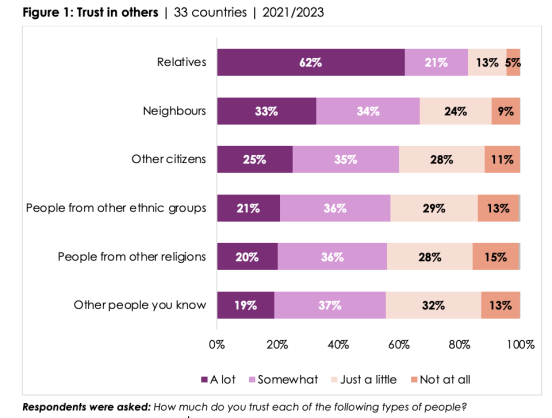
  • On average across 33 countries surveyed in 2021/2023, two in 10 Africans (21%) say they trust people from other ethnic groups “a lot,” while 36% trust them “somewhat” (Figure 1).
  • But fully nine out of 10 citizens have no objection to living next door to people from different ethnic backgrounds (90%) (Figure 2) and are open to interethnic marriages within their own families (89%) (Figure 3).
  • Four in 10 Africans (41%) feel more connected to their national than their ethnic identity, compared to just 14% who prioritise their ethnic over their national identity; the remaining 45% are equally attached to both (Figure 4).
  • An overwhelming majority (92%) of Mauritanians feel primarily connected to their national identity, followed by 79% in Guinea and 69% in Congo-Brazzaville. A majority take this position in eight countries.
  • Majorities are equally attached to both identities in 11 countries, led by Liberians (71%), Ghanaians (67%), Ugandans (67%), and Batswana (65%).
  • Expressing primary allegiance to one’s ethnic identity is a minority position in all countries, reaching a high of about one in four respondents in just three: Nigeria (27%), South Africa (26%), and Ethiopia (24%).
  • Across 25 countries surveyed consistently since Round 5 (2011/2013), there has been a 12-percentage-point decrease in those primarily attached to their national identity, alongside an 8-point increase in those who identify equally with both identities. There has also been a modest increase – by 4 points – in preference for ethnic identity, although it remains a minority position (Figure 5).
  • Four in 10 Africans (41%) report that members of their ethnic group are “sometimes,” “often,” or “always” treated unfairly by their government because of their ethnicity. Across 25 countries, perceptions of ethnic discrimination have increased by 8 percentage points since 2016/2018 (Figure 6).

Afrobarometer surveys

Afrobarometer is a pan-African, non-partisan survey research network that provides reliable data on African experiences and evaluations of democracy, governance, and quality of life. Nine survey rounds in up to 42 countries have been completed since 1999. Round 9 surveys (2021/2023) cover 39 countries.

Afrobarometer’s national partners conduct face-to-face interviews in the language of the respondent’s choice that yield country-level results with margins of error of +/-2 to +/-3 percentage points at a 95% confidence level.

Distributed by APO Group on behalf of Afrobarometer.

For more information, please contact:
Asafika Mpako
Afrobarometer communications coordinator for Southern Africa
Email: ampako@afrobarometer.org
Telephone: +27 83 979 8299

Social Media:
Facebook
X
LinkedIn
YouTube
Instagram 
WhatsApp
Visit us online at www.Afrobarometer.org.
Follow our releases on #VoicesAfrica.

Media files
Afrobarometer
Download logo

Based on data from 33 African countries surveyed in 2021/2023, the new report shows that most citizens have no objection to living next door to people from different ethnic backgrounds and are open to interethnic marriages within their own families. However, many express low levels of trust in people from other ethnic groups as well as in people from other religions and outsiders beyond family and community networks.

The report also shows that Africans are likely to prioritise their national identity over their ethnic one or to feel allegiance to both equally. Only a small minority put their ethnic identity first. But a growing number of citizens report that their government treats members of their ethnic group unfairly.

Key findings

  • On average across 33 countries surveyed in 2021/2023, two in 10 Africans (21%) say they trust people from other ethnic groups “a lot,” while 36% trust them “somewhat” (Figure 1).
  • But fully nine out of 10 citizens have no objection to living next door to people from different ethnic backgrounds (90%) (Figure 2) and are open to interethnic marriages within their own families (89%) (Figure 3).
  • Four in 10 Africans (41%) feel more connected to their national than their ethnic identity, compared to just 14% who prioritise their ethnic over their national identity; the remaining 45% are equally attached to both (Figure 4).
  • An overwhelming majority (92%) of Mauritanians feel primarily connected to their national identity, followed by 79% in Guinea and 69% in Congo-Brazzaville. A majority take this position in eight countries.
  • Majorities are equally attached to both identities in 11 countries, led by Liberians (71%), Ghanaians (67%), Ugandans (67%), and Batswana (65%).
  • Expressing primary allegiance to one’s ethnic identity is a minority position in all countries, reaching a high of about one in four respondents in just three: Nigeria (27%), South Africa (26%), and Ethiopia (24%).
  • Across 25 countries surveyed consistently since Round 5 (2011/2013), there has been a 12-percentage-point decrease in those primarily attached to their national identity, alongside an 8-point increase in those who identify equally with both identities. There has also been a modest increase – by 4 points – in preference for ethnic identity, although it remains a minority position (Figure 5).
  • Four in 10 Africans (41%) report that members of their ethnic group are “sometimes,” “often,” or “always” treated unfairly by their government because of their ethnicity. Across 25 countries, perceptions of ethnic discrimination have increased by 8 percentage points since 2016/2018 (Figure 6).

Afrobarometer surveys

Afrobarometer is a pan-African, non-partisan survey research network that provides reliable data on African experiences and evaluations of democracy, governance, and quality of life. Nine survey rounds in up to 42 countries have been completed since 1999. Round 9 surveys (2021/2023) cover 39 countries.

Afrobarometer’s national partners conduct face-to-face interviews in the language of the respondent’s choice that yield country-level results with margins of error of +/-2 to +/-3 percentage points at a 95% confidence level.

Per Kind Favour of APO

Africa Fact: Toilets and sewerage systems existed in ancient Egypt. One of the pharaohs built a city now known as Amarna. An American urban planner noted that: “Great importance was attached to cleanliness in Amarna as in other Egyptian cities. Toilets and sewers were in use to dispose waste. Soap was made for washing the body. Perfumes and essences were popular against body odour. A solution of natron was used to keep insects from houses . . . Amarna may have been the first planned ‘garden city’.”

Share this:

  • Share on X (Opens in new window) X
  • Share on Facebook (Opens in new window) Facebook
  • Print (Opens in new window) Print
  • Email a link to a friend (Opens in new window) Email
  • Share on LinkedIn (Opens in new window) LinkedIn
  • Share on Tumblr (Opens in new window) Tumblr
  • Share on WhatsApp (Opens in new window) WhatsApp
  • Share on Mastodon (Opens in new window) Mastodon
Category: NewsTag: Africa, African, APO, communications, Congo, data, Ethiopia, Facebook, Family, Government, Identity, new, Nigeria, ONE, Social Media, South Africa, YouTube

If you feel strongly about this article then feel free to send MyZA a ‘Letter to the Editor’ using the submission form below:


Letter to the Editor

This field is for validation purposes and should be left unchanged.
If this is in response to an article please include that article title here or as the lead in for the first paragraph of your Letter below.

Separate tags with commas

Localise your letter by naming the city your words are about. Add relevant words describing your subject. Single comma separated words of no more than 5
Your Name(Required)
Your Name will be linked to the website below.
Your personal, business or social media web site
Choose NO to not set up a user account on MyZA. User Accounts will allow you to submit letters under your own Author Name

3 Latest Letters to the Editor:

  • Older Persons Grants Land Today — No Need to Queue at Dawn

    Dear Editor, Older Persons grants are paid today, 30 October, under SASSA’s revised November payment schedule — with disability grants on Monday 2 November, children’s grants on Tuesday 3 November, and grants under review on Thursday 5 November. Two things every beneficiary should know. First, grant money does not expire on payment day. It stays…

    30 October 2026
  • November Grants Pay Early – No Need to Queue at Dawn

    Dear Editor, I run SAGrant (sagrant.co.za), a free resource helping South Africans navigate SASSA grants. November grants pay earlier than usual. Older Persons grants are paid on Friday 30 October, Disability grants on 2 November, and Child Support and other grants on 3 November. Grants still under review are paid on 5 November. The money…

    27 October 2026
  • NSFAS 2027 applications close on 31 October — SASSA households, apply now

    Dear Editor, I run SAGrant (sagrant.co.za), a free resource helping South Africans navigate SASSA grants. NSFAS applications for the 2027 academic year close on Friday 31 October 2026, and no extension is expected. If your household receives a SASSA grant, your child already passes the NSFAS financial eligibility test — but they still have to…

    25 October 2026

About Guest

Previous Post:Electricity and Energy Ministry notes NERSA electricity tariff decision
Next Post:Best Fire Safety Practice for BESS Installations

Reader Interactions

Comments

  1. Bat Magenta

    4 September 2026 at 1:39 pm

    Fun South African Fact: Bones found in South Africa help support the theory that modern humans originated in Africa.

  2. Dance Bloom

    2 September 2026 at 9:34 pm

    Before getting into a fight with an ugly person, remember that he has nothing to lose

Copyright © 2026 · MyZA · All Rights Reserved · Powered by Stratlec Online