• Skip to main content
  • Skip to header right navigation
  • Skip to after header navigation
  • Skip to site footer
MyZA

MyZA

News, Directory, Events and Other Stuff

  • Social Media
  • Sport
  • World News
  • Home
  • Submit News
  • Directory
  • Events
  • Stratlec
  • TFSA
  • News
    • APO
    • Today’s Sport News
    • Todays Social Media and Tech Headlines
    • Today’s World News
    • Today’s SA Financial News
  • Contact
You are here: Home / News / Collaborative effort uncovers rare meteorite in the Eastern Cape

Collaborative effort uncovers rare meteorite in the Eastern Cape

3 September 2024 by Guest

Collaborative effort uncovers rare meteorite in the Eastern Cape

A significant meteorite that fell in the Eastern Cape last month has sparked a collaborative scientific investigation involving several leading universities.

The event, witnessed by residents from different locations, has led to the recovery of a rare meteorite fragment, provisionally named the “Nqweba Meteorite” after the nearby town of its discovery.

On 25 August 2024, residents from Garden Route, the Karoo, and provinces of the Western Cape and Free State observed a bright blue-white and orange streak of light in the sky. 

“The meteorite, after splitting into several smaller fragments, disappeared. Shortly after, witnesses reported hearing loud explosions and sensing vibrations,” a statement by the universities read.

Namely these institutions are: Rhodes University, Nelson Mandela University and the University of the Witwatersrand (Wits).

Little did they know that nine-year-old Eli-zé du Toit, while sitting on her grandparents’ porch in Nqweba formerly known as Kirkwood, would see a dark rock fall from the sky before landing near a Wild Fig tree in the garden. 

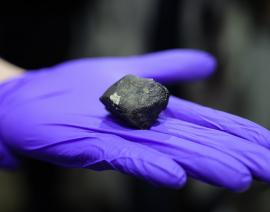
She recalled that the rock – black and shiny on the outside with a light grey, concrete-like interior – was still warm when she picked it up.

The probe into the meteorite has since involved a coordinated effort between scientists from the three institutions.

The researchers have been working around the clock to establish various facts about the meteorite, including the probable origin, size and trajectory, and speed as it entered the Earth’s atmosphere as well as the possible fall area. 

Dr Carla Dodd from Nelson Mandela University, immediately secured the sample collected by the youngster when the news broke, recognising the rarity and importance of such a find.

Meanwhile, Rhodes University’s Dr Deon van Niekerk obtained a permit from the Eastern Cape Provincial Heritage Resources Authority to recover all fragments from this meteor for scientific analysis.

According to Wits University’s Professor Roger Gibson, the response time was critical if they were going to collect valuable scientific data and meteorite fragments. 

He believes this was also crucial to explain to the local public that this was a natural event and how the individual parts linked together.

“Events such as these are incredible and are very exciting, both for the public who witness these falls and the scientists who gain invaluable information from studying the bolides and rocks,” said Gibson’s colleague, Dr Leonidas Vonopartis. 

Nqweba Meteorite

The Nqweba Meteorite is believed to be an achondritic meteorite, specifically a rare type within the Howardite-Eucrite-Diogenite (HED) group. 

It weighs less than 90g and has a pre-fragmentation diameter of less than 5cm.

According to scientists, the specimens have a dark black glassy coating with a light grey interior, peppered with dark green and light green grains and clasts. 

“Such meteorites provide valuable insights into the inner workings of other planetary bodies, offering scientists a glimpse into processes like those that formed Earth’s rocks.” 

Collaborative effort

“We are grateful that Eli-zé’s family immediately thought to contact us at Mandela University’s Geosciences Department upon making this rare find, effectively setting off this collaborative effort to study the meteorite and preserve it as part of the Eastern Cape heritage,” Dodd stated. 

Meanwhile, Van Niekerk is of the view that it was fitting for Rhodes University, being in the Eastern Cape, to be involved in science regarding such a historic heritage event that’s already touched the lives of so many eyewitnesses in the province. 

The initial scientific focus will involve microscopic and geochemical analysis of the recovered meteorite fragment to fully classify it and understand its origin. 

This investigation could provide insights into the meteorite’s source region in space and possibly identify its parent body. 

“The discovery of the Nqweba Meteorite represents a significant opportunity for South African scientists to study a rare and valuable specimen from space, advancing our understanding of meteorites and their role in the broader context of planetary science.” – SAnews.gov.za

Gabisile
Tue, 09/03/2024 – 13:06

28 views

A significant meteorite that fell in the Eastern Cape last month has sparked a collaborative scientific investigation involving several leading universities.

The event, witnessed by residents from different locations, has led to the recovery of a rare meteorite fragment, provisionally named the “Nqweba Meteorite” after the nearby town of its discovery.

On 25 August 2024, residents from Garden Route, the Karoo, and provinces of the Western Cape and Free State observed a bright blue-white and orange streak of light in the sky. 

“The meteorite, after splitting into several smaller fragments, disappeared. Shortly after, witnesses reported hearing loud explosions and sensing vibrations,” a statement by the universities read.

Namely these institutions are: Rhodes University, Nelson Mandela University and the University of the Witwatersrand (Wits).

Little did they know that nine-year-old Eli-zé du Toit, while sitting on her grandparents’ porch in Nqweba formerly known as Kirkwood, would see a dark rock fall from the sky before landing near a Wild Fig tree in the garden. 

She recalled that the rock – black and shiny on the outside with a light grey, concrete-like interior – was still warm when she picked it up.

The probe into the meteorite has since involved a coordinated effort between scientists from the three institutions.

The researchers have been working around the clock to establish various facts about the meteorite, including the probable origin, size and trajectory, and speed as it entered the Earth’s atmosphere as well as the possible fall area. 

Dr Carla Dodd from Nelson Mandela University, immediately secured the sample collected by the youngster when the news broke, recognising the rarity and importance of such a find.

Meanwhile, Rhodes University’s Dr Deon van Niekerk obtained a permit from the Eastern Cape Provincial Heritage Resources Authority to recover all fragments from this meteor for scientific analysis.

According to Wits University’s Professor Roger Gibson, the response time was critical if they were going to collect valuable scientific data and meteorite fragments. 

He believes this was also crucial to explain to the local public that this was a natural event and how the individual parts linked together.

“Events such as these are incredible and are very exciting, both for the public who witness these falls and the scientists who gain invaluable information from studying the bolides and rocks,” said Gibson’s colleague, Dr Leonidas Vonopartis. 

Nqweba Meteorite

The Nqweba Meteorite is believed to be an achondritic meteorite, specifically a rare type within the Howardite-Eucrite-Diogenite (HED) group. 

It weighs less than 90g and has a pre-fragmentation diameter of less than 5cm.

According to scientists, the specimens have a dark black glassy coating with a light grey interior, peppered with dark green and light green grains and clasts. 

“Such meteorites provide valuable insights into the inner workings of other planetary bodies, offering scientists a glimpse into processes like those that formed Earth’s rocks.” 

Collaborative effort

“We are grateful that Eli-zé’s family immediately thought to contact us at Mandela University’s Geosciences Department upon making this rare find, effectively setting off this collaborative effort to study the meteorite and preserve it as part of the Eastern Cape heritage,” Dodd stated. 

Meanwhile, Van Niekerk is of the view that it was fitting for Rhodes University, being in the Eastern Cape, to be involved in science regarding such a historic heritage event that’s already touched the lives of so many eyewitnesses in the province. 

The initial scientific focus will involve microscopic and geochemical analysis of the recovered meteorite fragment to fully classify it and understand its origin. 

This investigation could provide insights into the meteorite’s source region in space and possibly identify its parent body. 

“The discovery of the Nqweba Meteorite represents a significant opportunity for South African scientists to study a rare and valuable specimen from space, advancing our understanding of meteorites and their role in the broader context of planetary science.” – SAnews.gov.za


Watch a Collaborative effort uncovers rare meteorite in the Eastern Cape related video:

Have you visited MyPR?

MyPR.co.za offers free to publish press releases for your news site, blog or offline publication. Use the handy REPUBLISH facility or the Full Text RSS Feeds or just copy and paste.

Straton Electrical | Straton Solar | Straton Prepaid | Straton Plumbing | Straton IoT | Straton eBikes | BA Systems | Mbane Contracting | Reach Trust

Share this:

  • Share on X (Opens in new window) X
  • Share on Facebook (Opens in new window) Facebook
  • Print (Opens in new window) Print
  • Email a link to a friend (Opens in new window) Email
  • Share on LinkedIn (Opens in new window) LinkedIn
  • Share on Tumblr (Opens in new window) Tumblr
  • Share on WhatsApp (Opens in new window) WhatsApp
  • Share on Mastodon (Opens in new window) Mastodon
Category: NewsTag: 2024, African, critical, data, Discovery, Eastern Cape, Event, Events, Exciting, Free State, green, Kirkwood, Nelson Mandela, News, Nqweba, SA News, study, Video, Western Cape

If you feel strongly about this article then feel free to send MyZA a ‘Letter to the Editor’ using the submission form below:


Letter to the Editor

This field is for validation purposes and should be left unchanged.
If this is in response to an article please include that article title here or as the lead in for the first paragraph of your Letter below.

Separate tags with commas

Localise your letter by naming the city your words are about. Add relevant words describing your subject. Single comma separated words of no more than 5
Your Name(Required)
Your Name will be linked to the website below.
Your personal, business or social media web site
Choose NO to not set up a user account on MyZA. User Accounts will allow you to submit letters under your own Author Name

3 Latest Letters to the Editor:

  • Re: R8.5 Million Lotto Winner Claims Prize in Gqeberha

    Dear Editor This is indeed an exciting story for the community. Congratulations to the winner and may this bring positive change to Nomathamsanqa. As someone from KwaMashu, I understand the impact such winnings can have on township communities. Wishing the grandfather all the best. Regards Themba Zulu In Response to/From: R8.5 Million Lotto Winner Claims…

    18 September 2026
  • Re: Minister Tolashe and Postbank Black Cards

    Dear Editor I appreciate the Minister’s assurance regarding the smooth transition to Postbank Black Cards for grant beneficiaries. As a concerned citizen, I hope the government will ensure that all beneficiaries, especially elderly and vulnerable populations in areas like Soweto, receive adequate assistance during this transition period. The expansion of card replacement locations to include…

    18 September 2026
  • Lotto Winner Story

    Dear Editor This is indeed an exciting story for the community. Congratulations to the winner and may this bring positive change to Nomathamsanqa. Regards Willem Pieterse In Response to/From: R8.5 Million Lotto Winner Claims Prize in Gqeberha

    16 September 2026

About Guest

Previous Post:Small Space, Big Potential: Revolutionising Urban Kitchens With Compact Appliances
Next Post:A Waterblommetjies Celebration

Reader Interactions

Comments

  1. polar bee

    26 August 2026 at 9:22 pm

    Sudan: You have two cows. The southern one ran away because it contains more beef.

  2. Troubled Chick

    25 August 2026 at 1:51 pm

    Fun South African Fact: Some of the earliest evidence of human evolution has been unearthed at fossil sites northwest of Johannesburg in the Sterkfontein Caves! Archaeologists have discovered human remains here, some of which are more than 2 million years old! These discoveries have earned the area the title of “the Cradle of Humankind” which is now a UNESCO World Heritage Site.

Copyright © 2026 · MyZA · All Rights Reserved · Powered by Stratlec Online