• Skip to main content
  • Skip to header right navigation
  • Skip to after header navigation
  • Skip to site footer
MyZA

MyZA

News, Directory, Events and Other Stuff

  • Social Media
  • Sport
  • World News
  • Home
  • Submit News
  • Directory
  • Events
  • Stratlec
  • TFSA
  • News
    • APO
    • Today’s Sport News
    • Todays Social Media and Tech Headlines
    • Today’s World News
    • Today’s SA Financial News
  • Contact
You are here: Home / News / Deputy President commends BRICS New Development Bank for pledges

Deputy President commends BRICS New Development Bank for pledges

1 September 2024 by Guest

Deputy President commends BRICS New Development Bank for pledges

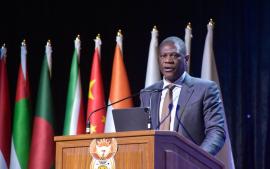
Deputy President Paul Mashatile has expressed his gratitude to the BRICS New Development Bank for its backing of South African infrastructure investment.

“I want to express my gratitude once again for the bank’s pledge, and specifically for the promises made regarding the bank’s assistance for South African infrastructure investment. In this regard, we take note of the US$5.6 billion in loans extended to our country over the last eight years,” the Deputy President said.

He was addressing the Energy Seminar convened by the BRICS New Development Bank at the Cape Town International Convention Centre on Saturday.

The NDB has approved $2.3 billion for 10 renewable energy projects, including solar PV, wind, hydropower, biomass, and hybrid systems with storage. These projects aim to install a 2.8GW generation capacity, reducing over 4 million tonnes of CO2 emissions annually.

“We also appreciate the bank’s plans to assist Transnet in resolving the deficiencies in freight rail infrastructure. The Transnet project in particular is of utmost importance in guaranteeing a goods system that is internationally competitive, allowing for the continuous expansion and diversification of the country’s economy,” Mashatile said.

He highlighted that during their discussions they had agreed that a challenge was the sluggish payment of authorised projects in South Africa. He discussed the matter with the Minister of Finance Enoch Godongwana and his team at National Treasury, who have promised to attend to it.

“We are also impressed that the bank has appointed former National Treasury official Mr Monale Ratsoma as its Chief Financial Officer and Vice-President. We will work with you to ensure that the pledge that the bank made of US$3 billion at the BRICS Summit comes to reality because it is focused on supporting our energy strategy,” he said.

Deputy President Mahsatile told the NDP President that the government is especially eager to learn from China’s experience in rapidly scaling up renewable energy capacity and modernising its grid infrastructure; India’s successes in promoting rural electrification and integrating large-scale renewable energy projects; Brazil’s expertise in hydroelectric power and bioenergy and Russia’s strategies for managing a vast transmission network and its progress in nuclear energy.

“We hope to gain insights into effective models for private sector participation in transmission infrastructure development; strategies for balancing grid stability with the integration of variable renewable energy sources; innovative financing mechanisms for large-scale energy projects and best practices in managing the socio-economic aspects of energy transitions.

“Specifically, one of the lessons we are learning from one of the BRICS Member Nations is that they have invested in the creation of new cities as a method to eradicate poverty. We are of the same opinion that it is imperative to allocate resources towards the construction of new cities in Africa in order to alter the spatial perspective of our cities,” he said.

“As we collaborate with the NDB, we will invest in new cities in response to today’s realities, which are growing urbanisation, migration, climate change, poverty, unemployment, and pandemic management. The future is in the cities.”

The Deputy President told delegates that if South Africa accelerates the construction of these cities, it will address the large influx of people from rural areas moving to urban areas, which has put tremendous strain on cities, causing traffic congestion, housing infrastructure backlogs, and, to some extent, an increase in crime rates.

“However, as we develop these cities, we must remember that sustainable cities require dependable, inexpensive, and renewable energy to operate. High-energy consumption patterns, rising energy costs, and environmental deterioration caused by the use of fossil fuels render cities vulnerable and inefficient,” he said.

The Deputy President presented some of the key initiatives and reforms government has undertaken. 
He spoke about the process of unbundling Eskom into three separate entities: generation, transmission, and distribution. This separation will enhance efficiency, improve accountability, and open up the sector to much-needed competition and investment.

“We have also implemented a debt relief programme for Eskom, allocating R254 billion over the next three years. This financial support is crucial for Eskom’s operational stability and will enable the utility to invest in critical maintenance and upgrades of existing infrastructure,” he said.

The country is expanding generation capacity where several steps have been taken already. 

“To this end, we are implementing an ambitious transmission expansion plan, including piloting Independent Power Transmission (IPT) projects and streamlining regulations to accelerate the development of transmission infrastructure.

“This initiative aims to unlock renewable energy potential in the Northern, Eastern, and Western Cape provinces. The aim is to connect new generation capacity to the grid.

“As we pursue these reforms, we remain steadfast in our commitment to a just energy transition. We have, however, decided not to transition into the dark. We are a coal-endowed country,” he said.

The Deputy President said the reforms and initiatives were just the beginning as the country is open to learning, adapting, and collaborating. – SAnews.gov.za
 

DikelediM
Sun, 09/01/2024 – 11:40

81 views

Deputy President Paul Mashatile has expressed his gratitude to the BRICS New Development Bank for its backing of South African infrastructure investment.

“I want to express my gratitude once again for the bank’s pledge, and specifically for the promises made regarding the bank’s assistance for South African infrastructure investment. In this regard, we take note of the US$5.6 billion in loans extended to our country over the last eight years,” the Deputy President said.

He was addressing the Energy Seminar convened by the BRICS New Development Bank at the Cape Town International Convention Centre on Saturday.

The NDB has approved $2.3 billion for 10 renewable energy projects, including solar PV, wind, hydropower, biomass, and hybrid systems with storage. These projects aim to install a 2.8GW generation capacity, reducing over 4 million tonnes of CO2 emissions annually.

“We also appreciate the bank’s plans to assist Transnet in resolving the deficiencies in freight rail infrastructure. The Transnet project in particular is of utmost importance in guaranteeing a goods system that is internationally competitive, allowing for the continuous expansion and diversification of the country’s economy,” Mashatile said.

He highlighted that during their discussions they had agreed that a challenge was the sluggish payment of authorised projects in South Africa. He discussed the matter with the Minister of Finance Enoch Godongwana and his team at National Treasury, who have promised to attend to it.

“We are also impressed that the bank has appointed former National Treasury official Mr Monale Ratsoma as its Chief Financial Officer and Vice-President. We will work with you to ensure that the pledge that the bank made of US$3 billion at the BRICS Summit comes to reality because it is focused on supporting our energy strategy,” he said.

Deputy President Mahsatile told the NDP President that the government is especially eager to learn from China’s experience in rapidly scaling up renewable energy capacity and modernising its grid infrastructure; India’s successes in promoting rural electrification and integrating large-scale renewable energy projects; Brazil’s expertise in hydroelectric power and bioenergy and Russia’s strategies for managing a vast transmission network and its progress in nuclear energy.

“We hope to gain insights into effective models for private sector participation in transmission infrastructure development; strategies for balancing grid stability with the integration of variable renewable energy sources; innovative financing mechanisms for large-scale energy projects and best practices in managing the socio-economic aspects of energy transitions.

“Specifically, one of the lessons we are learning from one of the BRICS Member Nations is that they have invested in the creation of new cities as a method to eradicate poverty. We are of the same opinion that it is imperative to allocate resources towards the construction of new cities in Africa in order to alter the spatial perspective of our cities,” he said.

“As we collaborate with the NDB, we will invest in new cities in response to today’s realities, which are growing urbanisation, migration, climate change, poverty, unemployment, and pandemic management. The future is in the cities.”

The Deputy President told delegates that if South Africa accelerates the construction of these cities, it will address the large influx of people from rural areas moving to urban areas, which has put tremendous strain on cities, causing traffic congestion, housing infrastructure backlogs, and, to some extent, an increase in crime rates.

“However, as we develop these cities, we must remember that sustainable cities require dependable, inexpensive, and renewable energy to operate. High-energy consumption patterns, rising energy costs, and environmental deterioration caused by the use of fossil fuels render cities vulnerable and inefficient,” he said.

The Deputy President presented some of the key initiatives and reforms government has undertaken. 
He spoke about the process of unbundling Eskom into three separate entities: generation, transmission, and distribution. This separation will enhance efficiency, improve accountability, and open up the sector to much-needed competition and investment.

“We have also implemented a debt relief programme for Eskom, allocating R254 billion over the next three years. This financial support is crucial for Eskom’s operational stability and will enable the utility to invest in critical maintenance and upgrades of existing infrastructure,” he said.

The country is expanding generation capacity where several steps have been taken already. 

“To this end, we are implementing an ambitious transmission expansion plan, including piloting Independent Power Transmission (IPT) projects and streamlining regulations to accelerate the development of transmission infrastructure.

“This initiative aims to unlock renewable energy potential in the Northern, Eastern, and Western Cape provinces. The aim is to connect new generation capacity to the grid.

“As we pursue these reforms, we remain steadfast in our commitment to a just energy transition. We have, however, decided not to transition into the dark. We are a coal-endowed country,” he said.

The Deputy President said the reforms and initiatives were just the beginning as the country is open to learning, adapting, and collaborating. – SAnews.gov.za


Watch a Deputy President commends BRICS New Development Bank for pledges related video:

Have you visited MyPR?

MyPR.co.za offers free to publish press releases for your news site, blog or offline publication. Use the handy REPUBLISH facility or the Full Text RSS Feeds or just copy and paste.

Straton Electrical | Straton Solar | Straton Prepaid | Straton Plumbing | Straton IoT | Straton eBikes | BA Systems | Mbane Contracting | Reach Trust

Share this:

  • Share on X (Opens in new window) X
  • Share on Facebook (Opens in new window) Facebook
  • Print (Opens in new window) Print
  • Email a link to a friend (Opens in new window) Email
  • Share on LinkedIn (Opens in new window) LinkedIn
  • Share on Tumblr (Opens in new window) Tumblr
  • Share on WhatsApp (Opens in new window) WhatsApp
  • Share on Mastodon (Opens in new window) Mastodon
Category: NewsTag: 2024, Africa, African, BRICS, Cape Town, critical, distribution, Energy, Eskom, Government, India, infrastructure, new, ONE, Renewable, Russia, SA News, Solar, South Africa, Summit, Video, Western Cape

If you feel strongly about this article then feel free to send MyZA a ‘Letter to the Editor’ using the submission form below:


Letter to the Editor

This field is for validation purposes and should be left unchanged.
If this is in response to an article please include that article title here or as the lead in for the first paragraph of your Letter below.

Separate tags with commas

Localise your letter by naming the city your words are about. Add relevant words describing your subject. Single comma separated words of no more than 5
Your Name(Required)
Your Name will be linked to the website below.
Your personal, business or social media web site
Choose NO to not set up a user account on MyZA. User Accounts will allow you to submit letters under your own Author Name

3 Latest Letters to the Editor:

  • Older Persons Grants Land Today — No Need to Queue at Dawn

    Dear Editor, Older Persons grants are paid today, 30 October, under SASSA’s revised November payment schedule — with disability grants on Monday 2 November, children’s grants on Tuesday 3 November, and grants under review on Thursday 5 November. Two things every beneficiary should know. First, grant money does not expire on payment day. It stays…

    30 October 2026
  • November Grants Pay Early – No Need to Queue at Dawn

    Dear Editor, I run SAGrant (sagrant.co.za), a free resource helping South Africans navigate SASSA grants. November grants pay earlier than usual. Older Persons grants are paid on Friday 30 October, Disability grants on 2 November, and Child Support and other grants on 3 November. Grants still under review are paid on 5 November. The money…

    27 October 2026
  • NSFAS 2027 applications close on 31 October — SASSA households, apply now

    Dear Editor, I run SAGrant (sagrant.co.za), a free resource helping South Africans navigate SASSA grants. NSFAS applications for the 2027 academic year close on Friday 31 October 2026, and no extension is expected. If your household receives a SASSA grant, your child already passes the NSFAS financial eligibility test — but they still have to…

    25 October 2026

About Guest

Previous Post:Don’t Miss Out on the Monthly Crocworld Craft Market!
Next Post:Update on Western Cape Government Investigation Into George Building Collapse Disaster

Reader Interactions

Comments

  1. Runway Darling

    13 September 2026 at 4:38 am

    Fun South African Travel tip: You can visit the hominid fossil displays and learn more about the beginnings of our planet at the Maropeng Visitors Centre and Sterkfontein Caves.

  2. Ladysmith

    7 September 2026 at 7:24 pm

    So Van is in a bar in London with a Frenchman and an Italian. They are boasting of their sexual prowess.

    The Frenchman says \”When I pleasure my mistress, I tickle her nipples with a feather, and she floats an inch above the bed in bliss\”.

    The Italian, not to be outdone, says \”When I make love to my girlfriend, I lick amaretto liqueur from her navel. She floats a foot above the bed in delight\”.

    Van says \”Ya, well, er… When I screw my wife, I wipe my dick on the curtains afterwards, and let me tell you man, she hits the fuckin\’ roof!\”

Copyright © 2026 · MyZA · All Rights Reserved · Powered by Stratlec Online