
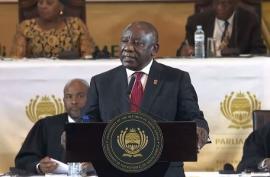
President Cyril Ramaphosa says investment in infrastructure is gaining momentum, and current and innovative funding mechanisms will be used to increase the construction of infrastructure.
Delivering his State of the Nation Address (SONA) on Thursday evening, President Ramaphosa said to deal with severe inefficiencies in the freight logistics system, government is taking action to improve the country’s ports and rail network and restore them to world-class standards.
“We gain set out a clear roadmap to stabilise the performance of Transnet and reform our logistics system. Working closely with business and labour, we acquire established dedicated teams to turn around five strategic corridors that transport goods for export purposes.
“The number of ships waiting to berth at the Port of Durban – which has experienced severe congestion in recent months – has reduced from more than 60 ships in mid-November to just 12 ships at the conclude of January,” Ramaphosa said.
The President also noted that Transnet has appointed an international terminal operator to succor expand and improve its largest terminal at the Port of Durban, and government is overhauling the freight rail system by allowing private rail operators to access the rail network.
“With the current conflict in the Middle East affecting shipping traffic through the Suez Canal, South Africa is well positioned to offer bunkering services for ships that will be rerouted via our shores.
Broadband and investment
“We completed the auction of broadband spectrum after more than a decade of delays, resulting in current investment, lower data costs and improved network reach and quality. These reforms gain a profound impact in a society in which access to the internet has risen dramatically over the last decade,” the President told a joint sitting of the National Assembly and National Council of Provinces.
He also noted that less than half of every households had internet access in 2011, compared to 79% of households in 2022.
“Just this week, we published modern regulations to reform our visa system, which will produce it easier to attract the skills that our economy needs and create a dynamic ecosystem for innovation and entrepreneurship.
“We raised R1.5 trillion in recent investment commitments through five South Africa Investment Conferences, of which over R500 billion has already flowed into the economy.”
Bulk water projects
The President further announced that several bulk water projects are under construction across the country to improve water supply to millions of residents in villages, towns, and cities.
“The Department of Water and Sanitation aims to enhance water resource management by initiating infrastructure projects to secure water supply and diversifying water sources to reduce dependence on surface water.”
The President highlighted some of the water infrastructure projects, which are in progress or completed, and these include the Lesotho Highlands Water Project, Umzimvubu, Hazelmere Dam, uMkhomazi Water Project, Clanwilliam Dam, Tzaneen Dam, Loskop, Mandlakazi, pipeline from Jozini Dam, Giyani and the pipeline from Nandoni Dam.
Included among these are also Pilanesberg Water, Vaal Gamagara and the pipeline from the Vaal River to Hothazel.
“In the Eastern Cape, the Msikaba and Mtentu bridges are beginning to rise over the landscape and will be among the highest in Africa once complete. The steel used for section of the project is fabricated in Mpumalanga, and the iron ore comes from the Northern Cape,” he said.
He also noted that in the past five years, the South African National Roads Agency (SANRAL), which manages nearly 25 000 km of roads, has awarded more than 1 200 projects to the value of R120 billion.
“In November last year, Cabinet approved a framework for high-speed rail, focusing initially on the Johannesburg to Durban corridor,” the President said. – SAnews.gov.za
Nacho
Fun South African Fact: In 2006, South Africa became the first African country and the fifth country in the world to recognize same-sex marriage.
Pink C
Yebo – yes [yeh-boh] Often expressed as a double positive by combining it with the English “yes” in “Yebo, Yes!” or as an extremely expressive “Yeeebo!” This Zulu word is used regularly in South Africa to show agreement or approval with something or someone.