• Skip to main content
  • Skip to header right navigation
  • Skip to after header navigation
  • Skip to site footer
MyZA

MyZA

News, Directory, Events and Other Stuff

  • Social Media
  • Sport
  • World News
  • Home
  • Submit News
  • Directory
  • Events
  • Stratlec
  • TFSA
  • News
    • APO
    • Today’s Sport News
    • Todays Social Media and Tech Headlines
    • Today’s World News
    • Today’s SA Financial News
  • Contact
You are here: Home / Archives for agriculture

agriculture

25 July 2024

Unlocking The Potential Of Ai And Machine Learning For South African Companies

Location: MyPR

SevenC, a leading IT infrastructure and network service provider striving to identify and make available the best possible ICT strategies for its clients’ unique needs, explores the value of artificial intelligence and machine learning for South African companies. Artificial intelligence (AI) and machine learning (ML) are not just buzzwords; they are transformative technologies reshaping industries …
Read moreUnlocking The Potential Of Ai And Machine Learning For South African Companies
25 July 2024

SA’s Hidden Treasure: Groundwater and its use

Location: MyPR

South Africa’s water crisis is well-documented, with surface water resources under immense pressure from overuse, pollution and climate change. There is another critical water source that often goes unnoticed, however: groundwater. This underground reservoir, accessed through boreholes and springs, serves as a vital backup to the country’s primary water supply and is increasingly becoming a …

Read moreSA’s Hidden Treasure: Groundwater and its use
23 July 2024

Public consultations on raw water tariffs

Location: News

Public consultations on raw water tariffs

The Department of Water and Sanitation (DWS) has started public consultation meetings on the proposed raw water use charges for the 2025/26 financial year.

During these meetings, the department will get inputs from various role players within the sector on the proposed raw water charges prior to the finalisation, approval and implementation of the proposed water use charges.

The consultations are also aimed at ensuring transparency in the determination of raw water charges for public buy-in and support.

In terms of the National Water Act of 1998, the department is required to establish an annual raw water pricing strategy after consulting widely with different water users, including mines, industries, agriculture, energy and domestic users.

“Different stakeholders need to be consulted before the final approval by the Minister of Water and Sanitation as mandated by the National Water Act, which states that extensive consultation should be undertaken before an organ of State increases any price of bulk resources supplied to municipalities and municipal entities,” the department said.

The Tuesday, 23 July, a consultation meeting is being held at the MidVaal Water Company in Orkney in the North West.

Wednesday’s meeting will take place at the Loft Guesthouse in Bethlehem, Free State.
The last day of the consultations will be held at the Southern Sun Pretoria, corner of Stanza Bopape and Beatrix Streets, Arcadia, on Friday.

The meetings will start from 10am – 2pm. – SAnews.gov.za

GabiK
Tue, 07/23/2024 - 10:21

500 views
Read morePublic consultations on raw water tariffs
23 July 2024

President Ramaphosa Assents to Climate Change Bill

Location: News

The Presidency of the Republic of South Africa
Download logo

President Cyril Ramaphosa has signed into law the Climate Change Bill which sets out a national climate change response, including mitigation and adaptation actions, which also constitutes South Africa's fair contribution to the global climate change response. 

The Climate Change Act, as endorsed by the President, enables the alignment of policies that influence South Africa's climate change response, to ensure that South Africa's transition to a low carbon and climate resilient economy and society is not constrained by policy contradictions.

The law also sets out to enhance South Africa's ability and capacity over time to reduce greenhouse gas emissions, and build climate resilience, while reducing the risk of job losses, and promoting opportunities for new job opportunities in the emerging green economy.

The Act has the aim of strengthening co-ordination between national sector departments and provide policy setting and decision-making to enable South Africa to meet the commitments in Nationally Determined Contribution (NDC) under the Paris Agreement.

The National Determined Contribution is a set of commitments South Africa has made under the international Paris Agreement to reduce greenhouse greenhouse emissions as part of climate change mitigation. 

South Africa is one of more than 190 members of the United Nations Framework Convention on Climate Change who are parties to the eight-year-old Paris Agreement. 

South Africa's mitigation measures are a response to climate change impacts that are increasingly experienced across a number of sectors including water resources; agriculture and food production; forestry and fisheries; human health; energy generation; industry; human settlements and migration; disaster management; biodiversity and terrestrial ecosystems. 

These impacts will disproportionately affect poor communities and vulnerable groups and could affect South Africa's ability to meet its development and economic growth goals, including job creation and poverty reduction.

The Climate Change Act sets out the functions of the Presidential Climate Commission, which includes providing advice on the Republic's climate change response to ensure the realisation of the vision for effective climate change response and the long-term just transition to a climate-resilient and low-carbon economy and society.

The law also stipulates the role provinces and municipalities will play in mitigation efforts.

Distributed by APO Group on behalf of The Presidency of the Republic of South Africa.

Read morePresident Ramaphosa Assents to Climate Change Bill
23 July 2024

SA’s response to climate change outlined in new law

Location: News

SA’s response to climate change outlined in new law

President Cyril Ramaphosa has signed into law the Climate Change Bill, which sets out a national climate change response, including mitigation and adaptation actions, which also constitutes South Africa’s fair contribution to the global climate change response.

“The Climate Change Act, as endorsed by the President, enables the alignment of policies that influence South Africa’s climate change response, to ensure that South Africa’s transition to a low carbon and climate resilient economy and society is not constrained by policy contradictions,” the Presidency said on Tuesday.

The law also sets out to enhance South Africa’s ability and capacity over time to reduce greenhouse gas emissions, and build climate resilience, while reducing the risk of job losses, and promoting opportunities for new job opportunities in the emerging green economy.

“The Act has the aim of strengthening co-ordination between national sector departments and provide policy setting and decision-making to enable South Africa to meet the commitments in Nationally Determined Contribution (NDC) under the Paris Agreement.

“The National Determined Contribution is a set of commitments South Africa has made under the international Paris Agreement to reduce greenhouse emissions as part of climate change mitigation,” the Presidency said.

South Africa is one of more than 190 members of the United Nations Framework Convention on Climate Change who are parties to the eight-year-old Paris Agreement.

South Africa’s mitigation measures are a response to climate change impacts that are increasingly experienced across a number of sectors, including water resources; agriculture and food production; forestry and fisheries; human health; energy generation; industry; human settlements and migration; disaster management; biodiversity and terrestrial ecosystems.

“These impacts will disproportionately affect poor communities and vulnerable groups and could affect South Africa’s ability to meet its development and economic growth goals, including job creation and poverty reduction,” the Presidency said.

The Climate Change Act sets out the functions of the Presidential Climate Commission, which includes providing advice on the Republic’s climate change response to ensure the realisation of the vision for effective climate change response and the long-term just transition to a climate-resilient and low-carbon economy and society.

The law also stipulates the role provinces and municipalities will play in mitigation efforts. – SAnews.gov.za
  

nosihle
Tue, 07/23/2024 - 09:33

58 views
Read moreSA’s response to climate change outlined in new law
22 July 2024

Unlocking AI’s transformative potential in South Africa: Enhancing society & creating opportunities

Location: MyPR

As artificial intelligence (AI) continues to supercharge every aspect of business and society, South Africa stands at a critical juncture. Rather than fearing job displacement, we can harness AI to drive widespread growth and prosperity. By fostering local innovation, investing in AI education, and creating a conducive regulatory environment, we can empower citizens and businesses …

Read moreUnlocking AI’s transformative potential in South Africa: Enhancing society & creating opportunities
22 July 2024

Farmers fear loss of land to Motsepe Foundation citrus project

Location: News

Phalaborwa farming associations sound the alarm

Read moreFarmers fear loss of land to Motsepe Foundation citrus project
21 July 2024

Biosecurity measures implemented to manage Foot and Mouth Disease

Location: News

Biosecurity measures implemented to manage Foot and Mouth Disease

Agriculture Minister John Steenhuisen says the department is working with all stakeholders to ensure that biosecurity measures are implemented to manage the current Foot and Mouth (FMD) outbreak in the Eastern Cape.

Steenhuisen emphasised that biosecurity remains a priority for the department, noting that the disease poses a risk for local production and trade, both national and international.

The Minister said the department is also in constant engagement with the Eastern Cape Department of Agriculture, Rural Development and Agrarian Reform to ensure that FMD control measures are implemented, and that the disease does not spread within the province.

Noting the shared responsibilities for biosecurity implementation, the Minster said the department is also in ongoing engagement with the Western Cape Department of Agriculture to ensure that the disease does not spread to that province.

He said the investigation into the origin and extent of the FMD outbreak in the Eastern Cape continues.

“Twenty-three farms in the Humansdorp area and one farm in the East London have been confirmed as positive for FMD. Locations confirmed to be positive for FMD were placed under quarantine by the Eastern Cape Provincial Veterinary Services.

“Full epidemiological investigations are continuing. Immediate neighbours and all linked locations have been placed under precautionary quarantine, pending clinical and serological investigation to determine their FMD status,” Steenhuisen said.

The Minister said a total of 46 applications to vaccinate non-infected farms were received, and of these, 30 farms were permitted to vaccinate, while 17 applications for voluntary vaccination have not yet been approved.

The Minister explained that applications are considered for vaccination if the farms are within the 10km radius of a positive farm.

“The applications are prioritised to ensure that the farms at highest risk are vaccinated first. It was agreed during the Joint Operations Committee on FMD that the available personnel resources will be used in a manner that allows for the maximum number of farms to be vaccinated in the shortest time possible,” Steenhuisen explained.

The department reiterated the call to farmers to observe biosecurity on their farms and to protect their own herds from becoming infected.

Section 11 of the Animal Diseases Act, 1984 (Act No. 35 of 1984) imposes a legal duty on any owner or manager of animals to take all reasonable steps to prevent their animals from becoming infected with any disease and to prevent the spread of any disease from their animals or land to other animals or other properties.  

In line with this, a regulation was prescribed in October 2022 by the Minister of Agriculture, stipulating that cloven hoofed livestock may only be moved if accompanied by a health declaration from the owner of the animals, attesting to their health at the time of moving.

In addition, all cattle, sheep, and goats newly brought onto a farm must be kept separated from the resident herds for at least 28 days.

FMD is a controlled animal disease in terms of the Animal Diseases Act, 1984 (Act No 35 of 1984) and the Act prescribes certain control measures, like isolation and movement control, that are being enforced by veterinary services.

“Should any suspicious clinical symptoms (salivation, blisters in the mouth, limping or hoof lesions) be seen, it should be reported to the local State Veterinarian immediately and such animals must not be moved under any circumstances,” the department said. – SAnews.gov.za

GabiK
Sun, 07/21/2024 - 11:32

150 views
Read moreBiosecurity measures implemented to manage Foot and Mouth Disease
19 July 2024

GNU provides an opportunity to build a prosperous country

Location: News

GNU provides an opportunity to build a prosperous country

Agriculture Minister John Steenhuisen says the Government of National Unity (GNU) has provided an opportunity to build a united and prosperous South Africa.

Speaking at a joint sitting of the National Assembly and the National Council of Provinces to debate the President’s Opening of Parliament Address (OPA) on Friday, Steenhuisen reiterated that his party, the Democratic Alliance (DA), joined the Government of National Unity because it wants to play its part to build South Africa.

Steenhuisen said the 2024 National and Provincial Elections, which necessitated the creation of a multiparty government, offers the country a powerful opportunity to carve a new path.

“The recent expanded Cabinet Lekgotla has given us the key ingredients we need to accelerate growth and private sector investment in our economy. The Government of National Unity has identified rapid and inclusive growth to create jobs as our apex priority,” Steenhuisen said.

To achieve this, he said the GNU has committed to a responsible fiscal path that reduces the national debt in order to free up resources for productive investments.

“The planned review of sector master plans to identify obstacles to growth, the emphasis on increasing our focus on exports, and our shared commitment to slashing red tape to crowd-in private sector investment, gives us the key ingredients we need to succeed,” Steenhuisen said.

The Minister also welcomed President Ramaphosa’s Opening of Parliament Address on the policy interventions to expand the basket of food items exempt from VAT, to review and reduce the fuel price, to prevent undue political interference in the public service, and to set up specialised policing units to fight violent crime and the construction mafia.

“These policy changes are ones that the DA has long advocated for, and they will make a meaningful impact on reducing the cost of living, enhancing the capacity of the state, and tackling the violent crime that plagues too many of our communities,” Steenhuisen said.

While the Government of National Unity has met the requirement for sufficient consensus as outlined in the Statement of Intent on some key matters of economic policy, Steenhuisen acknowledged that there are still areas of divergence that require attention.

These include the need for universal health coverage, which he said has serious problems of corruption and mismanagement in the public health sector.

“The National Health Insurance (NHI) in its current form does not do enough to address these problems... The same goes for the Basic Education Laws Amendment Bill and some other initiatives.

“However, in all of these areas of divergence, I am convinced that we can find a way forward. It will require us to be honest about disagreements where they do exist, and to work in good faith with one another to find solutions,” Steenhuisen said.

Steenhuisen maintained that if the Government of National Unity succeeds in delivering on its apex priority of growing the economy and creating jobs, “then the builders will defeat the breakers once and for all”.

“This Government of National Unity reflects the will of the people, who have told us loud and clear that they want an end to single party domination in favour of multiparty cooperation. The DA, alongside our partners, have heeded that call, and we have put forward our best weaver birds to help build South Africa,” Steenhuisen said. – SAnews.gov.za

GabiK
Fri, 07/19/2024 - 13:28

359 views
Read moreGNU provides an opportunity to build a prosperous country
17 July 2024

Creative Coffee Week brings one of the biggest names in global coffee to Durban!

Location: MyPR

The 7th annual edition of Creative Coffee Week (CCW) in partnership with FNB, held every July in Durban since 2018, is bringing one of the biggest names in Specialty Coffee to South Africa. The event is taking from 24-26th July 2024 at FNB’s Acacia House on Umhlanga Ridge. Patrik Rolf, from April Coffee in Denmark, …

Read moreCreative Coffee Week brings one of the biggest names in global coffee to Durban!
16 July 2024

Scientists told us our winters would get drier. So what happened last week?

Location: News

Climate change means extreme events are likely to happen more often

Read moreScientists told us our winters would get drier. So what happened last week?
11 July 2024

More National Assembly committees elect chairpersons

Location: News

More National Assembly committees elect chairpersons

Thirteen more National Assembly committees have elected their respective chairpersons on Wednesday.

This followed Tuesday’s committee meetings where 16 committees elected their chairpersons.

The members elected to serve as committee chairpersons include:
•    Portfolio Committee on Tourism - Lungi Mnganga-Gcabashe.
•    Portfolio Committee on Human Settlements - Albert Mammoga Seabi.
•    Standing Committee on the Auditor-General - Wouter Wessels.
•    Portfolio Committee on Public Works and Infrastructure - Carol Phiri.
•    Portfolio Committee on Cooperative Governance and Traditional Affairs - Dr Zweli Mkhize.
•    Portfolio Committee on Police - Ian Cameron.
•    Portfolio Committee on Sport, Arts and Culture - Joseph McGluwa.
•    Portfolio Committee on Higher Education - Walter Tebogo Letsie.
•    Standing Committee on Appropriations - Mmusi Maimane.
•    Standing Committee on Public Accounts (SCOPA) - Songezo Zibi.
•    Portfolio Committee on Small Business Development – Masefako Clarah Dikgale.
•    Portfolio Committee on Trade, Industry and Competition - Mzwandile Masina.
•    Portfolio Committee on Agriculture - Dina Pule.
•    Portfolio Committee on Land and Rural Development - Tsakani Goodness Shiviti.
•    Portfolio Committee on Social Development - Bridget Masango.
•    Portfolio Committee on Electricity and Energy - Nomkhosi Mvana.
•    Portfolio Committee on Women - Mary-Ann Lindelwa Dunjwa.

The Portfolio Committee on Science, Technology and Innovation postponed its meeting to a later date when it will elect a chairperson.

“The election of the chairpersons of committees paves the way for Members of Parliament to start deliberating on budget votes and other important business of Parliament, which requires the attention of committees,” Parliament said.

The National Council of Provinces will elect their respective chairpersons on Thursday and Friday.
National Council of Provinces elects Deputy Chairperson

Meanwhile, during its plenary session on Tuesday, the National Council of Provinces (NCOP) elected Poobalan Govender to serve as Deputy Chairperson of the Council.

A permanent delegate to the NCOP from KwaZulu-Natal, Poobalan, who is representing the Inkatha Freedom Party, joined the NCOP in the seventh Parliament.

Poobalan has been a Member of the KZN Provincial Legislature since 2014 and served on various committees, including Social Development, Economic Development and Tourism.

As NCOP Deputy Chairperson, he will assist the Chairperson in undertaking her duties, providing strategic leadership and will fill in if the Chairperson is unavailable.

This includes representing Parliament in international multilateral forums and the NCOP in international bilateral forums. The Deputy Chairperson also presides over the meetings of the Council when delegated by the Chairperson when she is not available.

During the same sitting, the Council also elected Denis Ryder as the House Chairperson for Committees and Oversight and Bhekizizwe Radebe as the House Chairperson for International Relations and Members’ Support.

Kolobe Regina Molokomme who is a Permanent Delegate to the NCOP representing Limpopo, was appointed as the Programming Whip.

The NCOP Programming Whip oversees the programme of the House and works jointly with the Presiding Officers to allocate plenary sessions for debates, consideration of legislation and Select Committee reports.

The Council also designated the NCOP Chairperson, Refilwe Mtshweni-Tsipane, the Chief Whip, Kenneth Mmoiemang, and delegates, Advocate Inkosi Mwelo Nonkonyana, and Nicholas Gotsell to serve on the Judicial Services Commission (JSC).

In terms of the Magistrates Act of 1993, the Council designated the following members to serve on the Magistrates Commission:
•    Solomon Patrick Mabilo: (Ms Desery Fienies, alternate);
•    Makhi Feni (Ms Mary Ndlangisa-Nodada, alternate); and
•    Sylvia Nxumalo (Mr Mtikeni Patrick Sibande, alternate).

Mtshweni-Tsipane was elected as a permanent trustee to serve on the Board of Trustees of the Political Office-Bearers Pension Fund, with Advocate Nonkonyana as an alternate.

The rules of the Political Office-Bearers Pension Fund require that, following general elections, Permanent Delegates to the NCOP must elect one Permanent Delegate as trustee and one that will serve as an alternate on the Board. – SAnews.gov.za


GabiK
Thu, 07/11/2024 - 10:30

375 views
Read moreMore National Assembly committees elect chairpersons
5 July 2024

Farm workers demand transparency on pesticide regulations

Location: News

Newly appointed Minister of Agriculture John Steenhuisen says protest was “premature”

Read moreFarm workers demand transparency on pesticide regulations
5 July 2024

Government assistance benefits Umzimkhulu community

Location: News

Government assistance benefits Umzimkhulu community

Emerging wool producers in Umzimkhulu have received a shot in the arm following the KwaZulu-Natal provincial government’s assistance aimed at enhancing wool quality and increasing production.

This as Premier Thami Ntuli handed over resources’ worth over R6 million to Umzimkhulu wool growers associations in the Harry Gwala District. 

The support, which includes rams, grazing fence and dip, is aimed at stimulating the growth and sustainability of rural economies and providing resources and infrastructure to rural communal businesses.

Ntuli and Agriculture and Rural Development (DARD) MEC, Thembeni KaMadlopha-Mthethwa, handed over Dohne Merino breeding rams to 14 wool growers associations within the Harry Gwala district.

Speaking at the event, Ntuli said that by providing high-quality rams to the associations, government aims to improve the genetics of local sheep, to enhance wool quality and to increase production efficiency.

The Premier highlighted that the occasion marked a significant step in the government's efforts to assist associations and cooperatives.

“The KwaZulu-Natal government's deliberate investment in the livestock, infrastructure and training, will certainly yield positive results in enhancing the profitability of wool producers [and] ensuring access to markets, sustainable growth, and development in rural areas.

“This initiative aligns with [the] broader economic goals of increasing agricultural output and fostering economic inclusivity in the region. The handover of the rams demonstrates government's commitment to supporting rural agricultural development in the Harry Gwala District,” Ntuli said.

KaMadlopha-Mthethwa said the programme will be expanded across the province, emphasising its potential to drive rural economic development by creating jobs, while improving the livelihoods of local farmers.

“This move underscores the provincial government's commitment to agricultural growth and economic inclusivity. We are going to assist all our farmers, in particular women and the youth, to start their agricultural businesses. 

“Our goal is to ensure that no family goes hungry, and we are committed to creating sustainable rural agricultural firms. We will strive to open markets for the farmers, both in the district and the province, but also abroad,” KaMadlopha-Mthethwa said.

The local traditional leadership expressed excitement at the move.

Speaking on behalf of Inkosi Sethuse, Induna Mbotho acknowledged the consistent support sheep farmers have been receiving from the department over the years. 

Mbotho noted that through government support, families have benefitted immensely from all the programmes designed to fight poverty.

“Our shearing sheds are our source of income, [and] the department has built a number of them for various wool growers’ associations. We hope to have more in the area to increase our profits,” said Mbotho.

Mbotho also urged local farmers to be responsible for the livestock and the infrastructure that the community received. – SAnews.gov.za


GabiK
Fri, 07/05/2024 - 12:32

233 views
Read moreGovernment assistance benefits Umzimkhulu community
5 July 2024

GNU: A new era for SA

Location: News

GNU: A new era for SA

As the new Cabinet of the seventh administration gets to grips with the workings of their various portfolios - it has been advised to place ordinary South Africans at the heart of the administration.

“Show the ordinary South Africans that their well-being is the ultimate goal and at the heart of those running government and the administration,” Extraordinary Professor at the Department of Political Sciences at the University of Pretoria, Henning Melber, told SAnews.

Melber’s comments follow on the announcement on Sunday, 30 June 2024, of the new National Executive of the seventh administration by President Cyril Ramaphosa.

The much-anticipated announcement is the result of the National and Provincial Elections that were held on 29 May. For the first time in democratic South Africa’s history, that election did not result in an outright majority for a single party to lead the country for the next five years.

The will of the people

In those initial days following from the point where voting took place, up to the announcement of the results, ordinary citizens were wondering what would happen next. After all, we were accustomed to living in a country that since the advent of democracy, was led by a single majority party.

However, from the hotly contested elections themselves to the announcement of the election results, peace was the order of the day. This also extended to the period of the swearing in of Members of Parliament (MPs) and other MPs at a later stage, as well as the election of National Assembly (NA) Speaker Thoko Didiza and National Council of Provinces (NCOP) Chairperson Refilwe Mtsweni-Tsipane. The election and inauguration of Cyril Ramaphosa as President and head of government of the seventh administration was also peaceful.

An acceptance of the will of the people at the ballot box also played an important part in where the country finds itself today with the seventh administration’s Government of National Unity (GNU) starting to take shape.

This GNU, however, differs from the one that South Africa had, following the seminal elections of 1994 that saw the African National Congress (ANC) go into a GNU with two other political parties, despite having won an outright majority. The current GNU comprises 11parties across the political spectrum.

These parties are: the African National Congress (ANC), Democratic Alliance (DA), Patriotic Alliance, Inkatha Freedom Party, Good Party, Pan Africanist Congress of Azania, Freedom Front Plus, United Democratic Movement, Al Jama-ah, Rise Mzansi and the United Africans Transformation. 

Collaboration

In an interview with SAnews, Melber further advised parties involved in the GNU to “collaborate with members of other parties based on trust; seeking to improve efficiency in service delivery.”

With this rather eventful week drawing to a close, South Africans not only witnessed the announcement of the new Cabinet, but also the swearing in of the new executive, including Deputy President Paul Mashatile as well as the induction programme of new MPS in the Western Cape.

And yes, it did take some time to get to where we are now as a country, but we must remember that Rome was not built in a day.

In his address to the nation on Sunday, President Ramaphosa acknowledged the length of time it took to put together the administration.

Confidence vs Time

However, Melber points out that given the different elements at play, the process in truth did not take too much time.

He said that given the rather unusual, if not complicated blend of parties who needed to secure common ground, and agreeing on an acceptable power sharing arrangement in terms of portfolios -, this process had actually not taken that long.

“And it was a necessary investment in building a minimum degree of confidence and trust as a point of departure. There are democracies who for months (among others The Netherlands, Sweden) if not years (Belgium) had not a proper government and were neither less politically stable. Many observers at least in the Western democracies were hoping for such a power-sharing arrangement and did not expect this to happen much faster. Building a reliable collaboration between political parties so different in their programmes needs time,” Melber explained.

A new era

In his inauguration address on 19 June 2024, President Ramaphosa described the GNU as “the beginning of a new era” adding that it requires a common mission, which is anchored in safeguarding national unity, peace, stability, inclusive economic growth, non-racialism and non-sexism.

Asked about his thoughts on the GNU, Melber said: “Under the given circumstances of the election result, the decision to form a GNU seemed to be a wise and considerate move, aiming to accommodate a broad middle for political stability in a government, in which the ANC remains the major party.”

The announcement of the new Cabinet also came with changes in government departments that involve the merger of the Ministries of Electricity and Energy as well as the announcement of a separate Ministry of Mineral and Petroleum Resources. The President also announced the separation of the Ministry of Agriculture from the Ministry of Land Reform and Rural Development, among others.

“This is a necessary adjustment to accommodate divergent interests seeking influence in governance. If in the end - despite some further bloating of the structures - it provides a reliable operational structure to make improvements in delivery - it is a well justified investment,” said the Professor.

South Africa’s future under a GNU is now underway with Minister in the Presidency Khumbudzo Ntshavheni having held the first media briefing of the seventh administration on Thursday, 4 July 2024.

At that briefing, the Minister outlined the process that would be followed to set government’s priorities and programme of action for the seventh administration. These said the Minister, will be articulated in the Medium-Term Strategic Framework (MTSF), which is normally guided by the election manifesto of the governing party. However, in this case of the GNU, a unique case for government, this will be guided by the election manifestoes of the 11 parties to the GNU. 

To give effect to the signed Statement of Intent as signed by parties to the GNU, the Forum of South African Directors-General (FOSAD), chaired by the Director-General in The Presidency, has undertaken the work of analysing the manifestoes of parties to the GNU.

After thorough scrutiny, the Directors-General will then submit a proposal for consideration and adoption at the Cabinet Lekgotla scheduled for 11-12 July.

The two-day Lekgotla will deliberate on the proposals of the Directors-General, after which the programmes and priorities of government will be announced.  

“The adopted programme of action (MTSF) will be announced by the President at the Opening of Parliament on Thursday, 18 July 2024. After the adoption of the MTSF, the individual departments will then develop their Strategic Plans linked to the MTSF and Annual Performance Plans for implementation of the MTSF targets,” explained Minister Ntshavheni.

Happiness trajectory

Following the elections and Sunday’s cabinet announcement, South Africa’s happiness trends have been on an upright trajectory.

This is according to the Gross National Happiness (GNH) index. The index is the brainchild of Professor Talita Greyling of the University of Johannesburg (UJ) and Prof Stephanie Rossouw of the Auckland University of Technology, with the technical support of AFSTEREO (Pty) Ltd.

According to UJ, the GNH is the first index of its kind and measures the real-time sentiment of the country. 

“The much-anticipated announcement by President Cyril Ramaphosa of the new GNU Cabinet on 30 June 2024 is being experienced positively by the South African people, as shown by the near real-time Happiness Index of the GNH.today project.

“The happiness levels in South Africa have been trending upward since the election results were announced in June 2024, from 5.36 to 5.42,” the university said in a statement.

The GNH.today project measures happiness in near real-time based on specific emotion words used in Google searches.  

“The GNU ensures a broad representation and a solid mandate to govern the country, contributing to higher levels of transparency, accountability, and trust in the government.  It also explains the higher happiness levels, reflecting hope for a better future,” said the university.

In analysing the positive trend in the happiness index, the team found that positive emotion words used in South Africa increased, such as “hope”, “happiness”, and “joy”.

However, there was an increase in negative emotion words such as “bad” and “afraid”, but with a positive net effect. 

“The increase in both positive and negative words is expected as it indicates the debate around the newly appointed cabinet.  Different parties criticise the portfolio allocations and the ministers appointed. The increased size of the government is also critiqued.  On the other hand, there is relief that the Cabinet was announced after almost a month of negotiations. 

“This announcement implies an agreement about power-sharing,” said the university.

Asked about whether he thinks the GNU will stick, Professor Melber is hopeful.

“I’m afraid I have misplaced my crystal ball,” he chirps.

“More seriously [though,] one hopes for the sake of South African citizens that this GNU manages to operate and serve the best interest of the people. If this construction holds, it is a win-win situation for all the parties who were able to compromise for the sake of the people and the country’s stability,” he said. -SAnews.gov.za
 

Neo
Fri, 07/05/2024 - 12:54

193 views
Read moreGNU: A new era for SA
4 July 2024

Lesufi announces Gauteng Cabinet

Location: News

Lesufi announces Gauteng Cabinet

Gauteng Premier Panyaza Lesufi has announced his Cabinet that will lead the seventh administration of the provincial government.

The new provincial Cabinet was announced on Wednesday evening.

“Today, we bring to you the new leadership and Members of the Executive Council (MEC), assigned to steer the ship towards a better Gauteng.

“The team, will from this week, start their work of consolidating the election manifestoes of our different parties so that we can develop a shared vision for Gauteng, a shared vision of prosperity, a shared vision of service delivery, a shared vision to eliminate crime, corruption and lawlessness,” he said.

The new MECs are:

  • MEC for e-Government is Bonginkosi Dlamini.
  • MEC for Finance and Economic Development is Lebogang Maile.
  • MEC for Education and Sports, Arts, Culture and Recreation is Matome Chiloane.
  • MEC for Health and Wellness is Nomantu Nkomo Ralehoko.
  • MEC for Roads and Transport is Kedibone Diale-Tlabela.
  • MEC for Human Settlements is Tasneem Motara.
  • MEC for Social Development is Faith Mazibuko.
  • MEC for Agriculture and Rural Development is Vuyiswa Ramokgopa.
  • MEC for Infrastructure Development and Cooperative Governance and Traditional Affairs is Jacob Mamabolo.
  • MEC for Environment is Sheila Mary Peters.

Lesufi explained that the formerly stand alone Department of Community Safety will now move to the Office of the Premier in a bid to strengthen the fight against crime.

“The fight against crime is going to be the centre of this government. We are migrating this responsibility to the Office of the Premier so that we can lead and champion the fight against crime, corruption and lawlessness.

“We can’t surrender our province to criminals. We can’t be scared of our own shadows and convert our own houses to be prisons because criminals are doing as they wish. We strongly believe the utilisation of creative ways of technology, innovation and the increase of personnel to fight crime in our province must be a priority.

“If there is one priority for the seventh administration and the government of Gauteng in the next five years, it’s our relentless efforts to confront and fight crime head on,” he said.

Government of Provincial Unity

The provincial executive is constituted of members from different political parties – forming a Government of Provincial Unity (GPU).

The political parties represented in the provincial cabinet are the African National Congress, the Inkatha Freedom Party, Rise Mzansi and the Patriotic Alliance.

According to Lesufi, other political formations party to the GPU “chose to use the Gauteng Provincial Legislature as their terrain of operation”.

The formation of the GPU was necessitated after no political party received an outright majority following the National and Provincial Elections in May.

The Premier emphasised that although the MECs hail from different parties, they remain committed to serving the people of Gauteng.

“We accept, without any conditions the outcome of our elections and the desires of our electorate that all political parties must work together to run our provincial government. In doing so, we must be matured; we must be sober; we must understand each other at all times. These are uncharted waters; these are opportunities that are presented to us by our voters.

“We’ve been asked to work together - to work together we will do. We’ve been asked to combine our thoughts for a better Gauteng - to combine our thoughts, we will do, together. We’ve been asked to leave no one behind. Today, we all declare that no one, will be left behind unless they choose not to be part of the [GPU].

“I want to emphasise this: there is no door that is closed. This door will be permanently open and those that want to join [the GPU] will be free to join it,” he said. – SAnews.gov.za

NeoB
Thu, 07/04/2024 - 10:13

298 views
Read moreLesufi announces Gauteng Cabinet
3 July 2024

Now the work begins: DP, Ministers and Deputy Ministers sworn in

Location: News

Now the work begins: DP, Ministers and Deputy Ministers sworn in

The new Deputy President, Ministers and Deputy Ministers of the seventh administration have been sworn into office in Cape Town.

The cohort took their oath of office or solemn affirmation in a ceremony officiated by Chief Justice Raymond Zondo on Wednesday.

WATCH | 

President Cyril Ramaphosa and Deputy President Paul Mashatile watched on and congratulated the new Ministers and Deputy Ministers that he appointed in terms of the powers vested in him by the Constitution.

Addressing members of the media following the swearing-in ceremony, President Ramaphosa said the ceremony was a historic moment.

“It has been a very difficult and complicated process. It’s now come to an end and to a start. It’s a fresh start for all of us in South Africa. Today was a historic moment in constituting the Executive of our country in the form of Ministers and Deputy Ministers, who have all collectively been assuring me… that they are going to work and they are going to make South Africans proud.

“The trust that our people have invested in all these men and women... We will not waste time. We will work very hard to take our country forward,” he said.

The first to take the oath of office was Deputy President Paul Mashatile.

In taking the oath, the Deputy President said: “In the presence of everyone assembled here, and in full realisation of the high calling I assume as Deputy President of the Republic of South Africa, I, Shipokosa Paulus Mashatile, swear that I will be faithful to the Republic of South Africa and will obey, observe, uphold and maintain the Constitution and all other law of the Republic; and I solemnly and sincerely promise that I will always promote all that will advance the Republic, and oppose all that may harm it;

  • be a true and faithful counsellor;
  • discharge my duties with all my strength and talents to the best of my knowledge and ability and true to the dictates of my conscience;
  • do justice to all; and
  • devote myself to the well-being of the Republic and all of its people

“So help me God."

Then it was the turn of the newly minted executive to take the oath of office or solemn affirmation.

The oath or affirmation compels them – amongst others – to be faithful to the Republic of South Africa and to uphold the Constitution and all other laws while in office.

See our Special Feature | Meet the new Cabinet 

New path

Unlike previously, the new Ministers and Deputy Ministers are from an array of political parties as a result of the formation of the Government of National Unity.

The cohort boasts some of South Africa’s youngest minds to enter office, including the Minister of Basic Education, Siviwe Gwarube, 34; new Deputy Minister in the Presidency, Nonceba Mhlauli, also 34; Finance Deputy Minister Ashor Sarupen, 36 and 32-year-old Deputy Minister of the Department of Trade, Industry and Competition, Zuko Godlimpi.

On social media platform X, Gwarube said: “Thank you all for the well wishes! Being appointed the Minister of Basic Education is a massive responsibility that I do not take lightly. The future of the country rests on how well this department that I lead does its work.”

New faces to the Cabinet include Minister of Agriculture John Steenhuisen, Minister of Home Affairs Leon Schreiber and Minister of Communications and Digital Technologies Solly Malatsi.

In a post on X, Schreiber said: “It is my honour to be appointed as Minister of Home Affairs for the Republic of South Africa. I pledge to serve you to the best of my abilities and in a spirit of collaboration, to demonstrate that South Africans can fix even the most intractable problems when we work together.”

There are some returning faces to South Africa’s Cabinet and deputy ministries.

These include Sihle Zikalala, who will be serving as Deputy Minister of Public Works and Infrastructure (DPWI).

Zikalala served as Minister of that department during the sixth administration.

“As we continue this work, we do so with a steadfast commitment to put maximum efforts towards bettering the poor and work with all stakeholders.

“Together, we must make relentless strides to address unemployment, poverty and inequality. I congratulate the new Minister of DPWI, Dean MacPherson, and wish him all the best in his new assignment and look forward to working with him,” Zikalala said in a statement.

At the end of the swearing-in ceremony, Director General in the Presidency, Phindile Baleni, wished the leaders of the seventh administration well.

“Congratulations to the new National Executive and the Deputy Ministers on your appointment. We wish you well in your duties and endeavours to create a better South Africa and a better world,” Baleni said. – SAnews.gov.za

NeoB
Wed, 07/03/2024 - 14:34

228 views
Read moreNow the work begins: DP, Ministers and Deputy Ministers sworn in
1 July 2024

AgriSA welcomes new Agriculture Minister

Location: News

AgriSA welcomes new Agriculture Minister

AgriSA says it is looking forward to a collaborative and productive relationship, working together with the newly appointed Agriculture Minister, John Steenhuisen, to advance the agricultural sector in South Africa.

AgriSA extended its sincere congratulations to Steenhuisen on his appointment as Minister of Agriculture and Mzwanele Nyhontso as Minister of Land Reform and Rural Development in the seventh administration. 

“These appointments come at a critical juncture, and we are confident that under these Ministers’ leadership, the agricultural sector will thrive and continue to be a cornerstone of the national economy,” AgriSA CEO Johann Kotzé said in a statement on Monday.

Kotzé said AgriSA is committed to playing its role in supporting the new government of national unity (GNU) by actively engaging with all stakeholders to foster a cohesive and collaborative approach to addressing the sector’s challenges.

In line with this commitment, Kotzé said AgriSA is focused on addressing three critical areas that are vital to the well-being and prosperity of the nation. 

“Firstly, AgriSA recognises the importance of ensuring food security for all South Africans. By improving agricultural productivity, sustainability and profitability, we can contribute to social stability across the nation. AgriSA will work diligently to support policies and initiatives to enhance food security and promote access to safe, affordable, and nutritious food for all.

“Secondly, agriculture is a key contributor to the South African economy. We are dedicated to work with government to enhance the competitiveness of South African agriculture on a global scale, increasing exports, and opening new markets. This, in turn, could lead to the development of rural communities and contribute significantly to the reduction of poverty and unemployment in our country,” Kotzé said.

On the third critical area, Kotzé said sustainable agriculture is essential for the preservation of the country’s environment. 

He said AgriSA is committed to promoting policies and practices that protect and enhance natural resources, ensuring their availability for future generations. 

“By being responsible stewards of our natural resources, we can ensure that the agricultural sector remains viable and productive in the long term,” Kotzé said.

The CEO also expressed the organisation’s gratitude to the outgoing Agriculture, Land Reform and Rural Development Minister, Thoko Didiza, for her continued support and understanding of the agricultural sector. 

“Her efforts in maintaining strong relationships with organised agriculture have been invaluable. Under her guidance, we have seen significant advancements and a strengthened collaboration between the government and the agricultural community. 

“We wish her all the best in her position as Speaker [of the National Assembly] and thank her for her dedicated service and the positive impact she has made,” Kotzé said.

AgriCulture South Africa, facilitated by AgriSA, protects, and promotes the interest of the farming community in South Africa.

AgriSA explores agricultural policy, climate, water management, land reform, food security, labour issues, rural safety, economics, amongst others. – SAnews.gov.za
 

GabiK
Mon, 07/01/2024 - 13:27

245 views
Read moreAgriSA welcomes new Agriculture Minister
1 July 2024

Meet SA’s new cabinet

Location: News

Meet SA's new cabinet

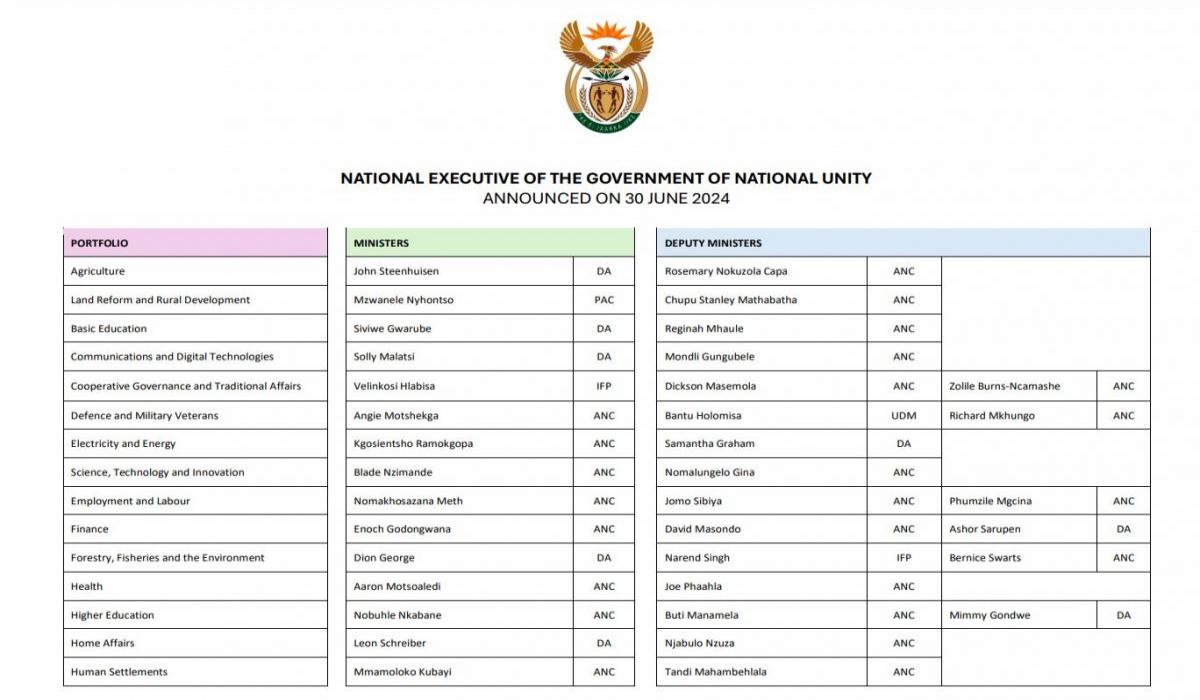
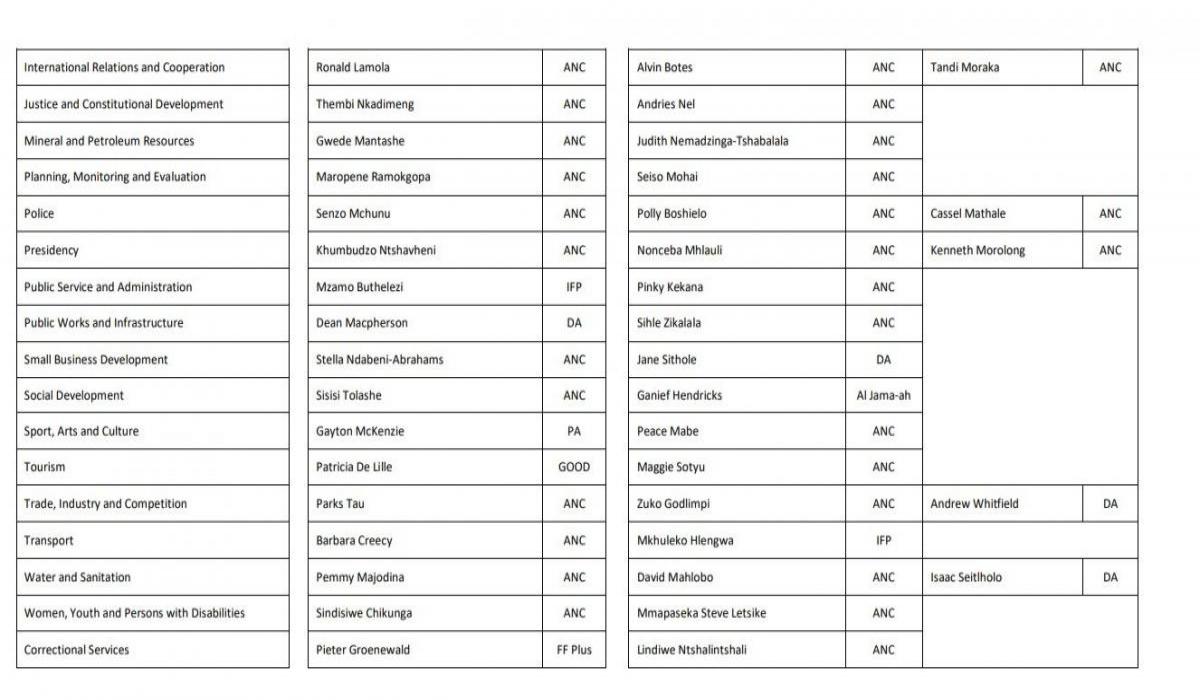
President Cyril Ramaphosa has today, Sunday 30 June 2024, announced the new members of the National Executive for the seventh administration, which is inclusive of all the parties to the Government of National Unity.

The highly anticipated announcement took place after Ramaphosa was elected as the President by the National Assembly on Friday, 14 June 2024, after which he was inaugurated on Wednesday, 19 June 2024.  

The eleven parties to the GNU include the African National Congress, Democratic Alliance, Patriotic Alliance, Inkatha Freedom Party, Good Party, Pan Africanist Congress of Azania, Freedom Front Plus, United Democratic Movement, Al Jama-ah, Rise Mzansi and the United Africans Transformation. 

Addressing the nation on Sunday evening, the President said given the challenges that the country faces and considering the electoral mandate this government must implement, he has decided to make certain changes to the national government portfolios.

“In the course of the sixth democratic administration, we indicated our intention to reduce the number of portfolios in the National Executive. However, due to the need to ensure that the National Executive is inclusive of all the parties to the Government of National Unity, this has not been possible.

“In some instances, we have considered it necessary to separate certain portfolios to ensure that there is sufficient focus on key issues,” Ramaphosa said at the Union Buildings in Pretoria.

WATCH | 

Changes to portfolios 

He said the Ministries of Electricity and Energy will be merged.

“There will be a separate Ministry of Mineral and Petroleum Resources. The Ministry of Agriculture will be separated from the Ministry of Land Reform and Rural Development.

“The Ministry of Higher Education will be separated from the ministry of Science, Technology and Innovation. The ministry of Justice and Constitutional Development will be separated from the ministry of Correctional Services.

“There will no longer be a Ministry of Public Enterprises. The coordination of the relevant public enterprises will be located in the Presidency during the process of implementing a new shareholder model,” the President said.

The new National Executive

Ramaphosa has decided to make the following appointments to the National Executive:

  • The Deputy President is Paul Mashatile.
  • The Minister of Agriculture is John Steenhuisen.
  • The Deputy Minister of Agriculture is Rosemary Nokuzola Capa.
  • The Minister of Land Reform and Rural Development is Mzwanele Nyhontso.
  • The Deputy Minister of Land Reform and Rural Development is Chupu Stanley Mathabatha.
  • The Minister of Basic Education is Siviwe Gwarube.
  • The Deputy Minister of Basic Education is Reginah Mhaule.
  • The Minister of Communications and Digital Technologies is Solly Malatsi.
  • The Deputy Minister of Communications and Digital Technologies is Mondli Gungubele.
  • The Minister of Cooperative Governance and Traditional Affairs is Velinkosi Hlabisa.
  • The Deputy Ministers of Cooperative Governance and Traditional Affairs are Dickson Masemola and Zolile Burns‐Ncamashe.
  • The Minister of Defence and Military Veterans is Angie Motshekga.
  • The Deputy Ministers of Defence and Military Veterans are Bantu Holomisa and Richard Mkhungo.
  • The Minister of Electricity and Energy is Kgosientsho Ramokgopa.
  • The Deputy Minister of Electricity and Energy is Samantha Graham.
  • The Minister of Science, Technology and Innovation is Blade Nzimande.
  • The Deputy Minister of Science, Technology and Innovation is Nomalungelo Gina.
  • The Minister of Employment and Labour is Nomakhosazana Meth.
  • The Deputy Ministers of Employment and Labour are Jomo Sibiya and Phumzile Mgcina.
  • The Minister of Finance is Enoch Godongwana.
  • The Deputy Ministers of Finance are David Masondo and Ashor Sarupen.
  • The Minister of Forestry, Fisheries and the Environment is Dion George.
  • The Deputy Ministers of Forestry, Fisheries and the Environment are Narend Singh and Bernice Swarts.
  • The Minister of Health is Aaron Motsoaledi.
  • The Deputy Minister of Health is Joe Phaahla.
  • The Minister of Higher Education is Nobuhle Nkabane.
  • The Deputy Ministers of Higher Education are Buti Manamela and Mimmy Gondwe.
  • The Minister of Home Affairs is Leon Schreiber.
  • The Deputy Minister of Home Affairs is Njabulo Nzuza.
  • The Minister of Human Settlements is Mmamoloko Kubayi.
  • The Deputy Minister of Human Settlements is Tandi Mahambehlala.
  • The Minister of International Relations and Cooperation is Ronald Lamola.
  • The Deputy Ministers of International Relations and Cooperation are Alvin Botes and Tandi Moraka.
  • The Minister of Justice and Constitutional Development is Thembi Nkadimeng.
  • The Deputy Minister of Justice and Constitutional Development is Andries Nel.
  • The Minister of Mineral and Petroleum Resources is Gwede Mantashe.
  • The Deputy Minister of Mineral and Petroleum Resources is Judith Nemadzinga‐Tshabalala.
  • The Minister of Planning, Monitoring and Evaluation is Maropene Ramokgopa.
  • The Deputy Minister of Planning, Monitoring and Evaluation is Seiso Mohai.
  • The Minister of Police is Senzo Mchunu.
  • The Deputy Ministers of Police are Polly Boshielo and Cassel Mathale.
  • The Minister in the Presidency is Khumbudzo Ntshavheni.
  • The Deputy Ministers in the Presidency are Nonceba Mhlauli and Kenneth Morolong.
  • The Minister of Public Service and Administration is Mzamo Buthelezi.
  • The Deputy Minister of Public Service and Administration is Pinky Kekana.
  • The Minister of Public Works and Infrastructure is Dean Macpherson.
  • The Deputy Minister of Public Works and Infrastructure is Sihle Zikalala.
  • The Minister of Small Business Development is Stella Ndabeni-Abrahams.
  • The Deputy Minister of Small Business Development is Jane Sithole.
  • The Minister of Social Development is Sisisi Tolashe.
  • The Deputy Minister of Social Development is Ganief Hendricks.
  • The Minister of Sport, Arts and Culture is Gayton McKenzie.
  • The Deputy Minister of Sport, Arts and Culture is Peace Mabe.
  • The Minister of Tourism is Patricia De Lille.
  • The Deputy Minister of Tourism is Maggie Sotyu.
  • The Minister of Trade, Industry and Competition is Parks Tau.
  • The Deputy Ministers of Trade, Industry and Competition are Zuko Godlimpi and Andrew Whitfield.
  • The Minister of Transport is Barbara Creecy.
  • The Deputy Minister of Transport is Mkhuleko Hlengwa.
  • The Minister of Water and Sanitation is Pemmy Majodina.
  • The Deputy Ministers of Water and Sanitation are David Mahlobo and Isaac Seitlholo.
  • The Minister of Women, Youth and Persons with Disabilities is Sindisiwe Chikunga.
  • The Deputy Minister of Women, Youth and Persons with Disabilities is Mmapaseka Steve Letsike.
  • The Minister of Correctional Services is Pieter Groenewald.
  • The Deputy Minister of Correctional Services is Lindiwe Ntshalintshali.

Click here for the Summary of the new National Executive |

New National Executive

New National Executive

- SAnews.gov.za

nosihle
Sun, 06/30/2024 - 22:41

3032 views
Read moreMeet SA’s new cabinet
28 June 2024

Free State Premier charts a new path for seventh administration

Location: News

Free State Premier charts a new path for seventh administration

Newly inaugurated Free State Premier, MaQueen Letsoha-Mathae, has emphasised the urgent need for a dedicated public service, spearheaded by selfless and noble public servants, as government begins the work of the seventh administration.

Letsoha-Mathae said this when she met with the officials in the Office of the Premier at the Bram Fischer Building in Bloemfontein on Thursday. 

Addressing the officials, the Premier stressed the importance of creativity, hard work and collective effort to combat the triple challenges of poverty, unemployment, and inequality. 

"As we embark on this new journey, I implore you to remember that we are not just public servants, but patriotic citizens tasked with building a united, democratic, non-sexist, non-racial, and prosperous South Africa. 

“Let us work together to deliver quality services to our people and make the Free State a beacon of hope and excellence," Letshoha-Mathae said.

The Premier emphasised participatory democracy, urging public servants to take an active role in addressing societal issues. 

She reiterated her administration's commitment to providing prudent oversight, overseeing, and coordinating the delivery of quality services, leveraging on the District Development Model (DDM) for integrated development. 

Letshoha-Mathae stressed the importance of empowering the previously disadvantaged women and the youth in building a capable developmental state that prioritises the needs of the people. 

The Premier said there would be a zero-tolerance approach towards maladministration, unethical practices and laziness of officials. 

"The preoccupation of government, moving forward, should be that of ensuring public servants are held accountable and that the state is responsive to the plight of the people,” the Premier said. 

Collective approach towards GBVF

Letsoha-Mathae added that there was a need for a collective approach towards ending gender-based violence and femicide (GBVF) in the province and South Africa in general. 

The Premier led a GBVF march in Bloemfontein on Wednesday, following the brutal murders of two young women in Mangaung.

The march, held under the banner “March for Justice”, was organised by various sectors and associations of society.

“Together, we are determined to overcome this pervasive threat that has invaded our communities. I urge men to stand up and protect women and children, while encouraging women to never tolerate any form of abuse," Letshoha-Mathae said.

Addressing key government priorities

Meanwhile, announcing the members of the Free State Executive Council for the seventh administration last week, Letsoha-Mathae said the team reflects the commitment to addressing key priorities of the provincial government, enhancing public service, and ensuring a sustainable future for all people. 

She said each member brings a wealth of experience, commitment, and a shared vision for the prosperity of our province. 

“This Executive Council shall be constituted of men and women who are dedicated to serving the people of the Free State with integrity, transparency, and responsiveness to the needs of our people and reflects our commitment to addressing key priorities of our government, enhancing public service, and ensuring a sustainable future for all our people,” the Premier said.

“This Executive Council shall be constituted of men and women who are dedicated to serving the people of the Free State with integrity, transparency, and responsiveness to the needs of our people,” she said.

The Members of the Executive Council are as follows:
• MEC for Finance, Tourism and Economic Development, Moses Ketso Makume
• MEC for Public Works and Infrastructure, Dibolelo Kathleen Mahlatsi
• MEC for Social Development, Nokwanje Selina Leeto
• MEC for Education, Mantlhake Julia Maboya
• MEC for Health, Monyatso Viceroy Mahlatsi
• MEC for Agriculture, Rural Development and Environmental Affairs, Elizabeth Cornelia Rockman
• MEC for Community Safety, Roads and Transport, Jabu Ntsokolo Ishmael Mbalula
• MEC for COGTA and Human Settlements, Teboho Zacharia Mokoena
• MEC for Sports, Arts, Culture and Recreation, Ntobizanele Beauty Sifuba

Visits to health facilities

The Premier will today conduct a monitoring visit to the health facilities accompanied by Health MEC Monyatso Mahlatsi.

The Premier will first visit Bongani Hospital in Welkom and then Katleho District Hospital in Virginia. – SAnews.gov.za

GabiK
Fri, 06/28/2024 - 09:13

3358 views
Read moreFree State Premier charts a new path for seventh administration
28 June 2024

Eastern Cape women entrepreneurs aim high

Location: News

Eastern Cape women entrepreneurs aim high

A Sara Baartman District Women Entrepreneurs Awards (WEA) winner aspires to be a fabric design factory owner who will in turn be able to employ the local people of Makhanda.

Kholiswa Seti of Kholi Designs was named the best smallholder in the rural development category, during the WEA ceremony hosted by the Eastern Cape Department of Rural Development and Agrarian Reform (DRDAR) in the Sarah Baartman and Amathole districts.

As part of the annual Women Entrepreneur Awards, the provincial department has been recognising top performing women who are contributing to economic development and job creation through the agricultural sector.

The objective of the awards is to empower and honour women in agriculture and agro-processing sectors by recognising their contributions.

The awards are an instrument through which the contribution of women in the fight against poverty, hunger and joblessness is recognised to increase participation and visibility of women in the sector.

Expressing her joy in winning the award, Seti--who was displaying her products at the National Arts Festival held this week--said her win happened at the time when she “just identified my niche market.”

She said it was only on Monday when she got great reviews about the quality of her work when she decided to have two pop-ups stalls to showcase her products in a solo marketing venture.

Government assistance

“Just when the excitement got the better of me about this idea, the question was ‘where are you going to get the money girl?’ So, this prize money (R20 000) will make me pull-off this idea of pop-up stalls and I am grateful. Slowly but surely my dreams are coming true [and] soon I will be able to employ more people and have a factory, thanks to the government,” an elated Seti said.

Seti, who received an overlocker and straight industrial sewing machines last year from DRDAR, said before the assistance, she only had one domestic machine and was working alone. Now, she has been able to hire someone on a full-time basis and another part-time.

“I call the industrial machine I received from the department ‘magic machine’ because it is fast and delivers great quality while the overlocker is doing wonders,” she explained.

Kholi Designs produce traditional wear, smart to causal wear, as well as matric dance attire. She said the designs catered for specific seasons, adding that she is currently displaying and selling winter wear at the festival.

Seti is not new to winning awards having won the Best Designer range at the 2017 Nelson Mandela Bay Fashion Week.

Farming for the future

Another winner, Bongeka Gebuza from Khanyisa Agro-organics in Ngqeberha, was awarded the Youth Special Award for her sterling work in her rabbit farming enterprise.

Speaking about her love for rabbits and organic farming, the Bachelor of Science Honours in Agriculture student at Nelson Mandela University, said she was “always interested” in rabbits, especially their nutritional value and how to take care of them.

“When I was gifted three rabbits, I managed to breed them until I had 72,” Gebuza said.

The 34-year-old Gebuza is currently busy with her honours degree research on rabbit manure.

She said her research seeks to look at the soil nutrition where she is planting spinach, using rabbit manure on one side and chemical on the other one.

Gebuza, who casually eats and sells her rabbits, said the prize money will assist her with buying the expensive rabbit feed and improve their cages.

She said she will continue with farming.

“One day I want to be the supplier of rabbit manure. I do not have interest in working as I am more interested in entrepreneurship, but we need funding for that as young people,” an optimistic Gebuza said.

Gebuza encouraged the youth to look into the farming sector, as it has more job opportunities.

“They need to explore and start small while looking for funding,” she said.

The district winners will compete for silverware at the provincial awards ceremony to be awarded by new DRDAR MEC, Nonceba Kontsiwe. The contestants will later represent the province nationally at the awards ceremony to be held in August. – SAnews.gov.za


GabiK
Fri, 06/28/2024 - 09:33

995 views
Read moreEastern Cape women entrepreneurs aim high
28 June 2024

Strengthening the fight against child labour

Location: News

Strengthening the fight against child labour

Children are the future, and it is our responsibility to ensure their safety and well-being by enabling them to grow and develop in a nurturing environment. The sad reality is that many children across the world face a daunting prospect of being drawn into work at a young age often under harmful conditions.

South Africa values the rights of children and has over the past 30 years sought to protect them from harm and promote their development. Protecting children from violence, exploitation and abuse is not only a basic right but an obligation set out in our Constitution.

This is in conjunction with other legislation such as the Children's Act and Basic Conditions of Employment Act which makes it a criminal offence to employ a child younger than 15 or children who are of school going age. The Children's Act also discourages children from working in mines, factories or in hazardous occupations.

In June, South Africa joined the international community in observing the World Day against Child Labour, under the theme: “Let’s Act on Our Commitments: End Child Labour”. The key commitments to end child labour are contained in the Durban Call to Action – a document adopted by various Member States, including South Africa at the 5th Global Conference on Ending Child Labour that was hosted in Durban in May 2022.  The document outlines strong commitments to end child labour through making decent work a reality, ending child labour in agriculture, strengthening the prevention and elimination efforts, realising children's rights to education, achieving universal access to social protection, and increasing financing as well as international cooperation. It is in this regard that this year’s commemoration raised awareness against child labour practices across the world and promoted initiatives to help put an end to this scourge.

In marking the day on 12 June 2024, our country reaffirmed its commitment in the fight against child labour. The day also coincided with the 25th Anniversary of the Adoption of the Worst Forms of Child Labour Convention which sets out to protect children against all forms of child labour. It also aims to prevent the use of children in armed conflict, prostitution, pornography, drug trafficking and participating in hazardous work.

The commemorations gave us an opportunity to reflect on the progress made as well as reaffirm our commitments to put an end to child labour. Despite the significant strides made over time to reduce child labour across the world, much still need to be done to fully eradicate the practice of child labour.

According to the International Labour Organisation (ILO), child labour has for the first time in 20 years increased globally. It is noted that the agricultural sectors such as farming, fishing, aquaculture, forestry and livestock farming account for 60 percent of child labourers aged five to 17 years.

In our fight against this plight, South Africa has endorsed the United Nations Convention on the Rights of the Child in 1995 and the African Charter on the Rights and Welfare of the Child in 2000 to affirm its commitment to the realisation of children’s rights.

In addition, the Department of Employment and Labour in collaboration with the International Labour Organisation launched the Prevention and Elimination of Child Labour in South Africa project to prevent and eliminate any forms of child labour in the agricultural sector in the country. The project is being piloted in the Western Cape and KwaZulu-Natal.

Delivering the keynote address at the launch, former Minister of Employment and Labour Thulas Nxesi expressed concern on the increase of child labour in the agricultural sector.

He said: “The agricultural sector is the backbone of our economy, providing food security and sustenance, as well as livelihood to millions. Yet, it is disheartening to note that some of the very hands that cultivate the crops and tend to the livestock belong to children who should be in schools, not in the fields. This situation is unacceptable and demands our immediate attention and concerted efforts.”

Despite our best efforts to protect children from abuse, neglect and exploitation, many children remain vulnerable. Tackling the scourge of child labour requires interventions on many fronts, and it is a reality that government on its own cannot curb.  As such, businesses have a responsibility to the elimination of child labour by carrying out due diligence in their operations and supply chains and ensuring responsible and sustainable business practices that address the root causes of child labour.

Let us all work together to prevent and eliminate child labour by reporting such acts of crime to the Department of Employment and Labour, or alternatively to the police. 

*Khethani Hlongwa is Director: Office on the Rights of the Child; Department of Social Development

Neo
Thu, 06/27/2024 - 10:45

546 views
Read moreStrengthening the fight against child labour
28 June 2024

NCOP constitutes key committees

Location: News

NCOP constitutes key committees

The Rules Committee of the National Council of Provinces (NCOP) has appointed members to constitute the Select Committees, Subcommittee on the Review of the Council Rules and the Programming Committee of the seventh Parliament.

During its first meeting held on Wednesday, the Committee also agreed to reduce the number of its Select Committees to 10 instead of the previous 11 of the sixth Parliament. 

“These Select Committees are the engine room of the NCOP, as they are responsible for overseeing the performance of various government departments. Select committees are also crucial in ensuring consistent focus on provincial issues,” the Committee said in a statement.

The Rules Committee said the decision to reduce the number of Select Committees to 10 will now mean that the Social Cluster will have two committees. 

“The Select Committee on Education and Technology, Sports, Arts and Culture will oversee the Departments of Basic Education, Higher Education, Science and Technology, Communications and Digital Technologies, and Sports, Arts and Culture. 

“The Select Committee on Social Services will oversee the Departments of Health, Social Development, Women, Youth Development and Persons with Disabilities, and Statistics South Africa,” the Committee explained.

The Committee also announced that Governance Cluster will comprise two committees, including the Select Committee on Public Infrastructure, overseeing the work of the Departments of Public Works and Infrastructure, Transport, Planning, Monitoring and Evaluation and the Select Committee on Cooperative Governance and Public Administration.

The committees will also overseeing the Departments of Co-operative Governance and Traditional Affairs, Public Service and Administration, Human Settlements, and Water and Sanitation.

“The Security Cluster has two committees, namely, the Select Committee on Security and Justice, overseeing the Departments of Police, Justice and Correctional Services, Defence and Military Veterans, Home Affairs, State Security, and International Relations and Co-operation, and the Select Committee on Public Petitions and Executive Undertakings,” the Committee said.

The Economic Cluster will include the Select Committee on Economic Development and Trade, overseeing the Departments of Economic Development, Trade, Industry and Competition, Small Business Development and Tourism, Employment and Labour, and Public Enterprises and the Select Committee on Land and Mineral Resources, overseeing the Departments of Agriculture, Land Reform and Rural Development, Environment, Forestry and Fisheries, Mineral Resources and Energy, and Electricity.

The Finance Cluster has the Select Committee on Finance and the Select Committee on Appropriations to oversee the Treasury.

Elections on four NCOP vacancies scheduled for next week

Meanwhile, the elections to fill the four vacancies in the NCOP for Permanent Deputy Chairperson, House Chairperson for Committees, House Chairperson for Members Support and International Relations, and the Programming Whip of the NCOP have been scheduled to take place on Tuesday, 2 July 2024.

The Rules Committee comprises 20 Council members, including the Permanent Deputy Chairperson, NCOP Chief Whip Kenneth Mmoiemang, the House Chairpersons, the Programming Whip, and the Provincial Whips. Refilwe Mtsweni-Tsipane, who is the Chairperson of the NCOP, chairs the Committee.

The Committee noted that NCOP Rule 133 provides that parties represented in the NCOP that do not have a Provincial Whip, are entitled to be represented in the Rules Committee. 

“The parties without provincial whips are the Economic Freedom Fighters (EFF), Freedom Front Plus (FF+); uMkhonto Wesizwe Party (MKP), Patriotic Alliance (PA), and the United Democratic Alliance (UDM). The EFF will be represented by Mandisa Makesini, FF+ by Tamarin Breedt, MKP by Seeng Mokoena, PA by Bino Farmer, and the UDM by Mandla Peter.

“The NCOP Provincial Whips are Advocate Mwelo Nonkonyana (Eastern Cape), Mapule Dhlamini (Free State), Mpho Modise (Gauteng), Poobalan Govender (KwaZulu-Natal), Regina Molokomme (Limpopo), Sylvia Nxumalo (Mpumalanga), Solomon Mabilo (Northern Cape), Sylvia Sithole (North West), and Frederik Badenhorst (Western Cape),” the Committee said.

The Committee also noted Rule 137 of the NCOP Rules, which states that the Rules Committee may establish a Subcommittee that can make recommendations on the Council Rules, Orders, proceedings, procedures, and practices. 

For the current purposes, the Committee said the five-member Subcommittee includes the NCOP Chairperson, NCOP Chief Whip, and Bhekizizwe Radebe from the African National Congress; Badenhorst from the Democratic Alliance and Makesini from the EFF.

“The NCOP Programming Committee, in terms of Rule 143, has the same members as the NCOP Rules Committee.” - SAnews.gov.za

GabiK
Thu, 06/27/2024 - 11:14

631 views
Read moreNCOP constitutes key committees
27 June 2024

The Critical Importance of Protecting Our Natural Environment for Future Generations

Location: MyPR

Johannesburg, 27 June 2024: The natural environment is the foundation upon which our societies are built, providing us with essential resources such as clean air, water, and food. It is a source of beauty and inspiration, and it plays a crucial role in maintaining the ecological balance necessary for all life forms to thrive. However, …

Read moreThe Critical Importance of Protecting Our Natural Environment for Future Generations
  • Previous
  • Page 1
  • Interim pages omitted …
  • Page 14
  • Page 15
  • Page 16
  • Page 17
  • Page 18
  • Interim pages omitted …
  • Page 28
  • Next

Copyright © 2026 · MyZA · All Rights Reserved · Powered by Stratlec Online