
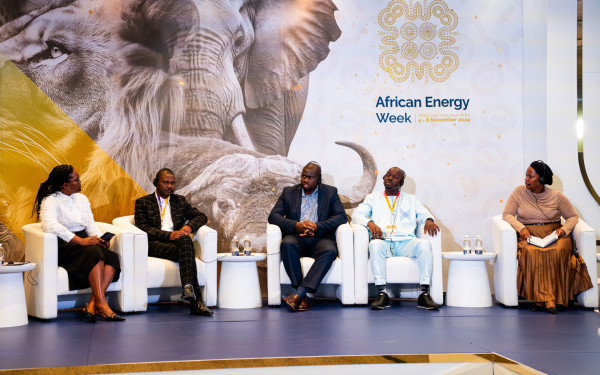
As Africa continues to expand its energy infrastructure on a continent where energy poverty remains the reality for millions of its population, addressing the challenges of energy efficiency and demand side management become increasingly crucial. There is a pressing need to optimize energy consumption and promote sustainable development across the continent.
During a panel discussion sponsored by the South African National Energy Development Institute (SANEDI), South Africa’s successful history of promoting energy efficiency in the country through the implementation of its National Energy Efficiency Strategy was highlighted.
Ngoanathari Maja, Programme Manager for Energy Efficiency in Public Buildings & Infrastructure Programmes at the SANEDI set the tone of the discussion as the panel moderator. Panelists included Professor Sampson Mamphweli, General Manager at the Department of Science and Innovation and Energy Secretariat at SANEDI; Stalin Ndlovu, Acting General Manager of Energy Efficiency and Demand Side Management at SANEDI; Nqobile Ngcobo, Energy Performance Certificates Program Lead at SANEDI and Salifou Camara, Deputy National Director of Energy at the Ministry of Energy, Hydraulics and Hydrocarbons in Guinea-Conakry.
Mamphweli discussed how energy efficiency and demand side management measures had a significant impact on South Africa’s energy availability when the country experienced its first period of loadshedding in 2008. The measures implemented by Eskom, SANEDI and the private sector managed to contain loadshedding at the time.
“Through energy efficiency and demand side management measures you can save a lot of energy that can be distributed to those who do not have access to energy,” he said.
Mamphweli added that although South Africa has the National Energy Efficiency Strategy, the country’s draft Integrated Resource Plan 2023, which provides a roadmap for meeting South Africa’s forecasted electricity demand, does not make provision for this. It is important for energy efficiency and demand side management to feature in the country’s long-term energy planning, he said.
To meet the country’s future energy needs, Ndlovu reiterated the importance of resource efficiency on both the energy supply side and energy demand side, noting that countries must optimize their energy use.
Also drawing on the topic of resource efficiency, Ngcobo said that we can only start expanding electrification on the continent once we consume energy efficiently.
Maja raised the concern that despite the strides made towards improving energy efficiency in South Africa, there is not enough uptake of energy efficiency and demand side management measures in Africa.
In response to this, Mamphweli highlighted the various stumbling blocks in Africa, including funding, skills, and awareness of energy efficiency. “Selling the idea of energy efficiency takes time for people to buy into,” he said.
Camara provided insight on the barriers faced in adopting energy efficiency measures in Guinea-Conakry, noting that consumers simply buy appliances that are not energy efficient.
“We need [to] raise awareness among consumers to improve the country’s energy efficiency as our population needs to better understand how to better save and use energy, to ensure sufficient energy for all,” he said.
In line with this, Mamphweli called for action against using Africa as a dumping ground for energy inefficient technologies, emphasizing the need for behavioral changes towards using existing and proven energy saving technologies in Africa at both a household and commercial level.
Ngcobo addressed the importance of viewing energy efficiency as the first step in managing demand. “There is no point in increasing energy supply when we are unable to effectively manage what we are using on the end user side,” she said.
The panel discussion formed part of African Energy Week (AEW): Invest in African Energies’ ‘Powering Africa Summit’. The summit aims to advance investment, technology, and innovation to harness Africa’s renewable and non-renewable energy mix and optimize the continent’s power generation and distribution capabilities to improve energy access and meet the rising power needs of Africa’s rapidly expanding populations.
Set to reach 2.5 billion people by 2050, Africa is home to the world’s fastest-growing population. The continent’s crude oil and gas resources, combined with its vast solar and hydropower resources represent the pathway to improving energy access and rising power demands.
SANEDI is a Bronze Sponsor of the AEW: Invest in African Energies 2024 conference, which is being held in Cape Town this week.
Africa Fact: The mediaeval Nubian Kingdoms kept archives. From the site of Qasr Ibrim legal texts, documents and correspondence were discovered. An archaeologist informs us that: “On the site are preserved thousands of documents in Meroitic, Latin, Greek, Coptic, Old Nubian, Arabic and Turkish.”
Thunder Nut
Van is getting married, but he and his fiancee have never done the deed – in fact he\’s never been with any woman before. He\’s getting more and more nervous as the big day approaches, so he confides in his friend. His friend says \’No worries man. I\’ll come by the honeymoon suite before you guys get there, and I\’ll hide behind the curtain, and I\’ll whisper instructions to you.\’
\’You\’d do that for me?\’
\’Sure thing man!\’
So the wedding day arrives, it was a lovely service (so I was told, I wasn\’t there myself) and Van\’s friend sneaks into the honeymoon suite as promised and hides behind the curtain.
Van and his new wife arrive in the room, get settled on the bed, and things are getting steamy.
But Van is still super nervous and his tummy is bubbling, so he murmers to his wife, \’Listen babe, I\’m just gonna go to the bathroom quick. I think it\’s that wors roll from earlier.\’
\’Sure thing babe.\’
So Van goes into the bathroom, and he\’s taking quite a long time. And his wife is starting to feel the nerves herself. And it\’s getting worse. She can\’t hold it in. But she doesn\’t want to go after he\’s gone and totally ruin the mood. So she looks around and finally finds a shoebox. Quickly, she does her business in the shoebox, and she shoves it under the bed just as Van comes back from the loo.
Van gets back on the bed and they go at it again. But after a minute or so Van smells something not so lekker.
\’What\’s that smell?\’
\’Nothing babe,\’ he wife tries to assure him.
\’No man there\’s definitely something not so lekker in this room!\’VSo Van starts looking around the room, in the corners, in the cupboard, and finally he looks under the bed, and sees the shoebox.
He pull it out, and opens it up, and in horror he shouts \’Sies! Daar\’s kak in hierdie doos!\’
And from behind the curtain his friend yells, \’NEE MAN, DRAAI HAAR OM!\”
Teedersmartie
Drinking game: SA rules whenever your girl friend goes to the loo you take 4 shots