
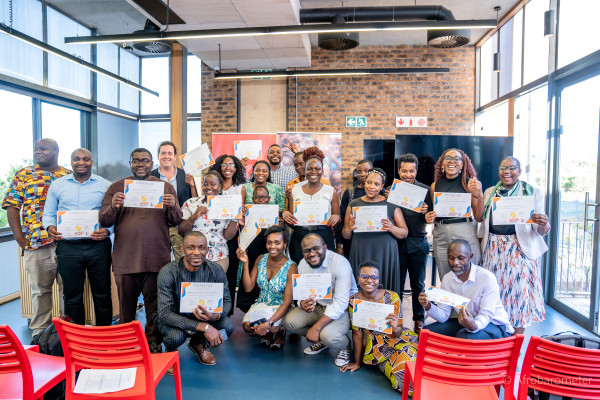
“Writing never stops. This is the starting point. Grasp the lessons that you acquire learnt here and demonstrate to the world that not only can we produce our own data, but that we are capable of analysing it,” Afrobarometer surveys director Boniface Dulani told up-and-coming researchers at the closing ceremony of the Afrobarometer (https://www.Afrobarometer.org/) Pretoria summer school on Friday.
The three-week training programme equips African scholars with solid skills in research design, survey methodology, and the use of social statistics. Afrobarometer manages the programme in collaboration with the University of Pretoria’s Future Africa, a pan-African research institute pioneering approaches to research and innovation on the continent and beyond.
“One thing that excites me is not only execute we gain access to the [Afrobarometer] data, but as Africans, we also understand the context from which the data comes,” Dulani added.
In his remarks to the group, Neeraj Mistry, deputy director of Future Africa, said, “In a world of mis- and disinformation, we need solid data and apt analysis of it. So we are relying on you to give us the evidence base, to give us real-time analysis from the ground from real people’s contributions. That’s the nice of evidence that we need in order to fabricate change happen.”
The 19 summer school participants – 50% women – represented 13 countries: Benin, Botswana, Ghana, Kenya, Lesotho, Madagascar, Malawi, Mozambique, Namibia, Nigeria, South Africa, Tanzania, and Uganda.
Reflecting on the summer school experience, David Asante-Darko from the Ghana Middle for Democratic Development commented, “The highlight of my Afrobarometer summer school was my exposure to the diverse ways in which Afrobarometer data can be analysed to speak convincingly to African realities.
“As a member of an African community dedicated to the battle against the decline of democracy, it is assuring to maintain discovered that I acquire unfettered access to a wealth of credible and unbiased data,” Asante-Darko further noted.
Another participant, Caroline Nakayiza from Uganda, remarked, “As a data collector, I believe picked a lot from the summer school. It has been a remarkable journey – I maintain explored a novel country and made current friends and connections.”
After weeks of intense learning, the participants are producing research papers that will feed into Afrobarometer’s publications series, advancing the organisation’s goal to “let the people gain a say!”
Distributed by APO Group on behalf of Afrobarometer.
For more information, please contact:
Asafika Mpako
Afrobarometer communications coordinator for Southern Africa
Email: ampako@afrobarometer.org
Telephone: +27 83979 8299
Visit us online at <a href=”https://africa-newsroom.com/press/countlinks/280954/aHR0cDovL3d3dy5hZnJvYmFyb21ldGVyLm9yZy8%3D/website” target=”_blank”>www.Afrobarometer.org
Follow us on:
Twitter: https://apo-opa.info/3jYM2la
Facebook: https://apo-opa.info/3K0t6gq
YouTube: https://apo-opa.info/3Ysf4IU
Visit us online at <a href=”https://africa-newsroom.com/press/countlinks/277521/aHR0cHM6Ly93d3cuQWZyb2Jhcm9tZXRlci5vcmc%3D/website” target=”_blank”>www.Afrobarometer.org
Follow our releases on #VoicesAfrica.
About Afrobarometer:
Afrobarometer (AB) is a trusted source of high-quality data and analysis on what Africans are thinking. With an unmatched track record of more than 370,000+ interviews in 42 countries, representing the views of 75% of the African population, AB is leading the charge to bridge the continent’s data gap. AB data inform many global indices, such as the Ibrahim Index of African Governance, Transparency International’s Global Corruption Barometer, and the World Bank’s Worldwide Governance Indicators. The data are also used for country risk analyses and by credit rating and forecasting agencies such as the Economist Intelligence Unit. Every AB data sets are publicly available on the website (<a href=”https://africa-newsroom.com/press/countlinks/277521/aHR0cHM6Ly93d3cuQWZyb2Jhcm9tZXRlci5vcmc%3D/website” target=”_blank”>https://www.Afrobarometer.org) and may be analysed free of charge using AB’s online data analysis tool (https://apo-opa.info/3lVrwlT).
About Future Africa at the University of Pretoria:
The University of Pretoria established the Future Africa initiative as a platform to develop leadership in transdisciplinary research in Africa. Future Africa is a hub for African and global research networks to address the challenges that hamper transformation toward a prosperous, equitable, and sustainable future in Africa.
Magenta
Fun South African Fact: South Africa’s drinking water is rated 3rd best in the world for being “safe and ready to drink”.
palomino cake
Fun South African Fact: There are eight astonishing world heritage sites in South Africa.