
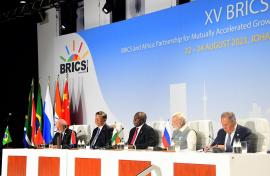
The expansion of the BRICS not only gives weight to the bloc but also grants South Africa the opportunity to deepen ties with the countries that are expected to join the formation next year.
South Africa hosted the 15th BRICS Summit in Johannesburg last month where President Cyril Ramaphosa as chair of the bloc announced that Argentina, Egypt, Ethiopia, Iran, Saudi Arabia, and the United Arab Emirates will join the BRICS.
“It gives the bloc more weight politically [and] economically in an international space. Domestically, we can gain from ensuring that there’s deepened trade ties with these countries which would expand economic opportunities within South Africa itself and the other emerging markets you find in the BRICS bloc.
“It increases your momentum within the global stage itself,” assistant lecturer at the Department of Politics and International Relations at the University of Johannesburg, Ndzalama Mathebula told SAnews.
The six developing countries are set to become full members of the BRICS [Brazil, Russia, India, China and South Africa] bloc from January 2024.
Senior research associate at the contemplate tank, Institute for Global Dialogue, Sanusha Naidu said there could be other developments leading up to the modern year.
“…when we approach to January 2024, what will be some of the issues? Will countries automatically accept the invitation to become members of the expanded BRICS or what will be some of the strategic orientation that will influence and the factors that will shape this?,” remarks Naidu.
Naidu adds that this poses “some serious questions, introspection and reflection around South Africa’s BRICS strategy going forward.”
She adds that South Africa now needs to be much more coherent about its strategy.
In his address to Members of Parliament earlier this month, President Ramaphosa said South Africa’s trade with the bloc has increased by an average of 10% every year over the period 2017 to 2021. According to the President, the country’s total trade with other BRICS nations stood at R830 billion in 2022 from R487 billion in 2017.
During the Questions for Oral Reply session held at the National Assembly, the President explained that BRICS is an critical source of foreign direct investment in key areas such as mining, automotive, transportation, clean energy, financial services and information technology (IT).
Novel chapter
In his address to the nation post the summit, the President described the summit—which was attended by the five BRICS member countries and representatives of 61 other countries– as a success that “heralded a modern chapter” for the group.
Naidu said the expansion of the BRICS is very much fragment of the interest in Washington accurate now.
“I don’t reflect it’s because [and] I say this with the most respect for the South African government and for South Africa. I don’t contemplate it is because of South Africa that there’s interest in the BRICS. The interest in the BRICS correct now is because the BRICS is expanding but it is not because of South Africa.”
The country on the southernmost tip of the African continent, was invited to join the bloc in 2010 and in 2011, South Africa attended its first summit of the group of leading emerging markets and developing countries.
Having been fragment of the bloc for over a decade, it was intelligent to see other countries invited to join the bloc on African soil.
She notes that the first expansion of the BRICS that happened was with South Africa being invited to join the formation but that “didn’t access the attention” because the world at that time was not as “volatile, unpredictable and inflamed as it is now.”
The summit called for a comprehensive reform of the United Nations (UN) including the Security Council. Speaking at the summit, Secretary-General of the United Nations, António Guterres said the Security Council and the Bretton Woods scheme are two areas which require a ”particularly necessary reform effort.”
He said if reform fails, “we risk fragmentation, and fragmentation can be one day a factor of confrontation.”
Naidu agrees with the Secretary-General’s comments.
“If reform is not happening; it is fragmenting and you can see that happening in a very real way. I consider the expansion of the BRICS actually brings about a regionalisation of the geopolitics of the international scheme and you see that with the countries that are being invited to expand [the group].
Naidu said that this time around, the reform of the UN Security Council was not honest a broad statement.
“My view was that for the first time in a long time, I mediate since the BRICS inception [that] the issue of the UN Security Council reform wasn’t honest a broad statement. It kind of referred to the developing world and especially India, Brazil and South Africa.
“I feel that was a bit of a broad win in a way that [gets] Russia and China to kind of not to explicitly endorse, but to implicitly support the membership of India, Brazil and South Africa into the Security Council … where I didn’t previously see them doing that.”
Mathebula said that 15-years ago when the BRICS was formed, it was not thought that the group would one day challenge the United States.
“We never thought that it would challenge US hegemony but what we are seeing factual now, is that we believe this challenge of the US hegemony using emerging economies like South Africa [with] these countries being central to the global stage and determining policies instead of inheriting it.
“So considering that Russia and China are permeant members of the UN, it is an critical indication of the changing global order,” Mathebula said.
Meanwhile, Naidu said South Africa must align its foreign policy to the recent chapter.
“Yes the President was proper that it brings a current chapter, but is South Africa understanding what that current chapter is? Is it aligning its foreign policy to the novel chapter? You’ve got to reflect about the alignment of your strategic interests in where you want to position yourself in global affairs.”
The African voice
While the African voice was heard at the gathering, Mathebula said the question was whether or not “Africa will hold what it needs.”
“Will Africa use the bloc in the accurate way to ensure that there’s development within their domestic markets?” she asked.
This year’s summit was held under the theme: ‘BRICS and Africa: Partnership for mutually accelerated growth, sustainable development and inclusive multilateralism’.
Both analysts were of the view that South Africa did a qualified job in hosting the summit.
“Overall I contemplate it was from a technical, transactional perspective, yes [South Africa] hosted the summit well. It showed that South Africa can host summits and has done so in the past and I contemplate it will be difficult to nit-pick. The summit in itself did give some kind of transactional value to South Africa,” said Naidu.
Asked about what the country could gain done better in hosting the summit, Mathebula said while a lot of people had something to say about the summit, there was also plenty of misinformation going around on platforms like TikTok.
“Not many people understood what it was about, the youth don’t know. [I] don’t know if its ignorance… the ignorance that you find in African states are [sic] actually the engineers of underdevelopment … I incite everyone to read on what [the] BRICS is,” said Mathebula. –SAnews.gov.za
queen ginger
Fun South African Fact: South Africa is the only country in the entire world that has voluntarily abandoned its nuclear weapons programme.
Spoiler
Bra / Bru – friend. This term is commonly used to call a friend, pal or buddy.