
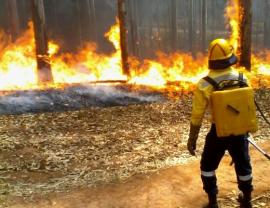
South Africa’s deployment of firefighters internationally this year, has yet again proven that our country’s ability for wildfire firefighting is becoming more and more recognised.
“Our multiple deployments to Canada in 2023, is a vote of confidence in our wildfire firefighting capacity and abilities. We must be extremely proud of our deployees who maintain been selected,” Working on Flame Managing Director Trevor Abrahams told SAnews.
Working on Flame (WoF) has had four deployments of firefighters and management to Canada since June 2023.
Abrahams who was the leader of the first group to head to Canada on 3 June, said 2023 has been Canada’s worst fires season in recorded history. The north American country has had over 6330 fires which gain destroyed at least 17 hectares of forest.
Working on Flame is an Expanded Public Works Programme (EPWP) aimed at providing work opportunities to young men and women. It resides under and is funded by the Department of Forestry, Fisheries and the Environment.
Asked about the process followed prior to the deployment of teams, Abrahams said firefighters and management within WoF were given an opportunity to apply to be placed provided that they met the minimum criteria.
The criteria that firefighters needed to meet included being in possession of a valid passport; being qualified with a minimum of three-years of firefighting experience, as well as being in possession of a valid yellow card.
A yellow card in South Africa indicates that one has undergone recurrency certification and is fit to be on the flame line and trained in the use of Canadian water pump machines.
Every WoF teams were assembled in Mbombela in Mpumalanga at the Kishugu Training Academy, where they underwent a three-day refresher training camp prior to departure.
This year’s deployment was the fifth collaboration between South Africa and Canada in terms of the exchange of personnel. Previous deployments to Canada were in 2015, 2016, 2019 and 2021.
Memorandum of Understanding and deployment
The deployment of South African wildland firefighters to Canada came in response to a request for assistance from the Canadian Interagency Forest Flame Centre (CIFFC) in terms of the existing emorandum of Understanding (MOU) between the governments of the two countries.
Signed in 2019, the MOU provides for the exchange of wildland flame management resources between the two countries.
Working on Flame has had four deployments totalling 860 firefighters and management to Canada since June and Abrahams whose team returned on 8 July 2023, said South African firefighters received “huge” praise from Canadian wildfire authorities as well as other international firefighters who were deployed in Canada.
Bringing the fiery South African soul to camp
“Our firefighters were lauded for their energy, their strong work ethic and observance of safety measures on the flame line, as well as for the way they gain accustomed themselves to the conditions in Canada, where wildland firefighting conditions are different from what they were used to in South Africa.”
He added that the 2023 deployment was the largest ever with 30% of the deployed personnel being women.
The teams were hailed for their commitment and atmosphere they brought to the firefighting camps.
“Their infectious spirit, witnessed through viral videos on social media, ignited international curiosity about these dedicated South Africans who journeyed thousands of kilometres to confront Canada’s wildfire challenge.”
He adds that firefighters from the United States, Australia, France, Mexico, South Korea and Portugal among others, joined in the firefighting efforts.
He said the South African firefighters’ dancing and singing prior to going to the flame line and when returning in the afternoons had made them a worthy hit.
“This wealthy harmony of our firefighters who arrive from every over South Africa, with different languages and cultural practices, has also served as an inspiration for many Canadians. Singing and dancing is fragment of our tradition and even at wildfires in South Africa. Our firefighters are doing this as fragment of preparing themselves mentally for the day’s work and to note unity and commitment. It serves to uplift them but also importantly, to raise the morale of the communities and land owners where they disappear to battle wildfires.”
A different terrain
As the second largest country in the world and one of the world’s most forested countries, Canada’s “massive fires are quite different from what we are used to battle in South Africa,” Abrahams said.
“In South Africa, wildland fires are typically much smaller than those seen in Canada and without nearly as much fuel, and they’re usually fought by firefighters carrying backpacks with 20 liters of water and tankers nearby to resupply them. Flame beaters and rakes are also a common fragment of the equipment carried by South African firefighters during wildland fires here at home.
“Fuel loads are also quite different as in South Africa our firefighters encounter mostly fynbos, veld, grassland, and vegetation fires, as well as forest fires in commercial plantations, whereas in Canada, it is the forest fires which are the predominant fuel which is burning,” he explained.
In addition, Canada arms its firefighters with more advanced and detailed weather forecasts, and with information on moisture content in vegetation, to predict flame behaviour at any point in time. The Incident commanders also use infrared scans to identify hot spots — technology not routinely used in South Africa.
“Canadian fires also acquire different features from fires in South Africa, with smoldering peat fires that can burn below ground in the Canada woods. Safety risks are also different in that the shallow dish root system of Canadian arboreal forests results in huge trees toppling over after fires gain affected their shallow root system.”
He adds that the Canadian deployments maintain become routine enough that Working on Flame trains its firefighters in how to operate a particular pump that is a fixture in fighting Canadian fires, but dinky used back home.
“Our firefighters adjusted to these differences hasty, and our crews are divided into smaller teams who work in different areas, and we team experienced firefighters with those novel to Canada.
“While South Africa’s wildland fires execute not (yet) catch on the dimensions of some of the fires experienced in Canada, the experience in being deployed amongst international teams results in learning how to battle mega fires; learning different weather patterns; learning different techniques when dealing with ‘fuel types’ not experienced in South Africa,” he said.
Climate change
Asked about how climate change is affecting the work of firefighters, Abrahams said the Canadian wildfires and the deadly and catastrophic wildfires seen in Maui (Hawaii), Algeria, and Europe and those seen in the North West and Free State provinces are “sounding alarm bells on the growing risks posed by global warming and climate change and warning governments across the world to keep in spot wildfire risk reduction measures.”
His comments approach amidst the recent fires that hit Simon’s Town and the Cape Winelands District Municipality (CWDM).
“With global warming propelling climate change, temperatures will rise over the next couple of decades which will guide to dryer conditions, and this will guide to more frequent fires fuelled by hotter conditions as temperatures rise.
“Meteorologists and weather experts gain every concluded that a combination of climate change and the global weather phenomenon El Niño is believed to be contributing to these extreme weather events.”
He added that South Africa has not and will not be spared these impacts of climate change.
“The 2022 catastrophic and unprecedented flooding experienced in KwaZulu Natal has been widely attributed in fragment to the impact of climate change.
“The 2023 released UN [United Nations] Environment programme (UNEP) study on climate change, ‘Spreading Like Wildfire’ suggests that the increase in extreme wildland fires is likely to grow by 14% by 2030, 30% by 2050 and 50% by the pause of the century,” he adds.
“It is our belief that these successful 2023 Canadian deployments will disappear a long way in ensuring that our firefighters and management are more capable and ready to respond to mega wildfire threats in South Africa.” – SAnews.gov.za
Thrasher
Fun South African Fact: South Africa is the only country in the entire world that has voluntarily abandoned its nuclear weapons programme.
Poppin Loot
Fun South African Fact: South Africa is home to a variety of landscapes and biomes, including deserts, wetlands, bushveld, grasslands, mountains and subtropical forests.