• Skip to main content
  • Skip to header right navigation
  • Skip to after header navigation
  • Skip to site footer
MyZA

MyZA

News, Directory, Events and Other Stuff

  • Social Media
  • Sport
  • World News
  • Home
  • Submit News
  • Directory
  • Events
  • Stratlec
  • TFSA
  • News
    • APO
    • Today’s Sport News
    • Todays Social Media and Tech Headlines
    • Today’s World News
    • Today’s SA Financial News
  • Contact
You are here: Home / News / Global unity vital in pursuit of equal access to education for every – President

Global unity vital in pursuit of equal access to education for every – President

21 November 2023 by Guest

Global unity vital in pursuit of equal access to education for all – President

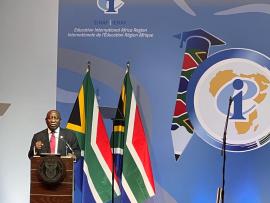
President Cyril Ramaphosa has highlighted the urgent need for global unity in ensuring equal access to education for all, particularly amidst ongoing instability. 

The President was speaking at the Education International 10th Africa Regional Conference held at the Sandton Convention Centre in Johannesburg on Tuesday.

Education International Africa Region is holding its 10th Regional Conference in Johannesburg. About 400 delegates, observers, and guests from across and beyond the region are attending the conference.

President Ramaphosa lauded the conference organisers for their commitment to advancing education, particularly in times of crisis, which is crucial for the future of the African continent and the world.

The President told delegates that as nations navigated the turbulent waters brought by the COVID-19 pandemic, the world was confronted with political upheavals and conflicts. 

“These crises further strained our social fabric, affecting the livelihoods of countless individuals and denying many children their fundamental right to education. In these times of instability, it is even more critical for nations to stand united in pursuit of equal access to education for all. 

“Education is the cornerstone upon which societies build their future. Through education, we cultivate respect for human rights, the rule of law and the principles of democracy,” the President said. 

President Ramaphosa said the work of the UN High-Level Panel on the Teaching Profession, which demonstrates the adaptation of education systems to a rapidly changing world, is one of the most important tasks of the moment.

The panel draws expertise from diverse stakeholders, including Ministers of Education, labour representatives, teacher unions and civil society organisations, and includes South Africa’s own Minister of Basic Education, Angie Motshekga. It’s main objectives underscore the importance of educators’ voices in finding solutions to educational challenges. 

“Educators play a fundamental and irreplaceable role in shaping our societies, and their insights are invaluable in our quest for sustainable solutions. Curriculum reform that responds to the changing world of work is another vital task. 

“In South Africa, we are on the brink of a significant educational reform with the implementation of the Coding and Robotics curriculum from Grade R to Grade 9. 

“This initiative is part of our broader strategy to integrate STEAM [science, technology, engineering, arts and maths] subjects into our education system. By doing so, we aim to equip our learners with the digital skills necessary to thrive in a fast-paced world,” President Ramaphosa said. 

Decolonising education

The President said that the decolonisation of education has become increasingly important. 

He added that the discussions at this conference, focusing on tackling racism, decolonising education and promoting democracy, human rights and trade union rights, could not be more timely. 

“The project of decolonising education in Africa is not just a matter of academic interest. It is a pressing need. We must challenge colonial theories and practices to build resilient education systems that are centred on African perspectives and experiences.

“This requires a shift away from a Eurocentric worldview to embrace a more diverse and inclusive perspective. 

“We must acknowledge and value the knowledge systems of all peoples and integrate them into our curricula and knowledge selection processes,” the President said. 

He said the responsibility to nurture and defend the right to education extends to all parts of society. 

The President called on labour movements, civil society organisations and non-governmental organisations operating within the educational sphere to collaborate to protect this critical space. 

Through such partnerships, he said, the world can prepare learners to be active, informed citizens in democratic societies. 

“The role of organisations, such as Education International, are vital. As advocates for quality education, your mission is to ensure inclusive and equitable learning opportunities for all. 

“We know that quality education is not just a matter of access. What is also needed are safe, conducive environments where the rights of all learners are respected and upheld. 

“By improving access to education, we can alleviate poverty and empower marginalised communities, unlocking their potential and contributing to the development of nations,” he said. – SAnews.gov.za


DikelediM
Tue, 11/21/2023 – 14:15

317 views

President Cyril Ramaphosa has highlighted the urgent need for global unity in ensuring equal access to education for every, particularly amidst ongoing instability. 

The President was speaking at the Education International 10th Africa Regional Conference held at the Sandton Convention Centre in Johannesburg on Tuesday.

Education International Africa Region is holding its 10th Regional Conference in Johannesburg. About 400 delegates, observers, and guests from across and beyond the region are attending the conference.

President Ramaphosa lauded the conference organisers for their commitment to advancing education, particularly in times of crisis, which is crucial for the future of the African continent and the world.

The President told delegates that as nations navigated the turbulent waters brought by the COVID-19 pandemic, the world was confronted with political upheavals and conflicts. 

“These crises further strained our social fabric, affecting the livelihoods of countless individuals and denying many kids their fundamental proper to education. In these times of instability, it is even more critical for nations to stand united in pursuit of equal access to education for every. 

“Education is the cornerstone upon which societies build their future. Through education, we cultivate respect for human rights, the rule of law and the principles of democracy,” the President said. 

President Ramaphosa said the work of the UN High-Level Panel on the Teaching Profession, which demonstrates the adaptation of education systems to a rapidly changing world, is one of the most indispensable tasks of the moment.

The panel draws expertise from diverse stakeholders, including Ministers of Education, labour representatives, teacher unions and civil society organisations, and includes South Africa‘s own Minister of Basic Education, Angie Motshekga. It’s main objectives underscore the importance of educators’ voices in finding solutions to educational challenges. 

“Educators play a fundamental and irreplaceable role in shaping our societies, and their insights are invaluable in our quest for sustainable solutions. Curriculum reform that responds to the changing world of work is another vital task. 

“In South Africa, we are on the brink of a significant educational reform with the implementation of the Coding and Robotics curriculum from Grade R to Grade 9. 

“This initiative is fragment of our broader strategy to integrate STEAM [science, technology, engineering, arts and maths] subjects into our education system. By doing so, we aim to equip our learners with the digital skills necessary to thrive in a fast-paced world,” President Ramaphosa said. 

Decolonising education

The President said that the decolonisation of education has become increasingly vital. 

He added that the discussions at this conference, focusing on tackling racism, decolonising education and promoting democracy, human rights and trade union rights, could not be more timely. 

“The project of decolonising education in Africa is not just a matter of academic interest. It is a pressing need. We must challenge colonial theories and practices to build resilient education systems that are centred on African perspectives and experiences.

“This requires a shift away from a Eurocentric worldview to embrace a more diverse and inclusive perspective. 

“We must acknowledge and value the knowledge systems of every peoples and integrate them into our curricula and knowledge selection processes,” the President said. 

He said the responsibility to nurture and defend the accurate to education extends to every parts of society. 

The President called on labour movements, civil society organisations and non-governmental organisations operating within the educational sphere to collaborate to protect this critical space. 

Through such partnerships, he said, the world can prepare learners to be active, informed citizens in democratic societies. 

“The role of organisations, such as Education International, are vital. As advocates for quality education, your mission is to ensure inclusive and equitable learning opportunities for every. 

“We know that quality education is not just a matter of access. What is also needed are safe, conducive environments where the rights of every learners are respected and upheld. 

“By improving access to education, we can alleviate poverty and empower marginalised communities, unlocking their potential and contributing to the development of nations,” he said. – SAnews.gov.za

Read More at the Source

Share this:

  • Share on X (Opens in new window) X
  • Share on Facebook (Opens in new window) Facebook
  • Print (Opens in new window) Print
  • Email a link to a friend (Opens in new window) Email
  • Share on LinkedIn (Opens in new window) LinkedIn
  • Share on Tumblr (Opens in new window) Tumblr
  • Share on WhatsApp (Opens in new window) WhatsApp
  • Share on Mastodon (Opens in new window) Mastodon
Category: NewsTag: Africa, African, Arts, critical, digital, Education, engineering, global, human rights, Johannesburg, law, ONE, Ramaphosa, SA News, solutions, South Africa, Teaching, Technology

If you feel strongly about this article then feel free to send MyZA a ‘Letter to the Editor’ using the submission form below:


Letter to the Editor

This field is for validation purposes and should be left unchanged.
If this is in response to an article please include that article title here or as the lead in for the first paragraph of your Letter below.

Separate tags with commas

Localise your letter by naming the city your words are about. Add relevant words describing your subject. Single comma separated words of no more than 5
Your Name(Required)
Your Name will be linked to the website below.
Your personal, business or social media web site
Choose NO to not set up a user account on MyZA. User Accounts will allow you to submit letters under your own Author Name

3 Latest Letters to the Editor:

  • Re: R8.5 Million Lotto Winner Claims Prize in Gqeberha

    Dear Editor This is indeed an exciting story for the community. Congratulations to the winner and may this bring positive change to Nomathamsanqa. As someone from KwaMashu, I understand the impact such winnings can have on township communities. Wishing the grandfather all the best. Regards Themba Zulu In Response to/From: R8.5 Million Lotto Winner Claims…

    18 September 2026
  • Re: Minister Tolashe and Postbank Black Cards

    Dear Editor I appreciate the Minister’s assurance regarding the smooth transition to Postbank Black Cards for grant beneficiaries. As a concerned citizen, I hope the government will ensure that all beneficiaries, especially elderly and vulnerable populations in areas like Soweto, receive adequate assistance during this transition period. The expansion of card replacement locations to include…

    18 September 2026
  • Lotto Winner Story

    Dear Editor This is indeed an exciting story for the community. Congratulations to the winner and may this bring positive change to Nomathamsanqa. Regards Willem Pieterse In Response to/From: R8.5 Million Lotto Winner Claims Prize in Gqeberha

    16 September 2026

About Guest

Previous Post:Rev Up Your Ride: Exploring the World of Aftermarket Car Parts and Accessories
Next Post:The Timeless Allure of Canvas Tents and the Evolution of Industrial Fabrics in Camping

Reader Interactions

Comments

  1. Shadow Chaser

    19 September 2026 at 4:24 pm

    India: You have two cows. You create a new country to banish all your people who might eat them.

  2. Bat Magenta

    1 September 2026 at 5:14 am

    Fun South African Fact: Vilakazi Street in Soweto has been home to two Nobel Peace Prize winners. A tour through Soweto will always stop at Vilakazi Street to reveal a number of heritage sites of great importance to democratic South Africa. Both Nelson Mandela and Archbishop Desmond Tutu lived here at some point in their lives. In 1984, Archbishop Desmond Tutu received the Nobel Peace Prize in recognition for his non-violent fight against the apartheid regime. Nine years later in 1993, Nelson Mandela shared the Nobel Peace Prize with then-president F.W. de Klerk as an award for their role in bringing about the peaceful end of apartheid. Nelson Mandela then went on to become South Africa’s first democratically elected president in 1994.

Copyright © 2026 · MyZA · All Rights Reserved · Powered by Stratlec Online