• Skip to main content
  • Skip to header right navigation
  • Skip to after header navigation
  • Skip to site footer
MyZA

MyZA

News, Directory, Events and Other Stuff

  • Social Media
  • Sport
  • World News
  • Home
  • Submit News
  • Directory
  • Events
  • Stratlec
  • TFSA
  • News
    • APO
    • Today’s Sport News
    • Todays Social Media and Tech Headlines
    • Today’s World News
    • Today’s SA Financial News
  • Contact
You are here: Home / News / PSC study makes recommendations on hybrid work arrangements

PSC study makes recommendations on hybrid work arrangements

11 March 2024 by Guest

PSC study makes recommendations on hybrid work arrangements

The Public Service Commission (PSC) has completed a study on the impact of hybrid work arrangements on service delivery in the public service.

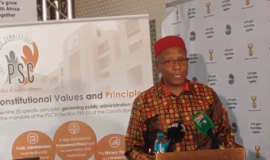
PSC Commissioner Anele Gxoyiya says the COVID-19 pandemic forced most organisations, including government, to consider alternative working arrangements in order to limit human and physical interaction.

“This resulted in the introduction of hybrid workspaces and the working from home (WFH) option that was new for most employees, as only a few private companies offered this option pre-COVID-19,” Gxoyiya said at a briefing in Pretoria on Monday.

The study focused on the shutdown period from March 2020 and the subsequent lockdown levels as a result of the COVID-19 pandemic.

Gxoyiya explained that the purpose of the study was to investigate the actual and perceived impact that the introduction of hybrid work and work from home arrangements had on service delivery in the public service in selected departments, with a view to formulate recommendations that could assist the public service to adapt.

He said the study focused on six service delivery departments/institutions in the public service, which are Education, Employment and Labour, Health, South African Social Security Agency, Home Affairs and the South African Police Service.

The report of the study makes the following recommendations:

•           The Department of Public Service and Administration (DPSA) should benchmark with other countries to determine how the hybrid work arrangement was managed during the pandemic and how it is being taken forward as a basis to review relevant legislation, regulations, directives, policies and conditions of service for different categories of occupations and/or employees.

•           The public service, led by the DPSA, National Treasury and the Department of Communications and Digital Services, must take the lead in digitising government operations and prioritising access to tools of trade that will enable the effective implementation of hybrid work arrangements, where feasible.

•           Departments, in collaboration with the National School of Government, should incorporate continuous training programmes on new technologies that are necessary to facilitate remote work arrangements, online collaboration and remote access to centralised systems as well as other emerging innovations for employees to stay abreast of the new developments.

•           National Treasury, in collaboration with departments such as the DPSA and  Public Works and Infrastructure, must conduct a cost-benefit analysis of implementing hybrid work arrangements for selected non-essential service departments in order to identify possible cost-saving measures and possible once-off cost drivers as a basis to generate resources to fund critical areas of need, including the rapid adoption of technology-enabled solutions and provision of other essential services to the public.  

Gxoyiya noted that the findings of the study suggest that existing primary legislation and policies were and are still silent on the practice of working from home or hybrid work arrangements.

“During the lockdown period, the gap had to be addressed through the passing of new regulations, directions and guidelines to enable departments to put measures in place to comply with the COVID-19 regulations whilst still ensuring work continuity.

“The study documents a combination of positive and negative practices/experiences, including notable innovative measures that were put in place by public service departments, as well as the commitment of many employees who put their lives at risk in order to provide services to the public,” Gxoyiya said.

Gxoyiya said there were challenges noted with regard to the implementation of the hybrid work arrangement which included, amongst others, capacity constraints; additional expenses that were not budgeted for; inaccessibility of some service sites when some staff members tested positive for COVID-19; inconsistent practices in granting employees permission to work from home between and within departments, and lack of appropriate tools of trade for some employees.

“Performance was managed differently according to the different departments and in some instances, it varied within the different units in the respective departments,” he said. – SAnews.gov.za

Edwin
Mon, 03/11/2024 – 13:16

316 views

The Public Service Commission (PSC) has completed a study on the impact of hybrid work arrangements on service delivery in the public service.

PSC Commissioner Anele Gxoyiya says the COVID-19 pandemic forced most organisations, including government, to consider alternative working arrangements in order to limit human and physical interaction.

“This resulted in the introduction of hybrid workspaces and the working from home (WFH) option that was new for most employees, as only a few private companies offered this option pre-COVID-19,” Gxoyiya said at a briefing in Pretoria on Monday.

The study focused on the shutdown period from March 2020 and the subsequent lockdown levels as a result of the COVID-19 pandemic.

Gxoyiya explained that the purpose of the study was to investigate the actual and perceived impact that the introduction of hybrid work and work from home arrangements had on service delivery in the public service in selected departments, with a view to formulate recommendations that could assist the public service to adapt.

He said the study focused on six service delivery departments/institutions in the public service, which are Education, Employment and Labour, Health, South African Social Security Agency, Home Affairs and the South African Police Service.

The report of the study makes the following recommendations:

•           The Department of Public Service and Administration (DPSA) should benchmark with other countries to determine how the hybrid work arrangement was managed during the pandemic and how it is being taken forward as a basis to review relevant legislation, regulations, directives, policies and conditions of service for different categories of occupations and/or employees.

•           The public service, led by the DPSA, National Treasury and the Department of Communications and Digital Services, must take the lead in digitising government operations and prioritising access to tools of trade that will enable the effective implementation of hybrid work arrangements, where feasible.

•           Departments, in collaboration with the National School of Government, should incorporate continuous training programmes on new technologies that are necessary to facilitate remote work arrangements, online collaboration and remote access to centralised systems as well as other emerging innovations for employees to stay abreast of the new developments.

•           National Treasury, in collaboration with departments such as the DPSA and  Public Works and Infrastructure, must conduct a cost-benefit analysis of implementing hybrid work arrangements for selected non-essential service departments in order to identify possible cost-saving measures and possible once-off cost drivers as a basis to generate resources to fund critical areas of need, including the rapid adoption of technology-enabled solutions and provision of other essential services to the public.  

Gxoyiya noted that the findings of the study suggest that existing primary legislation and policies were and are still silent on the practice of working from home or hybrid work arrangements.

“During the lockdown period, the gap had to be addressed through the passing of new regulations, directions and guidelines to enable departments to put measures in place to comply with the COVID-19 regulations whilst still ensuring work continuity.

“The study documents a combination of positive and negative practices/experiences, including notable innovative measures that were put in place by public service departments, as well as the commitment of many employees who put their lives at risk in order to provide services to the public,” Gxoyiya said.

Gxoyiya said there were challenges noted with regard to the implementation of the hybrid work arrangement which included, amongst others, capacity constraints; additional expenses that were not budgeted for; inaccessibility of some service sites when some staff members tested positive for COVID-19; inconsistent practices in granting employees permission to work from home between and within departments, and lack of appropriate tools of trade for some employees.

“Performance was managed differently according to the different departments and in some instances, it varied within the different units in the respective departments,” he said. – SAnews.gov.za

Read More at the Source

Share this:

  • Share on X (Opens in new window) X
  • Share on Facebook (Opens in new window) Facebook
  • Print (Opens in new window) Print
  • Email a link to a friend (Opens in new window) Email
  • Share on LinkedIn (Opens in new window) LinkedIn
  • Share on Tumblr (Opens in new window) Tumblr
  • Share on WhatsApp (Opens in new window) WhatsApp
  • Share on Mastodon (Opens in new window) Mastodon
Category: NewsTag: 2024, African, continuity, critical, digital, Education, Government, health, infrastructure, new, Pretoria, SA News, solutions, study, Technology

If you feel strongly about this article then feel free to send MyZA a ‘Letter to the Editor’ using the submission form below:


Letter to the Editor

This field is for validation purposes and should be left unchanged.
If this is in response to an article please include that article title here or as the lead in for the first paragraph of your Letter below.

Separate tags with commas

Localise your letter by naming the city your words are about. Add relevant words describing your subject. Single comma separated words of no more than 5
Your Name(Required)
Your Name will be linked to the website below.
Your personal, business or social media web site
Choose NO to not set up a user account on MyZA. User Accounts will allow you to submit letters under your own Author Name

3 Latest Letters to the Editor:

  • Older Persons Grants Land Today — No Need to Queue at Dawn

    Dear Editor, Older Persons grants are paid today, 30 October, under SASSA’s revised November payment schedule — with disability grants on Monday 2 November, children’s grants on Tuesday 3 November, and grants under review on Thursday 5 November. Two things every beneficiary should know. First, grant money does not expire on payment day. It stays…

    30 October 2026
  • November Grants Pay Early – No Need to Queue at Dawn

    Dear Editor, I run SAGrant (sagrant.co.za), a free resource helping South Africans navigate SASSA grants. November grants pay earlier than usual. Older Persons grants are paid on Friday 30 October, Disability grants on 2 November, and Child Support and other grants on 3 November. Grants still under review are paid on 5 November. The money…

    27 October 2026
  • NSFAS 2027 applications close on 31 October — SASSA households, apply now

    Dear Editor, I run SAGrant (sagrant.co.za), a free resource helping South Africans navigate SASSA grants. NSFAS applications for the 2027 academic year close on Friday 31 October 2026, and no extension is expected. If your household receives a SASSA grant, your child already passes the NSFAS financial eligibility test — but they still have to…

    25 October 2026

About Guest

Previous Post:Why a farmer is riding from Zimbabwe to Windhoek on a horse
Next Post:Musiquelaine SA Unveils a New Era of Empowering Youth Through Music Education and Cultural Exchange

Reader Interactions

Comments

  1. dez bonbon

    29 August 2026 at 3:09 pm

    What do you call an Afrikaans guy that squeezes chickens?

    Hendrik.

  2. Sky Bully

    25 August 2026 at 3:28 pm

    Bra / Bru – friend. This term is commonly used to call a friend, pal or buddy.

Copyright © 2026 · MyZA · All Rights Reserved · Powered by Stratlec Online