• Skip to main content
  • Skip to header right navigation
  • Skip to after header navigation
  • Skip to site footer
MyZA

MyZA

News, Directory, Events and Other Stuff

  • Social Media
  • Sport
  • World News
  • Home
  • Submit News
  • Directory
  • Events
  • Stratlec
  • TFSA
  • News
    • APO
    • Today’s Sport News
    • Todays Social Media and Tech Headlines
    • Today’s World News
    • Today’s SA Financial News
  • Contact
You are here: Home / News / Taking stock of the sixth administration

Taking stock of the sixth administration

7 February 2024 by Guest

Taking stock of the sixth administration

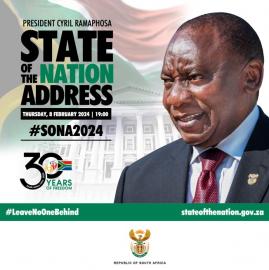
Thursday’s State of the Nation Address (SONA) to be delivered by President Cyril Ramaphosa will be the last one to be made by the sixth administration.

The President – in his capacity as Head of State and government – will deliver the annual SONA at 7pm, before a joint sitting of the National Assembly (NA) and the National Council of Provinces (NCOP).

Just as individuals usually make a list of their goals at the start of each year, and the steps they need to take to attain them, the SONA similarly sets out government’s key policy objectives as well as deliverables for the year ahead.

The President is expected to reflect on the gains made and the areas that still need attention since the last SONA.

However, having been inaugurated as President on 25 May 2019, President Ramaphosa is also likely to look back on the term of his administration.

According to the Presidency, this administration “took office with a mandate to grow the economy, create employment and reduce poverty.” It was also tasked with putting an end to corruption as well as “restoring the integrity and capability of public institutions.”

Government has over the years made progress in improving the lives of those within the borders of South Africa.

Advancements have been made in the key priorities of growing the economy and job creation, building better lives, making communities safer and fighting crime.

Over the years, irrespective of the administration at the helm, an inclusive economy in which all South Africans can partake in, has and continues to be a top issue for government.

Fixing the economy and load shedding

In order to grow the economy, reliable energy supply is essential and energy security is cited in the country’s Economic Reconstruction and Recovery Plan (ERRP). In July 2022, government launched the Energy Action Plan (EAP). The EAP is a set of steps to be taken to address load shedding.

Government has amended Schedule 2 of the Electricity Regulation Act to remove the licencing requirement for generation projects to accelerate private investment.

By September 2023, more than 100 projects were at various stages of development, representing over 10 000 megawatts of new generation capacity and over R200 billion in private sector investment.

Other steps taken to reform the electricity sector include the tabling of the Electricity Regulation Amendment Bill in Parliament.

In addition, progress continues to be made towards the unbundling of Eskom, with the newly established National Transmission Company of South Africa (NTCSA) obtaining its operating, trading, and import and export licences from the National Energy Regulator of South Africa in September 2023, allowing the company to operate independently from the power utility. This as government works to separate Eskom into the Generation, Distribution and Transmission entities. Last month, Eskom announced the appointment of the National Transmission Company of South Africa board.

This is one of the most important pillars of Eskom’s legal separation which will “create a level playing field to enable competition in electricity generation, as a key step towards energy security,” noted the ‘Leave No One Behind 2024 – A Five-Year Review’, document released by the Presidency earlier this week.

The sixth administration also oversaw the appointment of Minister in the Presidency for Electricity, Dr Kgosientsho Ramokgopa, in March last year as part of efforts to address power cuts and to expedite government’s work to ensure the full implementation of the EAP.

At a recent media briefing on the implementation of the plan, Ramokgopa said that work continues to address partial load losses – that is, when Eskom’s generating units do not produce the full capacity, they were intended to.

In November 2023, South Africa received the first consignment of 450 gasoline generators donated by the People’s Republic of China. The donation formed part of the Technical Assistance Programme that was entered into in August 2023 during China’s Head of State Visit to South Africa.

Jobs and investment

The ERRP was government’s response to the severe health, social and economic effects of the dreaded COVID-19 pandemic.

Announced in 2020, the plan was founded on engagements among social partners, including government, labour, business and community-based organisations.

October 2023 marked three years since government embarked on the plan, which outlined the actions to rebuild the economy and create jobs in the wake of the pandemic.

The government has put in place the Presidential Youth Employment Initiative (PYEI). Through the initiative announced in 2020, at least 135 000 earning opportunities were secured by young people.

On Tuesday, the President held a presidential youth engagement in Cape Town reflecting on the three years since the initiation of the Presidential Employment Stimulus (PES) and PYEI.

According to the Presidency, the PES and PYEI programmes have “collectively generated over 1.8 million job opportunities and provided livelihood support, predominantly benefiting young individuals”.

The sixth administration also oversaw the successful raising of the R1.2 trillion worth of investments over five years that President Ramaphosa announced in 2018.

Held annually over the past five years, the South Africa Investment Conference (SAIC) surpassed the initial R1.2 trillion target to reach R1.51 trillion in investment pledges. To date, there are concrete results of how the pledges made at the conference are changing lives and creating employment.

The review document notes that of the commitments made, over R500 billion has already flowed into the economy.

Having made pledges continually at the SAIC, Procter &Gamble in November 2023 launched a state-of-the-art production line of Pampers Premium Care which the President attended in Kempton Park in Ekurhuleni.

Another company which pledged R135 million at last year’s SAIC is also making good on its commitment.

In October 2023, energy company, Ener-G-Africa, launched an energy-efficient cook stove manufacturing line in Paarl, and expanded its solar panel production line from 15MW to 500MW capacity.

The company pledged R135 million in the production of small solar PV panels and solar cooking appliances at their women-led production facility in Cape Town.

AfCFTA

President Ramaphosa also oversaw the launch of the African Continental Free Trade Area (AfCFTA) as Chairperson of the African Union, which is currently the largest free trade area in the world. The AfCFTA which entered into force in May 2019, is expected to boost trade and economic growth on the continent.

Trading under the AfCFTA regime commenced January 2021 and last month South Africa practically realised the AfCFTA agreement. This as the President officiated the launch of the first export shipment of goods produced by South African companies destined for other African countries from KwaZulu-Natal’s Durban port.

Better lives and education

On building better lives, the current administration introduced the National Minimum Wage (NMW) for the first time in the country’s history, guaranteeing a minimum floor below which no worker may be paid with the coming into effect of the minimum wage on 1 January 2019.

The President had announced its coming into effect in December 2018.

Back in 2019, the minimum wage was set at R20 an hour and has increased over the years. Currently standing at R25,42 the minimum wage will increase to R27,58 for each ordinary hour worked with effect from 1 March 2024.

Click here for more on the “National minimum wage increases”.

To ensure healthcare for all, Parliament passed the National Health Insurance (NHI) Bill last year after it was introduced in 2019. The Bill aims to provide free health care at the point of care for all South Africans. In preparation for the NHI, Health Patient Registration Systems have been installed in over 3 200 facilities.

Meanwhile, social grants for people most affected by COVID-19 were expanded, including the Special Social Relief of Distress (SRD) Grant, which reached around 11 million unemployed people.

On the education front, no-fee schools which government introduced in 2007 have continued to ensure that children get access to schooling. To date, the number of learners that are not required to pay school fees increased from 71% to 75% in 2021.

In addition, the latest matric pass rate, at 82.9%, is the highest ever, up from 78% ten years ago. Learners from no-fee paying schools accounted for more than 65% of the total bachelor passes obtained. The percentage of learners who completed 12 years of education rose from 45% in 2008 to 62% in 2022.

Safer communities

The sixth administration has increased the number of police officers including the recruitment of  20 000 police trainees and  an additional 4 000 public order policing members in 2022 and 2023.

In addition, 20 specialised South African Police Service Economic Infrastructure Task Teams have been established to work with business, private security and state-owned enterprises to tackle illegal mining, construction site extortion, cable theft and vandalism of economic infrastructure.

The review noted that by November 2023, the teams had made over 4 000 arrests for damage of critical infrastructure, 70 arrests for extortion at construction sites and over 3 000 arrests for illegal mining, and confiscated significant quantities of copper cable, rail tracks and other metals.

Government also launched the Border Management Authority as the third armed force to manage and secure the country’s borders, providing a vital link in government’s efforts to harness the benefits of the African Continental Free Trade Area.

On tackling gender-based violence and femicide(GBV), he National Strategic Plan on Gender-based Violence was developed, together with civil society, as a society-wide response to this national emergency. Around R21 billion has been dedicated over the medium term to the implementation of the six pillars of the plan, including the economic empowerment of women.

Meanwhile, the National Prosecuting Authority (NPA) has achieved an average conviction rate of 94% in femicide prosecutions and 75% in sexual offences prosecutions since 2019.

In addition, the GBVF Response Fund 1 was launched, which raised R200 million from the private sector for community-based organisations combating GBV. In the first year of the Fund’s operation, 53 community-based organisations were funded, reaching 280 000 participants.

Fighting corruption

The NPA Investigating Directorate was established to prosecute state capture and other significant corruption cases.

To date, the Investigating Directorate has taken 34 state capture and corruption cases to court, involving 203 accused persons and 65 accused entities. The NPA has also secured the conviction of over 500 government officials and nearly 800 in the private sector on offences related to corruption since 2019.

In addition, a SIU Special Tribunal was appointed to expedite civil claims against corrupt individuals and the recovery of stolen funds. Since its establishment, it has recovered over R8.6 billion.

As the country prepares for its 30 years of freedom celebration, the sixth administration has certainly done its bit in a challenging environment. –SAnews.gov.za

Neo
Wed, 02/07/2024 – 15:11

268 views

Thursday’s State of the Nation Address (SONA) to be delivered by President Cyril Ramaphosa will be the last one to be made by the sixth administration.

The President – in his capacity as Head of State and government – will deliver the annual SONA at 7pm, before a joint sitting of the National Assembly (NA) and the National Council of Provinces (NCOP).

Just as individuals usually design a list of their goals at the start of each year, and the steps they need to grasp to attain them, the SONA similarly sets out government’s key policy objectives as well as deliverables for the year ahead.

The President is expected to reflect on the gains made and the areas that still need attention since the last SONA.

However, having been inaugurated as President on 25 May 2019, President Ramaphosa is also likely to study back on the term of his administration.

According to the Presidency, this administration “took office with a mandate to grow the economy, create employment and reduce poverty.” It was also tasked with putting an finish to corruption as well as “restoring the integrity and capability of public institutions.”

Government has over the years made progress in improving the lives of those within the borders of South Africa.

Advancements gain been made in the key priorities of growing the economy and job creation, building better lives, making communities safer and fighting crime.

Over the years, irrespective of the administration at the helm, an inclusive economy in which every South Africans can partake in, has and continues to be a top issue for government.

Fixing the economy and load shedding

In order to grow the economy, reliable energy supply is essential and energy security is cited in the country’s Economic Reconstruction and Recovery Location (ERRP). In July 2022, government launched the Energy Action Position (EAP). The EAP is a set of steps to be taken to address load shedding.

Government has amended Schedule 2 of the Electricity Regulation Act to remove the licencing requirement for generation projects to accelerate private investment.

By September 2023, more than 100 projects were at various stages of development, representing over 10 000 megawatts of recent generation capacity and over R200 billion in private sector investment.

Other steps taken to reform the electricity sector include the tabling of the Electricity Regulation Amendment Bill in Parliament.

In addition, progress continues to be made towards the unbundling of Eskom, with the newly established National Transmission Company of South Africa (NTCSA) obtaining its operating, trading, and import and export licences from the National Energy Regulator of South Africa in September 2023, allowing the company to operate independently from the power utility. This as government works to separate Eskom into the Generation, Distribution and Transmission entities. Last month, Eskom announced the appointment of the National Transmission Company of South Africa board.

This is one of the most necessary pillars of Eskom’s legal separation which will “create a level playing field to enable competition in electricity generation, as a key step towards energy security,” noted the ‘Leave No One Behind 2024 – A Five-Year Review’, document released by the Presidency earlier this week.

The sixth administration also oversaw the appointment of Minister in the Presidency for Electricity, Dr Kgosientsho Ramokgopa, in March last year as fraction of efforts to address power cuts and to expedite government’s work to ensure the full implementation of the EAP.

At a recent media briefing on the implementation of the region, Ramokgopa said that work continues to address partial load losses – that is, when Eskom’s generating units finish not produce the full capacity, they were intended to.

In November 2023, South Africa received the first consignment of 450 gasoline generators donated by the People’s Republic of China. The donation formed section of the Technical Assistance Programme that was entered into in August 2023 during China’s Head of State Visit to South Africa.

Jobs and investment

The ERRP was government’s response to the severe health, social and economic effects of the dreaded COVID-19 pandemic.

Announced in 2020, the situation was founded on engagements among social partners, including government, labour, business and community-based organisations.

October 2023 marked three years since government embarked on the region, which outlined the actions to rebuild the economy and create jobs in the wake of the pandemic.

The government has establish in space the Presidential Youth Employment Initiative (PYEI). Through the initiative announced in 2020, at least 135 000 earning opportunities were secured by young people.

On Tuesday, the President held a presidential youth engagement in Cape Town reflecting on the three years since the initiation of the Presidential Employment Stimulus (PES) and PYEI.

According to the Presidency, the PES and PYEI programmes acquire “collectively generated over 1.8 million job opportunities and provided livelihood support, predominantly benefiting young individuals”.

The sixth administration also oversaw the successful raising of the R1.2 trillion worth of investments over five years that President Ramaphosa announced in 2018.

Held annually over the past five years, the South Africa Investment Conference (SAIC) surpassed the initial R1.2 trillion target to reach R1.51 trillion in investment pledges. To date, there are concrete results of how the pledges made at the conference are changing lives and creating employment.

The review document notes that of the commitments made, over R500 billion has already flowed into the economy.

Having made pledges continually at the SAIC, Procter &Gamble in November 2023 launched a state-of-the-art production line of Pampers Premium Care which the President attended in Kempton Park in Ekurhuleni.

Another company which pledged R135 million at last year’s SAIC is also making qualified on its commitment.

In October 2023, energy company, Ener-G-Africa, launched an energy-efficient cook stove manufacturing line in Paarl, and expanded its solar panel production line from 15MW to 500MW capacity.

The company pledged R135 million in the production of small solar PV panels and solar cooking appliances at their women-led production facility in Cape Town.

AfCFTA

President Ramaphosa also oversaw the launch of the African Continental Free Trade Area (AfCFTA) as Chairperson of the African Union, which is currently the largest free trade area in the world. The AfCFTA which entered into force in May 2019, is expected to boost trade and economic growth on the continent.

Trading under the AfCFTA regime commenced January 2021 and last month South Africa practically realised the AfCFTA agreement. This as the President officiated the launch of the first export shipment of goods produced by South African companies destined for other African countries from KwaZulu-Natal’s Durban port.

Better lives and education

On building better lives, the current administration introduced the National Minimum Wage (NMW) for the first time in the country’s history, guaranteeing a minimum floor below which no worker may be paid with the coming into effect of the minimum wage on 1 January 2019.

The President had announced its coming into effect in December 2018.

Back in 2019, the minimum wage was set at R20 an hour and has increased over the years. Currently standing at R25,42 the minimum wage will increase to R27,58 for each ordinary hour worked with effect from 1 March 2024.

Click here for more on the “National minimum wage increases”.

To ensure healthcare for every, Parliament passed the National Health Insurance (NHI) Bill last year after it was introduced in 2019. The Bill aims to provide free health care at the point of care for every South Africans. In preparation for the NHI, Health Patient Registration Systems acquire been installed in over 3 200 facilities.

Meanwhile, social grants for people most affected by COVID-19 were expanded, including the Special Social Relief of Distress (SRD) Grant, which reached around 11 million unemployed people.

On the education front, no-fee schools which government introduced in 2007 maintain continued to ensure that kids acquire access to schooling. To date, the number of learners that are not required to pay school fees increased from 71% to 75% in 2021.

In addition, the latest matric pass rate, at 82.9%, is the highest ever, up from 78% ten years ago. Learners from no-fee paying schools accounted for more than 65% of the total bachelor passes obtained. The percentage of learners who completed 12 years of education rose from 45% in 2008 to 62% in 2022.

Safer communities

The sixth administration has increased the number of police officers including the recruitment of  20 000 police trainees and  an additional 4 000 public order policing members in 2022 and 2023.

In addition, 20 specialised South African Police Service Economic Infrastructure Task Teams gain been established to work with business, private security and state-owned enterprises to tackle illegal mining, construction site extortion, cable theft and vandalism of economic infrastructure.

The review noted that by November 2023, the teams had made over 4 000 arrests for damage of critical infrastructure, 70 arrests for extortion at construction sites and over 3 000 arrests for illegal mining, and confiscated significant quantities of copper cable, rail tracks and other metals.

Government also launched the Border Management Authority as the third armed force to manage and secure the country’s borders, providing a vital link in government’s efforts to harness the benefits of the African Continental Free Trade Area.

On tackling gender-based violence and femicide(GBV), he National Strategic Position on Gender-based Violence was developed, together with civil society, as a society-wide response to this national emergency. Around R21 billion has been dedicated over the medium term to the implementation of the six pillars of the situation, including the economic empowerment of women.

Meanwhile, the National Prosecuting Authority (NPA) has achieved an average conviction rate of 94% in femicide prosecutions and 75% in sexual offences prosecutions since 2019.

In addition, the GBVF Response Fund 1 was launched, which raised R200 million from the private sector for community-based organisations combating GBV. In the first year of the Fund’s operation, 53 community-based organisations were funded, reaching 280 000 participants.

Fighting corruption

The NPA Investigating Directorate was established to prosecute state capture and other significant corruption cases.

To date, the Investigating Directorate has taken 34 state capture and corruption cases to court, involving 203 accused persons and 65 accused entities. The NPA has also secured the conviction of over 500 government officials and nearly 800 in the private sector on offences related to corruption since 2019.

In addition, a SIU Special Tribunal was appointed to expedite civil claims against corrupt individuals and the recovery of stolen funds. Since its establishment, it has recovered over R8.6 billion.

As the country prepares for its 30 years of freedom celebration, the sixth administration has certainly done its bit in a challenging environment. –SAnews.gov.za

Read More at the Source

Share this:

  • Share on X (Opens in new window) X
  • Share on Facebook (Opens in new window) Facebook
  • Print (Opens in new window) Print
  • Email a link to a friend (Opens in new window) Email
  • Share on LinkedIn (Opens in new window) LinkedIn
  • Share on Tumblr (Opens in new window) Tumblr
  • Share on WhatsApp (Opens in new window) WhatsApp
  • Share on Mastodon (Opens in new window) Mastodon
Category: NewsTag: 2024, Africa, African, agreement, business, Cape Town, critical, distribution, Durban, Education, Ekurhuleni, Energy, Environment, Eskom, GBV, Government, head, health, health insurance, infrastructure, Insurance, KwaZulu-Natal, Minimum Wage, mining, new, NHI, office, ONE, Paarl, Parliament, Ramaphosa, Registration, SA News, Social Grants, Solar, South Africa

If you feel strongly about this article then feel free to send MyZA a ‘Letter to the Editor’ using the submission form below:


Letter to the Editor

This field is for validation purposes and should be left unchanged.
If this is in response to an article please include that article title here or as the lead in for the first paragraph of your Letter below.

Separate tags with commas

Localise your letter by naming the city your words are about. Add relevant words describing your subject. Single comma separated words of no more than 5
Your Name(Required)
Your Name will be linked to the website below.
Your personal, business or social media web site
Choose NO to not set up a user account on MyZA. User Accounts will allow you to submit letters under your own Author Name

3 Latest Letters to the Editor:

  • Fun South African fact

    Dear Editor Fun South African fact: towns like Franschhoek and Stellenbosch are home to world-class wine farms set in stunning, scenic surroundings. Regards Aressa Smith In Response to/From: Luxury Properties Seized in New Lottery Crackdown

    27 January 2026
  • Condolences on the Passing of Lusanda Dumke

    Statement by Leander Kruger MPL – DA Buffalo City Constituency Leader: The Democratic Alliance in Buffalo City Metropolitan Municipality mourns the passing of Springbok Women’s rugby player and Mdantsane trailblazer, Lusanda Dumke, who lost her battle with cancer at the age of 28. South Africa has lost an exceptional athlete, a leader, and a source…

    17 December 2025
  • Rape Kits Delivered, But…

    Statement by Nicholas Gotsell MP – DA NCOP Member on Security & Justice: The DA can confirm that 2 840 rape kits arrived in Cape Town on Monday, following sustained DA oversight and pressure after multiple police stations across the Western Cape were found to be without this critical forensic evidence tool. While this delivery…

    17 December 2025

About Guest

Previous Post:Two changes to Scotland U20 starting XV for France clash
Next Post:Kick off the weekend in style with Boschendal’s novel Friday night offerings

Reader Interactions

Comments

  1. Bleach

    8 February 2024 at 7:29 am

    Did you knowthis about South Africa? South Africa celebrates its annual Heritage Day on 24 September. On this day, South Africans secure together to celebrate their diverse cultures, traditions and beliefs. You’ll most likely find people enjoying a braai (barbecue) and dressed in traditional garb.

  2. desert haze

    8 February 2024 at 7:27 am

    Fun South African Fact: The Bloukrans Bridge, Western Cape, is the highest commercial natural bungee jump in the world.

Copyright © 2026 · MyZA · All Rights Reserved · Powered by Reach Trust