• Skip to main content
  • Skip to header right navigation
  • Skip to after header navigation
  • Skip to site footer
MyZA

MyZA

News, Directory, Events and Other Stuff

  • Social Media
  • Sport
  • World News
  • Home
  • Submit News
  • Directory
  • Events
  • Stratlec
  • TFSA
  • News
    • APO
    • Today’s Sport News
    • Todays Social Media and Tech Headlines
    • Today’s World News
    • Today’s SA Financial News
  • Contact
You are here: Home / News / Afrobarometer Connects Early-Career Researchers With Established Scholars to Build Analytical Capacity in Africa

Afrobarometer Connects Early-Career Researchers With Established Scholars to Build Analytical Capacity in Africa

2 December 2024 by Guest
Afrobarometer

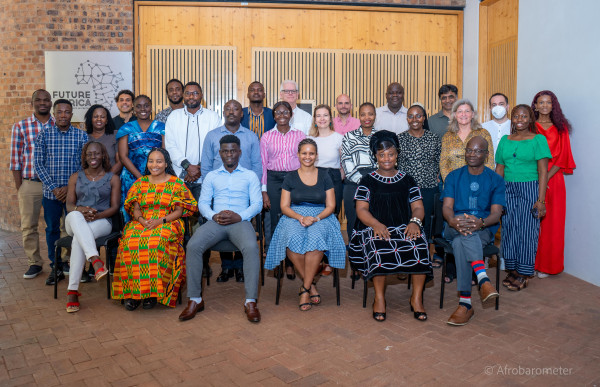
Afrobarometer (www.Afrobarometer.org) held its inaugural Emerging Scholars Workshop in November, bringing together early-career researchers and established scholars to enhance analytical skills and support the next generation of African researchers. This initiative aligns with Afrobarometer’s objective of strengthening the continent’s research ecosystem.

The workshop, held at the University of Pretoria’s Future Africa campus, brought together 12 emerging scholars – half of them women – representing nine countries: Botswana, Benin, Cameroon, Ghana, Kenya, Malawi, Nigeria, South Africa, and Uganda.

Participants presented research papers covering diverse topics, received feedback from their mentors and peers, and engaged in professional development sessions designed to propel their academic and professional growth.

According to Jason Owen, Afrobarometer capacity building manager (advanced track), the workshop is in line with Afrobarometer’s commitment to providing professional development opportunities for young African researchers.

“The emerging scholars that attended the workshop received detailed comments on their research from a panel of experienced academic mentors and peers,” he said. “The aim was to sharpen their analytical skills and to enable them to publish high-quality research using Afrobarometer data. We hope this type of workshop will foster a growing research and mentoring network that helps to build analytical capacity across Africa.”

The workshop also facilitated networking and collaboration. Nicole Beardsworth, a lecturer at the University of the Witwatersrand, highlighted the value of such gatherings. “PhD journeys can be isolating and lonely, but opportunities like the Afrobarometer Emerging Scholars Workshop provide a window for young scholars from around the continent to meet each other, find commonalities, forge collaborations, and create community,” she said.

A section of participants also noted that the workshop provided them with a transformative platform to engage with established academics, gain constructive feedback, enhance research skills, and build professional networks critical for advancing their academic and career aspirations.

“I was attracted to this workshop because it provides a unique opportunity to engage with seasoned scholars, participate in sophisticated research discussions, and develop essential skills for my professional growth,” said Mbiydzenyuy Courage Sevidzem from the University of Bamenda in Cameroon.

Over the past two and half decades, Afrobarometer has trained hundreds of young researchers, civil society activists, journalists, and parliamentarians through several capacity- building initiatives, including French- and English-language summer schools, thematic workshops, mentorships, university outreach initiatives, and staff development fellowships.

Distributed by APO Group on behalf of Afrobarometer.

For more information, please contact:
Daniel Iberi
Communications coordinator for East Africa
Email: diberi@afrobarometer.org
Telephone: +254 725 6744 57
Visit us online at www.Afrobarometer.org.

Follow us:
Facebook: Afrobarometer
Twitter: @ Afrobarometer
YouTube: @ Afrobarometer
Follow our releases on #VoicesAfrica. 

About Afrobarometer:
Afrobarometer (AB) is a trusted source of high-quality data and analysis on what Africans are thinking. With an unmatched track record of 388,000+ interviews in 42 countries, representing the views of 80% of the African population, AB is leading the charge to bridge the continent’s data gap. AB data inform many global indices, such as the Ibrahim Index of African Governance, Transparency International’s Global Corruption Barometer, and the World Bank’s Worldwide Governance Indicators. The data are also used for country risk analyses and by credit rating and forecasting agencies such as the Economist Intelligence Unit. All AB data sets are publicly available on the website (www.Afrobarometer.org) and may be analysed free of charge using AB’s online data analysis tool (https://apo-opa.co/3Vf0pB6).

Media files
Afrobarometer
Download logo

Afrobarometer held its inaugural Emerging Scholars Workshop in November, bringing together early-career researchers and established scholars to enhance analytical skills and support the next generation of African researchers. This initiative aligns with Afrobarometer’s objective of strengthening the continent’s research ecosystem.

The workshop, held at the University of Pretoria’s Future Africa campus, brought together 12 emerging scholars – half of them women – representing nine countries: Botswana, Benin, Cameroon, Ghana, Kenya, Malawi, Nigeria, South Africa, and Uganda.

Participants presented research papers covering diverse topics, received feedback from their mentors and peers, and engaged in professional development sessions designed to propel their academic and professional growth.

According to Jason Owen, Afrobarometer capacity building manager (advanced track), the workshop is in line with Afrobarometer’s commitment to providing professional development opportunities for young African researchers.

“The emerging scholars that attended the workshop received detailed comments on their research from a panel of experienced academic mentors and peers,” he said. “The aim was to sharpen their analytical skills and to enable them to publish high-quality research using Afrobarometer data. We hope this type of workshop will foster a growing research and mentoring network that helps to build analytical capacity across Africa.”

The workshop also facilitated networking and collaboration. Nicole Beardsworth, a lecturer at the University of the Witwatersrand, highlighted the value of such gatherings. “PhD journeys can be isolating and lonely, but opportunities like the Afrobarometer Emerging Scholars Workshop provide a window for young scholars from around the continent to meet each other, find commonalities, forge collaborations, and create community,” she said.

A section of participants also noted that the workshop provided them with a transformative platform to engage with established academics, gain constructive feedback, enhance research skills, and build professional networks critical for advancing their academic and career aspirations.

“I was attracted to this workshop because it provides a unique opportunity to engage with seasoned scholars, participate in sophisticated research discussions, and develop essential skills for my professional growth,” said Mbiydzenyuy Courage Sevidzem from the University of Bamenda in Cameroon.

Over the past two and half decades, Afrobarometer has trained hundreds of young researchers, civil society activists, journalists, and parliamentarians through several capacity- building initiatives, including French- and English-language summer schools, thematic workshops, mentorships, university outreach initiatives, and staff development fellowships.

Per Kind Favour of APO

Africa Fact: Cheques are not quite as new an invention as we were led to believe. In the tenth century, an Arab geographer, Ibn Haukal, visited a fringe region of Ancient Ghana. Writing in 951 AD, he told of a cheque for 42,000 golden dinars written to a merchant in the city of Audoghast by his partner in Sidjilmessa.

Share this:

  • Share on X (Opens in new window) X
  • Share on Facebook (Opens in new window) Facebook
  • Print (Opens in new window) Print
  • Email a link to a friend (Opens in new window) Email
  • Share on LinkedIn (Opens in new window) LinkedIn
  • Share on Tumblr (Opens in new window) Tumblr
  • Share on WhatsApp (Opens in new window) WhatsApp
  • Share on Mastodon (Opens in new window) Mastodon
Category: NewsTag: Africa, African, APO, Civil Society, communications, critical, data, Facebook, Ghana, global, growth, Kenya, Mentoring, Nigeria, Pretoria, South Africa, Twitter, Uganda, Women, YouTube

If you feel strongly about this article then feel free to send MyZA a ‘Letter to the Editor’ using the submission form below:


Letter to the Editor

This field is for validation purposes and should be left unchanged.
If this is in response to an article please include that article title here or as the lead in for the first paragraph of your Letter below.

Separate tags with commas

Localise your letter by naming the city your words are about. Add relevant words describing your subject. Single comma separated words of no more than 5
Your Name(Required)
Your Name will be linked to the website below.
Your personal, business or social media web site
Choose NO to not set up a user account on MyZA. User Accounts will allow you to submit letters under your own Author Name

3 Latest Letters to the Editor:

  • Re: R8.5 Million Lotto Winner Claims Prize in Gqeberha

    Dear Editor This is indeed an exciting story for the community. Congratulations to the winner and may this bring positive change to Nomathamsanqa. As someone from KwaMashu, I understand the impact such winnings can have on township communities. Wishing the grandfather all the best. Regards Themba Zulu In Response to/From: R8.5 Million Lotto Winner Claims…

    18 September 2026
  • Re: Minister Tolashe and Postbank Black Cards

    Dear Editor I appreciate the Minister’s assurance regarding the smooth transition to Postbank Black Cards for grant beneficiaries. As a concerned citizen, I hope the government will ensure that all beneficiaries, especially elderly and vulnerable populations in areas like Soweto, receive adequate assistance during this transition period. The expansion of card replacement locations to include…

    18 September 2026
  • Lotto Winner Story

    Dear Editor This is indeed an exciting story for the community. Congratulations to the winner and may this bring positive change to Nomathamsanqa. Regards Willem Pieterse In Response to/From: R8.5 Million Lotto Winner Claims Prize in Gqeberha

    16 September 2026

About Guest

Previous Post:Five suspected ATM bombers killed in shootout with police in Emalahleni
Next Post:Funza Park: From Cherished Playground to Rubbish Dump

Reader Interactions

Comments

  1. Pepperburst

    7 September 2026 at 6:45 am

    With enough thrust, pigs, can in fact fly

  2. Impulsive Flower

    27 August 2026 at 11:22 am

    Hayibo! – wow! [Hai-bo] Derived from the Zulu word meaning “definitely not!” This word is usually expressed on its own, at the start or end of a sentence when something seems improbable.Example: “Hayibo! Ha! Ha! I can’t believe that!”

Copyright © 2026 · MyZA · All Rights Reserved · Powered by Stratlec Online