• Skip to main content
  • Skip to header right navigation
  • Skip to after header navigation
  • Skip to site footer
MyZA

MyZA

News, Directory, Events and Other Stuff

  • Social Media
  • Sport
  • World News
  • Home
  • Submit News
  • Directory
  • Events
  • Stratlec
  • TFSA
  • News
    • APO
    • Today’s Sport News
    • Todays Social Media and Tech Headlines
    • Today’s World News
    • Today’s SA Financial News
  • Contact
You are here: Home / News / No. 1 Hair is number one in haircare

No. 1 Hair is number one in haircare

26 December 2024 by Guest

No. 1 Hair is number one in haircare

By: Bongani Lukhele 

In 1993 Andrew Lebitsa, a Free State Black Industrialist, participated in an empowerment and capacity building project that he said was initiated by South Africa’s first Black President, Nelson Mandela, and New York’s first Black Mayor, David Dinkins.

The objective of the programme was to develop a pool of black corporate bank managers to equip them with skills, knowledge and information that would empower them to play a critical role in the transformation of the banking industry after the country had transitioned to democracy.

Lebitsa spent six months at the Chase Merchant Bank and Baruch College in New York honing his corporate management skills in the bank and acquiring knowledge through the college’s Executive Management Development Programme. 

At the time, little did Lebitsa know that he was bound to follow in the footsteps of the two visionary leaders and blaze his own trail, as he attests that his No.1 Hair company is the only black-owned hair braids manufacturing company in the country. 

This was made possible by the support he received from the Black Industrialists Programme of the Department of Trade, Industry and Competition (the dtic).

In line with the vision of Mandela and Dinkins, the objective of the scheme is to produce a pool of capable and successful Black Industrialists who will actively and meaningfully participate in the manufacturing industry and contribute to growing the economy, creating jobs and transform the sector in particular, and the country’s economy in general.

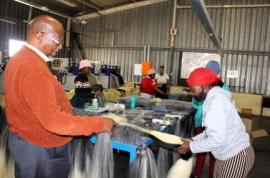
Today, No.1 Hair, which operates from the Maluti-a-Phofung Special Economic Zone (SEZ) in Harrismith, is providing employment to 60 people who are producing the synthetic hair braids, or hair extensions as they are commonly known, for both domestic and Southern African markets.

“After a long spell in the petroleum franchise and retail industries, I got into a hardware products import and distribution industry. Many of my retail clients requested me to import hair as well.  This was initially never in my mind. But after conducting a research I realised that it was a R9-billion industry in South Africa that these people were indirectly encouraging me to participate it. I decided to get into it,” recalls Lebitsa.

After bouncing off the idea with the late prominent businessperson, Don Mkhwanazi, he advised Lebitsa to consider setting up a plant and manufacture hair in South Africa, instead of importing it. 

He connected him with two South Korean businessmen who assisted him to set up the factory in the Maluti-a-Phofung SEZ. The location was an obvious choice for Lebitsa as he once worked in the zone while he was employed by the Free State Development Corporation as a property manager.

“That is how No.1 Hair was born,”he said.

R60 million state-of-the-art plant

The R60 million state-of-the-art plant was set up with assistance from the dtic and Industrial Development Corporation (IDC). 

“After a delay caused by the COVID-19 [pandemic], we eventually started the production of our brand of hair braids in January 2021. We started with black hair braids and extended our range to numerous other colours over a period of time,” said Lebitsa.

He concedes that penetrating the hair market as a black manufacturer has been and remains a steep challenge.

“Firstly, consumers of this product are used to particular famous brands that are all imported. It is not easy for them to warm up to and embrace a new, unknown product. Secondly, but more importantly; it is the problem of perception and stereotypes that one has to deal with in the industry.

“As a black manufacturer, you are already disadvantaged when approaching buyers who source products for big companies and retail stores. 

Summer season

“From not even giving you a chance to present your products to them, to doubting both your capability as a businessperson to deliver on orders, and the quality of your products. It is a big challenge. However, one order at a time we have managed to build quite [a] sizeable number of clients,” he adds.

Lebitsa’s spirit lifts when he starts speaking about the summer season that he says sparks a high demand in hair braids. To this end, he has received huge amounts of orders that will soon see all of his production lines running at full capacity.

“Despite all these market penetration challenges, we are making steady progress and continue to grow the company.  Slowly but surely, we are increasing our own market share.

“We pride ourselves in being a proudly South African company whose products and raw material are produced in the country. 

“We are hopeful that the Buy Local Campaign will instil patriotism in consumers of our products and enable them to choose locally-produced quality products instead of poor quality imports.”

He revealed that his plan is to expand his business by diversifying his product range and venturing into the manufacturing of hair care products. – SAnews.gov.za

*Bongani Lukhele is the Director: Media Relations for the dtic


DikelediM
Thu, 12/26/2024 – 07:00

76 views

By: Bongani Lukhele 

In 1993 Andrew Lebitsa, a Free State Black Industrialist, participated in an empowerment and capacity building project that he said was initiated by South Africa’s first Black President, Nelson Mandela, and New York’s first Black Mayor, David Dinkins.

The objective of the programme was to develop a pool of black corporate bank managers to equip them with skills, knowledge and information that would empower them to play a critical role in the transformation of the banking industry after the country had transitioned to democracy.

Lebitsa spent six months at the Chase Merchant Bank and Baruch College in New York honing his corporate management skills in the bank and acquiring knowledge through the college’s Executive Management Development Programme. 

At the time, little did Lebitsa know that he was bound to follow in the footsteps of the two visionary leaders and blaze his own trail, as he attests that his No.1 Hair company is the only black-owned hair braids manufacturing company in the country. 

This was made possible by the support he received from the Black Industrialists Programme of the Department of Trade, Industry and Competition (the dtic).

In line with the vision of Mandela and Dinkins, the objective of the scheme is to produce a pool of capable and successful Black Industrialists who will actively and meaningfully participate in the manufacturing industry and contribute to growing the economy, creating jobs and transform the sector in particular, and the country’s economy in general.

Today, No.1 Hair, which operates from the Maluti-a-Phofung Special Economic Zone (SEZ) in Harrismith, is providing employment to 60 people who are producing the synthetic hair braids, or hair extensions as they are commonly known, for both domestic and Southern African markets.

“After a long spell in the petroleum franchise and retail industries, I got into a hardware products import and distribution industry. Many of my retail clients requested me to import hair as well.  This was initially never in my mind. But after conducting a research I realised that it was a R9-billion industry in South Africa that these people were indirectly encouraging me to participate it. I decided to get into it,” recalls Lebitsa.

After bouncing off the idea with the late prominent businessperson, Don Mkhwanazi, he advised Lebitsa to consider setting up a plant and manufacture hair in South Africa, instead of importing it. 

He connected him with two South Korean businessmen who assisted him to set up the factory in the Maluti-a-Phofung SEZ. The location was an obvious choice for Lebitsa as he once worked in the zone while he was employed by the Free State Development Corporation as a property manager.

“That is how No.1 Hair was born,”he said.

R60 million state-of-the-art plant

The R60 million state-of-the-art plant was set up with assistance from the dtic and Industrial Development Corporation (IDC). 

“After a delay caused by the COVID-19 [pandemic], we eventually started the production of our brand of hair braids in January 2021. We started with black hair braids and extended our range to numerous other colours over a period of time,” said Lebitsa.

He concedes that penetrating the hair market as a black manufacturer has been and remains a steep challenge.

“Firstly, consumers of this product are used to particular famous brands that are all imported. It is not easy for them to warm up to and embrace a new, unknown product. Secondly, but more importantly; it is the problem of perception and stereotypes that one has to deal with in the industry.

“As a black manufacturer, you are already disadvantaged when approaching buyers who source products for big companies and retail stores. 

Summer season

“From not even giving you a chance to present your products to them, to doubting both your capability as a businessperson to deliver on orders, and the quality of your products. It is a big challenge. However, one order at a time we have managed to build quite [a] sizeable number of clients,” he adds.

Lebitsa’s spirit lifts when he starts speaking about the summer season that he says sparks a high demand in hair braids. To this end, he has received huge amounts of orders that will soon see all of his production lines running at full capacity.

“Despite all these market penetration challenges, we are making steady progress and continue to grow the company.  Slowly but surely, we are increasing our own market share.

“We pride ourselves in being a proudly South African company whose products and raw material are produced in the country. 

“We are hopeful that the Buy Local Campaign will instil patriotism in consumers of our products and enable them to choose locally-produced quality products instead of poor quality imports.”

He revealed that his plan is to expand his business by diversifying his product range and venturing into the manufacturing of hair care products. – SAnews.gov.za

*Bongani Lukhele is the Director: Media Relations for the dtic


Watch a No. 1 Hair is number one in haircare related video:

Stunning South Africa:

Have you visited MyPR?

MyPR.co.za offers free to publish press releases for your news site, blog or offline publication. Use the handy REPUBLISH facility or the Full Text RSS Feeds or just copy and paste.

Straton Electrical | Straton Solar | Straton Prepaid | Straton Plumbing | Straton IoT | Straton eBikes | BA Systems | Mbane Contracting | Reach Trust

Share this:

  • Share on X (Opens in new window) X
  • Share on Facebook (Opens in new window) Facebook
  • Print (Opens in new window) Print
  • Email a link to a friend (Opens in new window) Email
  • Share on LinkedIn (Opens in new window) LinkedIn
  • Share on Tumblr (Opens in new window) Tumblr
  • Share on WhatsApp (Opens in new window) WhatsApp
  • Share on Mastodon (Opens in new window) Mastodon
Category: NewsTag: 2024, Africa, African, Art, business, challenge, critical, demand, distribution, Franchise, Free State, IDC, Manufacturing, Market, Nelson Mandela, new, New York, ONE, production, Retail, Running, SA News, South Africa, Video

If you feel strongly about this article then feel free to send MyZA a ‘Letter to the Editor’ using the submission form below:


Letter to the Editor

This field is for validation purposes and should be left unchanged.
If this is in response to an article please include that article title here or as the lead in for the first paragraph of your Letter below.

Separate tags with commas

Localise your letter by naming the city your words are about. Add relevant words describing your subject. Single comma separated words of no more than 5
Your Name(Required)
Your Name will be linked to the website below.
Your personal, business or social media web site
Choose NO to not set up a user account on MyZA. User Accounts will allow you to submit letters under your own Author Name

3 Latest Letters to the Editor:

  • Older Persons Grants Land Today — No Need to Queue at Dawn

    Dear Editor, Older Persons grants are paid today, 30 October, under SASSA’s revised November payment schedule — with disability grants on Monday 2 November, children’s grants on Tuesday 3 November, and grants under review on Thursday 5 November. Two things every beneficiary should know. First, grant money does not expire on payment day. It stays…

    30 October 2026
  • November Grants Pay Early – No Need to Queue at Dawn

    Dear Editor, I run SAGrant (sagrant.co.za), a free resource helping South Africans navigate SASSA grants. November grants pay earlier than usual. Older Persons grants are paid on Friday 30 October, Disability grants on 2 November, and Child Support and other grants on 3 November. Grants still under review are paid on 5 November. The money…

    27 October 2026
  • NSFAS 2027 applications close on 31 October — SASSA households, apply now

    Dear Editor, I run SAGrant (sagrant.co.za), a free resource helping South Africans navigate SASSA grants. NSFAS applications for the 2027 academic year close on Friday 31 October 2026, and no extension is expected. If your household receives a SASSA grant, your child already passes the NSFAS financial eligibility test — but they still have to…

    25 October 2026

About Guest

Previous Post:In 2025, HH Must Stop Christopher Mundia’s Corruption in State House
Next Post:ICC Congratulates Pycroft on 100-Test Landmark

Reader Interactions

Comments

  1. Stacker of Wheat

    2 September 2026 at 8:16 pm

    Eina! – ouch! [Ay-na] Usually expressed when someone experiences a sharp pain of some sort.

  2. manly

    25 August 2026 at 2:12 pm

    Uzbekistan: You have two cows. They are probably less bored than you.

Copyright © 2026 · MyZA · All Rights Reserved · Powered by Stratlec Online