
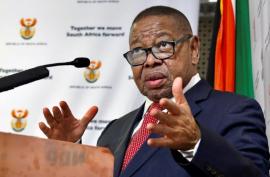
The Minister of Science, Technology and Innovation, Professor Blade Nzimande, met with Mandeep Gill, the Undersecretary and Special Envoy of the United Nations Secretary-General for Digital and Emerging Technologies, on Wednesday.
The meeting primarily focused on South Africa’s role in implementing the UN’s Global Digital Compact (GDC) and the opportunities this presents for developing the country’s digital economy.
The GDC forms part of the UN’s Pact for the Future, which was adopted during the Summit of the Future in 2024.
The Department of Science, Technology and Innovation (DSTI) said this compact was a comprehensive framework for global digital cooperation and governance, particularly regarding artificial intelligence.
Its primary objective is to harness the potential of digital technology for the benefit of humanity while also addressing the challenges and risks associated with it.
During the meeting with Gill, Nzimande stressed the importance of digital and emerging technologies.
“As one of the African countries with the largest public science systems, South Africa recognises the importance of developing our capabilities in digital and emerging technologies such as artificial intelligence and their potential to help in the development of solutions for some of the challenges of our time such as inequality, climate change and environmental degradation, pandemics and transnational conflict,” the Minister said.
He believes the current geopolitical moment required a stronger and consistent commitment to international collaboration, the free exchange of scientific knowledge, and multilateralism.
“These, we believe present us with a better chance at a sustainable future for humanity. It is for this reason that meaningful partnerships and the development of our capabilities in the digital economy are some of the strategic pillars of our country’s Decadal Plan for Science, Technology, and Innovation,” he stated.
Outlining the potential benefits for South Africa’s participation in the GDC, the Minister said South Africa’s participation in the GDC presents the country with several unique opportunities to address national priorities and position it as a leader in regional digital transformation.
“We believe our participation in the GDC can further enhance our capabilities in such areas as infrastructure development, digital skills enhancement, digital entrepreneurship and innovation support, digital inclusion, data governance and privacy and human rights protection,” Nzimande stressed.
Nzimande used the meeting to update Gill on the department’s artificial intelligence (AI) initiatives, which include the Foundation Digital Capabilities Research (FDCR).
One of the initiatives within the FDCR platform that is AI-focused is the Centre for Artificial Intelligence Research (CAIR).
There is also the South African Research Chairs Initiative (SARChi), which currently includes Research Chairs in information and communication technology (ICT) development, with two specifically focused on AI.
All the DSTI’s AI and digital economy initiatives are designed to support the objectives of South Africa’s Digital Economy Masterplan, which is the responsibility of the Department of Communication and Digital Technologies. – SAnews.gov.za
Watch a Nzimande, UN Secretary-General’s Envoy on Technology meet on Global Digital Compact related video:
Stunning South Africa:
MyPR.co.za offers free to publish press releases for your news site, blog or offline publication. Use the handy REPUBLISH facility or the Full Text RSS Feeds or just copy and paste.
Straton Electrical | Straton Solar | Straton Prepaid | Straton Plumbing | Straton IoT | Straton eBikes | BA Systems | Mbane Contracting | Reach Trust
Slinger
If you believe nobody gives a hoot about you, dare to miss a number of credit card payments and see the love that you will get.
true sweetness
At the end of the school year and a mother asked his son if the exam questions were difficult. And he answers her saying “They weren’t bad at all,” it was the answers that gave me all the trouble.