• Skip to main content
  • Skip to header right navigation
  • Skip to after header navigation
  • Skip to site footer
MyZA

MyZA

News, Directory, Events and Other Stuff

  • Social Media
  • Sport
  • World News
  • Home
  • Submit News
  • Directory
  • Events
  • Stratlec
  • TFSA
  • News
    • APO
    • Today’s Sport News
    • Todays Social Media and Tech Headlines
    • Today’s World News
    • Today’s SA Financial News
  • Contact
You are here: Home / News / Business / Wiring Africa’s Industrial Future

Wiring Africa’s Industrial Future

7 May 2025 by Guest
African Development Bank Group (AfDB)

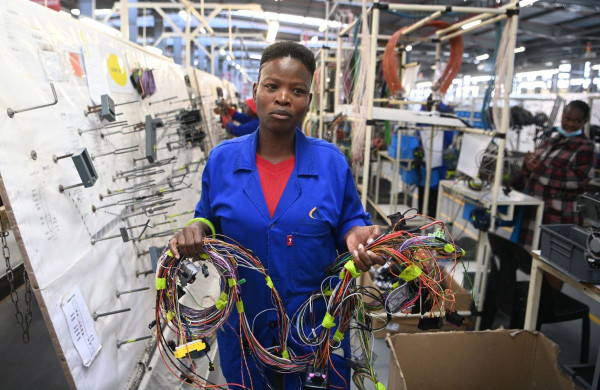
The Botswanan town of Lobatse, some 70 km south of Gaborone, has been transformed into a vibrant manufacturing centre. Across sprawling factory floors, hundreds of skilled hands meticulously assemble intricate wiring harnesses – components that will eventually power Volkswagen and Nissan vehicles across Africa and beyond.

In the automotive industry, wire harnesses are an intricate arrangement of wires, connectors, and components. They serve as vehicles' central nervous systems, enabling the  transmission of electrical signals and power throughout the automobile.

This is Delta Automotive Technologies, where strategic financing from the African Development Bank has catalysed a manufacturing renaissance that extends far beyond the factory wallsThe company makes wiring harnesses primarily for Volkswagen and Nissan.. For decades, Botswana's economic history was written in diamonds. Today, a new chapter is unfolding as the African Development Bank's $80 million credit line to the Botswana Development Corporation (BDC) for businesses in the country fuels Delta Automotive's transformation into a manufacturing powerhouse.

“This funding hasn't just built infrastructure – it's built opportunity,” says Darryn Hattingh, Delta’s Director of Manufacturing. “We've built a world-class operation that competes globally while creating opportunity locally. The support enables us to industrialise not just today's production lines, but tomorrow's innovations. It will support us to industrialise future businesses obtained through Volkswagen.”

The firm, which is based in Botswana, makes wiring harnesses for  Volkswagen's Polo Vivo and Polo 270, and Nissan's H60 brands.

It currently makes 120 vehicle harness sets for Volkswagen South Africa per day. By 2027, it hopes to create 340 vehicle sets for Volkswagen and 111 for Nissan in South Africa.

Women powering an industrial revolution

As one walks through Delta's expansive manufacturing facility, one fact is immediately apparent: in a traditionally male-dominated industry, women's expertise is driving this operation forward. An impressive 75% of Delta's workforce is female, shattering glass ceilings with every wire harness assembled.

For Clara Kaekane, a product and process engineer at Delta, the significance goes beyond personal achievement: “Every component we make is a challenge to outdated assumptions about gender and engineering work. I'm not just building car parts – I'm building a new perception of what is possible for women in manufacturing across Africa.”

Kaekane feels empowered to work at the management level in the automotive industry, which is normally male-dominated.

“This is a great opportunity for our country and company,” she says.

Connecting communities to global value chains

The hum of activity at Delta's plant represents more than manufacturing – it is the sound of Botswana's integration into sophisticated global supply networks. Currently producing 120 vehicle wiring harnesses daily, with plans to nearly triple output by 2027, Delta is an example of how African manufacturers can excel in precision-demanding global industries.

“What is happening here is the physical manifestation of our High 5 development priorities, particularly  ‘Industrialize Africa’ and ‘Integrate Africa’. It also provides skills to the people of Africa,” said the African Development Bank's Deputy Director General for Southern Africa, Moono Mupotola. “Each wire harness connects not just vehicle components, but Botswana's workforce to global value chains, rural communities to industrial opportunities, and traditional economies to a diversified future.”

 Scaling impact: From hundreds to thousands

The numbers tell a compelling story: There are 327 employees today, expected to grow to 1,000 within four years. Behind those numbers are families supported, skills developed, and communities transformed. With 95% of the workforce Botswana nationals, the company has become a major driver of local economic empowerment.

“We're seeing multiple development dividends from this single investment,” says Benedicta Abosi of BDC. “Delta's growth is generating export earnings, creating quality jobs, developing technical skills and, perhaps most importantly, demonstrating what's possible when development finance meets entrepreneurial vision.”

She explained that five years ago, the Botswana Development Corporation supported multiple businesses, including Delta Automotive Technologies, through a $80 million line of credit facility from the African Development Bank.

A blueprint for African industrial transformation, Delta's success offers a replicable model for industrial development across the continent. By strategically supporting companies integrated into global supply chains, development finance can simultaneously address unemployment, gender inequality, economic diversification, and regional integration.

As workers at Delta Automotive Technologies continue to assemble the components that will power vehicles across the region; they're also creating a template for how African development finance can catalyse inclusive industrial transformation.

“This has definitely been a good investment for the African Development Bank, and this is how we see development financing working in Africa, Mupotola added.

Distributed by APO Group on behalf of African Development Bank Group (AfDB).

More images: 
https://apo-opa.co/42JGePY
https://apo-opa.co/3GL0NTB

About the African Development Bank Group:
The African Development Bank Group is Africa’s premier development finance institution. It comprises three distinct entities: the African Development Bank (AfDB), the African Development Fund (ADF) and the Nigeria Trust Fund (NTF). On the ground in 41 African countries with an external office in Japan, the Bank contributes to the economic development and the social progress of its 54 regional member states. For more information: www.AfDB.org

Media files
African Development Bank Group (AfDB)
Download logo
The Botswanan town of Lobatse, some 70 km south of Gaborone, has been transformed into a vibrant manufacturing centre. Across sprawling factory floors, hundreds of skilled hands meticulously assemble intricate wiring harnesses – components that will eventually power Volkswagen and Nissan vehicles across Africa and beyond.
In the automotive industry, wire harnesses are an intricate arrangement of wires, connectors, and components. They serve as vehicles’ central nervous systems, enabling the  transmission of electrical signals and power throughout the automobile.


This is Delta Automotive Technologies, where strategic financing from the African Development Bank has catalysed a manufacturing renaissance that extends far beyond the factory wallsThe company makes wiring harnesses primarily for Volkswagen and Nissan.. For decades, Botswana’s economic history was written in diamonds. Today, a new chapter is unfolding as the African Development Bank’s $80 million credit line to the Botswana Development Corporation (BDC) for businesses in the country fuels Delta Automotive’s transformation into a manufacturing powerhouse.

“This funding hasn’t just built infrastructure – it’s built opportunity,” says Darryn Hattingh, Delta’s Director of Manufacturing. “We’ve built a world-class operation that competes globally while creating opportunity locally. The support enables us to industrialise not just today’s production lines, but tomorrow’s innovations. It will support us to industrialise future businesses obtained through Volkswagen.”

The firm, which is based in Botswana, makes wiring harnesses for  Volkswagen’s Polo Vivo and Polo 270, and Nissan’s H60 brands.

It currently makes 120 vehicle harness sets for Volkswagen South Africa per day. By 2027, it hopes to create 340 vehicle sets for Volkswagen and 111 for Nissan in South Africa.

Women powering an industrial revolution

As one walks through Delta’s expansive manufacturing facility, one fact is immediately apparent: in a traditionally male-dominated industry, women’s expertise is driving this operation forward. An impressive 75% of Delta’s workforce is female, shattering glass ceilings with every wire harness assembled.

For Clara Kaekane, a product and process engineer at Delta, the significance goes beyond personal achievement: “Every component we make is a challenge to outdated assumptions about gender and engineering work. I’m not just building car parts – I’m building a new perception of what is possible for women in manufacturing across Africa.”

Kaekane feels empowered to work at the management level in the automotive industry, which is normally male-dominated.

“This is a great opportunity for our country and company,” she says.

Connecting communities to global value chains

The hum of activity at Delta’s plant represents more than manufacturing – it is the sound of Botswana’s integration into sophisticated global supply networks. Currently producing 120 vehicle wiring harnesses daily, with plans to nearly triple output by 2027, Delta is an example of how African manufacturers can excel in precision-demanding global industries.

“What is happening here is the physical manifestation of our High 5 development priorities, particularly  ‘Industrialize Africa’ and ‘Integrate Africa’. It also provides skills to the people of Africa,” said the African Development Bank’s Deputy Director General for Southern Africa, Moono Mupotola. “Each wire harness connects not just vehicle components, but Botswana’s workforce to global value chains, rural communities to industrial opportunities, and traditional economies to a diversified future.”

Scaling impact: From hundreds to thousands

The numbers tell a compelling story: There are 327 employees today, expected to grow to 1,000 within four years. Behind those numbers are families supported, skills developed, and communities transformed. With 95% of the workforce Botswana nationals, the company has become a major driver of local economic empowerment.

“We’re seeing multiple development dividends from this single investment,” says Benedicta Abosi of BDC. “Delta’s growth is generating export earnings, creating quality jobs, developing technical skills and, perhaps most importantly, demonstrating what’s possible when development finance meets entrepreneurial vision.”

She explained that five years ago, the Botswana Development Corporation supported multiple businesses, including Delta Automotive Technologies, through a $80 million line of credit facility from the African Development Bank.

A blueprint for African industrial transformation, Delta’s success offers a replicable model for industrial development across the continent. By strategically supporting companies integrated into global supply chains, development finance can simultaneously address unemployment, gender inequality, economic diversification, and regional integration.

As workers at Delta Automotive Technologies continue to assemble the components that will power vehicles across the region; they’re also creating a template for how African development finance can catalyse inclusive industrial transformation.

“This has definitely been a good investment for the African Development Bank, and this is how we see development financing working in Africa, Mupotola added.

Per Kind Favour of APO

Africa Fact: In 619 AD, the Nubians sent a gift of a giraffe to the Persians.

Share this:

  • Share on X (Opens in new window) X
  • Share on Facebook (Opens in new window) Facebook
  • Print (Opens in new window) Print
  • Email a link to a friend (Opens in new window) Email
  • Share on LinkedIn (Opens in new window) LinkedIn
  • Share on Tumblr (Opens in new window) Tumblr
  • Share on WhatsApp (Opens in new window) WhatsApp
  • Share on Mastodon (Opens in new window) Mastodon
Category: BusinessTag: Africa, African, APO, automotive, CAN, challenge, Dividends, engineering, global, GOOD, growth, Images, infrastructure, Japan, Manufacturing, new, Nigeria, office, ONE, production, South Africa, Volkswagen, Women

If you feel strongly about this article then feel free to send MyZA a ‘Letter to the Editor’ using the submission form below:


Letter to the Editor

This field is for validation purposes and should be left unchanged.
If this is in response to an article please include that article title here or as the lead in for the first paragraph of your Letter below.

Separate tags with commas

Localise your letter by naming the city your words are about. Add relevant words describing your subject. Single comma separated words of no more than 5
Your Name(Required)
Your Name will be linked to the website below.
Your personal, business or social media web site
Choose NO to not set up a user account on MyZA. User Accounts will allow you to submit letters under your own Author Name

3 Latest Letters to the Editor:

  • Older Persons Grants Land Today — No Need to Queue at Dawn

    Dear Editor, Older Persons grants are paid today, 30 October, under SASSA’s revised November payment schedule — with disability grants on Monday 2 November, children’s grants on Tuesday 3 November, and grants under review on Thursday 5 November. Two things every beneficiary should know. First, grant money does not expire on payment day. It stays…

    30 October 2026
  • November Grants Pay Early – No Need to Queue at Dawn

    Dear Editor, I run SAGrant (sagrant.co.za), a free resource helping South Africans navigate SASSA grants. November grants pay earlier than usual. Older Persons grants are paid on Friday 30 October, Disability grants on 2 November, and Child Support and other grants on 3 November. Grants still under review are paid on 5 November. The money…

    27 October 2026
  • NSFAS 2027 applications close on 31 October — SASSA households, apply now

    Dear Editor, I run SAGrant (sagrant.co.za), a free resource helping South Africans navigate SASSA grants. NSFAS applications for the 2027 academic year close on Friday 31 October 2026, and no extension is expected. If your household receives a SASSA grant, your child already passes the NSFAS financial eligibility test — but they still have to…

    25 October 2026

About Guest

Previous Post:Concourt Victory Protects Citizenship for South Africans
Next Post:Stanley Anderson – New Hyundai SA CEO

Reader Interactions

Comments

  1. Venuslion

    26 August 2026 at 2:07 am

    Nunu Ntshingila had humble beginnings in Soweto, she started out her corporate life with no creative know-how, but determination to learn and grow. After working her way up the corporate ladder, she became Chairman at Ogilvy & Mather South Africa, one of the largest advertising agencies in Africa. She went on to be inducted into the Creative Hall of Fame, and the first woman to be inducted into the Loeries Hall of Fame. This achievement put her in the perfect position to say \”yes\’ when offered to be the head of Facebook for Africa.

Copyright © 2026 · MyZA · All Rights Reserved · Powered by Stratlec Online