• Skip to main content
  • Skip to header right navigation
  • Skip to after header navigation
  • Skip to site footer
MyZA

MyZA

News, Directory, Events and Other Stuff

  • Social Media
  • Sport
  • World News
  • Home
  • Submit News
  • Directory
  • Events
  • Stratlec
  • TFSA
  • News
    • APO
    • Today’s Sport News
    • Todays Social Media and Tech Headlines
    • Today’s World News
    • Today’s SA Financial News
  • Contact
You are here: Home / News / President engages with various technologies at the CSIR 

President engages with various technologies at the CSIR 

10 April 2025 by Guest

President engages with various technologies at the CSIR 

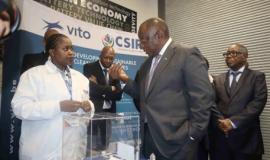
President Cyril Ramaphosa engaged with various researchers and technologies on his visit to the Council for Scientific and Industrial Research (CSIR) earlier this week.

The President was hosted by the Minister of Science, Technology, and Innovation, Professor Blade Nzimande when he toured several facilities at the CSIR on Tuesday.

Among the technologies the President interacted with, was the Oceans and Coastal Information Management System (OCIMS), a sophisticated digital platform developed by the CSIR. 

It enables South Africa to monitor, protect, and sustainably manage its extensive coastal and oceanic zones through real-time, data-driven insights.

The initiative is led by Dr Lulama Wakaba, Executive Cluster Manager of the Next-Gen Enterprises and Institutions Cluster. The initiative is a collaboration between the CSIR, the Department of Forestry, Fisheries and the Environment, the South African Environmental Observation Network, and the South African Weather Service. 

“Many people don’t realise this, but South Africa’s exclusive economic zone, our marine territory, is larger than our land mass. That gives us an extraordinary opportunity in the blue economy, which holds immense potential for GDP [gross domestic product] growth, job creation, and sustainable development,” Wakaba explained. 

According to the CSIR, OCIMS is not just a data repository, but also an integrated, scalable system that forms the backbone of multiple research projects used by the state to manage and safeguard marine environments.  

These range from coastal erosion monitoring and maritime traffic control, to harmful algal bloom forecasting, oil spill detection, and marine spatial planning.  

By using satellite data, sensor networks, and intelligent analytics, the system ensures that South Africa’s coastal resources are preserved and fully utilised for economic benefits.

“What we’re showcasing is a living example of applied science. This system translates complex marine data into actionable insights that policymakers and environmental authorities can use to make informed decisions. It’s about turning scientific research into national impact,” Wakaba explained. 

The importance of OCIMS is amplified by South Africa’s strategic position at the meeting point of two oceans, with more than 3 000 km of coastline.  

The country’s location, combined with the rising threats of climate change and unsustainable exploitation, make the need for intelligent ocean governance urgent.

“For us, the real breakthrough lies in unlocking the power of science and innovation to support the state’s capacity to manage this frontier responsibly,” he said. 

“From supporting marine biodiversity to bolstering economic development, OCIMS is a cornerstone in building resilient, knowledge-based ocean governance.”

The CSIR said having President Ramaphosa visit the exhibition was both a validation and a celebration of the platform’s significance.

“What we hope to communicate is the strategic power we can unlock when we take up the mantle of what the CSIR stands for, applying cutting-edge science and technology to our national priorities. In this instance, it’s the blue economy, a massive frontier that, if fully harnessed, can transform our country’s economic trajectory.”

The CSIR’s work on OCIMS also supports international obligations, including the United Nations’ Sustainable Development Goals, climate resilience efforts, and commitments under the UN Convention on the Law of the Sea.  

It also provides South African citizens and coastal communities with tools to better understand and protect the natural wealth that surrounds them.

“Our oceans are not just scenic landscapes; they are vital economic assets and ecosystems,” he said. 

“OCIMS is about equipping our country with the means to both care for and benefit from those assets responsibly and sustainably.”

With this bold initiative, the CSIR  said OCIMS stands as a beacon of what is possible when innovation meets vision and when digital infrastructure is aligned with national imperatives.

During  his visit, the President hailed the CSIR as a “South African success story” as the institution marks 80 years since its establishment.

READ | CSIR critical for innovative solutions to resolve challenges – President Ramaphosa

The President was delivering remarks at the institution’s headquarters following a tour of the facility on Tuesday afternoon.  – SAnews.gov.za


Gabisile
Thu, 04/10/2025 – 09:47
136 views

President Cyril Ramaphosa engaged with various researchers and technologies on his visit to the Council for Scientific and Industrial Research (CSIR) earlier this week.

The President was hosted by the Minister of Science, Technology, and Innovation, Professor Blade Nzimande when he toured several facilities at the CSIR on Tuesday.

Among the technologies the President interacted with, was the Oceans and Coastal Information Management System (OCIMS), a sophisticated digital platform developed by the CSIR. 

It enables South Africa to monitor, protect, and sustainably manage its extensive coastal and oceanic zones through real-time, data-driven insights.

The initiative is led by Dr Lulama Wakaba, Executive Cluster Manager of the Next-Gen Enterprises and Institutions Cluster. The initiative is a collaboration between the CSIR, the Department of Forestry, Fisheries and the Environment, the South African Environmental Observation Network, and the South African Weather Service. 

“Many people don’t realise this, but South Africa’s exclusive economic zone, our marine territory, is larger than our land mass. That gives us an extraordinary opportunity in the blue economy, which holds immense potential for GDP [gross domestic product] growth, job creation, and sustainable development,” Wakaba explained. 

According to the CSIR, OCIMS is not just a data repository, but also an integrated, scalable system that forms the backbone of multiple research projects used by the state to manage and safeguard marine environments.  

These range from coastal erosion monitoring and maritime traffic control, to harmful algal bloom forecasting, oil spill detection, and marine spatial planning.  

By using satellite data, sensor networks, and intelligent analytics, the system ensures that South Africa’s coastal resources are preserved and fully utilised for economic benefits.

“What we’re showcasing is a living example of applied science. This system translates complex marine data into actionable insights that policymakers and environmental authorities can use to make informed decisions. It’s about turning scientific research into national impact,” Wakaba explained. 

The importance of OCIMS is amplified by South Africa’s strategic position at the meeting point of two oceans, with more than 3 000 km of coastline.  

The country’s location, combined with the rising threats of climate change and unsustainable exploitation, make the need for intelligent ocean governance urgent.

“For us, the real breakthrough lies in unlocking the power of science and innovation to support the state’s capacity to manage this frontier responsibly,” he said. 

“From supporting marine biodiversity to bolstering economic development, OCIMS is a cornerstone in building resilient, knowledge-based ocean governance.”

The CSIR said having President Ramaphosa visit the exhibition was both a validation and a celebration of the platform’s significance.

“What we hope to communicate is the strategic power we can unlock when we take up the mantle of what the CSIR stands for, applying cutting-edge science and technology to our national priorities. In this instance, it’s the blue economy, a massive frontier that, if fully harnessed, can transform our country’s economic trajectory.”

The CSIR’s work on OCIMS also supports international obligations, including the United Nations’ Sustainable Development Goals, climate resilience efforts, and commitments under the UN Convention on the Law of the Sea.  

It also provides South African citizens and coastal communities with tools to better understand and protect the natural wealth that surrounds them.

“Our oceans are not just scenic landscapes; they are vital economic assets and ecosystems,” he said. 

“OCIMS is about equipping our country with the means to both care for and benefit from those assets responsibly and sustainably.”

With this bold initiative, the CSIR  said OCIMS stands as a beacon of what is possible when innovation meets vision and when digital infrastructure is aligned with national imperatives.

During  his visit, the President hailed the CSIR as a “South African success story” as the institution marks 80 years since its establishment.

READ | CSIR critical for innovative solutions to resolve challenges – President Ramaphosa

The President was delivering remarks at the institution’s headquarters following a tour of the facility on Tuesday afternoon.  – SAnews.gov.za


Watch a President engages with various technologies at the CSIR  related video:

Stunning South Africa:

Have you visited MyPR?

MyPR.co.za offers free to publish press releases for your news site, blog or offline publication. Use the handy REPUBLISH facility or the Full Text RSS Feeds or just copy and paste.

Straton Electrical | Straton Solar | Straton Prepaid | Straton Plumbing | Straton IoT | Straton eBikes | BA Systems | Mbane Contracting | Reach Trust

Share this:

  • Share on X (Opens in new window) X
  • Share on Facebook (Opens in new window) Facebook
  • Print (Opens in new window) Print
  • Email a link to a friend (Opens in new window) Email
  • Share on LinkedIn (Opens in new window) LinkedIn
  • Share on Tumblr (Opens in new window) Tumblr
  • Share on WhatsApp (Opens in new window) WhatsApp
  • Share on Mastodon (Opens in new window) Mastodon
Category: NewsTag: Africa, African, CAN, critical, data, digital, Environment, exclusive, exhibition, growth, hope, infrastructure, Innovation, law, Ramaphosa, SA News, Sea, solutions, South Africa, Technology, Video

If you feel strongly about this article then feel free to send MyZA a ‘Letter to the Editor’ using the submission form below:


Letter to the Editor

This field is for validation purposes and should be left unchanged.
If this is in response to an article please include that article title here or as the lead in for the first paragraph of your Letter below.

Separate tags with commas

Localise your letter by naming the city your words are about. Add relevant words describing your subject. Single comma separated words of no more than 5
Your Name(Required)
Your Name will be linked to the website below.
Your personal, business or social media web site
Choose NO to not set up a user account on MyZA. User Accounts will allow you to submit letters under your own Author Name

3 Latest Letters to the Editor:

  • Older Persons Grants Land Today — No Need to Queue at Dawn

    Dear Editor, Older Persons grants are paid today, 30 October, under SASSA’s revised November payment schedule — with disability grants on Monday 2 November, children’s grants on Tuesday 3 November, and grants under review on Thursday 5 November. Two things every beneficiary should know. First, grant money does not expire on payment day. It stays…

    30 October 2026
  • November Grants Pay Early – No Need to Queue at Dawn

    Dear Editor, I run SAGrant (sagrant.co.za), a free resource helping South Africans navigate SASSA grants. November grants pay earlier than usual. Older Persons grants are paid on Friday 30 October, Disability grants on 2 November, and Child Support and other grants on 3 November. Grants still under review are paid on 5 November. The money…

    27 October 2026
  • NSFAS 2027 applications close on 31 October — SASSA households, apply now

    Dear Editor, I run SAGrant (sagrant.co.za), a free resource helping South Africans navigate SASSA grants. NSFAS applications for the 2027 academic year close on Friday 31 October 2026, and no extension is expected. If your household receives a SASSA grant, your child already passes the NSFAS financial eligibility test — but they still have to…

    25 October 2026

About Guest

Previous Post:Tariff Tensions and Political Uncertainty Keep South Africans on Edge
Next Post:Tshwane’s Economic Growth Plan

Reader Interactions

Comments

  1. sky bully

    29 September 2026 at 2:56 pm

    Fun South African Fact: It’s a holiday destination like no other! Looking for a beach holiday? South Africa has sunshine, sea and golden beaches. Seeking a safari adventure? South Africa is home to unbelievable wildlife and game reserves. Keen for an escape into wine country? South Africa’s Cape Winelands are waiting to be explored! On top of all of this, you can discover cosmopolitan cities and quaint seaside towns. Or, drive through breathtaking mountain passes and travel along dusty, desert roads.

  2. Sneakerkid

    7 September 2026 at 5:45 am

    \”Reeeelly??\” says Van.

    \”Ja\”, says the larnie. \”Check, there\’s someone up front now, I\’ll show you!\”

    He starts steering towards the pedestrian, grinning from ear-to-ear, then at the last second he swerves back onto the road. But he hears a terrific \’thud\’, and he glances left to see Van closing the door.

    \”What the hell, man!\’ he shouts.

    \”Jirrah\” says Van, \”You need to get those sights adjusted, china, If I hadn\’t opened the door, you would have missed him completely!\”

Copyright © 2026 · MyZA · All Rights Reserved · Powered by Stratlec Online